Automating Medicaid Renewal with AI Tools
Procedural failures, not ineligibility, are stripping millions from Medicaid.
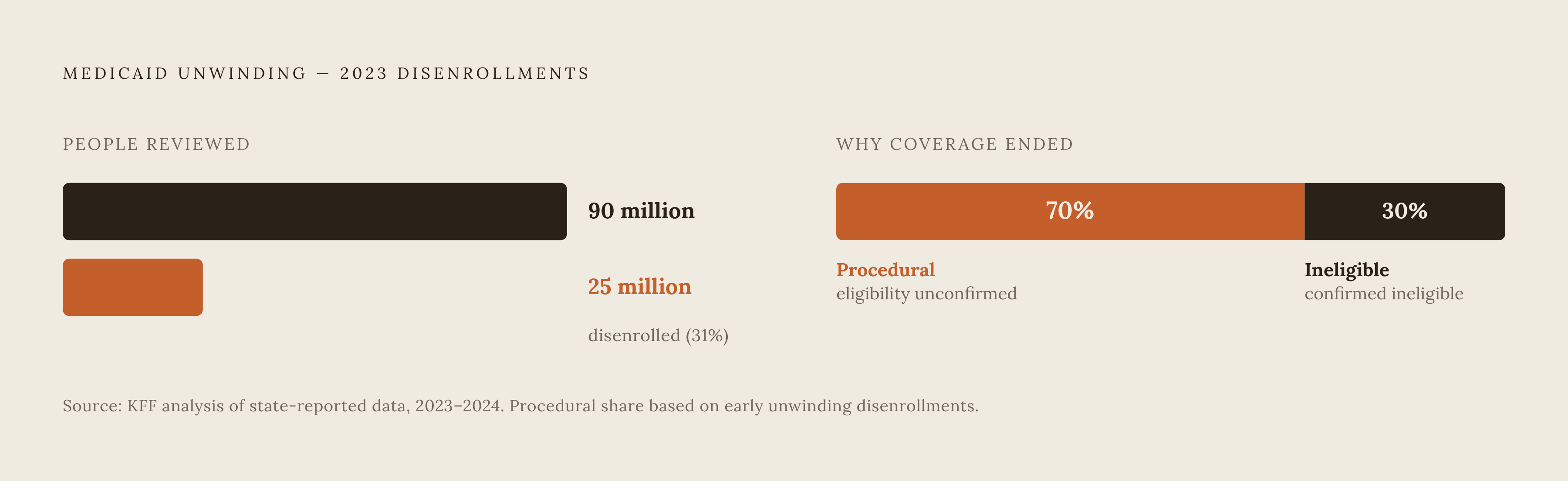
More than 90 million people came up for eligibility review when the COVID-era continuous enrollment provision ended in spring 2023. The real story from that "unwinding" isn't about who no longer qualified for Medicaid. It's about how many people who still qualified lost coverage anyway, because a form didn't get filled out or a piece of mail never found them. That distinction, between ineligibility and procedural failure, is the entire subject of this piece: what caused it, why a new federal law is about to make it worse, and how AI-driven automation is emerging as the most direct fix available.
Start with the scale. Per KFF, over 25 million people were disenrolled during the unwinding, which comes out to 31% of everyone whose renewal was completed. Roughly 70% of early disenrollments were classified as procedural, meaning the state couldn't confirm continued eligibility, not that it confirmed ineligibility. Those are different failures with the same outcome, and the gap between them is where this whole conversation lives.
The state-by-state spread makes the point even sharper. Montana disenrolled 57% of people going through renewal; North Carolina disenrolled 12%. Both states processed the same federal population under the same federal rules. What differed was process: how much of the renewal each state automated, how it verified income, whether it reached people through channels they'd actually respond to. If two states can produce a 45-point swing in outcomes using the same underlying eligibility criteria, the population isn't the variable. The system is.
That's the "time tax" that researchers and advocates have started naming directly: the cumulative burden of forms, income documentation, and deadlines that eligible people have to clear just to keep something they already qualify for. It falls hardest on caregivers, who are frequently managing someone else's renewal on top of their own, tracking two sets of deadlines, two mailboxes, two sets of paperwork rules. If most coverage loss during the unwinding was procedural rather than eligibility-based, then the fix isn't tightening eligibility rules. It's re-engineering the procedure. That's the frame for everything that follows.
How the One Big Beautiful Bill Act makes the procedural burden significantly worse starting in 2027
H.R. 1, the One Big Beautiful Bill Act, signed into law July 4, 2025, adds two changes that compound rather than simply add to each other. First, starting January 1, 2027, 44 states and jurisdictions (including DC) have to require adults in the ACA Medicaid expansion group to document at least 80 hours a month of community engagement, whether that's work, school, or another qualifying activity, to keep their coverage. Second, redetermination frequency for this group doubles, from once a year to twice a year.
Run those two changes together and the math gets uncomfortable fast. Doubling the renewal cadence doesn't just double the paperwork. It doubles the number of moments where a missed form, an outdated address, or a documentation gap can knock someone off the rolls, regardless of whether they're actually meeting the work requirement. Every renewal is a chance to fall through procedurally. Twice as many renewals means twice as many chances.
The population this touches isn't small. As of June 2025, roughly 20 million people were enrolled through the Medicaid expansion, per KFF, accounting for 30% of total enrollment in expansion states. CBO's projections on what happens to this population are stark: the work requirement provisions alone are expected to cut federal Medicaid spending by $326 billion over ten years. An earlier CBO analysis estimated 18.5 million people would be subject to the requirements annually, with 5.2 million losing federal Medicaid coverage by 2034 and a net increase of 4.8 million uninsured adults nationally.
Here's the part that should concern anyone who's paid attention to how ex parte renewal actually works: the Federal Data Services Hub, the backbone that makes automated verification possible, doesn't fully cover this new requirement. After CMS folded the Emmy API into the Hub, the system gained the ability to verify some compliance and exemption categories, like school enrollment or disabled veteran status. But it doesn't cover all of them. That means states can't fully automate work requirement verification without building new data infrastructure first. No amount of clever automation downstream fixes a hole in the data upstream.
And states have to build all of this while their federal funding shrinks. The Bipartisan Policy Center reported in November 2025 that the $200 million allocated for FY26 implementation is, per conversations BPC had with several state Medicaid departments, unlikely to cover the added administrative load. So states are being asked to run twice as many renewals, verify a brand-new eligibility category the federal data system can't fully support, and do it with funding most of them already expect to fall short. That's precisely the pressure pushing federal and state policy experts toward AI and technology modernization, not as an upgrade, but as the only plausible way to keep the system from buckling.
What ex parte renewal is and why it is the structural foundation of automated Medicaid renewal
Ex parte renewal means the state renews someone's Medicaid coverage using data it already has, wage records, tax filings, Social Security Administration data, other federal databases, without asking the beneficiary to lift a finger. No form. No mailed documentation. No action required at all, if the data confirms continued eligibility.
CMS's March 2024 final rule on streamlined eligibility determination pushes states hard toward this model. Per a 2025 study published in IJSAT, properly implemented enhanced ex parte processes can verify eligibility without any beneficiary action in more than 80% of cases. That's not a marginal improvement. That's the difference between a renewal system built around paperwork and one built around data the government already has sitting in a database somewhere.
The Federal Data Services Hub is what makes this possible. It connects to the Social Security Administration, the Department of Homeland Security, CMS's own Medicare enrollment records, and commercial payroll data through services like Verify Current Income, which runs on Equifax data. States pay to access those commercial sources, and as more states leaned on the service, CMS shifted Verify Current Income to a Medicaid-claimable service at a 75/25 federal match starting July 1, 2024, according to the National Association of Medicaid Directors. That's a meaningful signal: the federal government is subsidizing the infrastructure specifically because it wants states using it.
But the Hub has a hard limit already mentioned above, worth restating here because it's the crux of the next few years: existing data sources aren't sufficient to verify compliance with, or exemptions from, the new work and community engagement requirements. The data backbone that makes ex parte renewal work for standard eligibility simply doesn't extend to this new category yet.
State adoption of ex parte renewal was wildly uneven heading into the unwinding. Early 2023 rates ranged from under 25% in some states to over 50% in others, and Health Affairs reported in 2025 that roughly half of all states were violating federal rules by running too few automated ex parte renewals. KFF's January 2025 survey found more than half of states now report that 50% or more of ex parte renewals are processed automatically by the eligibility system. Compare that to new applications, where only 25% of states report similar automation rates, and the picture becomes clear: renewal automation has moved much further, much faster, than automation on the front end of enrollment. Why would that be? Probably because the data needed to renew someone already exists in the system from their last enrollment, while a brand-new applicant requires building a verification record from scratch.
That gap between renewal automation and application automation sets up the next question directly: when states actually put resources into pushing ex parte rates up, what happens?
What the evidence shows when states actively invest in automating ex parte renewals
The clearest answer comes from a Health Affairs study published in 2025, describing a joint CMS and U.S. Digital Service effort working directly with California, New York, South Carolina, and Wisconsin, four states that together cover close to 30% of Medicaid beneficiaries nationwide. Interventions went live in South Carolina in September 2023, and in California, New York, and Wisconsin that December.
The results, measured against states that didn't get this kind of direct support: ex parte renewal rates rose by 21.6 percentage points, overall completed renewals rose by 7.7 percentage points, and procedural denials fell by 8.3 percentage points. Those aren't small effects. An 8-point drop in procedural denials, applied across a state's full Medicaid population, translates into a meaningful number of people who kept coverage they were always entitled to.
California offers the sharpest single snapshot. Its ex parte rate jumped from 36% in November to 66% in December, after the state automated several flexibilities CMS had already offered under the Section 1902(e)(14)(A) waiver process, according to Georgetown's Center for Children and Families. That jump in automation translated directly into fewer procedural disenrollments in the months that followed.
Zoom out and the pattern holds across the country. Georgetown CCF reported in January 2024 that 42 states saw their ex parte rates increase since starting unwinding renewals, with gains ranging from 1 to 73 percentage points. Twenty-three states posted double-digit increases, and 9 states improved by 30 points or more. That's not a fluke concentrated in a handful of well-resourced states. It's a pattern that shows up almost everywhere the effort gets made.
One might argue the harder question isn't whether this works, since the data settles that pretty firmly, but whether it scales. The Health Affairs authors are direct about this limit themselves, noting that policies and rules only work when states actually have the capacity to implement them. The four-state intervention required a dedicated federal team working hands-on with state officials. That's a resource-intensive model, and nothing about it guarantees it can be replicated across all 44 states about to face work requirements in 2027. And none of these studies yet capture what happens under semiannual renewal cadences or work requirement verification, because those conditions don't start until 2027. The evidence proves the intervention works. It doesn't yet prove the intervention survives contact with double the renewal frequency and a data-verification gap the Hub can't currently close.
The layered set of AI tools states and providers are using across the renewal process
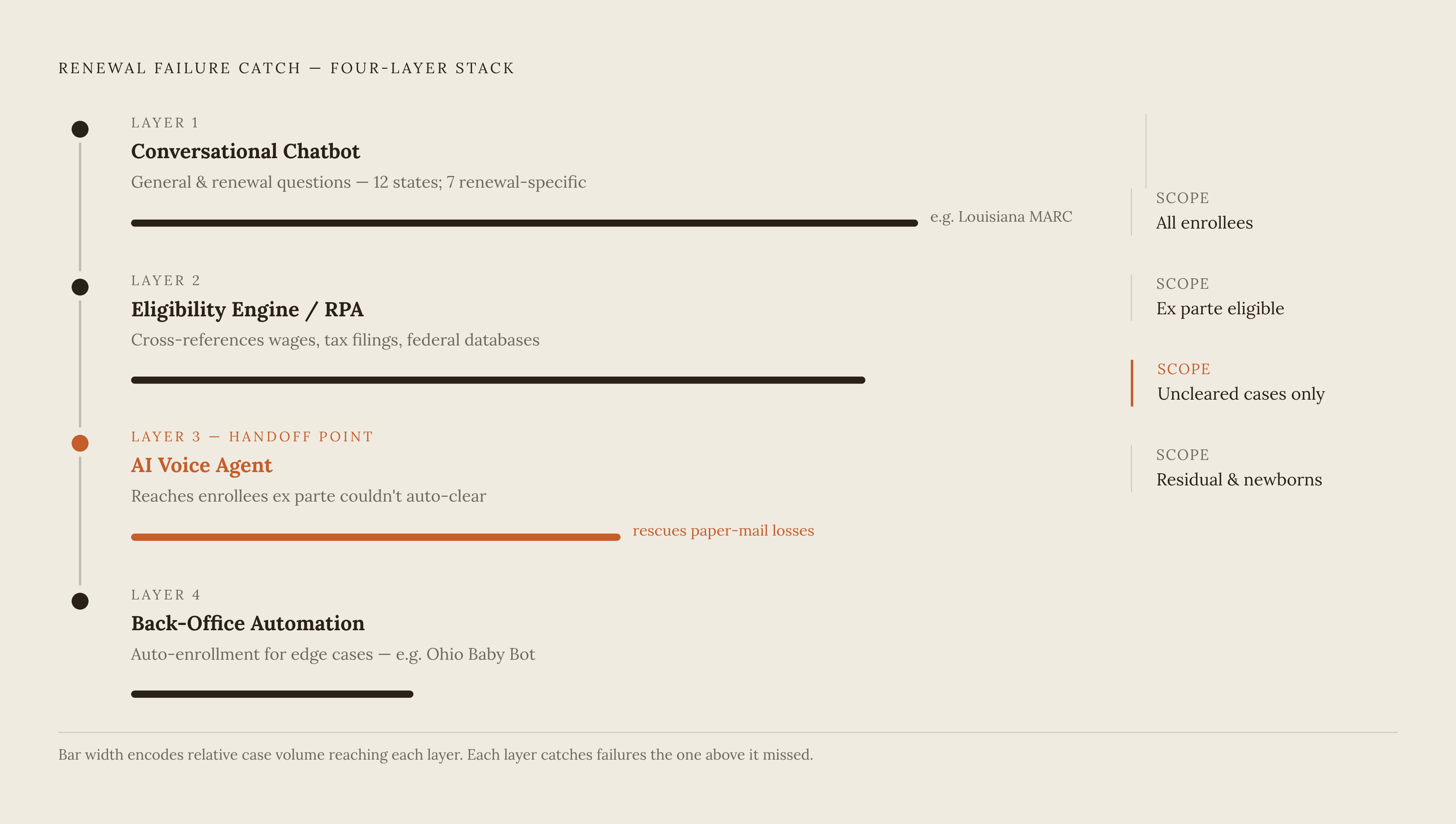
States aren't relying on one tool to solve this. They're stacking four distinct layers, each aimed at a different point where the renewal process breaks down.
The first layer is conversational: AI chatbots that answer basic member questions and help people navigate the process. KFF's January 2025 survey found 12 states use chatbots on their Medicaid websites for general questions, 6 states have integrated them into the application process itself, 7 use them during renewal specifically, and 8 use them to help members manage their online accounts. Louisiana's chatbot, called MARC, runs on natural language processing and answers questions in English, Spanish, and Vietnamese around the clock, according to the Bipartisan Policy Center; when it can't resolve something, it routes the person to a customer service line. The job here is narrow but important: catch the members who don't know a renewal is coming, or don't understand what they're being asked to submit.
The second layer is the eligibility engine itself, the robotic process automation that cross-references applicant data against wage records, tax filings, and federal databases in close to real time, cutting out the need for paper documentation, per state implementation reporting. Machine learning models within these systems flag which cases are most likely to see an eligibility change, letting agencies prioritize reviews instead of treating every renewal identically. States that have extended this data-sharing to SNAP and TANF have improved income verification accuracy while reducing the administrative load tied to mailing paper forms and manually processing what comes back by mail or phone, according to KFF.
The third layer is voice. AI voice agents are being used specifically for the population ex parte renewal couldn't clear automatically, which, is exactly why Medicaid is described as one of the cleaner use cases for AI in state government: the call types are well-defined, data fields are standardized across MES and MMIS platforms, and most of the decisions involved are rules-based rather than judgment calls. The workflow runs in sequence: the state attempts ex parte renewal first, and only the enrollees whose ex parte didn't resolve get an AI voice agent outreach call. For a simple renewal with no change in household or income, that single call can complete the whole thing. The agent captures any changes, walks the person through the required redetermination questions, and submits the update straight to the state's eligibility system.
The fourth layer sits in the back office, out of view of the enrollee entirely. Ohio built something it calls "Baby Bot," which automatically adds a newborn to the mother's existing Medicaid case, saving what Ohio Medicaid described as weeks of county staff time, per the Bipartisan Policy Center. Some states are exploring back-office AI tools to analyze billing and payment data and flag suspicious patterns among providers. CMS has signaled interest in expanding income verification tools that connect directly to payroll and gig-economy data, so eligibility can be confirmed without the enrollee submitting any paperwork at all.
These four layers aren't redundant with each other. They're sequential. Awareness, verification, action, back-office cleanup: each one catches a different kind of failure the others miss.
How providers are using enrollment automation to catch patients before coverage lapses
States aren't the only ones building this infrastructure. Provider systems, hospitals and clinics, are building their own early-warning layer on top of it.
Some of this data comes through direct exchanges with state Medicaid agencies or managed care organizations that share renewal timelines, and some of it gets calculated just from known enrollment dates, according to a January 2026 report from Cedar. Once a provider has that timeline, the system can prioritize patients by clinical complexity rather than treating everyone the same: someone managing multiple chronic conditions with 45 days left until renewal gets flagged differently than a healthy patient with four months of runway.
The identification can happen before a patient ever walks in the door. During pre-registration, a system can run a real-time insurance eligibility check and kick off a screening workflow before the appointment even happens, per Cedar, well before the patient has any reason to think about a bill at all.
Outreach channel matters just as much as timing. People have real, often stubborn preferences, text versus email versus a phone call, and automation is what makes it possible to reach each person the way they'll actually respond, instead of defaulting to one channel for everyone. One Medicaid patient, quoted in Cedar's January 2026 report, put it simply: "I don't think there are enough times that I could be reminded of updating my information."
The stakes here connect directly back to the OBBBA math from earlier. CBO estimates the new verification steps and tightened eligibility rules will cause millions of people to lose coverage, many of whom still qualify. Providers running automated renewal tracking are positioned to intervene before that loss happens, rather than discovering it after a claim gets denied.
Trust matters as much as the technology underneath it. A patient dealing with a new diagnosis or already stretched thin financially might assume any outreach is a collections call in disguise. Systems built to lead with screening instead of billing, and that offer a private digital workflow instead of a staff member calling out of the blue, remove that barrier before it forms.
Where AI-driven renewal automation runs into genuine limits
None of this is a complete fix, and it's worth being honest about exactly where it stops working.
The work requirement data gap is structural, not something clever engineering solves. The Federal Data Services Hub, as already discussed, cannot currently verify compliance with or exemption from the new 80-hour-a-month community engagement requirement. That's a missing data pipeline, not a missing algorithm. No AI model, however well-trained, can verify data the Hub doesn't have access to in the first place.
State capacity is the second limit, and it's a people problem as much as a technology one. The Health Affairs authors were explicit that the interventions they studied worked because CMS and the U.S. Digital Service put a dedicated team of five to six federal experts directly into the room with state officials. That's a model built on scarce expertise, and there's no clear path for it to scale automatically across all 44 states facing new work requirements in 2027.
Chatbots and voice agents have their own ceiling. They handle rules-based, well-defined cases cleanly, which is most of what a standard renewal looks like. But complex household situations, contested exemption documentation, anything that requires actual human judgment, still needs a caseworker. That's not a flaw in the tools. It's just where their design stops.
A related but distinct problem shows up in prior authorization, a different corner of Medicaid administration that's also being automated. Research on AI in Medicaid has found real efficiency gains — better triage of requests, faster real-time decisions — but has also identified that governance frameworks for overseeing AI in coverage decisions remain underdeveloped, with federal liability standards still an open question. A March 2026 study on arXiv tested GPT-4o, Claude Sonnet 4.5, and Gemini 2.5 Pro on generating prior authorization letters and found the clinical content held up well, but administrative precision consistently slipped: missing billing codes, absent requests for authorization duration, thin follow-up plans. Those are exactly the gaps that payer workflows are built to catch and reject.
And there's a scale risk baked into automation itself that's worth sitting with. If a data source feeding these systems is wrong, or an eligibility rule gets mis-coded somewhere in the logic, an automated system doesn't make that mistake once. It applies it to an entire population simultaneously. A human caseworker processing renewals one at a time might catch an anomaly. A system processing thousands at once won't, unless someone built a check for that specific failure in advance.
What families and caregivers can do now to use these tools and protect continuous coverage
Start with the calendar, because the calendar is about to compress. Annual renewals are still the norm today, but starting in 2027, expansion enrollees face renewal twice a year instead of once. That's half the runway to catch a problem before it becomes a disenrollment. Check directly with the state Medicaid agency or managed care organization to confirm the actual renewal date on file. Don't assume a notice will show up in time to act on it.
Keep contact information current with the state. This one is easy to overlook and it undercuts everything else: ex parte automation only works if the state can actually reach the enrollee and match records against current data. An old address or a disconnected phone number doesn't just delay a notice, it can bypass the automated process entirely and drop the person into a manual paper renewal they may never see arrive.
Respond to outreach that feels automated, even the chatbot messages and the AI voice calls. Those contacts exist because ex parte renewal already tried and failed to confirm eligibility automatically. Ignoring that outreach is functionally the same as missing a paper form: the outcome is identical, even if the process feels less official.
Ask providers directly whether their system tracks Medicaid renewal timelines. Hospital and clinic financial counselors increasingly have this information available, and a caregiver managing someone else's care, on top of their own, has every reason to ask the provider to flag it before coverage lapses rather than after a claim gets denied.
None of these steps guarantee continuous coverage. What they do is close the exact gap this piece opened with: the space between people who remain eligible and people who lose coverage anyway, because a form didn't arrive, a number changed, or a system had no way to reach them in time. The tools described here were built specifically to shrink that gap. Whether they shrink it enough, under twice the renewal frequency and a data hole the Hub hasn't closed yet, is the open question the next few years will actually answer.
Sources
- Medicaid Enrollment Automation: What’s Working for Providers | Cedar
- AI and Medicaid: Balancing the Promise of Efficiency with Guardrails to Ensure Responsible Use • Bipartisan Policy Center
- Interventions To Automate Medicaid Renewals Reduce Procedural Denials And Increase Coverage | Health Affairs
- AI-Generated Prior Authorization Letters: Strong Clinical Content, Weak Administrative Scaffolding
- Medicaid and CHIP Eligibility, Enrollment, and Renewal Policies | KFF
- ijsat.org
- kff.org
- kff.org