AI Assistance for Non-English Speaking Caregiver Families
AI tools are now helping non-English speaking families navigate health care and caregiving systems.
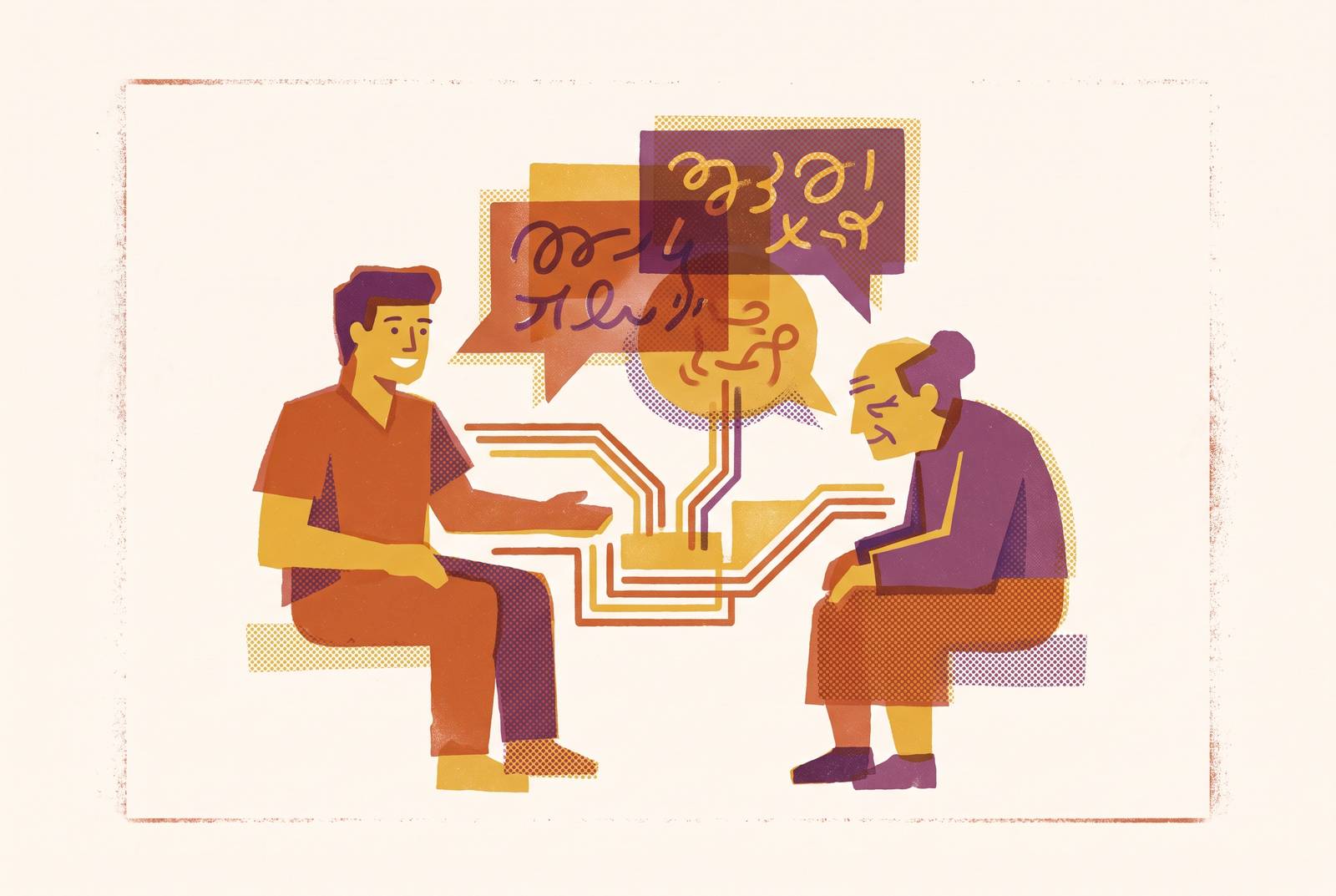
More than 25 million people in the United States, over 8% of the population, have limited English proficiency, according to Census Bureau data. That single number sets up everything this piece is about: what happens when a family already struggling to navigate American health care and benefits systems has to do it in a second language, or a third one, and what role AI tools are starting to play in closing that gap. This isn't a small corner case. Households across the country speak more than 350 languages combined, and Spanish speakers represent 5.3% of speakers in the LEP population, the largest single group, according to KFF data. Layer onto that the more than 50 million Americans providing unpaid care to aging relatives, a growing share of whom do so primarily in a language other than English, and the scale of the problem starts to come into focus.
Here's the thing about a benefits and care system that's already confusing for English speakers: language doesn't just add a layer on top of it. It multiplies every friction point already baked into the system. A form that's merely annoying to fill out in English becomes a genuine barrier in Tagalog. A phone queue that tests patience for a native speaker can become an insurmountable wall for someone whose second language is still developing. This piece traces that compounding effect through documented health outcomes, through the specific and often overlooked harm done to child interpreters, through the gap between legal mandates and actual practice, and into where AI tools are now stepping in, sometimes well, sometimes not.
What language barriers actually cost caregiver families in health and care outcomes
Start with the clinical stakes, because they're not abstract. Limited English proficiency correlates with higher rates of misdiagnosis, medication errors, and poor adherence to treatment plans, a finding cited widely across health equity and machine translation research. These aren't edge cases born of unusual circumstances. They're the predictable result of patients and providers failing to understand each other on decisions that carry real medical weight.
Mental health outcomes tell a similar story, and the causes run deeper than language alone. A 2025 preprint on medRxiv points to cultural stigma, gaps in regional mental health resources, and a shortage of providers trained to work across cultures as compounding factors alongside the language barrier itself. None of these problems exist in isolation. They stack.
Children bear some of this weight too, often before anyone else in the family. Data from the 2021 National Survey of Children's Health shows kids in Spanish-speaking households are more likely to lack insurance, more likely to have no regular source of care, and more likely to go without care they actually need. Parents in these households report worse interactions with providers across the board: less listening, less shared decision-making, less cultural sensitivity. Reporting from LanguageLine and HIMSS in 2025 frames language access as what public health researchers call a social determinant of health. Patients who can't communicate well with a provider are less likely to show up for preventive care in the first place, which means problems get caught later, when they're harder and more expensive to treat.
Digital tools were supposed to help here. Instead, they've often just moved the barrier somewhere new. A Kaiser Permanente Northern California study from 2025, covering 480,833 Latino members (31.8% with limited English proficiency) and 137,904 Chinese members (31.6% with limited English proficiency), found lower patient portal use among LEP patients during 2019. Scheduling apps, medication reminder tools, and clinical note portals were mostly designed with digitally literate English speakers in mind. For everyone else, they've become one more thing to work around rather than one more thing that helps.
The child interpreter problem: why the status quo carries its own serious costs
Here's a question worth sitting with: when a hospital has no interpreter available, who actually translates the doctor's words for mom or dad? Often, it's the kid. Language brokering, where children interpret for their immigrant or refugee parents, affects an estimated 75 to 90% of immigrant and refugee children worldwide. Among Syrian refugee populations specifically, preliminary data suggests the number climbs as high as 85%.
This isn't a harmless workaround. Between 18 and 20% of child language brokers report clinically significant psychological distress tied directly to the role, according to multiple studies cited in a 2025 PMC review. The harms aren't vague, either. They're specific and recurring: parentification, where a child takes on adult emotional responsibility well before they're ready for it; exposure to subject matter no child should have to translate, whether that's a parent's cancer diagnosis, a conversation about domestic violence, or details of reproductive health; and, per 2025 research on medRxiv, elevated psychological distress along with long-term maladaptive coping patterns.
It isn't only children who cause problems when pressed into this role. Any untrained family member standing in for a professional interpreter introduces risk: miscommunication, breaches of a parent's or grandparent's privacy, and friction that ripples through the whole household afterward. The point of laying all this out isn't to shock. It's to establish, plainly, that the gap AI tools are now trying to fill isn't some minor scheduling inconvenience. The status quo already has victims, and more often than people realize, those victims are the youngest people in the room.
Why the official infrastructure for language access isn't closing the gap
There's already a law on the books meant to fix this. Section 1557 of the Affordable Care Act requires health care entities that receive federal funding to take reasonable steps toward meaningful access for patients with limited English proficiency, which includes qualified interpreters and translated documents. The mandate exists. Compliance does not, at least not consistently.
One study of mental health and substance use treatment facilities found 41% of mental health facilities and 59% of substance use treatment facilities out of compliance with language access rules for deaf and hard-of-hearing patients. That's not a rounding error. That's a majority-adjacent failure rate in one of the two categories, in a system with a legal obligation to do better.
Why does this keep happening? Part of it comes down to plain supply and demand: there simply aren't enough qualified interpreters to go around, and even where they exist, clinicians underuse the services available to them, a pattern documented in research on language access compliance. Multilingual patient portals exist too, on paper, but research out of the University of Illinois (Huang and colleagues, posted on arXiv) found many are poorly integrated into clinical workflows or so limited in function that they discourage the very use they're meant to enable. When no interpreter shows up and the portal doesn't help, providers fall back on improvised, informal communication strategies that fall well short of what complex medical decisions require. That's a communication floor sitting well below what any complex medical decision actually requires.
Research on Spanish-speaking caregivers has documented the workarounds families rely on when the official system fails them: free online machine translation tools, leaning on children or other family members with all the risks already described, and ad hoc improvisation by providers themselves. None of these are adequate for decisions that carry real medical stakes. AI tools, then, aren't entering a crowded, competitive market. They're stepping into a vacuum, one where families have already been improvising, often dangerously, for years.
What AI tools are actually available to non-English caregiver families right now
So what's actually out there today? Real-time translation apps make up the most mature category. A systematic review from December 2024 evaluated several platforms in clinical contexts, including Google Translate, Microsoft Translator, Apple iTranslate, AwezaMed, Pocketalk W, and something called the Asynchronous Telepsychiatry App. At HIMSS 2025, vendors showcased wearable AI devices capable of real-time speech-to-text conversion, and smart glasses that deliver live subtitles or earpiece interpretation were described as near-term possibilities, though not yet validated for clinical use. One notable sector-specific entry is Care to Translate, an AI translation app built specifically for healthcare and elder care settings, which won a Red Dot Award in 2025 for its multilingual medical translation design.
Conversational chatbots for health care make up a second, fast-growing category. A systematic review planned for 2026 screened 503 records and included 49 studies covering chatbots deployed across a range of clinical settings and supporting multiple languages, including many that tend to be underrepresented in tech development generally. On the human-interpreter side, LanguageLine announced integration with Epic, the electronic health record platform used by a huge share of U.S. hospitals, connecting its 24/7 multilingual interpreter service directly into clinical workflows. That's not AI translation, worth noting: it's a professional human service made easier to reach.
Then there's support built specifically for caregivers rather than patients. A 2024 review of ten studies examined adaptive conversational agents as caregiver support tools; one pilot deployment of a chatbot called CareHeroes was linked to lower caregiver depression scores at the three-month mark (t=2.03, p=0.03). Research on informal caregiver expectations for chatbots has found that multilingual capability isn't treated as a nice-to-have — it is assumed as a baseline requirement. Separately, emerging research has examined whether large language model tools could help train informal caregivers of older adults on error prevention, safety, and basic health literacy in a home care setting.
Medication management rounds out the practical toolkit. Medication management apps in this space aim to handle dosing schedules, send reminders to caregivers and care recipients, and flag missed doses before they become a bigger problem.
Benefits navigation deserves its own mention, because it's often overlooked next to clinical tools. The same barriers that block a family from getting good care also block them from enrolling in programs they already qualify for: eligibility rules, enrollment portals, and support lines are still overwhelmingly English-only. AI-powered navigation tools that work multilingually, surfacing which Medicare, Medicaid, or caregiver compensation programs a family is eligible for and walking them through enrollment in their own language, are addressing the exact same structural gap that translation apps address at the bedside. It's the same problem wearing a different form.
Where AI translation works well and where it breaks down in caregiving contexts
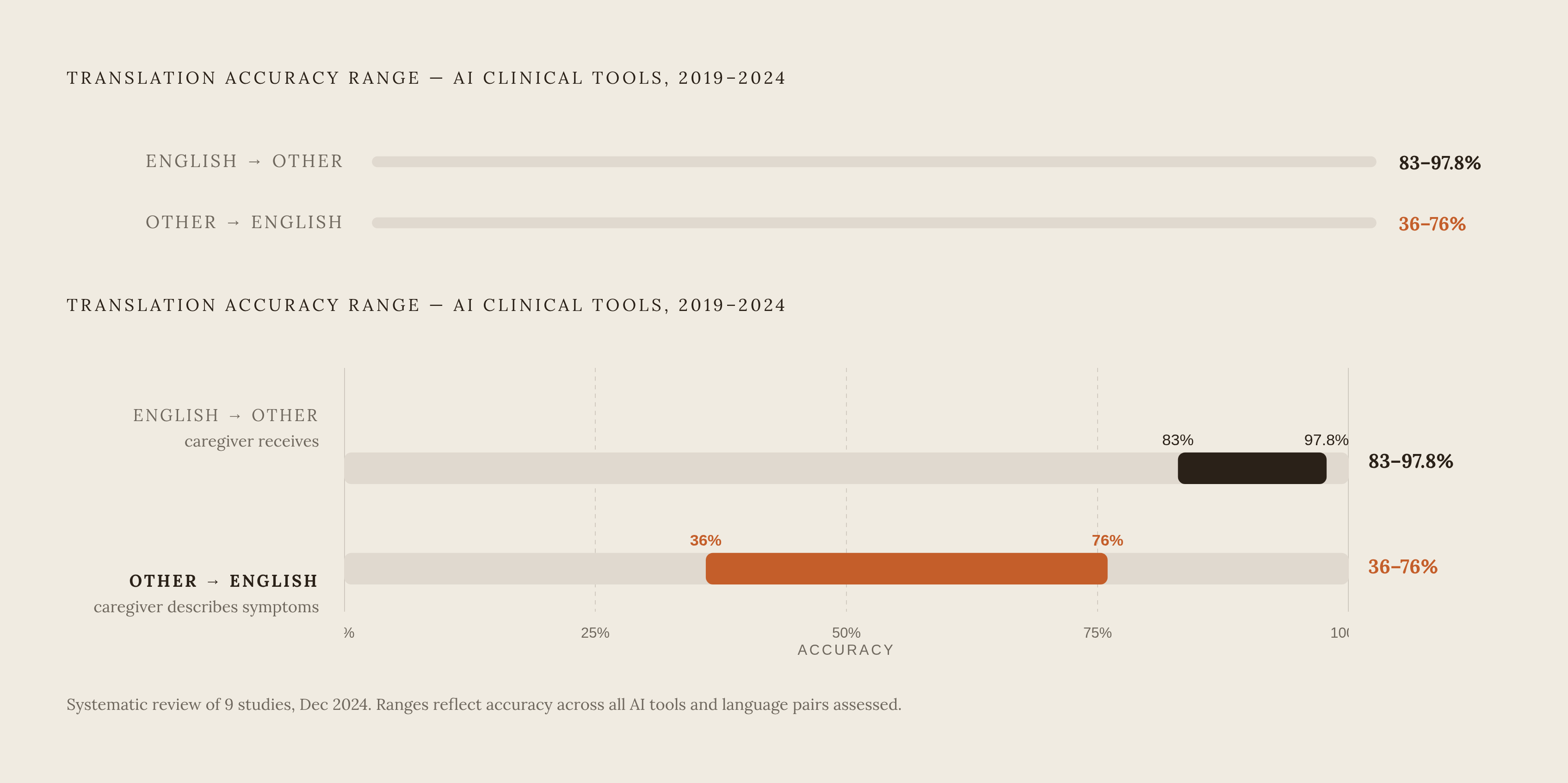
Here's where things get complicated, and where caregivers need to pay close attention. That December 2024 systematic review, covering nine studies published between 2019 and 2024, found accuracy translating from English ranging from 83 to 97.8%. Translating back into English, though, accuracy dropped to somewhere between 36 and 76%. That's not a small gap. That's an asymmetry that matters enormously the moment a caregiver is trying to describe a symptom, a side effect, or a worry to a provider, since that's precisely the direction where the tools perform worst.
Patient satisfaction with these tools runs high, between 84 and 96.6% in the same body of research. Clinician satisfaction sits lower, between 53.8 and 86.7%. That gap is worth sitting with for a second: it suggests clinicians are catching errors, ambiguities, or awkward phrasings that satisfied patients simply don't notice, because they have no way to know what got lost.
A 2024 systematic review in Annals of Translational Medicine found AI performs reasonably well in simple, low-risk exchanges, but accuracy degrades once conversations turn complex, emotionally loaded, or high-stakes. Researchers have documented specific failure patterns: regional dialects that standardized models weren't trained to recognize, idioms and culturally embedded phrases that translate literally but land wrong, and emotionally sensitive topics, like a terminal diagnosis or an end-of-life conversation, where any imprecision carries outsized consequences.
There's also a resource gap layered on top of all this. Performance is strongest for languages with large training datasets, meaning Spanish and Mandarin generally perform best, while low-resource and Indigenous languages perform worst. That's a cruel irony worth naming directly: the communities with the fewest alternative options are also the ones getting the least reliable tools.
The clearest illustration of what's actually at stake here comes from a 2023 BBC investigation, which found that translation failures contributed to more than 80 cases of infant death or serious brain injury in England between 2018 and 2022, tied to hospital staff relying on online translation tools for complex medical conversations. That's not a hypothetical risk. That's a documented one. Meanwhile, the research base hasn't kept pace with the technology's spread: yet research specifically examining how AI affects interpreter services for patients with limited English remains thin. And there's a trust problem sitting underneath all of it. Patient navigators interviewed by Huang and colleagues at UIUC flagged confidentiality as a real barrier: families may hold back from fully using an AI tool if they have no way to verify where their sensitive health information actually goes.
What caregivers and clinicians actually say they want from AI language tools
What do the people actually using these tools say they need? A 2025 study from the Academic Pediatric Association interviewed 20 caregivers, speaking 11 different languages other than English, alongside 22 pediatric clinicians, specifically about their experience with AI language tools in health care settings.
Both groups landed in roughly the same place: openness to AI for specific, bounded tasks, and real hesitation about anything beyond that. Real-time document translation, things like forms, discharge instructions, and medication labels, drew broad support. So did asynchronous written communication, where speed matters more than nuance and there's time to double-check a phrase before hitting send. Filling in when a human interpreter simply isn't available also came up as an acceptable, if imperfect, use case.
The concerns overlapped just as much as the enthusiasm did. Both caregivers and clinicians worried about accuracy in medical contexts specifically, and clinicians, despite being more familiar with the technology generally, weren't any less worried about whether it had been properly validated. Caregivers raised privacy concerns about where their sensitive health data ends up. And both groups named a subtler worry: that AI mediation strips out the human, relational quality of a care conversation, the part that isn't just about getting the words right.
Caregivers were specific about what it would take to earn their trust: ease of use, independent validation that the tool is actually accurate, and a sense that the tool was built with their community in mind, not simply translated for them after the fact. That distinction, built with versus translated for, came up again and again. Clinicians at HIMSS 2025 arrived at a similar consensus from the other side of the exam table: AI is a genuinely useful bridge, but not a replacement for human oversight in anything critical, and a live, medically qualified interpreter needs to be reachable around the clock as a backstop. Patient navigators interviewed by Huang and colleagues at UIUC saw a role for AI in helping patients prepare for visits and build rapport beforehand, but flagged the risk of it crowding out human interaction in ways that matter more for LEP patients specifically, especially where low digital literacy or unreliable technology access complicate things further, no matter how well the tool itself is designed.
One more data point worth noting, even though it comes from outside health care: a 2025 study out of the National University of Singapore (Qin and colleagues), examining 31 teams using an AI speaking assistant, found that participants felt the tool improved the logical flow and depth of what they said in a second language, even though it didn't measurably improve their actual speaking ability. It also added a multitasking burden and, while not statistically significant, participants reported feeling somewhat more anxious while using it. That's a tradeoff worth understanding before assuming a similar tool would work cleanly in a caregiving context, where the stakes are considerably higher than classroom conversation.
How to use AI language tools as a caregiver family, and when to insist on more
Start with a simple test: is this tool giving a family access to something they'd otherwise have zero access to, or is it standing in for a service the system is legally obligated to provide anyway? That distinction should guide almost every decision about when to lean on AI and when to push back and demand a human.
AI translation tends to be most reliable for a caregiver family in a handful of situations. Reading and understanding written documents, discharge summaries, medication instructions, appointment letters, is one, particularly in a widely spoken language like Spanish or Mandarin where the tools have more training data behind them. Preparing questions and notes ahead of a provider visit is another, since it takes pressure off the real-time conversation and lets a caregiver think without a clock running. Asynchronous communication through a patient portal fits here too, given there's time to reread a message and catch something that sounds off before sending it.
Caution belongs in a different set of situations, and caregivers should know where the line sits before they're standing in an exam room needing to cross it. Real-time verbal interpretation for anything high-stakes, delivering a diagnosis, discussing treatment options, obtaining informed consent, carries real risk given that 36 to 76% accuracy range translating into English. Anything in a lower-resource language, an Indigenous language or a strong regional dialect, deserves extra skepticism, since both accuracy and the evidence behind these tools drop off considerably. And any setup that still routes a child into the role of operating the translation tool on a parent's behalf hasn't actually solved the underlying problem. It may reduce the burden somewhat. It doesn't eliminate the exposure and responsibility that comes with putting a child in the middle of a serious medical conversation.
None of this means AI tools aren't worth using. The evidence says they help, often meaningfully, in situations where the alternative was a translation app note scribbled during a rushed hallway conversation, or nothing at all. What the evidence also says, clearly and repeatedly, is that these tools work best as a bridge to human expertise rather than a replacement for it, and the families using them deserve to know exactly where that bridge ends.
Sources
- Designing Beyond Language: Sociotechnical Barriers in AI Health Technologies for Limited English Proficiency
- The Future of Digital Health Must Be Multilingual
- Understanding language barriers within patient portals: workarounds and opportunities for Spanish-speaking caregivers | JAMIA Open | Oxford Academic
- Caregiver and Pediatric Clinician Perspectives on Artificial Intelligence for Language Services - Academic Pediatrics
- ncbi.nlm.nih.gov
- medrxiv.org
- atm.amegroups.org