How to Avoid IRMAA Surcharges on Medicare Premiums
Plan Roth conversions during the two-year lookback window to manage your taxable income later.
IRMAA stands for Income-Related Monthly Adjustment Amount, a surcharge Medicare tacks onto Part B and Part D premiums for beneficiaries whose income clears certain thresholds. Avoiding it comes down to one core discipline: knowing which income sources feed the calculation, and then using legal, well-worn planning moves, Roth conversions, qualified charitable distributions, and careful timing of withdrawals and gains, to keep Modified Adjusted Gross Income under the line that triggers extra cost.
That last term matters more than most people realize. MAGI differs from the number on the bottom of your 1040: it's your adjusted gross income plus tax-exempt interest, meaning municipal bond income you may hold specifically because it's tax-free gets added right back in for IRMAA purposes. Wages, pensions, taxable IRA and 401(k) withdrawals, Roth conversions, and the taxable share of Social Security all count too, though only the non-taxable slice of Social Security stays out. A retiree who realizes a large long-term capital gain and pays zero federal capital gains tax on it, because their bracket allows it, can still watch that gain push MAGI into a higher IRMAA tier, and that alone can run $1,148 to $2,886 in added Medicare surcharges. Roughly 8% of Part B beneficiaries pay this surcharge in any given year, a small slice of the Medicare population, but the dollars involved are large enough that ignoring the mechanics is expensive. IRMAA behaves like a tax even though it technically isn't one, and every strategy that follows starts from understanding exactly what feeds into that MAGI figure.
How the two-year lookback and cliff structure make the stakes unusually high
Here's what catches people off guard: IRMAA assessed this year is based on your tax return from two years prior, not on this year's income. The 2026 surcharge calculation looks at 2024 returns, the ones filed in 2025. So a Roth conversion done today, a home sale, an unusually large RMD, none of it shows up in your premium until two years later, often long after the money that caused it has been spent or reinvested. There's no undoing this after the fact, and only planning done in advance, with that two-year delay in mind, prevents the surprise.
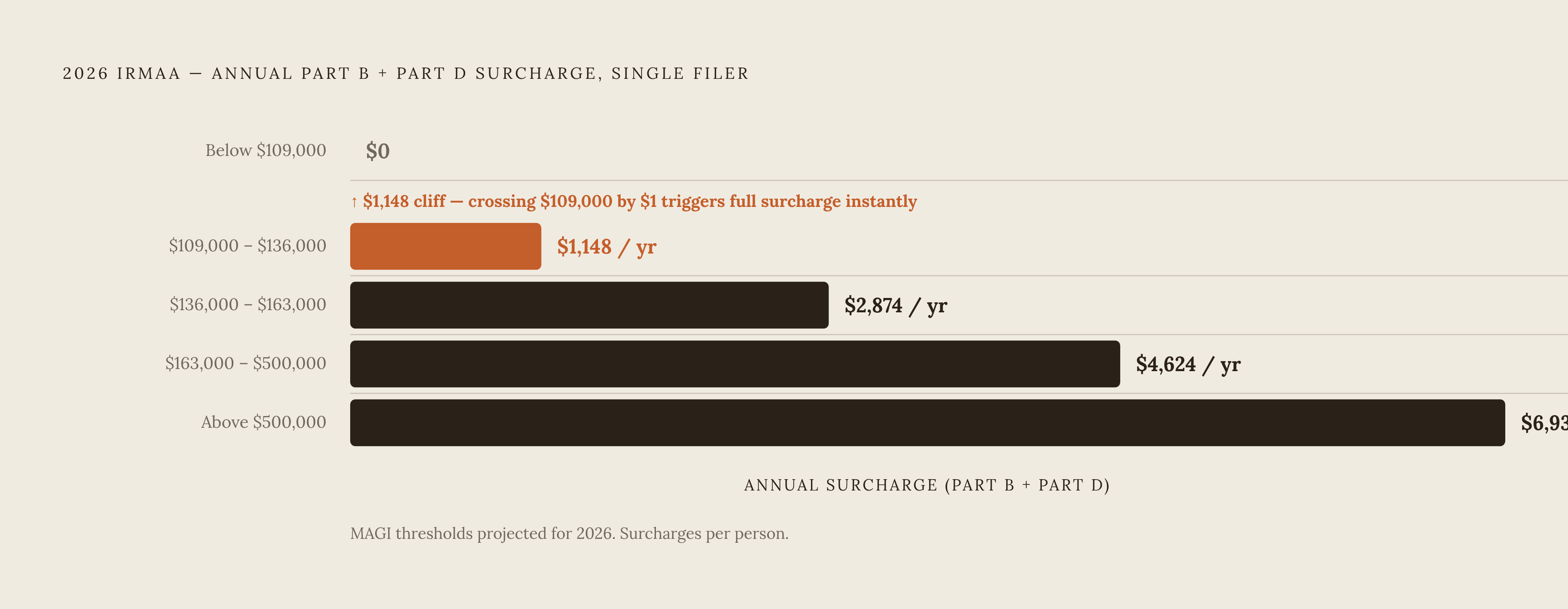
Then there's the cliff. IRMAA brackets don't phase in gradually the way ordinary tax brackets do. Cross a threshold by one dollar and you owe the full surcharge for that entire tier, not a prorated amount. For a single filer, crossing into the first tier costs a minimum of $1,148.40 more per year, and for a married couple where both spouses are on Medicare, that same single dollar over the line costs $2,297 per year combined, since the surcharge applies per person. Move from Tier 1 into Tier 2, and another $3,475 gets added annually. The marginal cost of one extra dollar of income near a bracket boundary can run into the thousands.
Put those two features together, the lookback and the cliff, and the planning horizon turns out to be earlier than most retirees expect, while precision near the bracket edges becomes something close to essential. A single miscalculated Roth conversion at the wrong time can echo two years forward as a bill nobody saw coming. Knowing that, the obvious next question is where exactly those 2026 lines sit.
The 2026 IRMAA brackets and what crossing each one actually costs
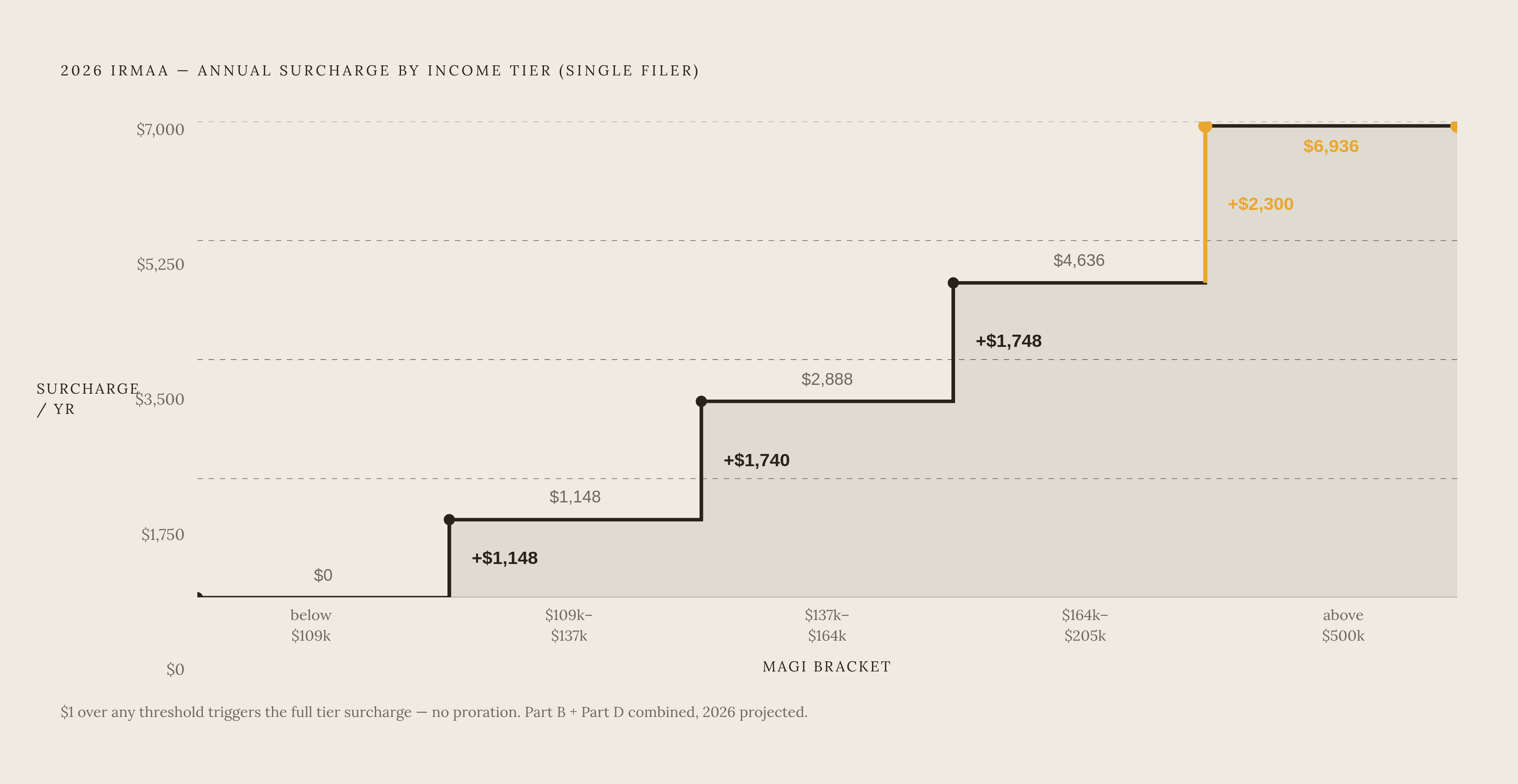
The starting point is the standard Part B premium, set at $202.90 per person per month for 2026 before any surcharge applies. From there, the first IRMAA tier begins at $109,000 in MAGI for single filers and $218,000 for married couples filing jointly, using the 2024 return. The brackets climb from there: the single-filer range runs from $109,000 up through $205,000 across the middle tiers, and the top tier kicks in above $500,000 for single filers or $750,000 for joint filers.
Across the five tiers, the Part B surcharge alone ranges from $81.20 to $487.00 per month. Part D adds its own surcharge on top, up to $91.00 more per month at the highest tier. Combine both and a single person at Tier 1 pays $95.70 extra per month; at the top tier, that combined figure reaches $578.00 per month. Annualized, Tier 1 runs $1,148 per person per year, while the top tier runs $6,936 per person per year. Kiplinger has put the average cost for high-income beneficiaries who pay any surcharge at $3,847 per year in combined Part B and Part D charges, which gives a sense of where most affected retirees actually land rather than the extremes.
Worth noting: the thresholds do move with inflation, which offers a small amount of relief over time. The single-filer entry point moved from $97,000 in 2023 to $103,000 in 2024, $106,000 in 2025, and $109,000 in 2026, with early estimates placing 2027 near $112,000. That drift helps at the margins, but it's not a substitute for managing income deliberately; a $3,000 shift in the threshold over four years does very little for someone whose MAGI is trending up by tens of thousands a year.
One more mechanical detail worth knowing: the surcharge gets deducted automatically from Social Security checks for most beneficiaries. If Social Security hasn't started yet, CMS sends a direct bill. And the Part D portion of IRMAA has to be paid straight to Medicare no matter which company administers the underlying drug plan.
Using the pre-Medicare window for Roth conversions before the lookback bites
Here's the opportunity hiding inside the lookback structure. Income typically drops hard between the day someone retires and the day they enroll in Medicare at 65: the paycheck stops, RMDs haven't started yet if the person is under 73, and taxable income often sits at its lowest point in decades. That gap is exactly when Roth conversions do the least damage.
Conversions made in years that fall outside any future Medicare lookback period carry no IRMAA consequence at all. Someone who stops working at 60 has roughly four tax years, ages 60 through 63, to convert traditional IRA or 401(k) assets to Roth without touching Medicare premiums in any way. Wait until 64 to convert, though, and that income lands squarely in the two-year lookback, arriving as a surcharge in the second year of Medicare coverage, around age 66, rather than the first.
Once Medicare coverage has already started, conversions are still possible, but they need to be sized against the thresholds rather than done in one large move. A $150,000 conversion at age 63 can push MAGI into a higher tier and add roughly $3,473 a year in premiums starting at 65. The real planning question is how much to convert this year without stepping over the next cliff, not whether to convert at all. That means running projections against MAGI specifically, not just taxable income, and filling up the current tax bracket right up to the edge of the next IRMAA threshold rather than past it.
One caveat carries real weight here: a Roth conversion is not considered a life-changing event under Social Security Administration rules, and there's no appeal path to undo an IRMAA surcharge that a conversion caused. Once the money moves, the two-year clock is running, and the only real defense was planning that happened before the conversion, not after.
Conversions also do something else worth mentioning: they shrink the traditional IRA balance that eventually generates RMDs. For retirees who already give to charity, there's a companion strategy that tackles that same RMD problem from a different angle.
How qualified charitable distributions reduce MAGI directly, not just taxes
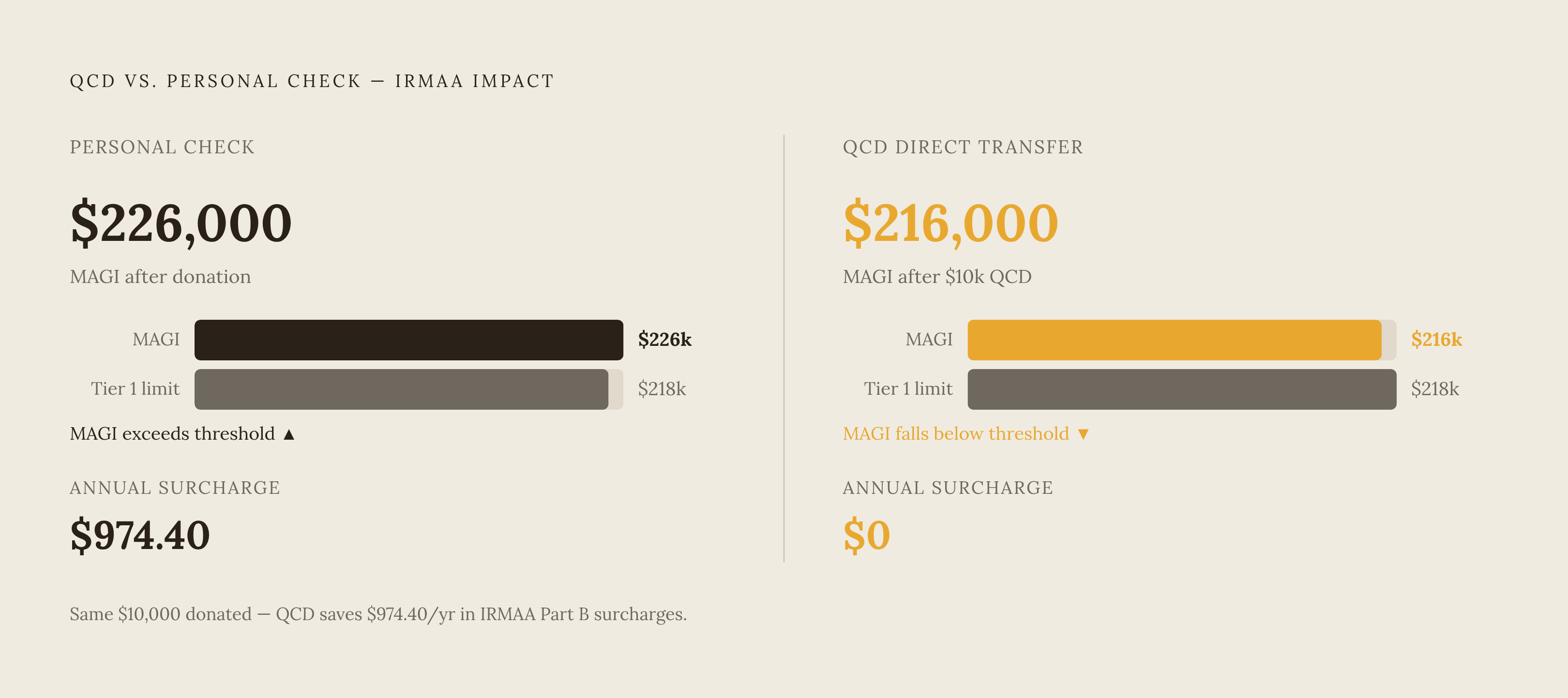
A qualified charitable distribution, or QCD, is a direct transfer from a traditional IRA to a qualified charity, available to anyone 70½ or older. The amount counts toward satisfying an RMD, but it never touches AGI in the first place.
That distinction is the whole point. A QCD is an above-the-line exclusion: the income never enters MAGI at all, which makes it more powerful than a charitable deduction that only reduces taxable income after AGI has already been calculated and IRMAA has already looked at it. Consider a couple sitting at $226,000 in MAGI, just over the joint Tier 1 threshold. If they make a $10,000 QCD instead of writing a personal check to the same charity, MAGI drops to $216,000, which pulls them back under the threshold entirely and eliminates $974.40 in annual Part B surcharges. Same donation, same charity, radically different Medicare bill.
For 2026, the QCD limit sits at $111,000 per person per year, indexed for inflation under SECURE 2.0 and up from the flat $100,000 cap that applied before 2024. Married couples can each use the full limit against their own IRAs. And because QCD eligibility starts at 70½ while RMDs don't begin until 73, there's a multi-year window to draw down an IRA balance and manage MAGI before distributions become mandatory.
The rules have to be followed exactly, though, or the whole benefit evaporates. Funds must move directly from the IRA custodian to the charity; if the money touches a personal checking account first, even briefly, the exclusion is lost and the full distribution lands in MAGI as ordinary income. The deadline is December 31 of the tax year, not the following April. Eligible accounts include traditional IRAs, inherited IRAs, and inactive SEP or SIMPLE IRAs, but not workplace plans like 401(k)s. And donor-advised funds along with private foundations don't qualify as recipients, no matter how legitimate the underlying charitable purpose.
This strategy fits a specific kind of retiree best: someone already giving to charity, already taking RMDs, for whom the QCD costs nothing extra in real dollars while delivering a dollar-for-dollar reduction in MAGI.
Other income-timing moves that work alongside Roth conversions and QCDs
Capital gains deserve their own look, because realized gains from a taxable brokerage account land in MAGI the moment they're recognized. Bunching gains into one year or spreading them across two or three, rather than realizing a large position all at once, can keep any single year's MAGI under a threshold that a lump-sum sale would blow past. Tax-loss harvesting helps offset gains and lowers MAGI directly, but there's a trap worth flagging again here: shifting the proceeds into municipal bonds afterward doesn't reduce MAGI at all, since muni interest gets added back in regardless of its tax-exempt status.
Social Security claiming age plays a role too. Social Security claiming age affects how much of those benefits flows into MAGI, and because of the two-year lookback, that tradeoff needs to be modeled against MAGI two years forward, not just against this year's tax return.
RMD management ties the earlier strategies together. Because RMDs are mandatory and fully taxable once they start, the real lever is reducing the IRA balance before RMDs kick in. Roth conversions done in the years before Medicare enrollment shrink that future balance and, by extension, future RMDs. QCDs then satisfy the RMD requirement once it arrives without adding a cent to MAGI. The two strategies are sequential rather than competing, conversions doing their best work earlier, QCDs picking up once RMDs become mandatory.
None of this calls for anything exotic: no complex trusts, no private placement, no strategy that needs a specialist to explain twice. These are documented, ordinary techniques that work because IRMAA rewards exactly one thing: control over when and how income gets recognized. Projecting MAGI two years out, rather than reacting to the current year's tax return, is really the whole game.
Appealing an IRMAA surcharge when income has genuinely dropped
Sometimes the surcharge arrives and it's simply wrong for where a retiree's finances actually stand today. A formal appeals process exists for exactly that situation: a beneficiary can request a reduction in IRMAA when a qualifying life-changing event has lowered their income since the base year the lookback used.
The list of qualifying events is specific and limited. The qualifying events cover specific involuntary life changes such as retirement or loss of income, and the list is narrow enough that it doesn't stretch to cover everything that might lower someone's income in a given year.
What doesn't qualify is just as important. A Roth conversion, even a large one, isn't a life-changing event, regardless of how it affects the following year's finances, and a voluntary asset sale doesn't qualify either, nor does routine year-to-year income variation of the kind every retiree experiences. The appeal exists for genuine, involuntary income loss, not for the consequences of tax planning choices someone made on purpose.
Filing means submitting SSA-44 along with documentation of the qualifying event and evidence of the more recent, lower income. The Social Security Administration then recalculates using that more current figure instead of the two-year-old return. Many eligible beneficiaries never file at all, simply because the process, while fully documented, isn't something Medicare or Social Security advertises loudly. Benefits navigation tools and advisors who specialize in Medicare have started helping close that gap for beneficiaries and the family members helping manage their care.
The appeal serves as a correction, exists to fix a surcharge that no longer reflects reality, and doesn't substitute for the planning discussed in the sections above it. Roth conversion timing, QCDs, and careful handling of capital gains remain the only real way to keep IRMAA from applying in the first place, rather than disputing it after the bill has already arrived.