Free and Low-Cost Tools for Navigating Medicaid and Medicare Enrollment as a Caregiver
Caregivers can navigate complex enrollment rules with free tools designed for each specific task.
Roughly 38 million family caregivers across the country handle Medicare and Medicaid paperwork for someone else, and most of them have never had a day of training for it. Medicare runs on one set of federal rules everywhere, but Medicaid is run state by state, so income thresholds, covered services, and application steps shift depending on where someone happens to live.
The timing makes it worse. Caregivers rarely sit down with a spreadsheet and a free afternoon to sort through this. Most come to it from a hospital waiting room, or three days after a diagnosis nobody saw coming, trying to make sense of enrollment windows, plan types, dual-eligibility rules, and cost-assistance programs that all live in separate bureaucratic silos with separate applications. None of it was built to be learned in a hurry. And yet a hurry is exactly the condition most caregivers are in the first time they run into it.
Caregiver enrollment tasks driving tool choice
Before picking a tool, name the job first. Caregivers are usually working through four distinct tasks whether they've named them or not, and each one calls for a different kind of resource.
Orientation comes first: figuring out what Medicare actually covers and when someone has to sign up. Task two is comparison shopping, weighing Medicare Advantage against Part D against Medigap. Task three is screening, hunting down the cost-assistance programs (Medicare Savings Programs, Extra Help, Medicaid) that could cut a household's costs substantially if anyone knew to apply. Task four is the one every caregiver eventually needs no matter how much research they've done on their own: a human being, for the moment a web form can't answer the question actually being asked.
Medicare is a federal, uniform program, while Medicaid is state-administered, meaning its rules and income thresholds vary by location, and some resources handle screening for cost-assistance programs such as Medicare Savings Programs, Extra Help, and Medicaid reasonably well. Others are narrow on purpose, built to do exactly one thing. The sections below follow this same task breakdown, so a caregiver in the middle of a crisis can skip straight to what applies to them instead of reading an entire portal homepage hunting for the one paragraph that matters.
Medicare.gov and the Medicare Plan Finder: the official starting point for plan comparison
Medicare.gov is the federal government's own portal, free to browse without an account, and it holds coverage details, provider search, plan comparison, and enrollment under one roof. The tool most caregivers end up spending real time in is the Medicare Plan Finder, reachable directly at Medicare.gov/plan-compare or through a link off the homepage.
2026 brought real upgrades. Provider network data is now being incorporated into Plan Finder for 2026, so a caregiver can check whether a loved one's doctors are in-network before enrolling. Just as significant, the display for Medicare Advantage supplemental benefits got overhauled. Plan documents used to list roughly 30 benefits, things like fitness programs, health education, over-the-counter drug allowances, as vague "some coverage" or "no coverage" labels that told a caregiver almost nothing useful. Now those benefits carry the same level of cost-sharing detail that hearing, vision, and dental have had for years, which matters for anyone trying to compare plans on something more solid than guesswork.
Language access matters here too. Medicare.gov pages switch to Spanish with one click on "Cambiar a español," and the 2026 Medicare & You handbook comes in English, Spanish, Chinese, Korean, Vietnamese, Arabic, Russian, and Tagalog, with large print, Braille, audio, and eBook formats available. For a caregiver supporting a parent who doesn't speak English, that isn't a nice-to-have. A plan decision made with real understanding tends to hold up a lot better than one made on faith.
SHIP counselors: free, unbiased, one-on-one help in every state
Plan Finder answers a lot of questions, but it can't sit down with someone and talk through their actual situation. That's the job State Health Insurance Assistance Programs, or SHIPs, do: free, one-on-one Medicare counseling for beneficiaries, their families, and caregivers, with no income requirement to qualify for the help.
The scale of this network surprises most people who've never used it. There are 54 grantees covering every state plus Puerto Rico, Guam, D.C., and the U.S. Virgin Islands, spread across more than 2,000 offices and staffed by roughly 12,500 trained counselors and volunteers. In 2022 alone, SHIP counselors served over four million older adults and people with disabilities. That is nationwide infrastructure, not a niche resource, and a lot of caregivers never hear it exists until someone happens to mention it.
Counselors handle specific, thorny problems: sorting out Medicare Advantage network restrictions and denials, working through Part D prescription drug coverage, and walking eligible beneficiaries through applications for state Medicaid programs known as Medicare Savings Programs, which can cover Part A and Part B premiums, deductibles, coinsurance, and copayments.
Medicare Interactive: the reference library caregivers can use between appointments
Not every question needs a live counselor on the phone. That's the gap Medicare Interactive fills. Produced by the Medicare Rights Center, it's a free online reference built for older adults, people with disabilities, their families, caregivers, and the professionals who work with them.
Hundreds of answers to Medicare questions are written in plain language and checked by staff attorneys, not drafted as marketing copy, which sets them apart from content designed to sell a plan. That distinction affects how much a caregiver can trust what they read, because a lot of what caregivers find when they search online is written by companies trying to sell a plan. A lot of what caregivers find when they search online is written by companies trying to sell a plan, and that colors the information even when it's technically accurate.
Most caregivers lose ground right here, at the screening step, because nobody told them to look, even though the programs exist. It's because nobody told them to look.
BenefitsCheckUp, built by the National Council on Aging, closes exactly that gap. It's a free online screening tool that checks a person's eligibility across Medicaid, Medicare Savings Programs, Extra Help, SNAP, and dozens of other state and local programs in one sitting. For a caregiver who genuinely doesn't know where to start, this is often the best entry point there is, because it turns an overwhelming research project into a single form.
But screening only gets a caregiver halfway. A tool can tell someone they likely qualify for a Medicare Savings Program, which is real and useful, and still leave the state Medicaid application unfilled and the follow-up paperwork untracked. That gap between finding out a benefit exists and actually getting enrolled in it is where real money gets left on the table, quietly, year after year. The tools that bridge screening and enrollment matter as much as the screener that surfaced the opportunity. Arguably more.
Area Agencies on Aging and the Eldercare Locator: local coordination when needs go beyond Medicare
Insurance is rarely the only problem a caregiver is trying to solve. Area Agencies on Aging, established under the Older Americans Act in 1973, now number more than 600 across the country, each one shaped around its own local community's needs. They exist precisely because caregiving is never just paperwork.
Why does a local aging agency belong in a piece about Medicare and Medicaid tools specifically? A caregiver juggling daily care duties, mounting paperwork, and enrollment deadlines all at once is heading toward burnout, and AAAs are built to address that whole picture, including the insurance choices sitting on top of it.
AARP's free Medicare webinars and educational resources
AARP runs free Medicare webinars aimed at people going through initial enrollment for the first time. They cover the different Medicare parts, the enrollment windows that trigger penalties if missed, coverage gaps that catch people off guard, and specifically how to dodge the late-enrollment penalties that otherwise follow someone for the rest of their time on Medicare.
Sessions are designed to give participants opportunities to get specific Medicare questions addressed. Beyond the webinars, AARP members get AARP Navigator, a personalized guidance program covering Medicare enrollment, cost management, and open enrollment decisions alongside other life-planning topics. For quick questions, AARP also offers digital tools on its Medicare hub designed to help answer Medicare questions on the spot.
The cost-assistance programs worth knowing how to apply for: MSPs, Extra Help, and paid caregiver programs
Read this section slowly. This is where actual dollars get won or lost. Medicare Savings Programs come in four varieties, each with its own income threshold, and applications route through state Medicaid agencies, though SHIP counseling can help walk through the process and screening tools can help identify eligibility.
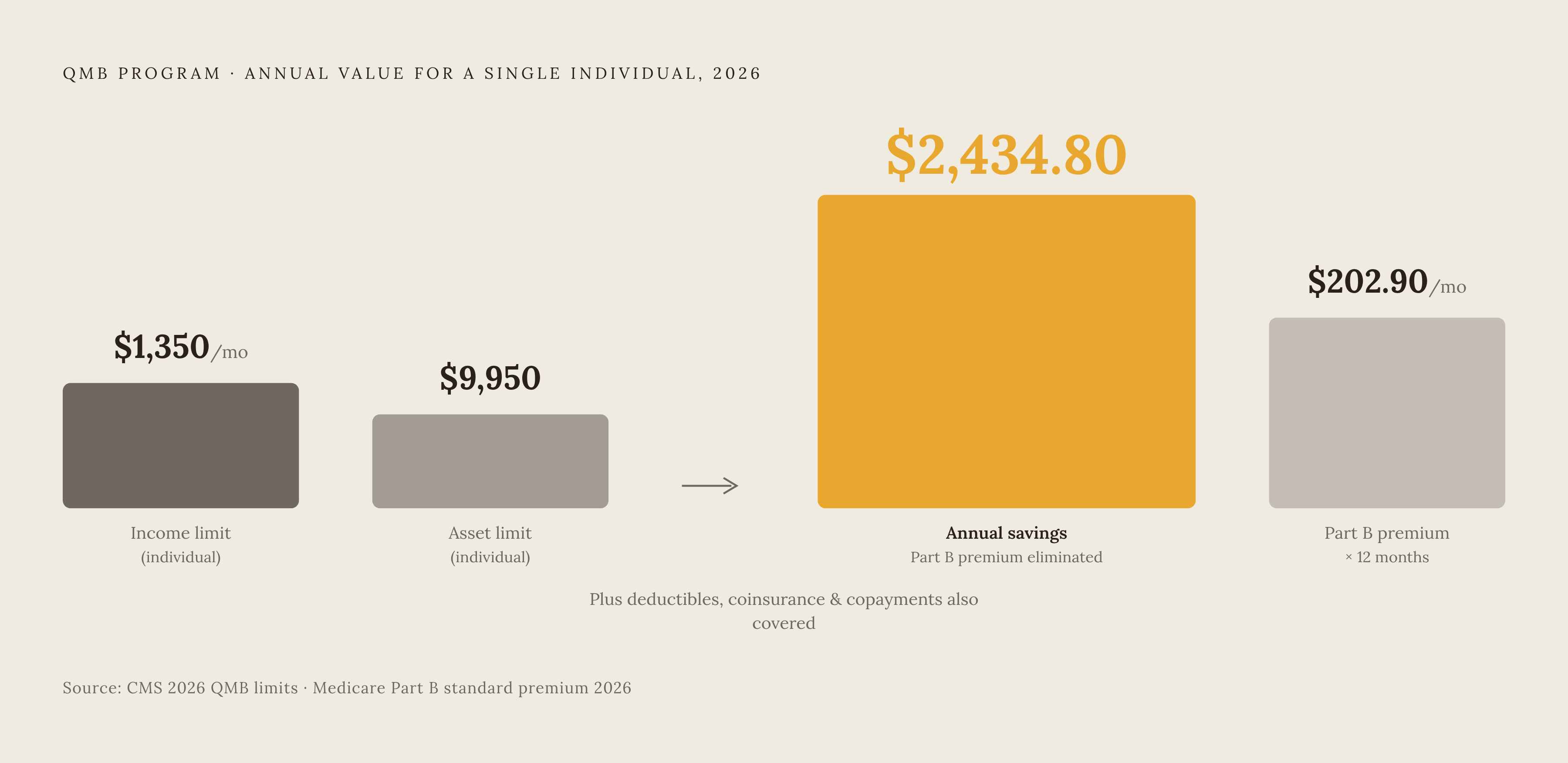
For 2026, the Qualified Medicare Beneficiary (QMB) program has an income limit of $1,350 a month for an individual or $1,824 for a couple, with asset limits of $9,950 and $14,910 respectively. QMB alone wipes out the $202.90 monthly Part B premium, more than $2,400 a year in savings before counting anything else the program covers. That's a real number for a household stretching a fixed income across rent, medication, and care costs.
Run the actual numbers before assuming a parent's income disqualifies them. The higher tiers catch more households than most people expect, and the assumption that "we make too much" is usually where families stop looking, which causes them to miss benefits they actually qualify for.
Separately, there's Extra Help, also called the Low-Income Subsidy, which cuts Part D premiums, deductibles, and prescription copays for people with limited income and resources.
This is exactly where task three, the cost-assistance hunt, tends to fall apart for caregivers. Each program means a separate application through a separate agency, and state Medicaid systems don't always talk to each other cleanly. Some services aim to pair eligibility screening with enrollment assistance across Medicare and Medicaid benefits, closing that specific gap so a caregiver can work through the process in one place instead of chasing separate applications across separate portals. Brevy, a free Medicare and Medicaid enrollment service, is one example of that approach. Whether a caregiver goes that route or works SHIP and BenefitsCheckUp directly, the point holds regardless of path: this money gets disbursed to people who apply for it, and the only way to lose it is to never apply at all.