Free Tools for Helping Caregivers Navigate Medicaid and Medicare Enrollment
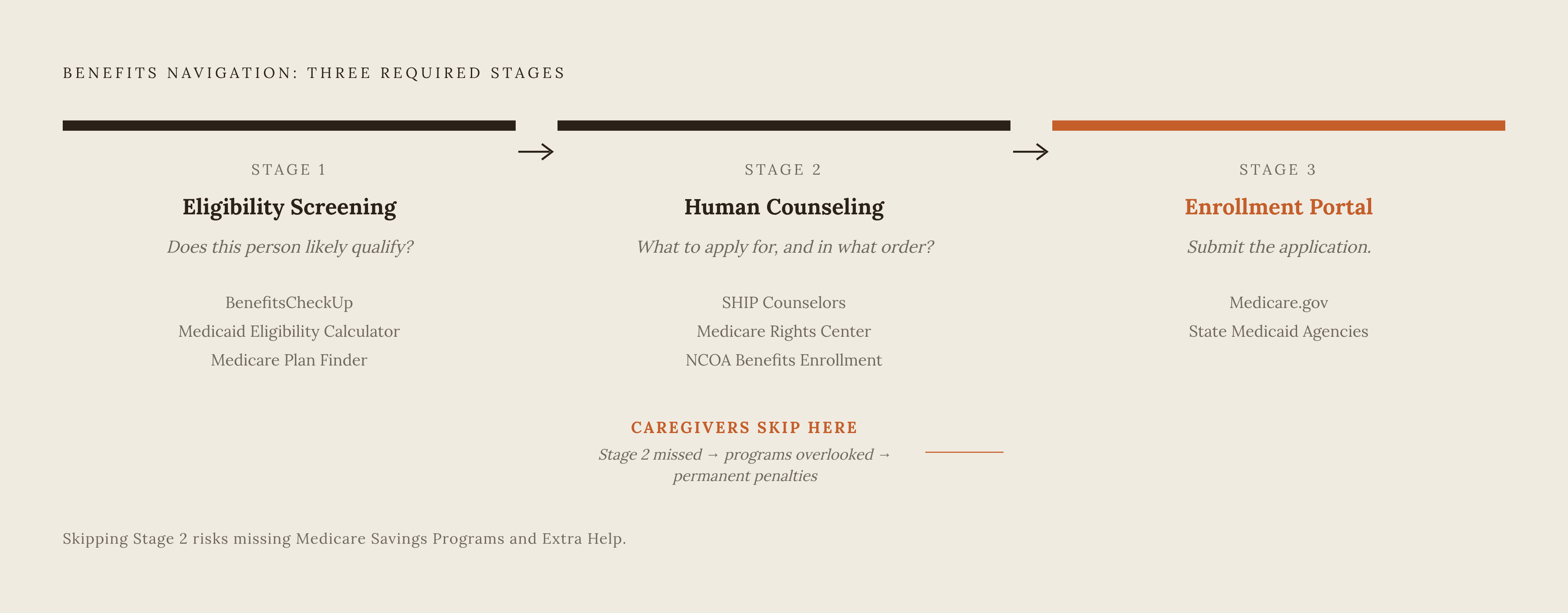
Navigating Medicare and Medicaid requires screening, counseling, then enrollment—in that order.

Somewhere between 38 million and 63 million Americans are providing unpaid care for an aging or disabled loved one right now, depending on which federal estimate is used. That range alone tells a story: caregiving is not a fringe experience, and neither is the confusion that comes with trying to enroll someone else into Medicare or Medicaid.
How the free navigation landscape is organized
The free tools available to caregivers fall into three categories, and conflating them is where a lot of navigation attempts go sideways. The first is eligibility screening, tools that estimate what a person likely qualifies for before anyone files anything. The second is human counseling, trained and unbiased people who interpret rules, flag options, and sit with a caregiver through an application. The third is the enrollment portal itself, the government system where the actual paperwork gets submitted and processed.
Caregivers under time pressure tend to skip straight to the third category. That instinct is understandable, but it is also how programs get missed. A caregiver who jumps to Medicare.gov to pick a plan, without first screening for a Medicare Savings Program or Extra Help, may end up enrolling someone into coverage that costs far more out of pocket than it should. The sequence that actually works is screen, then understand, then enroll, in that order, because each category exists to answer a different question at a different moment.
Timing complicates this further. Medicare runs on fixed windows: the General Enrollment Period and Medicare Advantage Open Enrollment Period both fall between January 1 and March 31, and the annual Open Enrollment Period runs October 15 through December 7. Missing one of these windows, or using the right tool outside the right window, can mean a late enrollment penalty that is permanent. No single resource covers all three categories well. The strongest outcomes come from stitching together a screener, a counselor, and a portal, rather than expecting one tool to do the whole job.
Free online eligibility screeners that tell you what your loved one likely qualifies for
NCOA's BenefitsCheckUp, at benefitscheckup.org, has been running since 2001 and covers both public and private benefits programs across all 50 states and D.C. A caregiver answers a handful of questions, the results stay confidential, and a recent update lets users search by topic and ZIP code directly, which matters for anyone helping a parent who lives three states away. NCOA also staffs a helpline at 1-877-293-8875, Monday through Friday, 8 a.m. to 7 p.m. EST, for follow-up once the screener returns results. Benefits go unclaimed every year because nobody flagged that someone qualified.
The Medicaid Eligibility Calculator, at medicaideligibilitycalculator.com, shows 2026 income limits by state and household size. It is free and fast, and caregivers, low-income applicants, and professional benefits navigators all use it as a first pass. The numbers it returns are estimates. Final eligibility is always decided by the state Medicaid agency, so the calculator functions best as a filter before a counseling conversation.
Medicare.gov's Plan Finder occupies an unusual middle position, because it does double duty as both a screening tool and an enrollment portal. A caregiver can enter a loved one's current medications and compare coverage, pricing, and pharmacy networks side by side. Starting in 2026, enrolling through Plan Finder rather than through a broker or third-party marketer may qualify a beneficiary for a Special Enrollment Period if the provider network information listed turns out to be wrong, a protection that did not exist in earlier years. Plan Finder is also reachable by phone at 1-800-MEDICARE (1-800-633-4227) for anyone who would rather talk through the comparison than click through it.
Screeners are good at answering one question: does this person likely qualify? What they cannot do is walk someone through what to apply for first, or sit beside a caregiver while a form gets filled out incorrectly. That is a human's job.
Free counseling programs staffed by trained, unbiased humans
State Health Insurance Assistance Programs, known as SHIPs, exist in every state and offer counseling that is both free and unbiased, a distinction that matters given how many paid brokers operate in the same space with a financial stake in which plan gets chosen. SHIP counselors cover Medicare, Medicare Advantage, Part D, Medigap, Medicare Savings Programs, and Extra Help, which is essentially the entire stack a caregiver needs to understand before making a decision. A local counselor can be found through the SHIP Locator at shiphelp.org, or by calling the national helpline at 1-877-839-2675. NCOA's own Open Enrollment Toolkit for professionals points people toward SHIP for exactly this reason: it carries institutional credibility that a search engine result does not. SHIP counseling becomes especially valuable during the Open Enrollment Period from October 15 through December 7, and again during the overlapping General Enrollment and MA Open Enrollment windows from January 1 through March 31.
The Medicare Rights Center runs a national helpline at 800-333-4114, open to beneficiaries, caregivers, and professionals alike. In a January 2026 press release, the organization put the stakes bluntly: a lack of knowledge and notice around Medicare rules can lead to missed opportunities, unexpected costs, or permanent penalties. That last word, permanent, is not rhetorical. A Part B late enrollment penalty sticks for as long as someone has Medicare, unless they qualify for a Medicare Savings Program, in which case the penalty disappears. That single fact, buried in the fine print of MSP rules, is the kind of detail a counselor catches and a caregiver working alone might not.
The Medicare Rights Center also runs Medicare Interactive, at medicareinteractive.org, a free independent reference built for both caregivers and professional advocates. It covers Medicare Savings Programs (QMB, SLMB, QI), what happens when someone enrolls at 65 without yet claiming Social Security, Part B late enrollment penalties, and the specific questions to ask before signing onto a Medicare Advantage plan. There is also a shorter monthly series called Medicare Minutes, built for people who need a current-topics update without sitting through a full webinar.
NCOA's Benefits Enrollment Centers, funded under the Medicare Improvements for Patients and Providers Act through the federal Administration for Community Living, go a step further than counseling. They offer one-on-one help through the actual enrollment process, functioning as close to a full-service navigator as the free landscape gets.
For caregivers whose needs extend past Medicare paperwork into home care coordination or local support, the Eldercare Locator, run by the Administration for Community Living, is the better entry point. Reachable at 800.677.1116, Monday through Friday from 8:00 a.m. to 9:00 p.m. ET, or online at eldercare.acl.gov, it fields roughly 400,000 requests a year and refers most of them to a network of more than 600 Area Agencies on Aging, plus nearly 300 Title VI Native American Aging Programs. Those regional agencies handle guidance on Medicaid and waiver program enrollment, including Home and Community-Based Services waivers, which sit outside what a Medicare-focused counselor typically covers.
Family Caregiver Alliance runs a separate tool through caregiver.org that differs from everything above because it centers the caregiver, not the care recipient. It locates caregiver-specific support, respite care, and local programs designed to keep the person providing care from burning out.
A newer category has entered this space too: AI-powered benefits platforms that pair automated screening with human enrollment support. NCOA's BenefitsCheckUp and the Medicaid Eligibility Calculator both address the under-enrollment gap from the numbers side, and emerging platforms that combine AI screening with live enrollment support, like Brevy, a free government benefits navigation service that also connects people to live enrollment specialists, are expanding that same range of tools, helping caregivers surface programs they qualify for before committing to a formal application. These platforms work best as a starting point, the thing that prepares a caregiver to walk into a SHIP counseling session already knowing which programs to ask about, rather than as a replacement for the counselor.
Free educational resources for caregivers who need to understand the system, not just apply to it
AARP runs free live webinars covering the basics, including what to consider before approaching Medicare enrollment, how work status, travel, and lifestyle affect plan choice, the differences between plan types, and where to find more help afterward. The format is deliberately non-technical, aimed at caregivers encountering Medicare's structure for the first time rather than professionals who already speak the jargon.
NCOA publishes an Open Enrollment Toolkit for Professionals every year, addressing the decision to join or switch a Medicare health or drug plan for the coming year. It includes an Enrollment Periods Calendar, plan comparison guides, and a guide to the consumer mailings that appear around open enrollment season, useful for a caregiver trying to figure out whether the letter in Mom's mailbox from a plan she's never heard of is something to act on or ignore. It also spells out what brokers can and cannot legally do when marketing Medicare plans, which matters given how aggressively that channel gets worked every fall. On the cost side, CMS projected in September 2025 that the average basic monthly premium for standard Part D coverage will drop to roughly $34.50 in 2026, a number worth knowing before comparing plan quotes that claim to be a deal.
Medicare Interactive's webinar library doubles as a self-paced educational resource, separate from live counseling access. One session, titled "What's New in 2026?", is available as a recording and useful for any caregiver trying to refresh their knowledge before open enrollment starts rather than during it, when the volume of decisions tends to overwhelm the time available to research them.
Public libraries are quietly becoming part of this landscape too. Chicago Public Library is running a series of free, in-person programs this fall aimed at older adults, caregivers, and anyone approaching 65, walking through Medicare options in a classroom-style setting. It is one confirmed example, not a claim that every library system runs something comparable, but it is worth a caregiver checking their own local branch, since library systems have started treating Medicare literacy as a public service worth investing in.
The programs most worth enrolling into, and what each one delivers
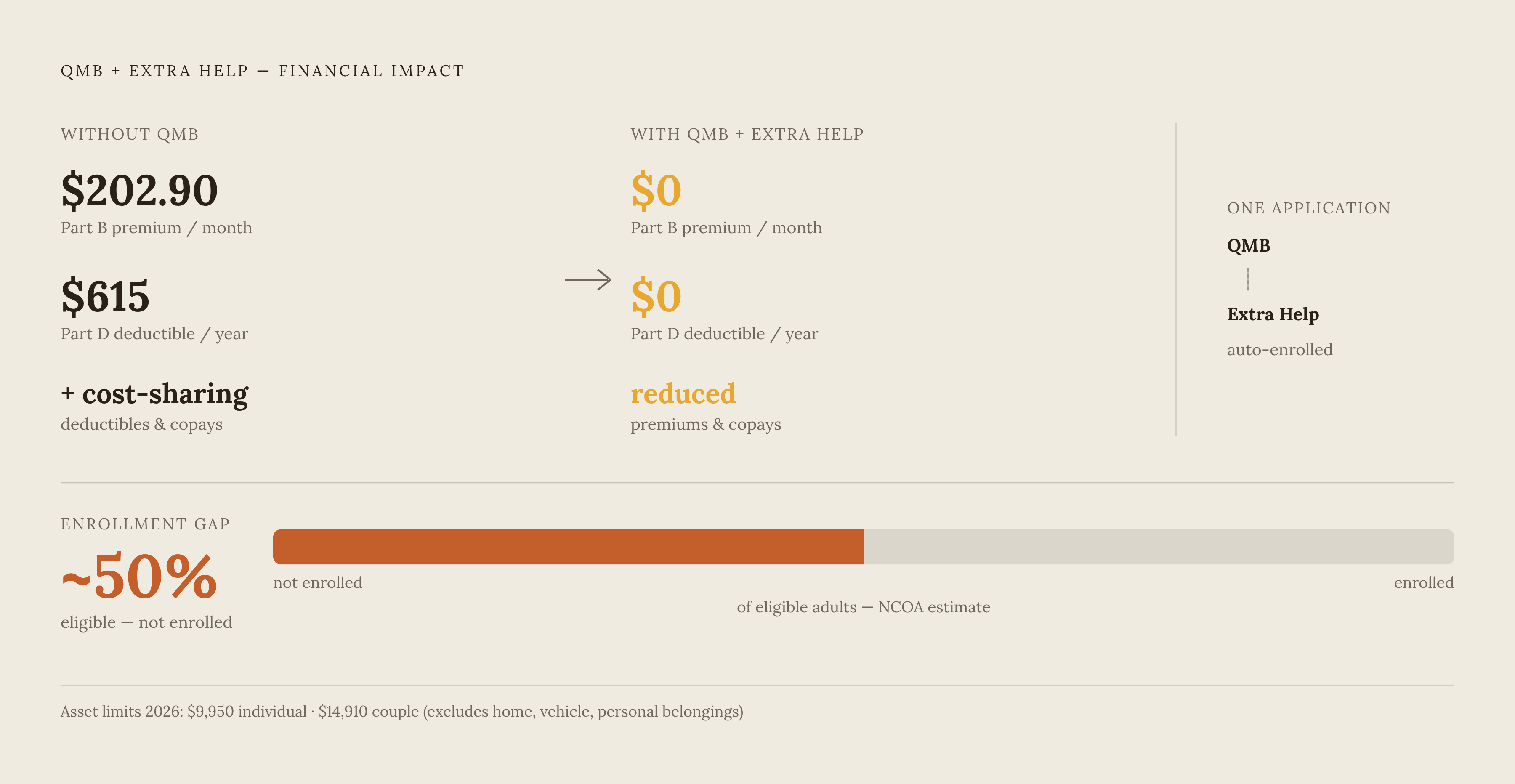
Screening and counseling exist to answer a prior question: once eligibility is established, which programs actually move the needle financially? Medicare Savings Programs are the highest-leverage starting point, and QMB is the one worth chasing hardest. There are four MSP tiers, QMB, SLMB, QI, and QDWI, each with its own income threshold, but QMB is the one that eliminates the Part B premium (currently $202.90 a month), along with deductibles and most cost-sharing. For 2026, the asset limits are $9,950 for an individual and $14,910 for a couple, and the home, one vehicle, and personal belongings are all excluded from that count. NCOA estimates that only about half of eligible older adults are actually enrolled in an MSP. That means the honest framing for a caregiver is not "check if you qualify," but "you may already qualify and simply not know it," because enrollment in QMB, SLMB, or QI automatically triggers Extra Help enrollment for prescription drug costs. One application, two programs.
Extra Help, also called the Low Income Subsidy, cuts Part D premiums, deductibles, and copays substantially. Anyone with full Medicaid, an MSP, or SSI gets enrolled automatically; everyone else has to apply through Social Security directly. The 2026 Part D out-of-pocket cap is $2,100, up from $2,000 in 2025 under the Inflation Reduction Act's redesign of the drug benefit, and the maximum Part D deductible for 2026 is $615. Extra Help reduces or eliminates that deductible entirely for people who qualify, which is not a marginal saving when prescription costs are the line item eating most of a fixed income.
Dual eligibility, meaning enrollment in both Medicare and Medicaid at once, fills gaps that Medicare alone leaves wide open: long-term nursing care beyond what Medicare covers, additional prescription coverage, eyeglasses, hearing aids. Dual Eligible Special Needs Plans, or D-SNPs, are Medicare Advantage plans built specifically to coordinate both benefits under one roof rather than forcing a beneficiary to juggle two separate systems. Enrollment in D-SNPs grew from 2.2 million in 2018 to more than 6.0 million in 2026, a jump that signals rising awareness among people who qualify for both programs, even if the growth curve alone doesn't prove every eligible dual has been reached yet. Provider directory data is being integrated into Medicare's Plan Finder, through a third-party interim solution in 2026 and directly from MA plans starting in 2027, and refreshed within 30 days of any known change. That should make the question "is Dr. Whoever actually in-network" a good deal more reliable to answer than it has been.
What ties all of this together, screeners, counselors, educational webinars, and the programs themselves, is the same throughline from the opening: the gap is not a lack of eligible people. It is a lack of navigation. The tools exist. The money is allocated. What is missing, for millions of caregivers managing someone else's enrollment under time pressure and without training, is knowing which door to knock on first.
Sources
- Medicare Advantage Open Enrollment and General Enrollment Periods Underway - Medicare Rights Center
- Medicare Open Enrollment Toolkit for Professionals
- 2025 Health Insurance Open Enrollment - Wikipedia
- Medicaid Eligibility Calculator & Income Limits 2026
- Explore & Engage: Medicare Webinars
- Medicare Enrollment Assistance: Get Help from NCOA
- ncoa.org
- chipublib.org