Remote and Long-Distance Caregiver Challenges
Distance caregivers face unique logistical barriers that proximity would simply erase.
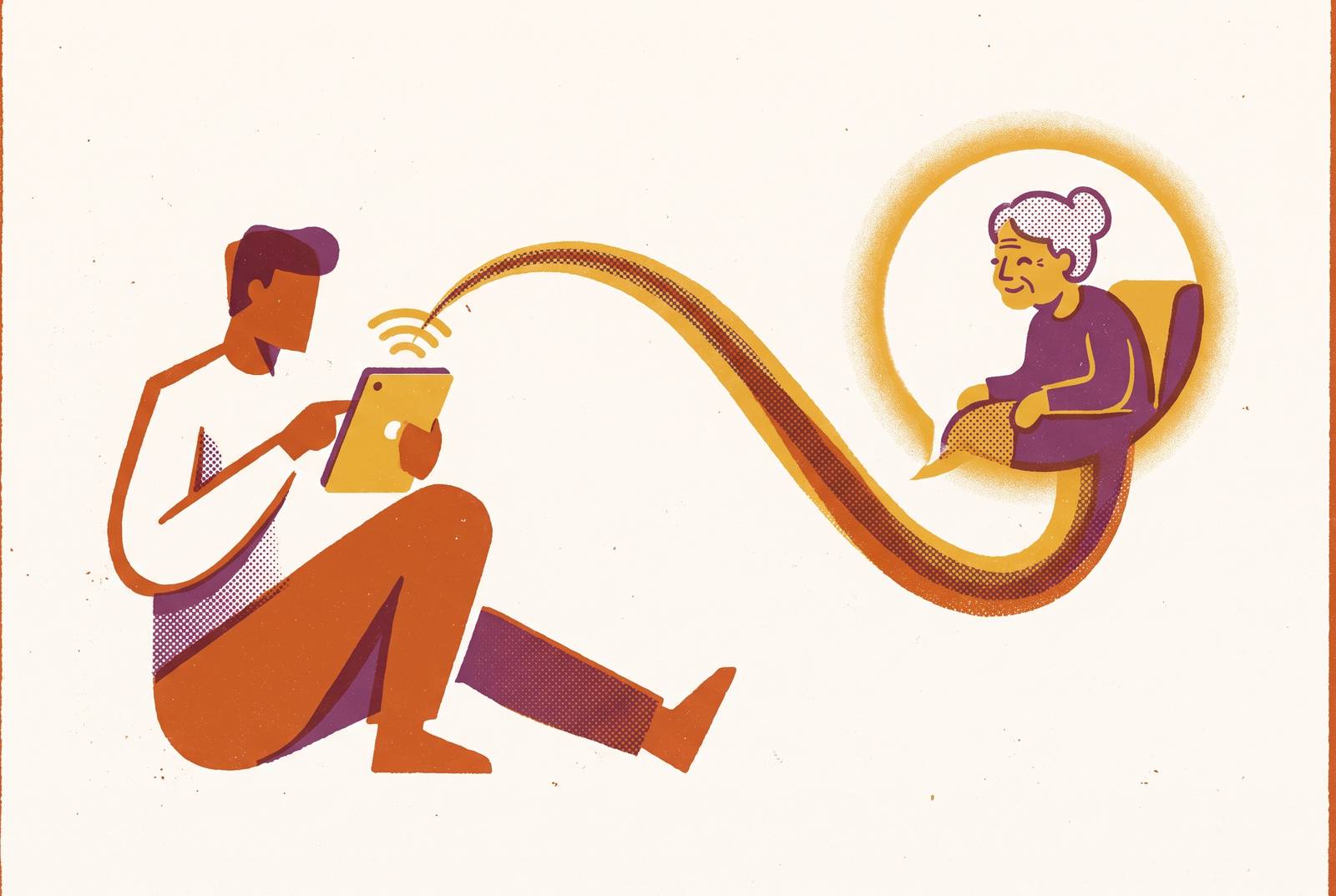
Long-distance caregiving is its own category of labor with demands that differ from caregiving that happens under one roof. The distance itself changes what the role demands: a caregiver who cannot see, cannot observe in real time, and cannot step in when something goes wrong faces a structural problem that proximity would simply erase.
Long-distance caregiving as a distinct role from local caregiving
Melissa Fisher, a caregiver who spoke to GoodRx, described the role in a way that captures its strange, undercharted quality: "I feel like caregiving remotely is still kind of an unknown place." That sense of being somewhere uncharted is the experience itself. A mobile workforce has scattered adult children away from the towns where their parents chose to age in place, so that the parents remain fixed while their children's careers, marriages, and households moved on without them. The average long-distance caregiver now lives 450 miles, or about seven hours of travel, from the person they support. Even researchers cannot settle on where "long-distance" begins. Some studies draw the line at one hour away, others at two or more, and that disagreement says something important on its own: no single institution has fully mapped who belongs to this population or what they need. The 2025 AARP/NAC report and its companion Caring Across States identify distance caregivers' needs as relatively overlooked compared to proximate caregivers, a gap flagged as a priority for the next legislative cycle. That omission is not an accident of oversight. It reflects a deeper failure to recognize that distance does not simply make caregiving harder. It changes what caregiving is, turning a role built on presence into one built on inference, delegation, and trust placed in people the caregiver may never meet.
Size and makeup of the long-distance caregiving population
The scale of this population argues against treating it as a niche concern. AARP and the National Alliance for Caregiving's Caregiving in the US report counts tens of millions of Americans as family caregivers, a jump of millions of people from 2015, representing nearly one in four U.S. adults. Within that group, roughly one in nine family caregivers, or 11% according to the National Alliance for Caregiving, lives more than two hours from the person they support. Applied across the full caregiving population, that share points to millions of households managing care from a distance, not dozens or hundreds. The typical caregiver is 51 years old, and three in five are women, a demographic detail that matters because it places this role squarely in the middle of peak career years. Many of these caregivers moved for a job, a partner, or a new start, and now find themselves pulled back toward a parent's needs from states or time zones away. Nearly a third are also raising children under 18 while caring for an aging parent, a three-way split of attention, work, parenting, and remote caregiving, that proximate caregivers simply don't face in the same configuration. And the role rarely arrives by invitation. As Fisher put it, "It's not like you were recruited to it or that you say to yourself, 'I'm prepared to step into becoming a caregiver now.'" Caregiving, for most people in this position, starts with a phone call.
The logistical challenge of managing care you cannot directly observe
Every task a local caregiver can simply do becomes, at a distance, a problem of coordination, verification, and trust in intermediaries. Scheduling appointments, managing medications, keeping multiple providers in sync: none of it can be confirmed firsthand, so it all depends on someone else's eyes being the caregiver's eyes. The skills gap compounding this is already severe industry-wide. Only one in nine family caregivers has received any medical training for the tasks they routinely perform, yet more than half now handle complex medical duties such as administering injections, managing feeding tubes, and coordinating specialist care without formal instruction. Distance widens that gap further, because there is no one on-site to catch a missed dose or a mistake before it becomes a crisis. Compounding the skills problem is an information problem: aging parents routinely minimize their difficulties over the phone, and without the ability to observe them directly, a long-distance caregiver has no reliable way to detect the subtle shifts in cognition, mobility, or mood that usually signal it's time to escalate care. Sharon Greenspan, a long-distance caregiver based in Tucson supporting someone in Florida, told GoodRx that the difficulty often starts before any care decision gets made at all: "it's often difficult to even figure out who to speak with." That one line captures how much of long-distance caregiving is actually logistics work disguised as care work, chasing down the right nurse, the right case manager, the right neighbor with a spare key. Legal and financial groundwork adds a further layer that has to be handled before any emergency hits: power of attorney, HIPAA authorization with providers, access to online banking, and oversight of insurance claims all fall to the long-distance caregiver, and all require setup well in advance of a crisis rather than during one. With providers, local aides, siblings in other states, and the care recipient all in the loop, fragmentation is a constant risk. One missed update, one piece of information that doesn't reach the right person at the right moment, and the whole structure of remote coordination can come apart.
The financial cost that travel and remote coordination add on top of already-high baseline expenses
The logistics have a price tag, and it sits on top of a baseline that is already steep. The average family caregiver spends roughly a quarter of their income on caregiving activities, which on its own represents a significant transfer of resources from household budgets into unpaid labor. Long-distance caregivers spend more. Research from Where You Live Matters puts their average annual expenses at $8,728, above that baseline, driven mainly by travel and the last-minute flights that a parent's fall or hospitalization forces them to book. Those flights are the most expensive and least flexible cost in the entire system, because they cannot be planned around. One might argue that hiring local help, a part-time aide or a geriatric care manager, would be cheaper in the long run than repeated cross-country trips, and the aggregate math often supports that. But establishing that kind of professional relationship requires upfront capital that not every caregiver has sitting in reserve. Lower-income caregivers are significantly more likely to experience the full range of financial impacts documented by AARP, so the compounding cost of distance lands hardest on exactly the households least equipped to absorb it. Zooming out, AARP's Valuing the Invaluable 2026 report finds that the unpaid labor family caregivers collectively provide exceeds all U.S. private business healthcare spending and total Medicaid expenditures combined. That comparison is the backdrop against which every individual caregiver's $8,728 has to be understood, a privately absorbed cost sitting inside a public system that has not figured out how to carry its share. Many caregivers respond by rationing their own rest instead of their money. Fisher told GoodRx, "I don't take my PTO, I don't take any sick leave. I feel like I'm always trying to pad my time off" against whatever emergency comes next. That is a caregiver substituting her own recovery time for a financial cushion she doesn't otherwise have.
Employment and the financial pressure on long-distance caregivers who work
Seven in ten family caregivers hold jobs, according to the AARP/NAC Caregiving in the US report, yet most working caregivers still struggle to balance the two roles, and the share reporting work impacts has not moved since 2020. Awareness of caregiving's toll on employment has grown substantially over the past five years, yet the actual experience of working caregivers has not improved to match it. Roughly half of employed caregivers arrive late, leave early, or take unplanned time off because of caregiving demands, and a substantial minority go further, taking leaves of absence, dropping from full-time to part-time, or leaving the workforce. Hourly workers, who make up a large share of the caregiving population, absorb the sharpest version of this penalty, since every hour away from the job is an hour of unpaid wages with no cushion behind it. Long-distance caregivers face a particular variant of this problem: because a crisis requiring travel can arise with no warning, there is no way to plan time off around it in advance, which leaves most of that absence reactive and frequently uncovered by any formal leave policy. Some employers have started to take the structural nature of this conflict seriously. The San Antonio Employer Advocacy Initiative, a five-part discussion series run between 2021 and 2023 by the Successfully Living and Aging in San Antonio Caregiver Workgroup and reaching representatives from 34 organizations, found that institutional culture, more than formal policy alone, shapes whether a caregiving employee actually gets supported. Most workplaces have not made that cultural shift yet. The initiative is evidence that employers are beginning to recognize caregiving as a workforce issue worth their attention, even though the problem remains unsolved.
The emotional texture of long-distance caregiving: guilt, anticipatory anxiety, and loss of control
What does it feel like to carry this role from hundreds of miles away? Guilt, helplessness, and worry are the emotions most consistently reported by long-distance caregivers, according to both the Caregiver Action Network and Willow Falls. But the guilt here has a specific shape. The guilt is a diffuse, low-grade sense of never quite being enough, regardless of how many calls get made or flights get booked. Anticipatory anxiety may be the single most defining emotional feature of the role. A caregiver who lives nearby watches a parent's decline unfold gradually, in real time. A long-distance caregiver sees it only in snapshots, a visit, a phone call, an occasional video chat, and has to fill in everything between those snapshots with imagination. That gap between information points becomes a kind of background static, a low-level fear that never fully switches off. Fisher described this to GoodRx in a way that lands with particular precision: she sometimes feels as though she's simply waiting for the next bad thing to happen, a posture of constant readiness that wears a person down even on the days when nothing actually goes wrong. That exhaustion is caused not by any single event but by the sustained expectation of one. It's caused by the sustained expectation of one.
There's also a loss of control that doesn't get talked about as often as the guilt or the anxiety, but that may compound both. When the people on the ground, a sibling, a hired aide, a hospital discharge planner, make the medical decisions, the hiring choices, or the living-arrangement calls, the long-distance caregiver is frequently told after the decision has already been made, if they're told. Being left out of decisions that affect someone a caregiver feels fully responsible for is its own distinct wound, separate from guilt and separate from worry. And because the role, as Fisher told GoodRx, "is very reactive," arriving without warning and without training, caregivers step into it with no emotional scaffolding already in place to absorb any of this. Burnout sets in not from the task list but from the sustained vigilance underneath it, a labor that never appears on any list though it is no less real for being invisible.
Distance, mental health, and the limits of the intuitive assumption
It would be reasonable to assume, after all of this, that more distance simply means worse mental health for the caregiver. That assumption feels intuitive, but the research complicates the picture rather than confirms it.
Work presented at the Gerontological Society of America's Innov Aging conference examined the mental health consequences of long-distance caregiving and found that distance alone does not cleanly predict psychological distress. Other factors, including the caregiver's own financial strain and their personal health status, appear to carry more weight than the number of miles between caregiver and care recipient. One might ask: if distance itself isn't the deciding variable, what does that say about where intervention should actually focus? It suggests that the logistical and financial burdens documented throughout this piece, the cost of last-minute flights, the absence of paid leave, the skills gap left by zero medical training, may matter more to a caregiver's wellbeing than the raw fact of geographic separation. That doesn't mean distance is irrelevant.
Sources
- Long-Distance Caregiving: Resources for Effective Remote Care
- Navigating the Challenges of Long-Distance Caregiving
- The 63 Million Caregivers Crisis: Long-Distance Family Impact
- What Are the Challenges of Being a Long-Distance Caregiver? - GoodRx
- LONG-DISTANCE CAREGIVING: MENTAL HEALTH CONSEQUENCES AND USE OF RESOURCES
- The High Cost of Caregiving