Platforms That Help Caregivers Identify Government Benefits Their Family Members Qualify For
Digital tools now help caregivers navigate the $58 billion benefits gap.
A growing set of digital tools now exists specifically to help caregivers cut through the fog of government benefits programs and figure out what their family members actually qualify for. This piece looks at how those platforms work, where they differ, and what a caregiver should weigh before picking one. Platforms That Help Caregivers Identify Government Benefits Their Family Members Qualify For
Why so many caregivers miss benefits
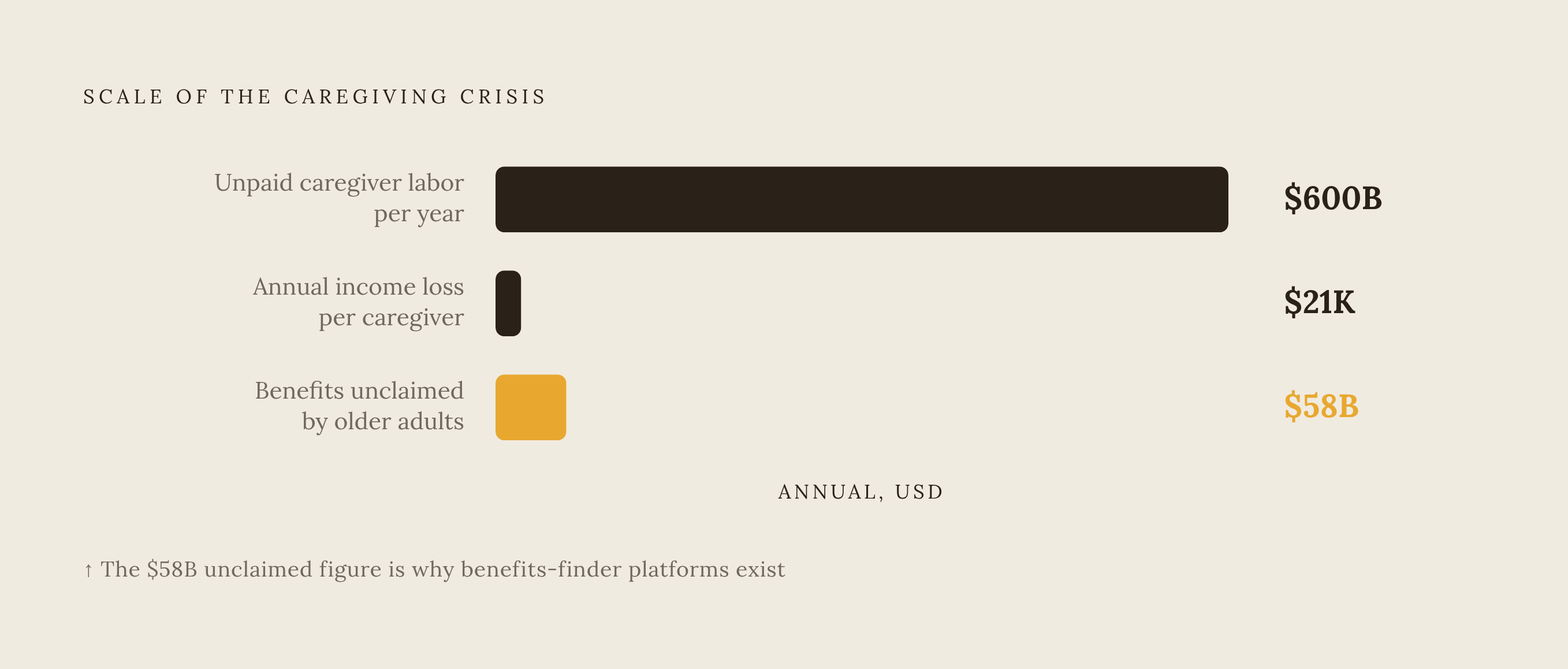
Start with the population. Collectively, they provide something like $600 billion in unpaid labor every year, measured in care that never appears on a paycheck, a tax form, or a résumé Benefits for Caregivers of Elderly or Disabled Family Members. That's a figure large enough to constitute an entire shadow economy running on family obligation. That's an entire shadow economy running on family obligation.
The financial toll on individual caregivers is not abstract either. Caregivers report losing an average of roughly $21,000 a year in income because of the time and flexibility caregiving demands aplaceformom.com myfriendben.org. Only 8% of caregivers report actually getting paid for the work, through informal personal care agreements, self-directed Medicaid arrangements, or VA programs aplaceformom.com. The need is enormous, the compensation pathways exist, and almost nobody is using them.
Zoom out further and the picture gets worse. NCOA calculates that $58 billion in benefits goes unclaimed every year by older adults who qualify for programs like SNAP, SSI, and the Medicare Savings Programs but never enroll ncoa.org Benefits for Caregivers of Elderly or Disabled Family Members myfriendben.org. That figure alone is the reason this entire category of platform exists.
Why does the gap persist? Part of it is sheer fragmentation. Benefits programs run at the federal, state, and county level, often simultaneously, each with its own income thresholds, asset tests, and application quirks. And the rules don't hold still.
The awareness gap also isn't distributed evenly. Only 23% of women caregivers feel they're getting enough federal support, compared to 35% of men, which suggests the information itself isn't reaching people the same way across the board aplaceformom.com. Many caregivers don't realize they, personally, might qualify for direct payment, separate entirely from whatever benefits their care recipient gets. The overwhelm here is what happens when a system this fragmented meets people who have no spare hours to become policy experts on top of everything else. It's what happens when a system this fragmented meets people who have no spare hours to become policy experts on top of everything else. The population this piece is written for is defined by the AARP report's finding of 63 million family caregivers in the U.S. Eligibility rules shift year to year, as seen in the 2026 Part B premium rising to $202.90 from $185 and the Medicare drug out-of-pocket cap moving to $2,100 AARP Caregiving in the US 2025 Medicare Caregiver Resources 2026 rubywell.com assets.ncoa.org, and services like Brevy, a free Medicaid and Medicare enrollment service, exist specifically to help caregivers track and act on those moving targets.
The scope of a benefits-finder platform
At its core, a benefits screener works the way a decent intake interview would: it asks about income, household size, age, disability status, state of residence, and what benefits someone already receives, then it spits back a list of programs the person is likely eligible for. Simple in concept. Complicated in execution, because the underlying rules it's checking against are anything but simple.
What do these tools typically cover? Federal entitlement programs sit at the center: Social Security, SSI, Medicare, Medicaid. Layered on top are the means-tested programs, SNAP, LIHEAP, Section 8 and Section 202 housing, and the Medicare Savings Programs. Some screeners go further and surface caregiver-specific payments, like Medicaid's home and community-based services waivers, consumer-directed programs, and VA PCAFC stipends. A smaller subset also picks up tax-based relief, including the Dependent Care FSA, the Child and Dependent Care Credit, and the EITC.
Caregivers need to slow down and read the fine print, though. Most screeners determine likely eligibility. They do not enroll anyone, and they do not guarantee approval. Some platforms pair the results list with real enrollment help, human follow-up, or a warm handoff to a case worker. Others just hand over links and wish the user luck. That distinction matters enormously if someone is trying to get a parent onto a Medicare Savings Program before an enrollment window closes ncoa.org Benefits for Caregivers of Elderly or Disabled Family Members myfriendben.org.
It also helps to separate two different jobs a caregiver might be trying to do. One is finding benefits for the care recipient, the aging or disabled family member. The other is finding benefits or compensation for the caregiver, directly. These are not the same search, and a lot of tools are built to answer only one of them. The platforms worth using tend to handle both.
One might argue that accuracy is the whole ballgame here, and it's hard to disagree. A screener throwing out false positives wastes a caregiver's limited time chasing programs that were never a real match. A screener with false negatives is worse: it quietly leaves money on the table that a family genuinely qualified for. A screener that generates false positives wastes caregiver time, while one with false negatives leaves money unclaimed, so 90%+ accuracy is a meaningful benchmark myfriendben.org
The programs caregivers most often miss
Medicare Savings Programs is near the top of the missed-benefits list, and the scale of the miss is startling. CMS data shows roughly 1.25 million people already receiving Extra Help for their drug costs also qualify for a Medicare Savings Program and simply aren't enrolled in it ncoa.org. Extra Help for Part D can save up to $5,700 a year in drug costs in 2026 Medicare Caregiver Resources 2026. And here's a detail that rarely gets mentioned: enrolling in QMB, SLMB, or QI also triggers automatic Extra Help enrollment, a compounding benefit caregivers rarely know about.
Medicaid's home and community-based services waivers, along with consumer-directed programs, are the main route to actually getting paid as a family caregiver. Nearly every state, all of them except Alaska, offers some version of a self-directed Medicaid program that lets a family member draw a wage for care, though the rates differ state to state. About 11 states now run a Structured Family Caregiving model as of 2026, which pays a daily stipend rather than an hourly wage AARP Caregiving in the US 2025.
For caregivers connected to a veteran, the VA's Program of Comprehensive Assistance for Family Caregivers, PCAFC, is arguably the single largest direct-payment program available. Base stipends run roughly $37,000 to $42,000 a year, translating to a monthly range of about $1,900 to $3,500 depending on tier and location Benefits for Caregivers of Elderly or Disabled Family Members. The VA recently extended the transition period for legacy participants and applicants through September 30, 2028, meaning their stipends won't drop due to reassessment during that window, with some exceptions. Stipend amounts also shift in 2026 with a 1% federal GS pay scale bump Benefits for Caregivers of Elderly or Disabled Family Members. What gets missed constantly, though, is everything sitting around the stipend: CHAMPVA health coverage, mental health counseling, and a minimum of 30 days of respite care every year. Caregivers know about the check. Fewer know about the rest of the package.
PACE, the Program of All-Inclusive Care for the Elderly. It's available in 33 states and Washington D.C. as of 2026, and for anyone dual-eligible for Medicare and Medicaid, there's no premium, deductible, or copay at all.
Kinship caregivers may be the most overlooked group of all. More than 2.7 million children in the U.S. The National Institute on Aging reports that older relatives are raising them, and a large share of these caregivers have no idea what's available to them. As of 2025, 58 Title IV-E agencies have approved plans for the Kinship Guardianship Assistance Program Benefits for Caregivers of Elderly or Disabled Family Members.
Working caregivers, meanwhile, tend to miss the tax-side relief. The Dependent Care FSA limit jumped to $7,500 in 2026, up from $5,000, thanks to recent legislation. The Credit for Caring Act, reintroduced in Congress in March 2025, would create a nonrefundable credit worth up to $5,000, covering 30% of qualified long-term care costs above $2,000 a year Benefits for Caregivers of Elderly or Disabled Family Members Benefits for Caregivers of Elderly or Disabled Family Members. It has bipartisan support in both chambers, but as of early 2026 it still hasn't passed Benefits for Caregivers of Elderly or Disabled Family Members Benefits for Caregivers of Elderly or Disabled Family Members. It has bipartisan support in both chambers but hasn't passed yet. The QMB program eliminates the $202.90/month Part B premium plus deductibles and most cost-sharing, amounting to more than $2,400 in annual savings before touching any other benefit Eligibility requires the care recipient to qualify for Medicaid and be assessed as needing nursing-facility-level care at home Programs include TANF child-only grants, Medicaid/CHIP for the child, SNAP, and state kinship guardianship assistance payments, which are highly state-dependent, exactly where a screener adds value Medicare Caregiver Resources 2026
NCOA BenefitsCheckUp: the established national screener for older adults
BenefitsCheckUp, run by the National Council on Aging, has been around since 2001, which in the world of digital benefits tools makes it something close to an elder statesman. It's free, confidential, and screens against nearly 2,000 benefits programs covering food, medicine, utilities, and other everyday costs, with national reach. Last year alone, 200,000 users found an average of $6,000 in annual savings apiece, adding up to $1.2 billion in total savings surfaced, infrastructure operating at national scale assets.ncoa.org. That's infrastructure operating at national scale, not a small pilot program. That's infrastructure at national scale.
What sets BenefitsCheckUp apart from a pure web tool is the support wrapped around it. There are 100 community-based Benefits Enrollment Centers spread across states and territories, built specifically for people who can't or won't use an online screener assets.ncoa.org. NCOA also just secured a 31-month National Benefits Helpline and Screening Service contract running from February 1, 2026 through August 31, 2028, adding a toll-free line and online chat on top of the existing tool assets.ncoa.org. That matters because a lot of older adults trust a phone call from a real person more than they trust a web form, and the BEC network along with the new helpline is a direct answer to that, even if digital access still lags in plenty of communities.
Where it falls short of a complete solution: the screener is oriented mainly around the care recipient rather than the caregiver's own eligibility, and while it generates a solid list of programs, whether someone actually gets enrolled depends on which BEC partner picks up the case, not a guarantee baked into the online tool itself. For a caregiver hunting for benefits across a wide swath of federal and state programs for an older relative, particularly one who'd rather talk to a person than click through a form, BenefitsCheckUp remains a strong starting point.
MyFriendBen: the AI-assisted screener built for speed, anonymity, and multi-state expansion
MyFriendBen took a different path. It was incubated at Gary Community Ventures in Colorado and launched there in 2023, free and fully anonymous aplaceformom.com. Since then it's expanded to Illinois, Massachusetts, North Carolina, Texas, and Washington, on top of its Colorado base. A Kansas launch got underway in June 2026, and Missouri followed in August 2026. The Texas rollout, in May 2026, came through a partnership with the Child Poverty Action Lab acting as anchor funder.
The screener itself covers government benefits, tax credits, and nonprofit programs, runs in 21 languages, and takes a median of 6.6 minutes to complete, with 77% of users finishing inside 10 minutes myfriendben.org. It claims over 90% accuracy on eligibility determinations myfriendben.org. To date, more than 115,000 households have connected to public benefits through the tool, with an estimated $58 million in impact unlocked ncoa.org AARP Caregiving in the US 2025 Benefits for Caregivers of Elderly or Disabled Family Members myfriendben.org.
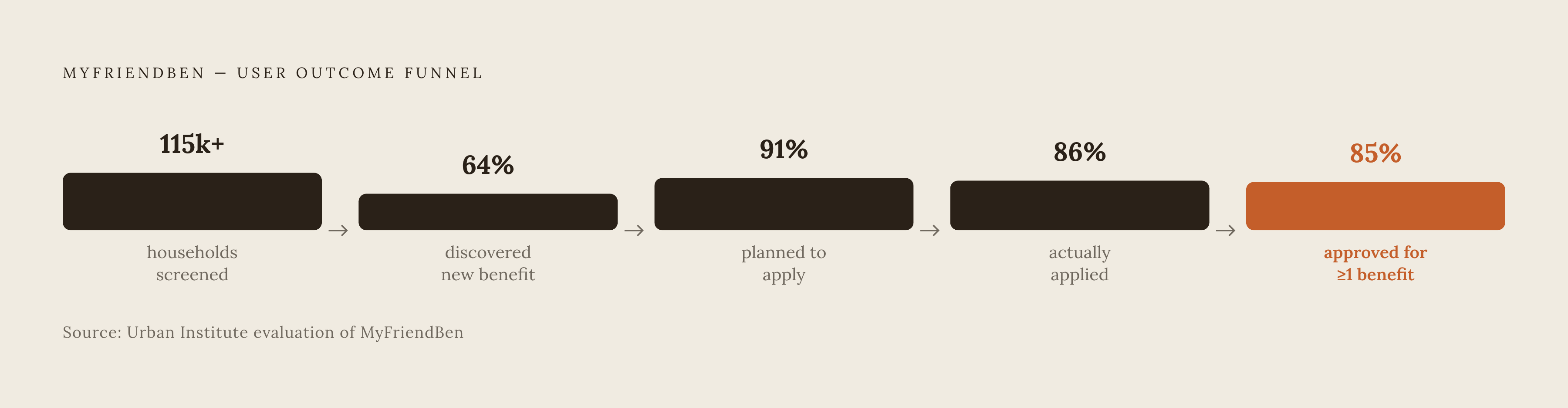
The more interesting evidence comes from an independent Urban Institute evaluation published around August 2026, which is currently the most credible outside look at how the tool performs in the real world. Some 64% of users discovered a benefit they'd never known about before finance.yahoo.com. About two-thirds learned of at least one new benefit, and nearly as many picked up new information about benefits they'd already heard of but didn't fully understand. 91% planned to apply within three months, and 93% said they'd recommend the tool to friends or family. Follow-up at the three-month mark showed 86% had actually applied for at least one new program, and among those who applied, 85% got approved for at least one benefit. Usability scores held up as well, with 79% calling the screener "very easy" and 95% saying the questions were clear.
But the same evaluation didn't paper over the weak spots. A meaningful share of users who didn't apply said it was because they doubted their own eligibility, weren't sure how to actually apply, or mistakenly assumed the screener itself would file the application for them. That last one is a design lesson as much as a caregiver lesson: a results list, however accurate, isn't the same thing as an application. MyFriendBen is confined to the states listed above. It's confined to the states listed above, so caregivers elsewhere will need to look elsewhere too.
Other screeners and access points caregivers should know about
Benefits.gov is the federal government's own front door, useful as a general reference for federal programs but typically less tailored than a purpose-built screener. Treat it as a supplement to a state-specific or population-specific tool, not a replacement for one.
State Medicaid agencies deserve a direct mention because they are essential for consumer-directed caregiver pay programs. The state agency is usually the final word on what's actually available locally and how the application process works, and a generic national screener won't always catch every state's specific waiver options, so a follow-up call to the state agency is often a necessary next step.
For veterans' families, the VA Caregiver Support Line at 1-855-260-3274, along with VA Form 10-10CG filed online, is the application route. It's the direct access point for one of the richest caregiver benefit packages on offer, though not a screener. Every VA medical center also staffs a Caregiver Support Coordinator, a person, not an algorithm, who can walk a family through the more tangled eligibility questions that a web form can't fully resolve.
Area Agencies on Aging round out the list. Funded under the Older Americans Act, these local organizations coordinate Meals on Wheels, in-home services, and local benefits navigation, and they're often the best option for caregivers who'd rather sit across a table from someone than fill out another online form.
A newer category combines automated screening with actual enrollment support, closing the exact gap the Urban Institute flagged, where people find a benefit but stall out before applying. That hybrid structure, screening plus a human who actually helps someone apply, may end up being the more durable model as this category matures, precisely because eligibility was never really the hard part. Getting the application filed, correctly, before a deadline passes, always was.