How PCAFC Stipend Tiers Are Actually Calculated
The formula multiplies federal pay scales, locality adjustments, and tier factors to set stipends.

PCAFC stipend amounts look arbitrary until you see the formula behind them. The VA runs every dollar figure through a federal pay scale, a locality adjustment, and a two-tier multiplier, and once you know those three inputs, you can reproduce your own stipend with a calculator in about ten minutes. That's more than most caregivers realize when they first open their award letter, and honestly, more than a lot of VA staff explain to them upfront.
The Program of Comprehensive Assistance for Family Caregivers pays a monthly, tax-free stipend to one designated Primary Family Caregiver per veteran household. One person, not the veteran, not a rotating cast of relatives splitting duties. The payment traces back to a specific line on an Office of Personnel Management pay table. Up to two secondary caregivers can be named for training and respite benefits, but neither gets a direct check. And before any of the math applies, the veteran has to qualify for PCAFC itself; eligibility for the program is a separate gate from the calculation that determines what the stipend pays out.
What the stipend isn't tells you almost as much as what it is. It varies by locality, so there's no flat federal number paying the same in Montana as in Manhattan. It's not tied to receipts, and it's not means-tested against a caregiver's income or a veteran's assets. It's a wage-equivalent payment, built to approximate what the federal government pays an entry-level professional for comparable support work. Wage-equivalent, not expense-based. That distinction runs through everything below.
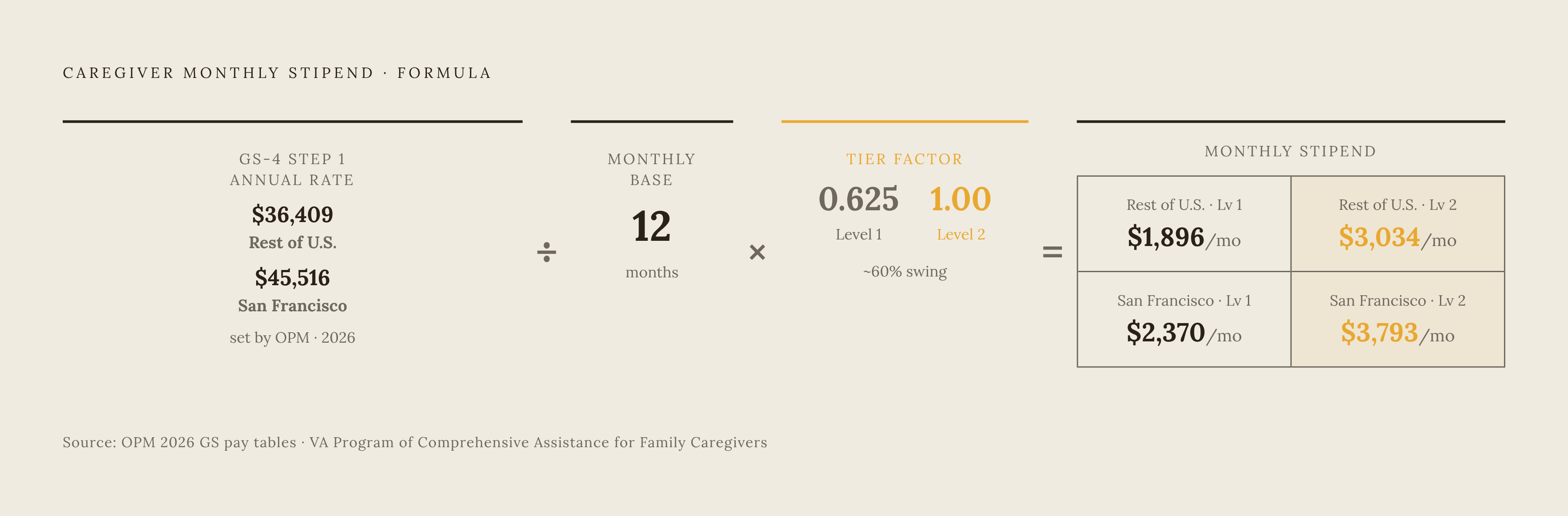
The federal pay scale the formula is built on: GS-4, Step 1
The regulatory anchor is 38 CFR § 71.40, and it's worth reading slowly, because the language is unusually precise for a benefits regulation. It defines the "monthly stipend rate" as the OPM General Schedule annual rate for GS-4, Step 1, in the veteran's locality pay area, divided by twelve. One sentence, and it's the foundation under every dollar amount a caregiver ever sees on a PCAFC award letter.
Why GS-4, Step 1? It's the government's internal benchmark for entry-level professional support work, the kind of job that needs competence and judgment but not years of specialized training. The VA didn't invent a caregiver wage from scratch; it borrowed one that already existed inside the federal pay system. Pegging the stipend to an existing labor standard means the number isn't up for political negotiation every budget cycle. It moves when OPM's tables move, automatically, without the VA issuing fresh guidance every year.
That automation cuts both ways, though. The VA never actually sets a national stipend figure; the figure falls out of wherever OPM's tables land, and OPM updates those tables every January. When OPM raises the General Schedule, PCAFC stipends adjust effective the first of the following month, never earlier than OPM's own effective date. In practice, that's meant a January 1 adjustment most years. The 2026 tables carry a 1% across-the-board base pay increase, and that 1% flows through to every PCAFC stipend in the country, whether the caregiver lives in rural Nebraska or downtown San Francisco.
Because the base depends on locality, two caregivers doing functionally identical work for two different veterans, at the same tier, can end up with noticeably different monthly checks. The formula doesn't smooth that gap out. It's built to produce it.
How the veteran's location sets the baseline dollar amount
OPM splits the country into dozens of locality pay areas, each carrying its own percentage bump above the national base GS rate. The VA uses the locality where the veteran lives, not where the caregiver lives, and that matters more than it sounds like it should, given how often a caregiver commutes in from a cheaper area to care for a veteran in an expensive one.
For 2026, the "Rest of U.S." locality, the catch-all covering most rural counties and smaller metros, sets the GS-4, Step 1 annual rate at $36,409. That's the floor. Most caregivers outside major metro areas are working off this number whether they realize it or not.
Now compare the high-cost localities. San Jose–San Francisco–Oakland carries a locality adjustment of 46.34% above the national base, pushing the GS-4, Step 1 rate to $45,516 for 2026. New York–Newark sits at 37.95%, landing at $42,907. Those aren't rounding errors. A caregiver in San Francisco starts from a base roughly 25% higher than a caregiver in rural Ohio, before a tier factor even enters the picture.
Fair? Depends what you think the stipend is supposed to measure. If it's meant to track the local cost of hiring someone to do comparable work, the locality adjustment holds up; a home health aide costs more in the Bay Area than in a small Kansas town, and the formula tracks that reasonably well. If you think the stipend should reflect how demanding the caregiving is, regardless of zip code, the locality gap looks harder to defend. The VA's formula picks the first interpretation. It's a labor-market instrument, not a care-intensity instrument, and that choice shapes everything downstream.
One detail caregivers miss often enough to flag directly: if the veteran relocates, the stipend recalculates based on the new locality, effective the first of the following month, but the caregiver has to notify the VA within 30 days of the move. Miss that window and the VA can pursue recovery of whatever overpayment built up in the meantime. A 2026 analysis from benefitsusa.org puts the overall range of PCAFC monthly payments, factoring in both locality and tier, at roughly $1,898 to $3,792. Nearly a two-fold spread, and almost all of it comes down to the two variables covered so far.
The two-level tier structure and the multipliers that produce the final payment
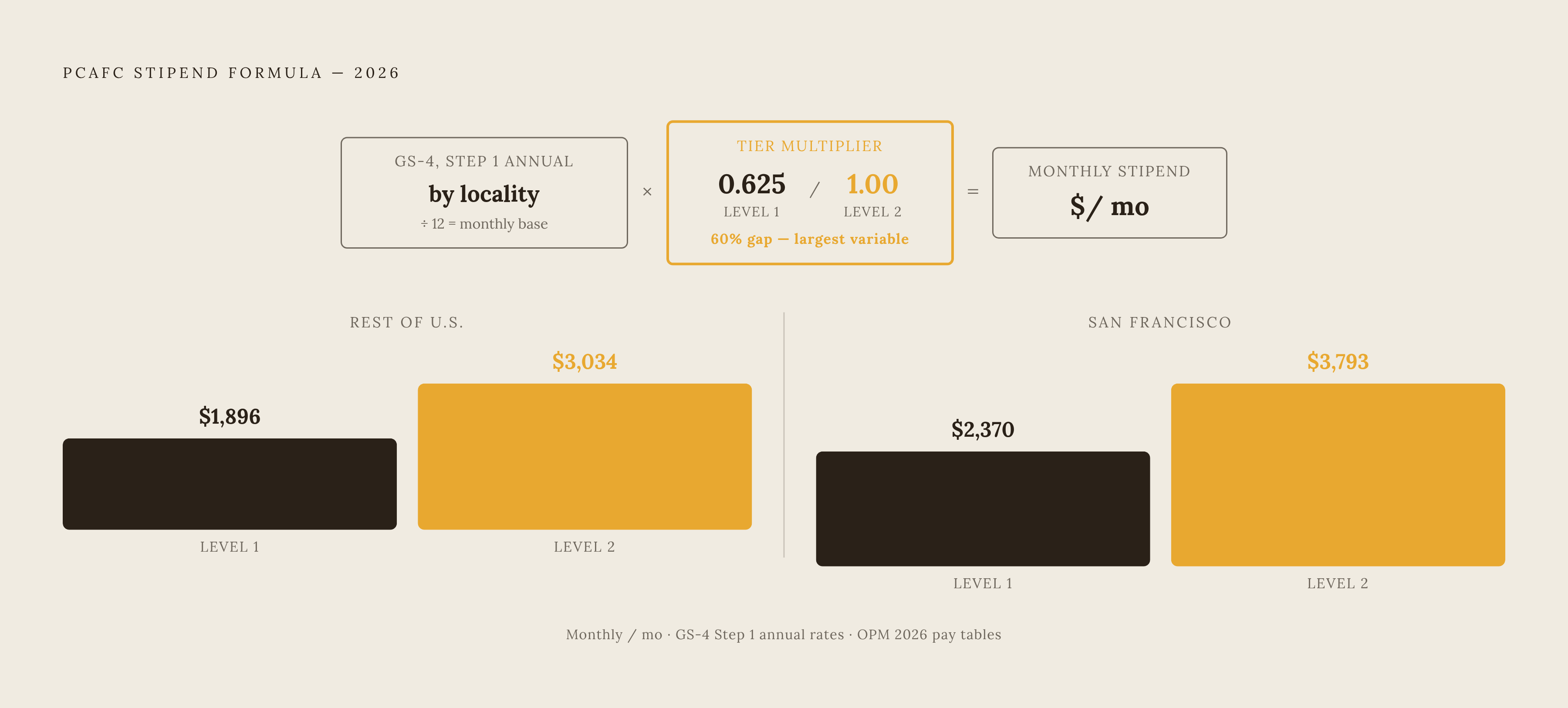
The base sets the ceiling and floor. The tier factor is what actually lands in the checking account, and it's the single piece of the formula that matters most to any one caregiver's bottom line.
The system in effect since October 1, 2020, codified in 38 CFR § 71.40, works like this: monthly stipend equals the GS-4, Step 1 annual rate for the veteran's locality, divided by 12, times a tier factor. Two tiers, no more.
Level 1 carries a multiplier of 0.625, or 62.5% of the monthly stipend rate. It applies when the veteran needs personal care assistance or supervision but hasn't been found "unable to self-sustain in the community," a phrase that sounds soft until you see its regulatory definition in the next section. Run the 2026 numbers and Level 1 lands around $1,896 a month in the Rest of U.S. locality, about $2,370 in San Francisco, roughly $2,234 in New York.
Level 2 carries a multiplier of 1.00, the full stipend rate, no reduction. It applies when the VA determines the veteran is, in fact, unable to self-sustain in the community. The 2026 figures jump accordingly: about $3,034 a month in the Rest of U.S. locality, roughly $3,793 in San Francisco.
Level 2 pays 60% more than Level 1. Every month, every locality, no exceptions. That's the largest swing anywhere in the PCAFC formula, bigger than any locality gap, and it comes down to a single clinical call made by VA assessors. Get placed at Level 1 when the veteran's actual condition supports Level 2, and a caregiver is leaving well over a thousand dollars a month on the table.
The VA's own 2022 fact sheet grounds this in a real example: a Dallas veteran with a GS-4, Step 1 annual rate of $34,916 produced a Level 1 stipend of about $1,818.54 a month and a Level 2 stipend of about $2,909.67. Different year, different locality, same formula, same roughly 60% gap. The math holds up every time. The tier call underneath it doesn't always, and that's the subject of the next section.
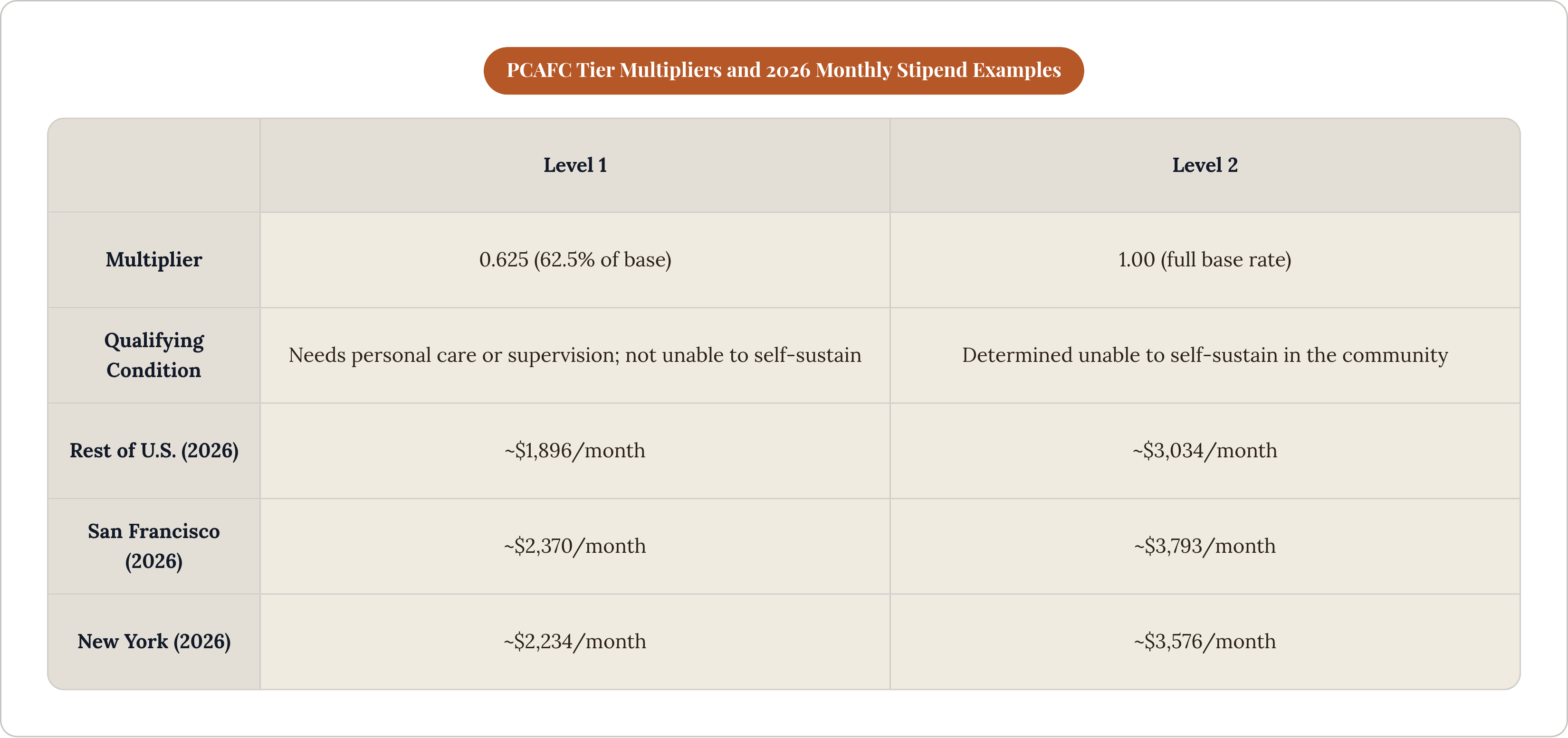
What "unable to self-sustain in the community" actually means in a clinical assessment
This isn't a loose clinical impression. It's a defined legal term under 38 CFR § 71.15, and VA assessors aren't supposed to apply gut judgment to it. A veteran meets the definition if either of two conditions holds.
First: the veteran needs personal care services every time they complete three or more of the seven listed Activities of Daily Living, and is fully dependent on a caregiver for those tasks. The seven ADLs cover bathing, dressing, toileting, the basic mechanics of self-maintenance. Second, an alternative path: the veteran needs supervision, protection, or instruction on a continuous basis, which comes up more often with traumatic brain injury or serious psychiatric conditions, where the risk isn't physical dependence so much as judgment and safety.
Who makes this call? Since late 2020, the VA has used Centralized Eligibility and Appeals Teams, CEATs, staffed by inter-professional, licensed practitioners with specific PCAFC training. CEATs decide both whether a veteran qualifies for the program and which tier applies once they're in.
Congressional testimony has flagged something that deserves more attention than it usually gets: field staff on the CEAT don't consistently interpret the "unable to self-sustain" question the same way from one assessor to the next. So the single determination responsible for a 60% swing in monthly pay is also the determination most prone to inconsistent application. That's a real crack in a program that otherwise runs on a formula precise enough to calculate to the penny, and it's worth sitting with, because everything else in this system is so exact.
What does that mean for a caregiver walking into an assessment? Document beforehand, not after. Keep detailed records of which ADLs the veteran needs help with, how often, and whether that help amounts to full dependence rather than occasional assistance. Note any continuous supervision needs too, especially cognitive or behavioral ones that might not surface in a single conversation with an assessor. If a Level 1 determination comes back and doesn't match the caregiver's actual day-to-day, an appeal is available, and the documented inconsistency in how CEAT staff apply this standard is itself a reasonable basis for filing one.
The legacy three-tier formula still running in parallel through September 2028
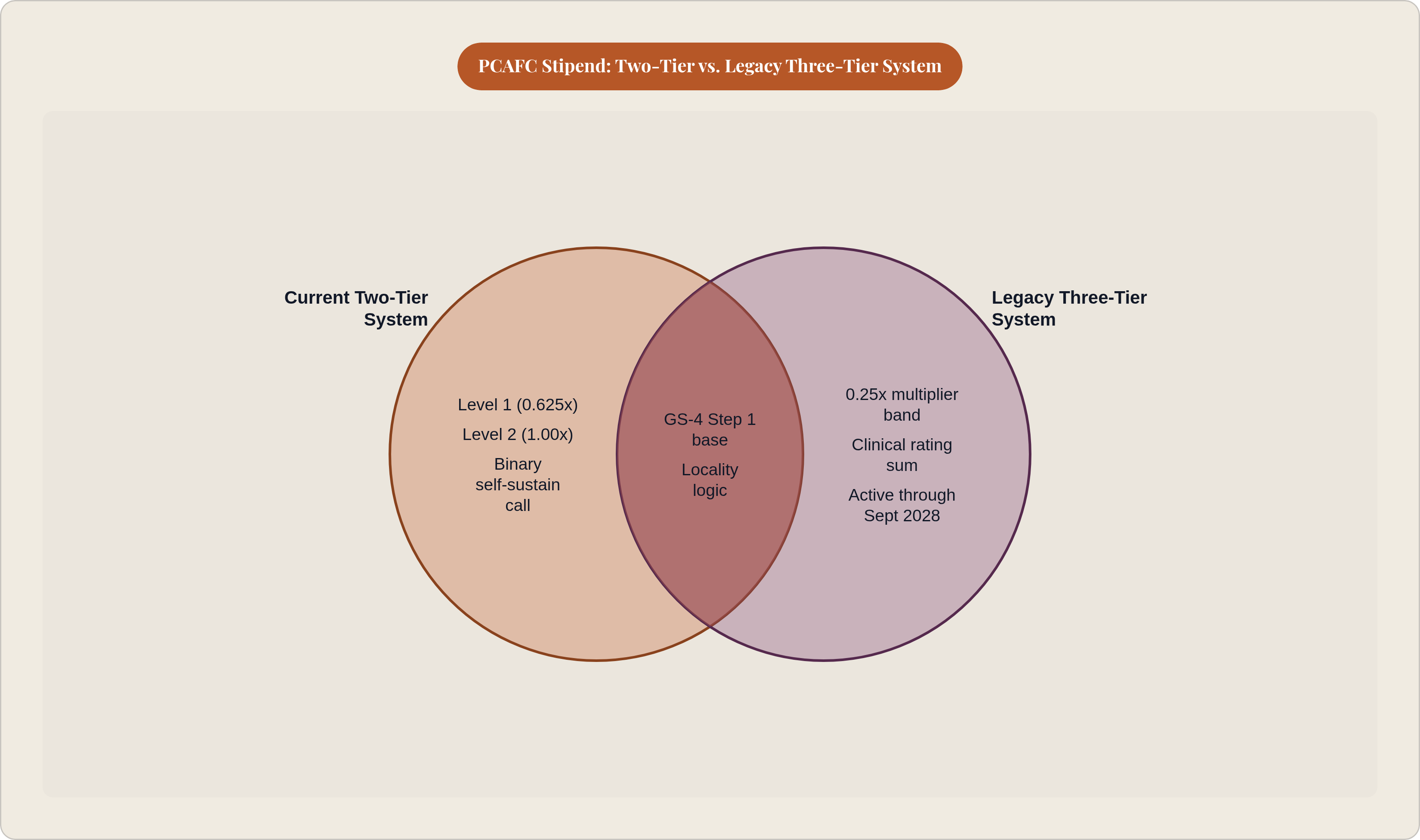
Not every caregiver in the program runs on the two-tier formula above. Caregivers enrolled before October 1, 2020, may still be calculated under the original clinical rating system, and a Federal Register rule finalized in 2025 extended that legacy formula through September 30, 2028.
The legacy structure uses three tiers instead of two, built around a clinical rating sum rather than a binary self-sustainment call. A rating sum of 21 or higher triggers a 1.00 multiplier, functionally the same as today's Level 2. A sum of 13 to 20 triggers 0.625, matching today's Level 1. But there's a third band that no longer exists for anyone enrolling now: a sum of 1 to 12 triggers a 0.25 multiplier, a lower tier phased out once the current system took effect.
Two protections got built into the transition, and both matter a great deal to legacy caregivers. First, if a legacy participant's stipend under the newer system would come out higher than their legacy amount, the VA pays the higher figure; nobody loses money because of the system change itself. Second, as long as the veteran still lives at the address on record, the legacy amount can't drop below what the caregiver was receiving as of September 30, 2020, the day before the new formula took effect.
Why does any of this matter beyond the caregivers directly affected? Scale. Before the March 2022 court decision in Veteran Warriors, the VA had completed roughly 80% of legacy reassessments, and of those, about 12,970 caregivers were found no longer eligible for the program at all. That's the backdrop the 2025 extension needs to be read against: a direct response to a reassessment process that had already pushed thousands of caregivers out before litigation stepped in. Through all of it, one thing never changed: the GS-4, Step 1 base and the locality logic stayed exactly the same. Only the multipliers and the clinical instrument used to assign them differ between legacy and current systems.
Reading your own stipend: applying the formula to a specific locality
Say you're staring at an award letter, trying to figure out where the number came from. You can rebuild it yourself, using tools that are public right now, no VA login required.
Start with the veteran's locality pay area. OPM publishes locality tables covering every county and metro region in the country, and the VA goes by the veteran's address on file, not the caregiver's, so don't assume your own zip code applies if you live somewhere else. Next, pull the 2026 GS-4, Step 1 annual rate for that locality off OPM's published salary tables; they're updated every January and freely accessible. Divide by 12 to get the monthly stipend base, then multiply by 0.625 for Level 1, or 1.00 for Level 2.
That's the whole calculation, and it takes maybe ten minutes with the tables open in another tab. But notice what it can't tell you: which tier applies. The math is deterministic once you know the tier; the tier itself comes out of a clinical assessment, not a table lookup. The formula gets you most of the way there and leaves the most consequential variable sitting outside the spreadsheet entirely.
This is where most of the confusion between caregivers actually starts. Two families compare notes, see different numbers, and assume something went wrong, when usually nothing did. Locality and tier compound each other, and together they explain nearly every apparent discrepancy caregivers run into. A caregiver in a cheaper locality at Level 2 can out-earn a caregiver in an expensive locality stuck at Level 1. It comes down to which variable moves more.
What changes year to year and what to watch for
The formula isn't frozen, and caregivers who treat their first award letter as gospel are setting themselves up to miss adjustments they're actually owed.
The most predictable change is the annual OPM update. Every January, OPM issues new General Schedule tables, and those changes flow through to PCAFC stipends automatically. The 2026 tables reflect a 1% increase over 2025 at the base level, modest, but real, and applied uniformly across every locality in the country.
Less predictable, and easy to miss, is that locality percentages themselves shift independently of that base increase. A metro area's locality adjustment can rise or fall year to year based on OPM's ongoing labor market surveys, so the GS-4, Step 1 rate for a given city can move by more or less than the national 1%, depending on how that area's own percentage shifted. Two forces stack on top of each other every January, one base increase, one locality adjustment, and they don't always point the same direction.
Veteran relocation stays a live variable too. Moving from a lower-paying to a higher-paying locality raises the stipend; moving the other way lowers it. Either direction, the 30-day notification window applies, and missing it risks an overpayment recovery action from the VA.
Then there's the legacy cohort's deadline sitting out there. The parallel three-tier system runs through September 30, 2028, and caregivers still under it should treat that date as a real horizon, not an abstraction. The transition period ends, the calculation basis shifts, whether or not anyone's planned for it by then.
Tier reassessment cuts both directions too. The clinical call underlying Level 1 versus Level 2 isn't locked in forever, and the VA can revisit it. A worsening condition is grounds to request reassessment toward Level 2, and if a caregiver suspects the current Level 1 placement no longer matches reality, tracking functional changes over time and asking for a fresh look is a reasonable step, often a necessary one. Watch OPM's January announcement, stay alert to the veteran's locality and functional status. Those two things are really all that stand between a caregiver and an accurate number, year after year.