Financial Planning for Caregivers Who Left the Workforce
How caregivers can rebuild financially after leaving work.
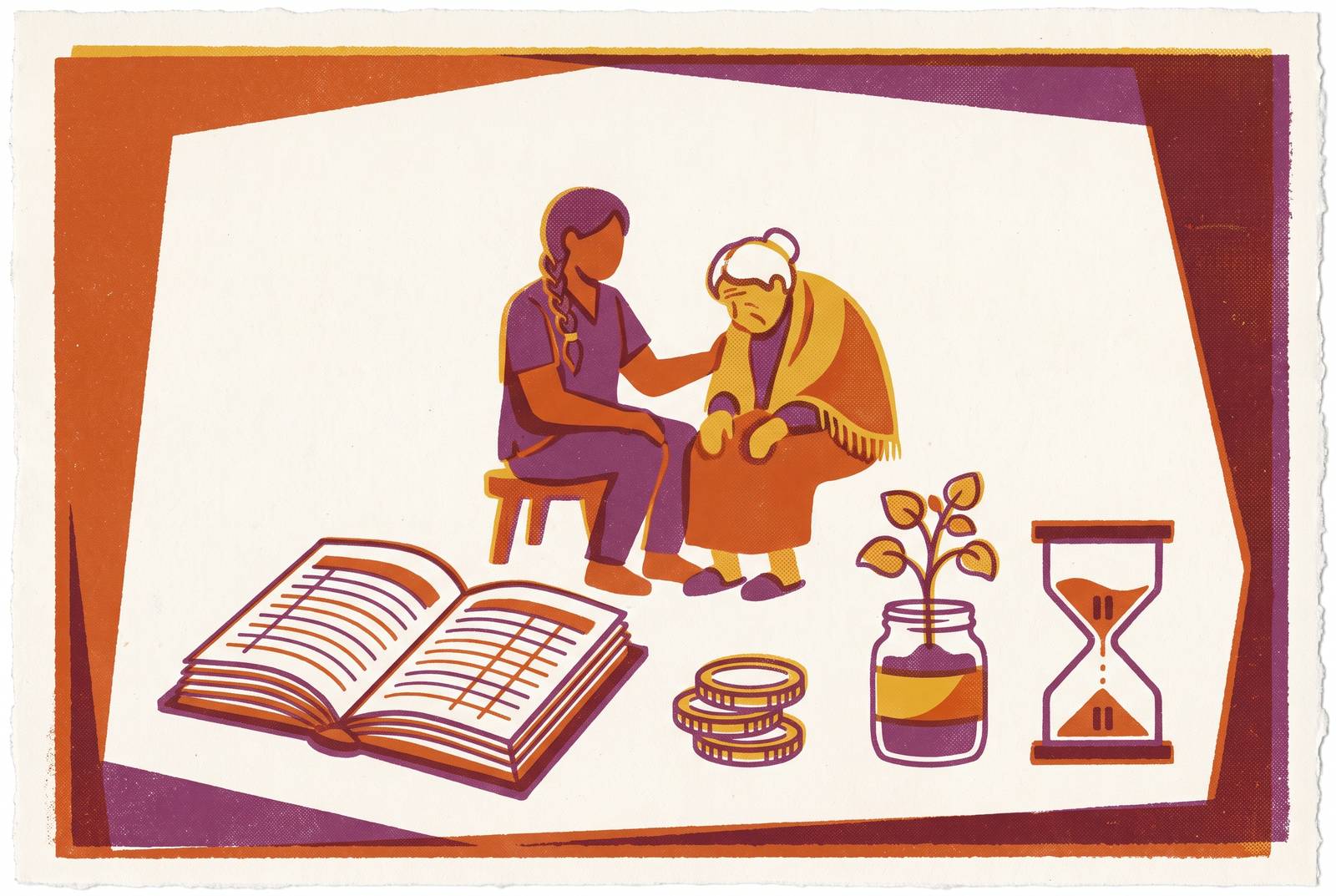
Financial planning for family caregivers has to grapple with a strange asymmetry: the labor is enormous, and the compensation is close to zero. This piece walks through what caregiving actually costs, in wages, retirement contributions, and Social Security credits, and then lays out a phase-by-phase way to rebuild after it. The goal isn't to talk anyone out of caregiving. It's to make sure the financial damage doesn't outlast the caregiving itself. Financial Planning for Caregivers Who Left the Workforce.
How caregiving pushes people out of the workforce, and who bears the cost
Start with the scope of it. An estimated 63 million Americans are family caregivers as of 2025, according to AARP and the National Alliance for Caregiving, which makes this a labor-force reality on the scale of a major demographic shift, not a private struggle confined to a few households. A Catalyst survey found that 42% of women who voluntarily quit their jobs pointed to caregiving responsibilities, including the cost of childcare, as the reason.
Why does caregiving push people out at this rate? Look at the hours. Women are five times more likely than men to say caring for others is why they left work. Caregiving leaves of absence now account for 6% of all leave claims, up from 2.4% in 2020, and those leaves last close to four times longer than they used to Care.com. That's not a temporary dip. That's a deepening exit pattern Care.com.
The damage isn't distributed evenly. A survey found that 37% of women who exited worked somewhere with no flexibility, compared with 22% of those who stayed Catalyst. Lower-wage, hourly workers get squeezed hardest, because they're the ones least likely to have the scheduling leverage to reduce hours instead of quitting entirely. The median caregiver age is around 50, which lands squarely in peak earning and peak retirement-saving years. That timing is what makes the rest of this article necessary. More than 455,000 women left the U.S. workforce between January and August 2025 alone, per Catalyst. Hours of care range from 27 to 40 per week, and the sheer time load makes workforce participation structurally difficult Fidelity. Return-to-office pressure compounds the problem: the share of Fortune 500 companies requiring full-time in-office work rose from 13% to 24% between 2024 and mid-2025, per Care.com, and women ages 25–44 with a child under five saw workforce participation drop nearly 3 percentage points after steady growth through early 2025.
The dollar value of unpaid caregiving that no paycheck captures
Put a number on it first, because the number is almost hard to believe. Family caregivers logged 49.5 billion hours of care in 2024, per the AARP Public Policy Institute. The estimated economic value of that labor exceeds the $967 billion private businesses spent on healthcare that year, and it tops the $932 billion spent on Medicaid AARP. Unpaid family caregiving is worth more, in dollar terms, than the country's entire Medicaid budget AARP.
The value of a single hour of that care rose from $16.59 to $20.41 in 2024, tracking the rising cost of home care and direct-care wages, with state-level rates running from $14.12 in Louisiana up to $27.05 in Washington Fidelity AARP. And virtually none of that value reaches the person actually doing the work. That gap between contribution and compensation isn't a footnote. It's the central problem this entire piece is trying to help caregivers navigate around.
What caregivers lose: income, savings, out-of-pocket costs, and employer benefits
Moving from the macro number to the household level makes the picture sharper. About 78% of caregivers report spending their own money on caregiving costs, averaging $7,242 a year; for caregivers who are also feeling strain at their paid job, that average jumps to $10,525. Separately, 45% report at least one concrete financial hit: drained savings, unpaid bills, or money borrowed to cover the gap Financial Planning for Family Caregivers.
The time commitment has been climbing too. Every one of those added hours is an hour not spent earning, advancing, or contributing to a retirement account.
Leaving a job also forfeits costs that don't appear on a bank statement but matter just as much. The employer 401(k) match disappears the day the paycheck stops. Health coverage often has to be replaced with COBRA, which runs around $650 a month for an individual, though ACA subsidies can offset that depending on income. Financial planners generally recommend modeling out health insurance costs before cutting hours, because staying near 30 hours a week can mean keeping full-time benefits, while falling below it can mean losing them entirely. Meanwhile, 28% of caregivers stop contributing to retirement altogether during their caregiving stretch, and 12% go further and pull money out of retirement accounts to cover care costs directly Caregiver Financial Planning Considerations.
So consider that $7,242 average out-of-pocket figure again. It's an average. It undercounts anyone who has also lost a paycheck, an employer match, and health coverage all at once. Stacking those together produces a real number that is a lot higher than any single average suggests, because that stacking effect, the compounding of loss on loss, appears in the retirement math next. Financial impacts documented in the AARP/National Alliance for Caregiving 2025 report include the following. Time devoted to caregiving has nearly tripled, from 9 hours weekly in 2020 to 23 hours in 2025, per InvestmentNews (the hours lost to paid work have grown proportionally). Hidden costs of leaving a job that caregivers often overlook, per Fidelity, include the following.
The retirement and lifetime earnings gap that caregiving creates
The numbers stop being about a single year and start being about a career. The Urban Institute found in 2025 that mothers who provide family care lose an average of $237,000 in lifetime earnings, counting lost wages, reduced Social Security benefits, and the retirement contributions that never got made. Even a single year off can leave a mark: a one-year gap equal to $5,000 in missed retirement contributions can compound into a loss of almost $79,000 over a career Pension Bee.
Why does one missed year do that much damage? Because Social Security benefits are calculated using the highest 35 years of earnings, so a caregiving year with zero income doesn't just fail to help, it actively drags the average down. There's no going back and refiling that year. That mechanical fact is locked in. That mechanical fact is probably the single least understood part of caregiving's financial cost, because it means the damage isn't just "money not earned," it's a permanent downward adjustment to a formula that follows someone for the rest of their life.
An older but still widely cited figure from a 2011 MetLife study put the number even higher for women over 50 who left work to care for a parent: an average loss of $324,004 across wages, Social Security, and pensions. That number predates the newer Urban Institute analysis, so treat the $237,000 figure as the more current baseline, but the fact that both numbers are in six figures says something on its own. It isn't a rounding error. It's a structural outcome.
The confidence gap tracks right along with it. Just 63% of women feel confident about retiring comfortably, versus 75% of men, and 43% of women report having served as a caregiver at some point in their career, compared with 35% of men, according to the Transamerica Center for Retirement Studies. Compounding drives all of it: every missed contribution year doesn't just remove that year's dollars, it removes decades of growth on top of those dollars. A 5-year gap during prime earning years (ages 45–55) reduces lifetime earnings by $250,000–$500,000 when accounting for lost advancement and compound growth Caregiver Financial Planning Considerations.
Financial steps to take while still in the caregiving role
None of this means the financial picture is fixed in place the moment caregiving starts. The decisions made during caregiving affect the financial trajectory that follows it.
Start with an emergency fund, or protect the one already in place, aiming for three to six months of essential expenses, because caregiving throws off unpredictable costs that will otherwise get paid for out of retirement savings or new debt. Track caregiving-specific costs separately, co-pays, transportation, home modifications, in their own budget line, because the true size of the drain is invisible until it's written down.
Staying in the paid workforce in some form, even part-time, protects more than the paycheck suggests: modest earned income can preserve IRA eligibility and keep a foot inside employer benefit programs. That threshold isn't symbolic.
For a caregiver married to a working spouse, a spousal IRA is worth using. For 2026, the contribution limit is $7,500, with an additional $1,100 catch-up for those 50 and older, for a total of $8,600. Roth eligibility phases out for married couples filing jointly once joint income is between $242,000 and $252,000 for 2026. Anyone on a high-deductible health plan should also look at HSA contributions, which come with a triple tax advantage: contributions are deductible, growth is tax-free, and withdrawals for medical expenses are tax-free too. After age 65, an HSA functions essentially like a traditional IRA for any purpose at all.
Audit the care recipient's own resources before personal funds get tapped further. Medicaid eligibility rules and community spouse protections differ by state; California, for example, eliminated its Medi-Cal asset limit as of January 1, 2024, under AB 133, though the federal 60-month lookback on asset transfers still applies everywhere for long-term care eligibility. Veterans or surviving spouses may qualify for the VA's Aid & Attendance benefit, which can provide a meaningful monthly payment. Because these programs vary so much by state and situation, and because manually researching all of them is genuinely difficult, tools that help surface eligible benefits and walk someone through enrollment can turn theoretical eligibility into an actual, collected benefit. Remote or part-time roles may preserve full-time benefits at roughly 30 hours per week. Working 29 versus 31 hours per week can mean keeping or losing health coverage.
Rebuilding retirement savings after returning to the workforce
One might argue the damage described above sounds permanent. It isn't, not entirely. Caregiving itself is usually temporary, averaging around 4.5 years, but the financial hole only stays temporary if there's a deliberate plan to climb back out of it.
Catch-up contributions are the sharpest tool available the moment someone returns to paid work. The standard 401(k) limit for 2026 is $24,500. At age 50 or older, an additional $8,000 catch-up brings the total to $32,500. On the IRA side, the 50-and-older catch-up adds $1,100 on top of the $7,500 base limit for 2026.
The gender gap this all sits on top of is already wide before caregiving even enters the picture. Vanguard's 2025 How America Saves report puts the average 401(k) balance at $126,971 for women versus $171,859 for men, across all ages. Caregiving years widen that gap further. The catch-up window matters so much once someone is back earning.
Social Security deserves its own look too. Delaying a claim past full retirement age earns credits that can partially offset the drag from zero-income caregiving years inside that 35-year calculation, so it's worth modeling different claiming ages before locking anything in. And because the mechanics here, Social Security gaps, catch-up contribution windows, and Medicaid lookback periods, require coordinated planning rather than generic retirement advice, working with a financial planner who specifically understands caregiving's financial mechanics tends to produce a very different plan.
Two bills in Congress that would change the rules for caregiver retirement savings
Two bipartisan bills introduced in both the House and Senate in April 2026 would change some of this math directly, though neither is law yet.
The first, the Improving Retirement Security for Family Caregivers Act (S. 8274 in the House), would let qualifying caregivers contribute up to the annual Roth IRA maximum even if their actual earned income is lower than that Fidelity. To qualify, a caregiver needs to provide 500 or more hours of caregiving in a year while working fewer than 500 paid hours, and the bill defines a family caregiver broadly: an unpaid family member, a foster parent, or another unpaid adult who is unemployed or significantly underemployed Fidelity. Paul Richman of the Insured Retirement Institute described it as similar in spirit to a spousal IRA, but broader and more flexible, especially for caregivers who don't fit neatly into the rules that already exist. That framing matters: a spousal IRA only works if there's a working spouse to attach it to. This bill doesn't require one.
The second, the Catching Up Family Caregivers Act, would let caregivers of any age, not just those 50 and older, make catch-up contributions to workplace plans like 401(k)s. Under current law, that standard $24,500 limit for 2026 comes with catch-up contributions locked behind the age-50 threshold.
Both bills sit in committee as of April 2026, so neither should be counted on yet, but both are worth tracking. The need behind them isn't shrinking. Under SECURE 2.0, ages 60–63 have a catch-up limit that rises to $11,250, for a total of $35,750, which is the window most returning caregivers will be in AARP. The qualification thresholds require documented hours, 500 hours of caregiving, under 500 hours of paid work, so start tracking caregiving hours now, regardless of whether the bills become law. Context: the U.S. Population 65 and older reached 61.2 million in 2024, up 13% from 54.2 million in 2020, per the Census Bureau, and demand for family caregiving will grow, making legislative solutions more urgent over time.
How to sequence financial recovery across the caregiving phases
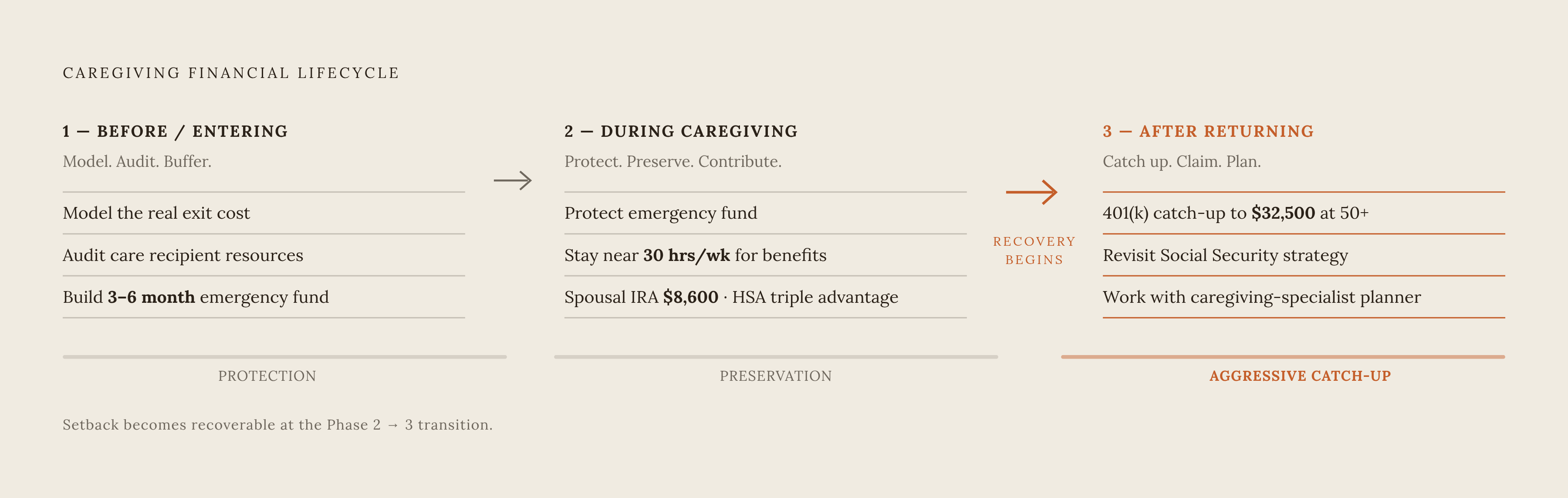
Everything above resolves into three phases: before or entering caregiving, during it, and after returning to paid work, and each phase calls for a different set of priorities.
Before stepping back from work, the job is to model the real cost of the exit. During caregiving, the priorities shift toward protection: keep the emergency fund intact, keep any paid work arrangement that preserves benefits eligibility, and use every available account, spousal IRA, HSA, to keep some form of savings moving even at a reduced pace. After returning, the priority flips again, toward aggressive catch-up: maxing out the higher contribution limits available at 50 and beyond, revisiting the Social Security claiming strategy, and bringing in a planner who treats the caregiving gap as a specific, model-able problem rather than a vague setback to work around eventually.
None of these phases erase what caregiving costs. But the gap between "permanent damage" and "recoverable setback" comes down almost entirely to whether someone treats each phase deliberately, with the right tool at the right moment, instead of only reacting to the financial hit after it's already compounded for a decade.
Sources
- Life events | Hidden-costs-of-caregiving | Fidelity
- Caregiver Financial Planning Considerations
- Financial Planning for Family Caregivers
- The workforce shift employers can’t ignore: Caregiving pressures and the Great Exit | CareBenefits by Care.com
- Caregiving pressures top factor pushing women out of the workforce, Catalyst finds
- Caregiving in the US 2025
- Family Caregivers Account for $1 Trillion in Essential Care
- How Caregiving Affects Retirement | PensionBee (US)