Dealing With Dementia-Related Aggression Toward Family Members
Recognizing dementia aggression as neurological damage, not malice, opens the path to safer care.
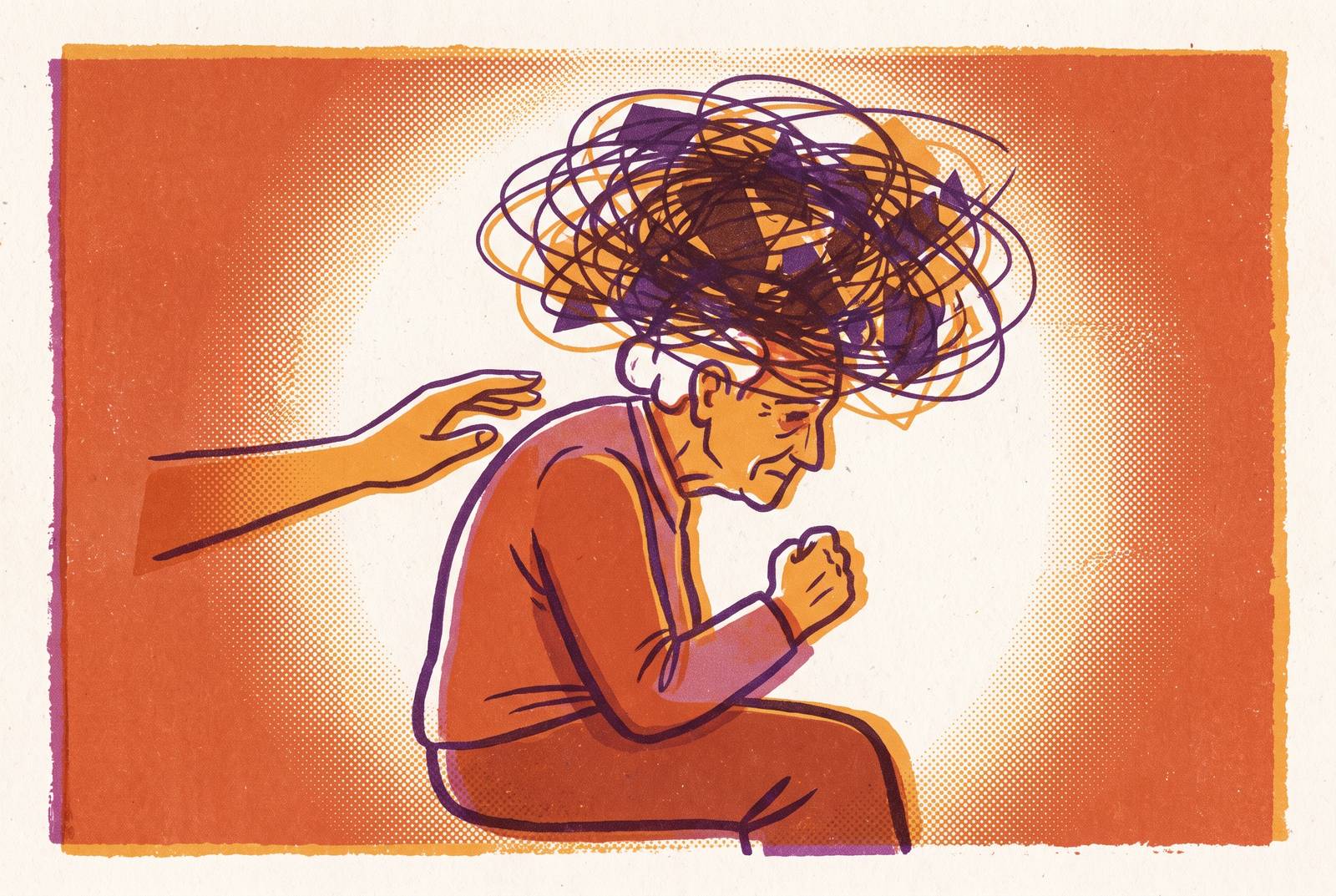
Dementia-related aggression toward family members is a neurological symptom. That distinction is the foundation for reducing harm, but understanding alone cannot make caregiving safe. Responding well also requires attention to triggers, clear safety boundaries, and structured support that protects both the person with dementia and the family member caring for them.
Why dementia aggression is a neurological symptom, not a behavioral choice
Being hit, screamed at, or threatened by a family member can be frightening and emotionally devastating. Yet dementia changes the brain systems that regulate emotion and communication, so the outburst is not evidence of malice or a deliberate rejection of the relationship. Damage to the frontal lobes and limbic system can weaken emotional control while making distress harder to express in words. Verbal or physical aggression may be the only way the person has left to show that something feels wrong.
The UW ECHO-Dementia session of March 14, 2025 described associations between agitation and aggression and measurable brain changes, including atrophy, changes in white matter integrity, and altered cerebral blood flow. Frontotemporal dementia can cause inappropriate comments or rude reactions early on because it damages the areas that control behavior and personality, while aggression in Alzheimer's disease usually comes later with confusion or delusions. The ECHO-Dementia session also described early agitation and aggression as signs of a poorer prognosis and more danger for caregivers, so recognizing them helps people see the risks as well as feel reassured.
What actually triggers an episode — the modifiable layer beneath the neurology
If the brain damage cannot be reversed, what can change? The things that trigger an episode can often be changed. After an episode, the useful question is what discomfort, confusion, or perceived threat preceded it. Pain and illness need close attention because someone who cannot say what hurts may show it through aggression. Infections such as urinary tract infections can cause delirium, so a GP should be consulted whenever aggression escalates without an obvious cause.
Loud noise, clutter, bright lighting, crowded spaces, or a disrupted routine can create confusion and fear. Hunger, dehydration, and fatigue can add to that distress, and even mild dehydration can affect cognition and mood. Dressing and bathing are frequent flashpoints because the person may not understand the task or may feel exposed and threatened.
Perception can also change the meaning of an otherwise familiar encounter. Hallucinations and delusions, particularly common in Lewy body dementia, may make a trusted carer seem like a threatening stranger. What looks like aggression from outside the person's experience may be terror within it. Medication side effects can further increase confusion or restlessness, which makes regular medication review another part of understanding triggers. The practical task is to distinguish the underlying neurological vulnerability from the conditions that can be reduced.
How common this is — and why it stays hidden
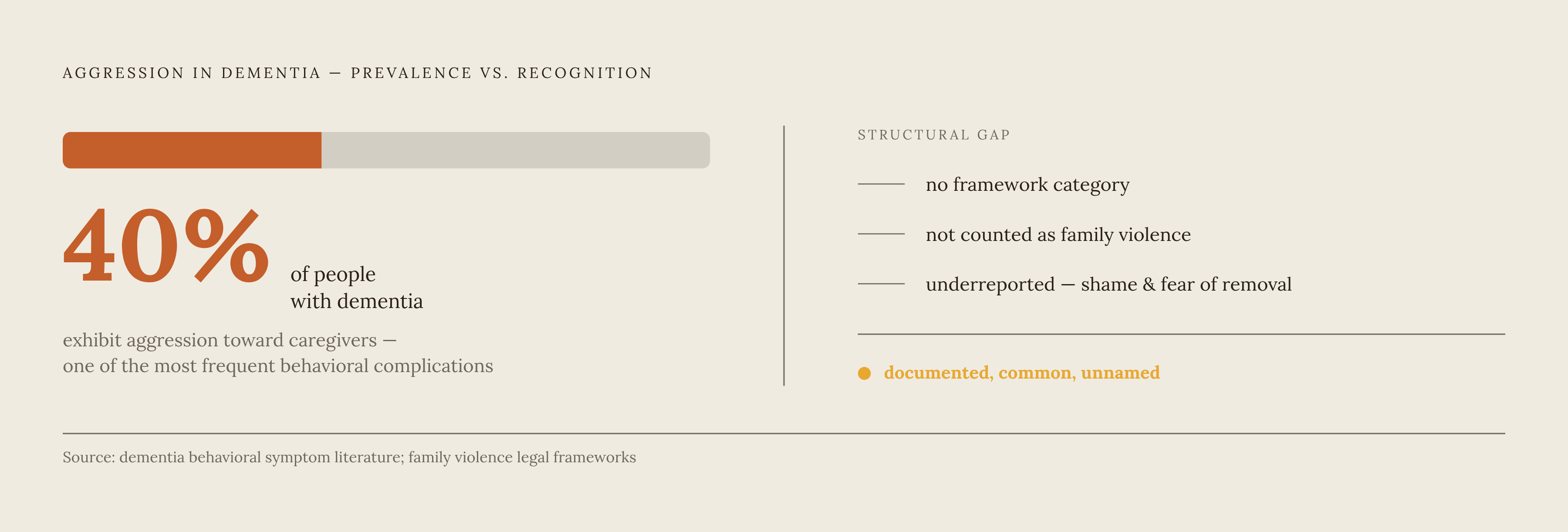
Approximately 40% of people with dementia exhibit aggression. For a family member who has kept an incident secret, recognizing that this is a documented problem can bring relief. It means the experience is not unique, and it belongs within conversations about dementia care. Aggression and agitation are among the most frequent and disruptive behavioral complications of cognitive decline. They add to the burden on caregivers, raise the cost of care, and increase the risk that the person will move into residential care too soon.
Yet frequency does not translate into visibility. The ECHO-Dementia session of March 14, 2025 identified a gap in family violence frameworks, which have no recognized category covering violence directed at family caregivers by a person with dementia. Research on family caregiving has also lagged behind research in formal care settings. Within families, shame, guilt, embarrassment, and fear that disclosure will lead to the person's removal from their care can keep incidents unspoken. Hidden experiences are difficult to measure and cannot readily become the basis for support.
The bidirectional dynamic — how caregiver stress can become caregiver harm
Research identifies harm within dementia caregiving as a systemic pattern under strain. A 2025 study in the Journal of Elder Abuse and Neglect found that behavioral symptoms in people receiving care significantly predicted abusive behavior by their care partners. Care partner depressive symptoms significantly mediated that relationship, pointing to depression as a pathway. Most participants in that study reported at least one abusive behavior toward the person they cared for. That finding warrants attention, but it does not establish that most caregivers in general are abusers.
A 2025 JAMA Network Open cohort study found that on days when caregivers used alcohol, they were more likely to be physically aggressive or neglectful that same day. A 2024 University of Texas study found that men more often engaged in neglect and physical aggression, and that the risks differed for younger men and older women. Caregivers also reported neglectful responses to physical aggression by the person with dementia, showing how harm can run in both directions. The actionable implication is to screen caregivers for depression and connect them with treatment and support, because addressing that pathway protects the person receiving care as well as the caregiver.
How to respond safely in the moment an episode happens
During an episode, the immediate goal is safety. Keep your voice gentle, your body language relaxed, and your movements slow. Stepping back gives the person space instead of pressing ahead with the task that triggered the reaction. Allow time for emotions to settle. If there is immediate physical danger to you, leave the room and call for help, because physical safety is not abandonment.
Remove sharp or heavy objects from the immediate environment and move them out of reach. Do not argue, try to prove the person wrong, or attempt to physically restrain them. Logical correction is unlikely to be processed in that moment and can increase distress. Use short, simple sentences and keep your voice calm and reassuring. If words are not helping, try gentle music, a familiar object, or sitting quietly nearby.
These responses address fear and distress rather than treating the episode as a dispute that can be won. A tense or loud response can reinforce the threat the person already perceives. Once the episode passes, the person may remember little or nothing of it. That loss of memory is neurological. Recrimination can trigger another episode, so it is not a useful way to seek acknowledgment or prevent recurrence.
Non-pharmacological strategies as the established first line of ongoing management
Between episodes, the established first line is non-pharmacological management, including individualized behavioral strategies, environmental adaptations, structured routines, and caregiver education. NICE guidance (NG97) recommends psychological and behavioral strategies before medication is considered. The underlying logic is to reduce distress before it escalates. A predictable daily structure and a calm, familiar environment remove sources of confusion and anxiety. Attention to unmet needs such as pain, hunger, loneliness, and boredom makes this approach specific to the person.
Caregiver education matters because the interpretation of an outburst shapes the response. Someone who understands aggression as a neurological symptom can respond to distress. But how well can these approaches work when a caregiver has no relief? A 2025 UTHealth Houston study found that 70–91% of caregivers reported using nonpharmacological strategies as their first response, yet aggression, inappropriate behaviors, and safety-related behaviors were most likely to overwhelm those strategies. At that point, caregivers sometimes turned to medication and sometimes to neglect.
This limit shows that effective behavioral and environmental strategies still need conditions in which they can be used. Unsupported family caregivers face sustained, unrelieved exposure that differs from professional work in formal settings.
When medication enters the picture and what the evidence actually says
Medication has a role, but the evidence supports a narrower claim than a general solution to dementia-related aggression. The FDA approved Rexulti (brexpiprazole), developed by Otsuka and Lundbeck, on May 10, 2023, specifically for agitation associated with dementia due to Alzheimer's disease. It was the first FDA-approved treatment for that indication. This was a meaningful regulatory milestone, but the indication does not encompass every behavioral symptom or every type of dementia. The distinction matters because aggression has different causes and forms.
Three Phase 3 clinical trials found brexpiprazole 2 to 3 mg/day effective and well-tolerated for agitation in Alzheimer's dementia, but the effect sizes were small. The FDA labeling carries a black box warning that antipsychotics have been associated with an increased risk of death in patients with dementia-related psychosis. Caregivers and prescribers need to weigh that warning explicitly against the potential benefit. Asking about medication is therefore a question of informed care.
Prescribed drugs can themselves make confusion, restlessness, or aggression worse, so medication assessment also needs to look for these effects. Periodic reassessment matters both for drugs used to manage symptoms and for drugs prescribed for other conditions. A multispecialty advisory panel's 2025 practitioner's guide in Postgraduate Medicine emphasized communication between family caregivers, primary care, and specialists across care transitions. That communication supports the detection, management, and prevention of escalating agitation. Medication is most accurately understood as a tool within that wider clinical partnership.
What structured support looks like — and how caregivers find it
For care to last, caregivers need help with the conditions they live and work in as well as advice on how to give care. The UW Memory and Brain Wellness Center's ECHO-Dementia program offers one model of recognizing unpaid home caregivers as a population with distinct needs. Its March 14, 2025 session covered the views of family caregivers and law enforcement and featured a project in which clinicians and law enforcement work directly together on dementia crisis intervention across Washington State. This gives families a system in which services work together to respond to a crisis, with help beyond what families can do alone. It also recognizes that danger at home calls for more than an explanation of the disease.
Other structures focus on ongoing care and access to established programs. The CMS Guiding an Improved Dementia Experience (GUIDE) Model, launched in 2024, is a payment demonstration project that aims to support dementia care programs. Health systems taking part are adding support for caregivers to their structured dementia care. The Best Programs for Caregiving (BPC) online database has a free directory of evidence-based programs for people who care for family members and friends. Caregivers, community-based organizations, and healthcare providers can use it to find programs that have been shown to help.
Financial support is another concrete part of this picture. Many family caregivers do not know they may be able to get paid through publicly funded programs that pay family members to give care. Benefit discovery can help reduce financial strain that compounds burnout, and an AI-guided benefit discovery and enrollment tool can help families identify programs when they do not know where to start. Steady care from a trained home carer or a structured day program can also give caregivers a break while keeping a familiar routine.
Sources
- Aggressive & Violent Behavior in the Context of Dementia: The Family Caregiver & Law Enforcement Perspectives - Memory and Brain Wellness Center
- SLIDESMANIA.COM Aggressive & Violent Behavior in the Context of Dementia:
- Alcohol Use and Abusive or Neglectful Behaviors Among Family Caregivers of Patients With Dementia
- GENDER DIFFERENCES IN TYPES OF AGGRESSION USED AMONG DEMENTIA FAMILY CAREGIVERS
- Behavioral symptoms in patients with dementia are associated with care partner abusive behaviors - PMC