Senior Farmers Market Nutrition Program Access and Eligibility
How navigating varied state rules determines who actually receives fresh produce vouchers.
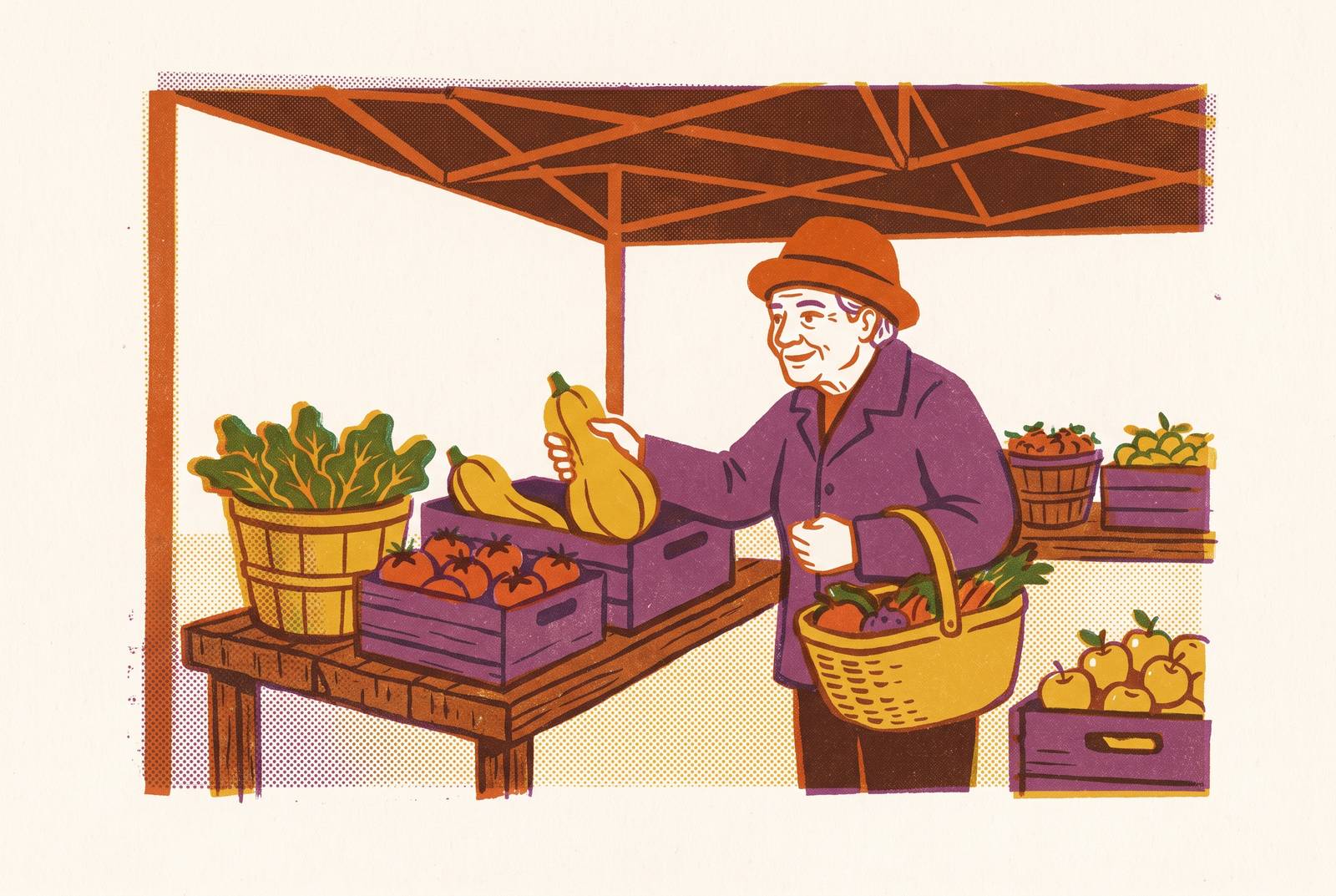
The Senior Farmers Market Nutrition Program, often called simply "farmers market vouchers," puts fresh produce within reach for more than 750,000 low-income older adults each year. But reaching those benefits requires clearing a set of hurdles that vary sharply by state, county, and season. Eligibility is the easy part. The difficult part is navigating a patchwork of local rules, tight windows, and first-come, first-served distribution before the vouchers run out.
What the Senior Farmers Market Nutrition Program actually is and does
The Senior Farmers Market Nutrition Program (SFMNP) is a federally funded, state-administered produce voucher program. It grants low-income older adults purchasing power at farmers markets, roadside stands, and community-supported agriculture programs that have been certified as authorized outlets. The vouchers buy fresh fruits, fresh vegetables, fresh herbs, and honey. They do not buy meat, poultry, dairy, eggs, canned or jarred produce, or baked goods, and the benefit is not cash, nor is it a general grocery supplement. It is a targeted tool for fresh, local food access.
Funding flows through the Farm Bill. The USDA's Food and Nutrition Service awards grants to authorized state agencies, which include State Councils on Aging, State Departments of Agriculture, and similar bodies. Those agencies run the program locally: eligibility certification, voucher distribution, and vendor enrollment all sit at the state and local level. A March 2026 Federal Register filing recorded 56 SFMNP state agencies, 1,113 local agencies, 838,410 participants, and 18,991 authorized outlets across the country. Seventy percent of those local agencies are operated by government entities and thirty percent by non-profits. Ninety percent of federal funds support food costs. The remaining ten percent covers administration.
Recognizing both names early matters. A senior who has heard of "farmers market vouchers" but not the SFMNP acronym is still describing the same program. Both refer to the same small, seasonal instrument: a coupon or card that converts fresh produce into something a fixed income can afford.
Who qualifies: the federal baseline for age and income
The federal eligibility test is simple in principle. An applicant must be at least 60 years old on the day of application, with no upper age limit, and must have household income at or below 185 percent of the federal poverty guidelines. These two criteria can usually be checked in under a minute. The complexity enters later, in the state-level implementation. At the federal baseline, the test is binary: age and income, nothing more.
The income ceiling effective July 1, 2026 through June 30, 2027 follows a monthly dollar threshold for a one-person household that rises with each additional member, per the Riverside County Office on Aging's 2026 SFMNP income eligibility chart. Alaska and Hawaii carry slightly higher income ceilings because their cost of living is higher. Household size, not location, is the primary variable most applicants need to check against their own circumstances.
For many applicants, there is a shortcut. The two programs remain separate, with separate administration, and receiving one does not block the other. A senior can use SFMNP vouchers and SNAP benefits together, stretching a food budget across both the farmers market and the grocery store.
Why meeting the eligibility requirements does not guarantee benefits
Meeting the age and income test gets an applicant into the line, not out of it. The SFMNP is not an entitlement program. Every eligible senior competes for a capped pool of vouchers distributed first-come, first-served, which means the practical question is not only whether one qualifies but whether one applies before the pool runs dry.
Hawaii illustrates the stakes plainly. Supplemental ARPA funds expired September 30, 2025, returning the program to its original budget level and reducing the number of older adults who could participate in the 2026 season. Ohio's Area Agency on Aging imposed a hard application deadline of May 22, 2026, specifically to document unmet need and advocate for more funding.
The implication is clear. The window between "program opens" and "slots fill" can be weeks, not months. Applying at the earliest possible date is functionally part of the eligibility equation. That is not a dramatic claim about administrative failure. It is the arithmetic of a capped, non-entitlement benefit. The program sets a buffet, and the buffet has a fixed number of plates.
How the application process actually varies from state to state
There is no single SFMNP application. The process, timeline, format, and distribution method are each set by the local administering agency, which means a senior's experience of applying depends almost entirely on where they live. The USDA's SFMNP state agency contact map is the starting point for finding the right office, but from there the applicant must contact the local agency directly. The variation is not a matter of minor paperwork differences. It is structural.
The Hawaiʻi Foodbank's 2026 program offered three application paths: an online application, which the agency recommended as the fastest, a paper application by mail, and a downloadable or printable form. Applicants who submitted an application the previous year, regardless of whether they received coupons, were mailed a new application automatically, but still had to submit a current-year form. The program ran April through October 31.
Montgomery County, Pennsylvania took a different approach through the Share Food Program. An email address was required to book, and those without an appointment were turned away. Valid photo ID was mandatory.
North Carolina's program operates on yet another model: summer-only, from July 1 to September 30, and explicitly not available in all counties. The 2026 season closed, with information for 2027 expected in late June of that year. A senior who received vouchers last season and assumes they will arrive again this season will likely receive nothing.
What benefit amounts look like across states and why they differ so much
The federal program sets a benefit floor, but actual voucher amounts vary widely across states and counties. Local agencies can supplement federal funds with state, local, or donor money, and many do. The general federal range sits at $20 to $50 per year depending on location, per NCOA's 2026 guide. That is a narrow band in dollar terms, but it encompasses a broad spectrum of purchasing power at a farmers market.
The named examples show how differently the same federal program can materialize. Montgomery County, Pennsylvania issued five vouchers of equal value, redeemable across the season. Riverside County, California loaded an EBT card at the higher end of the typical state range. A senior in one county might receive an electronic card, while a senior two states away receives paper checks worth half as much.
The USDA revises income eligibility guidelines each spring and encourages participating agencies to adopt them immediately, but each agency decides independently whether to change the dollar benefit amount. The income threshold and the benefit amount can therefore move independently of each other. The federal floor anchors the program, but it does not equalize it.
The structural gap between who the program is designed to help and who it reliably reaches
The first-come, first-served, non-entitlement design of SFMNP favors seniors with internet access, transportation, and awareness of the program. Those seniors are not necessarily the ones who most need fresh produce. The populations the program targets, older adults living near or below the poverty line, are often the least equipped to navigate a time-sensitive, locally varying application process. The program's architecture rewards administrative capability at the exact moment it should be compensating for its absence.
San Francisco's appointment-only model makes the barrier concrete. Booking requires an email address and an online scheduling system. Attendance requires a valid photo ID and a meaningful time commitment. Each of these is a genuine obstacle for the populations the program targets, and together they form a gauntlet that filters out some of the most food-insecure seniors in the city. Geographic exclusion compounds the problem. SFMNP is an optional program, and not every state participates. Within participating states, not every county has a local agency. North Carolina's program is explicitly unavailable in all counties, which means a rural senior in a non-participating county has no path to the benefit no matter how promptly they apply.
Even among seniors who receive vouchers, roughly one in seven issued vouchers go unredeemed nationally, per senior-meals.org. Practitioners attribute this to transportation barriers, unawareness of authorized vendors, physical inability to prepare produce, and seasonal market schedules that conflict with seniors' mobility. A voucher that is issued but never redeemed delivers no nutrition. Participating seniors' fruit and vegetable intake increased as a result.
One might argue that decentralization allows local agencies to tailor delivery to local conditions, and that is a valid point. But it does not explain why rural Appalachian counties with the highest need are excluded from the electronic system, or why appointment-only distribution in an urban area requires email access. The principle of local control is sound. The implementation, in too many places, has left the principle serving administrative convenience rather than the seniors the program exists to feed.
What the 2026 Farm Bill process means for program funding and vendor access
The 2026 Farm Bill proposals would hold SFMNP funding steady and modestly expand it. Through fiscal year 2026, the program receives a fixed level of annual mandatory funding from the Commodity Credit Corporation, and both House and Senate Farm Bill proposals reauthorize that level through fiscal year 2031, per a nonpartisan federal research body. The core funding is stable. The expansion arrives on the margins.
Both House and Senate bills propose adding tree nuts to the list of eligible foods. The vendor side carries more significance. Both bills would require the USDA to establish a streamlined, potentially unified application process for farmers and ranchers seeking authorization across SNAP, WIC, WIC FMNP, SFMNP, and GusNIP. That could meaningfully expand the number of authorized outlets without requiring additional appropriations, directly addressing the geographic access gaps that leave some counties without any place to spend a voucher.
The simultaneous restructuring of SNAP complicates the picture. Seniors losing SNAP benefits will increasingly rely on SFMNP, intensifying demand for a capped, non-entitlement program at the exact moment that ARPA-era supplemental funding has ended. The Farm Bill debate arrives, in other words, while the pressure on state SFMNP programs is already rising.
How to actually find and apply for the program in your state before slots fill
Because the program opens, fills, and closes on a locally determined schedule, and because a motivated, informed applicant has a genuine advantage over one who waits, the right sequence of steps is the practical difference between receiving benefits and being waitlisted. The process is not complicated, but it rewards persistence and early action. The first step is to confirm the program operates where you live. Not every state participates, and within participating states, not every county has a local agency. The USDA's SFMNP state agency contact map is the starting point. The second step is to find out when the local program opens. Application windows vary from January, when Alabama opened in 2026, to summer, when Riverside County distributed benefits August 4 through August 31. Contact the local agency directly rather than assuming a universal start date. The third step is to gather what may be needed. Most programs require age verification and either income documentation or proof of SNAP or CSFP participation. San Francisco requires a valid photo ID at the appointment. Montgomery County, Pennsylvania requires no ID and accepts self-declared information. Requirements vary.
The fourth step is to choose the fastest available application method. Hawaiʻi Foodbank explicitly recommends online application as the fastest way to secure a spot. Where an appointment system is used, as in San Francisco, book as early as the scheduling system opens. The fifth step is to know the redemption window. Benefit expiration dates vary: November 30, 2026 in Alabama, Pennsylvania, Riverside County, and San Francisco. October 31, 2026 in Hawaii. September 30, 2026 was the last issuance date in Pennsylvania. These are representative examples, not universal dates. The sixth step is to locate authorized vendors before benefits arrive, using the local agency's vendor map or list. Riverside County's authorized market list was updated as of July 27, 2026, and Hawaiʻi Foodbank maintains a vendor map on its SFMNP page.
Returning participants face one additional rule: re-apply every year. Alabama instructs returning participants to reuse their existing card's 16-digit number. Hawaii mails returning applicants a new application but still requires a current-year submission. The program rewards those who treat each season as a new application cycle, and punishes those who assume continuity where none exists.
Sources
- What Is the Seniors Farmers’ Market Nutrition Program? Eligibility, Benefits, and How to Apply
- Senior Farmers' Market Nutrition Program - Hawaiʻi Foodbank
- North Carolina Seniors Farmers' Market Nutrition Program
- 2026 Senior Farmers Market Nutrition Program application open through May 22 - Area Agency on Aging
- Senior Farmers' Market Nutrition Program
- Share Food Program