SFC Stipend Interaction With Social Security Benefits
Tax-free SFC stipends may still reduce Social Security benefits.

Structured Family Caregiving pays a daily stipend to a family member who lives with the person receiving care, funded through a state Medicaid home and community-based services waiver. That distinction matters immediately: the money comes from Medicaid, administered at the state level, while Social Security benefits (SSI, SSDI, and retirement) are administered federally by the Social Security Administration under separate statutes. The reason SFC stipends often arrive tax-free traces to IRS Notice 2014-7, which extended "difficulty of care" treatment, originally written for foster parents, to Medicaid waiver payments made to caregivers who share a home with the person they care for. Under Internal Revenue Code Section 131, that shared residence is what qualifies the payment for exclusion from federal gross income, so co-residence is the hinge on which the entire arrangement turns: it is the structural condition that makes SFC work and the same condition that earns the tax break. None of that, however, tells a caregiver what happens to their SSI payment, their SSDI eligibility, or their early retirement earnings test, because the IRS and the SSA operate under entirely different statutory frameworks, and a notice from one agency does not bind the other. The question that actually determines what happens to a caregiver's benefits is which Social Security program applies to them or to the person they care for, and how that specific program counts the stipend, a question the tax exemption does not answer and was never designed to.
SFC stipend income's effect on SSI payments and the asset limit most caregivers forget
Supplemental Security Income is need-based. It does not simply cut a recipient off once their income crosses some ceiling. Instead, SSA subtracts countable income from the federal benefit rate, so every dollar of countable SFC stipend income chips away at the monthly SSI payment. In some states, SFC stipends reach a level high enough to offset the entire SSI payment, and caregivers well below that point still feel the effect: above the earned-income exclusion, benefits fall by a dollar for every two dollars earned, so the reduction spreads across a wide range of incomes. That sliding scale is the part of the SSI interaction most people expect once they understand SSI is need-based. What catches far more caregivers off guard is the asset side of the same program. SSA caps countable resources at $2,000 for an individual, a figure fixed by statute that does not adjust for inflation, and SFC wages that simply sit uncollected and unspent in a checking account can push a recipient over that limit even in a month when their income alone would have kept them eligible. Earned income and accumulated savings are tracked under two different rules within the same program, and a caregiver can manage one carefully while tripping the other without realizing it. None of this is softened by Notice 2014-7. The IRS exclusion determines what counts as taxable income; it does not determine what SSA treats as countable income for SSI purposes, and SSA decides that question independently. Difficulty-of-care payments still have to be reported to SSA, and the agency's own guidance, including POMS SI 01320.175, shows that treatment of these payments can vary depending on how the state program is structured and how the payment is classified for deeming purposes. A caregiver who assumes a tax-free stipend is automatically benefit-neutral is operating on an assumption SSA never made. SSI's dual income and resource traps, monthly wages reducing benefits on one hand and accumulated savings disqualifying outright on the other, mean a caregiver should model the actual financial outcome before accepting an SFC stipend. Benefit eligibility and enrollment tools that calculate the net effect of earned income on a specific SSI case, rather than relying on the assumption that a tax exemption settles the matter, are the kind of check that catches this before a payment is reduced or a resource limit is crossed.
SSDI's Substantial Gainful Activity threshold and monthly SFC earnings
Social Security Disability Insurance runs on an entirely different logic than SSI. It is not need-based, it does not look at assets, and it does not shrink gradually as income rises. Eligibility turns on a single question: do monthly earnings cross the Substantial Gainful Activity threshold? Crossing it means SSA treats the recipient as demonstrating an ability to perform substantial work, with consequences that depend on where the recipient sits in the process, whether still applying, inside the nine-month Trial Work Period, or in the Extended Period of Eligibility that follows. For 2026, the non-blind SGA threshold is $1,690 per month, and SFC stipends in higher-paying states can reach or exceed that figure, so a caregiver drawing SSDI needs to track monthly earnings against that number the way an SSI recipient tracks income and assets against theirs. The mechanism is cleaner than SSI's, a single line rather than a sliding scale layered on top of a resource cap, but the same unresolved question from the SSI section reappears here in a different form. Notice 2014-7 removes income-tax liability from the stipend; it does not reclassify the payment as passive or unearned income for SSA's purposes, and whether an excluded payment counts as "earned income" for SGA is a question the exemption simply does not reach. An SSDI recipient who treats the tax-free status of the stipend as proof that it falls outside the SGA calculation, and earns above $1,690 a month anyway, risks a retroactive benefit suspension along with a demand for repayment. The assumption that Notice 2014-7 resolves the SGA question is a dangerous blind spot, and SSDI recipients who believe the exemption neutralizes the calculation are the ones most exposed to that retroactive risk; independent verification of how SSA will actually count the SFC earnings, separate from what the IRS says about taxability, is essential before enrollment, before a suspension notice arrives. Social Security retirement introduces a third framework entirely, and it turns out to be the one with the least agreement about how it applies.
The earnings test for early Social Security retirement recipients and SSA's disagreement over whether SFC stipends count toward it
Workers who claim Social Security retirement benefits before reaching full retirement age run into an earnings test that looks, on paper, similar to SGA but operates on its own schedule and its own thresholds. For 2026, SSA deducts a dollar of benefits for every two dollars earned above $24,480 for someone who will be under full retirement age for the entire year, and a gentler reduction, a dollar for every three dollars earned, for those who reach full retirement age sometime in 2026, above a higher threshold. Once a worker has actually reached full retirement age, the earnings test disappears entirely no matter how much they earn that year, and only the long-term credit question remains, addressed in the following section. For early claimants, though, the theoretical answer is that difficulty-of-care payments, being excluded from income under Notice 2014-7, should fall outside the earnings test. That is the clean, rule-based answer a tax preparer or program brochure would give. At least one caregiver had SSA determine that their Notice 2014-7-exempt stipend counted toward the earnings test anyway, and different SSA field offices have applied the rule in different ways for comparable cases. That is not a caregiver's confusion or a one-time clerical error. It points to a genuine ambiguity in how the agency implements the exclusion at the point of contact, one that produces different outcomes for caregivers in functionally identical situations depending on which office reviews the case. Every one of these thresholds moves together each year: SSA's 2026 COLA applied a 2.8 percent increase to benefits payable to tens of millions of beneficiaries starting in January 2026. The earnings-test limits, the SGA threshold, and the SSI figures all shift at once, creating an annual window in which a caregiver needs to recheck whether last year's safe stipend level still clears this year's limit. Related but separate from the earnings test, the Social Security Fairness Act of 2023, signed into law January 5, 2025, repealed the Government Pension Offset and the Windfall Elimination Provision for benefits payable after December 2023, a change documented in the Congressional Research Service's report. Caregivers who previously worked in noncovered employment alongside an SFC arrangement, and who were once subject to those offsets, are no longer reduced on that basis, which shifts the benefit arithmetic for some families even as the earnings-test ambiguity remains unresolved for others.
The long-term cost most caregivers never calculate: SFC stipends that are tax-exempt but generate no Social Security credits
Every section so far has dealt with near-term risk: a reduced monthly SSI check, a suspended SSDI benefit, a disputed earnings-test determination. There is a cost that unfolds over years rather than months, and it affects far more caregivers than the acute risks do, because it does not announce itself. Unpaid family caregiving builds no Social Security credits whatsoever, since the work generates no reported income and SSA has no record that it happened. An SFC stipend has the potential to change that, but only if the payment arrangement actually generates FICA tax contributions along the way. Whether it does comes down to how the stipend is paid. A caregiver employed through an agency that issues a W-2 typically pays Social Security and Medicare taxes even on income that Notice 2014-7 excludes from federal gross income, and those FICA contributions are what build credits toward future retirement benefits, though the outcome still depends on how the specific arrangement is structured, and excluded income can in some cases produce no FICA contribution. A caregiver paid a direct stipend with no W-2 employer in the picture typically generates no FICA and accumulates no credits. The employment model, not the tax treatment, decides the outcome: route the payment through an agency and FICA applies to otherwise-excludable income, building credits year over year; pay the stipend directly and the caregiver gains income today while giving up the retirement-security benefit that payroll tax contributions would have built. This is where Notice 2014-7's tax advantage runs hardest against the caregiver's own long-term interest, since the very provision that eliminates income tax liability today is, in a non-W-2 arrangement, the same mechanism that eliminates the FICA contribution that would have counted toward retirement decades later. Proposals to create a Social Security caregiver credit for unpaid care have surfaced repeatedly but have not been enacted, which leaves the employment-model decision, agency-based W-2 versus direct stipend, as the only lever currently available to a paid SFC caregiver who wants that income to count toward future benefits. Framed as a planning decision rather than a hidden penalty, it is one worth making with full knowledge of what each structure does and does not build.
Getting the enrollment picture right before the stipend starts
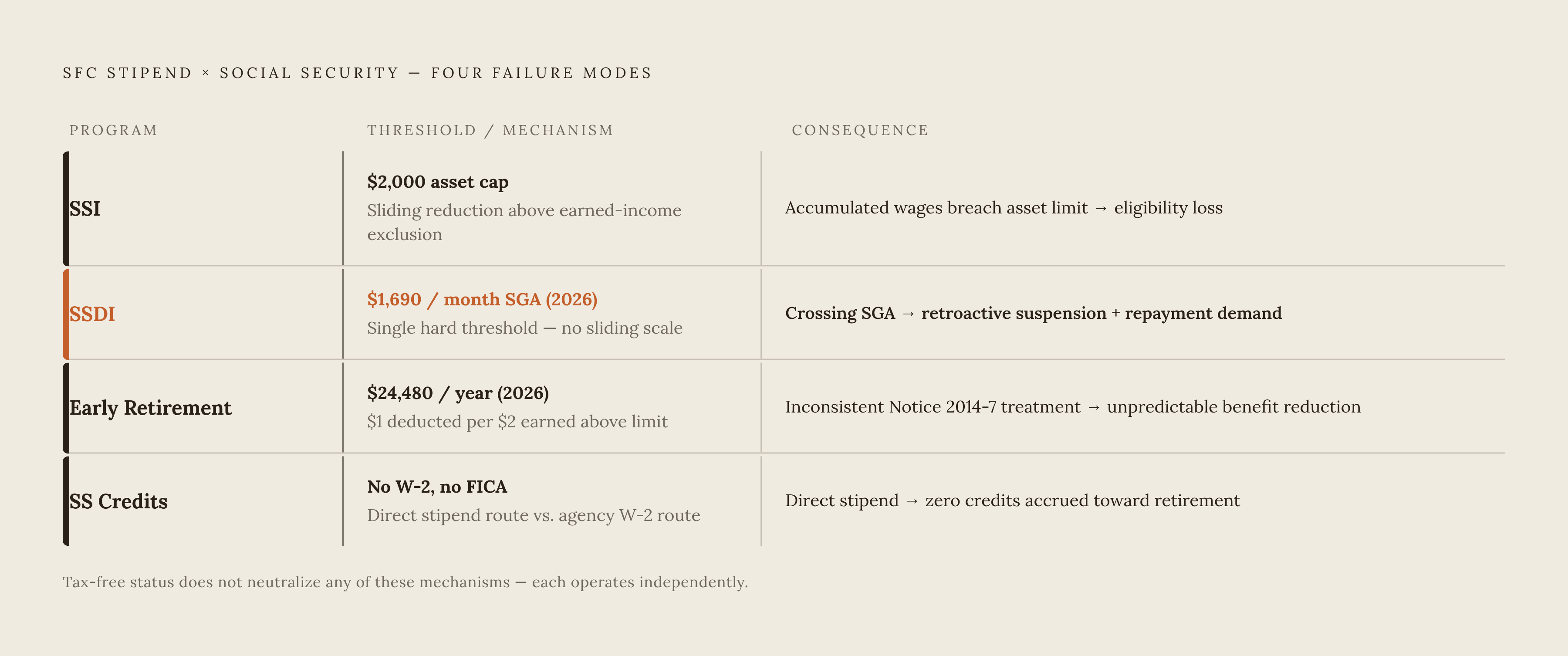
An SFC stipend does not interact with Social Security in one way. It interacts in at least four distinct ways, SSI, SSDI, early retirement, and the credit-building question that applies regardless of program, and getting the wrong one wrong carries a different consequence in each case: a reduced monthly SSI payment, a retroactively suspended SSDI benefit with repayment demanded, a disputed earnings-test reduction, or a decade of retirement credits that were never earned. The sequence that prevents these outcomes is straightforward to describe even if it is rarely followed in practice: identify which Social Security program the caregiver actually participates in, if any; determine if the SFC arrangement pays through a W-2 agency or as a direct stipend; confirm what the state program requires reporting to SSA; and only then assess, under that specific program's income-counting rules, whether the stipend creates a risk that needs active management. Skipping straight to "is this income tax-free?" answers only what Notice 2014-7 was written to answer, and program materials and tax preparers that stop there are working from half the map. The benefits system itself does not flag the gap. Families typically discover the Social Security side of the equation only after a payment has already been reduced, a benefit already suspended, or a resource limit already crossed, at which point the available remedies are narrower and the damage is often already done. Because the IRS and SSA apply fundamentally different rules to the same payment, determining which Social Security program actually applies before enrollment is a step that services built around Medicaid and Social Security eligibility interaction, Brevy among them, are designed to clarify upfront, so a caregiver understands the full picture before accepting a stipend. Brevy's AI-powered benefit discovery and enrollment support identifies which Social Security program a caregiver participates in, flags the income-counting rules that program applies to SFC income, and walks families through the reporting and enrollment steps that need to happen before the stipend begins. None of this changes what the stipend pays or what the tax code says about it. It changes whether the caregiver still has the Social Security benefit they were counting on a year, five years, or twenty years from now, which is the actual stake behind a question that, on its surface, looks like nothing more than paperwork.
Sources
- SSI Federal Payment Amounts for 2026
- Cost-of-Living Adjustment (COLA) Information
- 2026 Updates to Social Security Substantial Gainful Activity (SGA) Limits
- SSDI Trial Work Period Rules 2026: Work and Keep Benefits
- congress.gov
- Georgia Structured Family Caregiving (SFC) Guide (2026)
- Cost-of-Living Adjustment (COLA) Information