Long-Term Care Insurance Medical Disqualifiers Explained
Knowing which diagnoses trigger automatic denial helps you assess your eligibility before applying.

LTCI uses a strict medical underwriting process that disqualifies a substantial share of applicants, and if you understand which conditions trigger automatic denial, which produce a rated or modified approval, and which fall into a gray zone evaluated case-by-case, you get a realistic sense of where you stand before you ever submit paperwork. This matters because LTCI underwriting operates on a logic that differs sharply from the health coverage most people are used to, and that difference shapes everything that follows in the application process.
Long-term care insurance underwriting versus other health coverage
Standard health insurance cannot deny you coverage just because you have a pre-existing condition. LTCI has no such restriction, so an insurer can decline you on medical grounds alone. That single structural fact explains why LTCI underwriting feels so much more consequential than a trip to the health insurance marketplace: there is no guaranteed-issue backstop, no open enrollment period that forces an insurer to take an applicant regardless of history. An insurer evaluating an LTCI application is making a bet on whether the applicant will need paid care, and if the applicant already shows signs that care is imminent, the insurer's exposure is no longer a risk to be priced. It is closer to a certainty, and insurers do not price certainties the way they price risk.
The underwriting process reflects that logic in its structure. HBK Wealth's overview states that LTCI applications move through a health questionnaire, a review of medical records, and often a cognitive and activities-of-daily-living (ADL) assessment. You can pass the questionnaire and still fail the records review, and you can pass both and still fail a cognitive screen. You can look healthy on paper and answer every question honestly, but you can still get declined, because one layer of the process catches something the others missed. Keep that layered structure in mind through every section that follows, because it explains why so many different mechanisms, diagnosis, function, cognition, prescription history, lifestyle, can each independently sink an application. Age sits underneath all of them, quietly raising the odds that any given layer will catch something. Denial rates do not creep upward gradually as applicants get older; they climb steeply by decade.
How age amplifies every other underwriting risk factor
Age by itself is not listed as a disqualifying condition on any carrier's underwriting sheet. But age is the variable that makes every other disqualifier more likely to appear, and the data on denial rates makes that relationship concrete. That figure rises to nearly half of all applicants over 70. The conditions being screened for, cognitive decline, functional dependency, chronic disease complications, simply accumulate with time, so an underwriting process built to catch those conditions will catch more of them in an older applicant pool almost by mathematical necessity.
Carriers have built that reality into their own business rules. Most stop issuing traditional LTCI policies entirely somewhere between ages 75 and 80, and some carriers set the cutoff as early as 70. Once you cross that threshold, that carrier simply will not sell you the product, no matter how healthy you are. That creates a narrowing window that is easy to underestimate. It is the condition acquired during the years of waiting. The real cost of delay is a shrinking set of options, not a higher premium. That sets up the question the rest of this piece works through: which specific conditions, functional states, and histories are doing the disqualifying, and where does an applicant actually have room to influence the outcome?
Conditions that automatically disqualify an applicant regardless of severity or management
A defined set of diagnoses triggers automatic, insurer-wide denial from traditional LTCI, and severity or management does not change that. These are not judgment calls left to an underwriter's discretion. The diagnosis alone closes the application, regardless of how stable the applicant's condition appears or how well it has responded to treatment.
Neurological and cognitive conditions make up the largest share of this category. Alzheimer's disease and all forms of dementia are automatic declines, as are Parkinson's disease, ALS (Lou Gehrig's disease), multiple sclerosis, and schizophrenia, a set documented consistently by Hotaling Insurance and in Aines Carter's guide to LTCI eligibility. Advanced or metastatic cancer falls into the same category: an active or recent diagnosis, particularly within the past five to ten years, typically results in denial, though the exact window varies by cancer type and stage. Advanced heart disease is on that same list of automatic disqualifiers.
This specific set of conditions is screened for a clear reason. An applicant carrying any of these diagnoses should expect a traditional LTCI application to end in decline, because of what the diagnosis itself represents to an underwriter, regardless of severity.
Functional disqualifiers: when current dependency on care triggers denial
Diagnosis is not the only thing insurers screen for. They also decline you based on your present functional state, apart from any named condition, because if you need help with activities of daily living when you apply, that mirrors the exact benefit trigger the policy would eventually pay on. An insurer is not going to sell a policy that would need to start paying claims almost immediately.
The HBK Wealth guide confirms that needing assistance from another person for two or more activities of daily living, bathing, dressing, toileting, eating, or transferring, at the time of application is a near-certain decline.
There is an important exception for applicants who have recently had surgery. Supporting medical documentation from a physician, not a self-report of expected recovery, is what moves the application through this exception.
This category catches a group of applicants who often assume they are in the clear because their specific diagnosis never appeared on the automatic-decline list discussed in the previous section. The underwriter is asking what the applicant currently needs help doing, and the answer to that question can disqualify an application all by itself.
Cognitive screening as a separate underwriting gate, especially for applicants over 60
Cognitive screening operates as its own distinct hurdle in the underwriting process, separate from the diagnosis review and the functional assessment, and it can produce a decline even in applicants who carry no diagnosis of dementia or any other memory disorder.
Failing that screen tends to produce a decline. A carrier might tolerate a borderline result on a physical ADL assessment, but it is far less willing to extend the same flexibility on cognition, because getting that call wrong costs so much more.
Passing a records review and a health questionnaire says nothing about how that same applicant will perform on a cognitive interview, so carriers treat it as a separate gate rather than folding it into the broader health review.
Conditions evaluated case-by-case: what makes the difference between approval, rating, and denial
Not every chronic condition ends in an automatic decline. Many produce a spectrum of outcomes, approval at standard rates, approval with a premium surcharge, approval with an exclusion rider, or denial, depending on how well the condition is controlled and whether complications have developed. This is the gray zone where the largest share of applicants with ongoing health conditions land, and an applicant's own management of their health has the most direct bearing on the underwriting outcome here.
Diabetes offers the clearest illustration of how this works. Type 1 diabetes is a harder case across the board, but not an impossible one: some carriers will consider it given long-term, well-documented excellent control.
Cancer history follows a similar pattern. High blood pressure and mild asthma, by contrast, are generally not disqualifying at all when properly managed, and applicants with these conditions may qualify at standard rates with no surcharge.
What ties these examples together is a principle that runs through all case-by-case underwriting: stability and trajectory carry as much weight as the diagnosis itself. A condition that is well-managed, not progressing, and free of complications is evaluated differently than the same diagnosis accompanied by active deterioration, even though both applicants could check the same box on a health questionnaire. If one insurer declines you, that is not necessarily the final word, because another carrier may rate the same file and offer coverage.
How prescription history can override everything else in underwriting
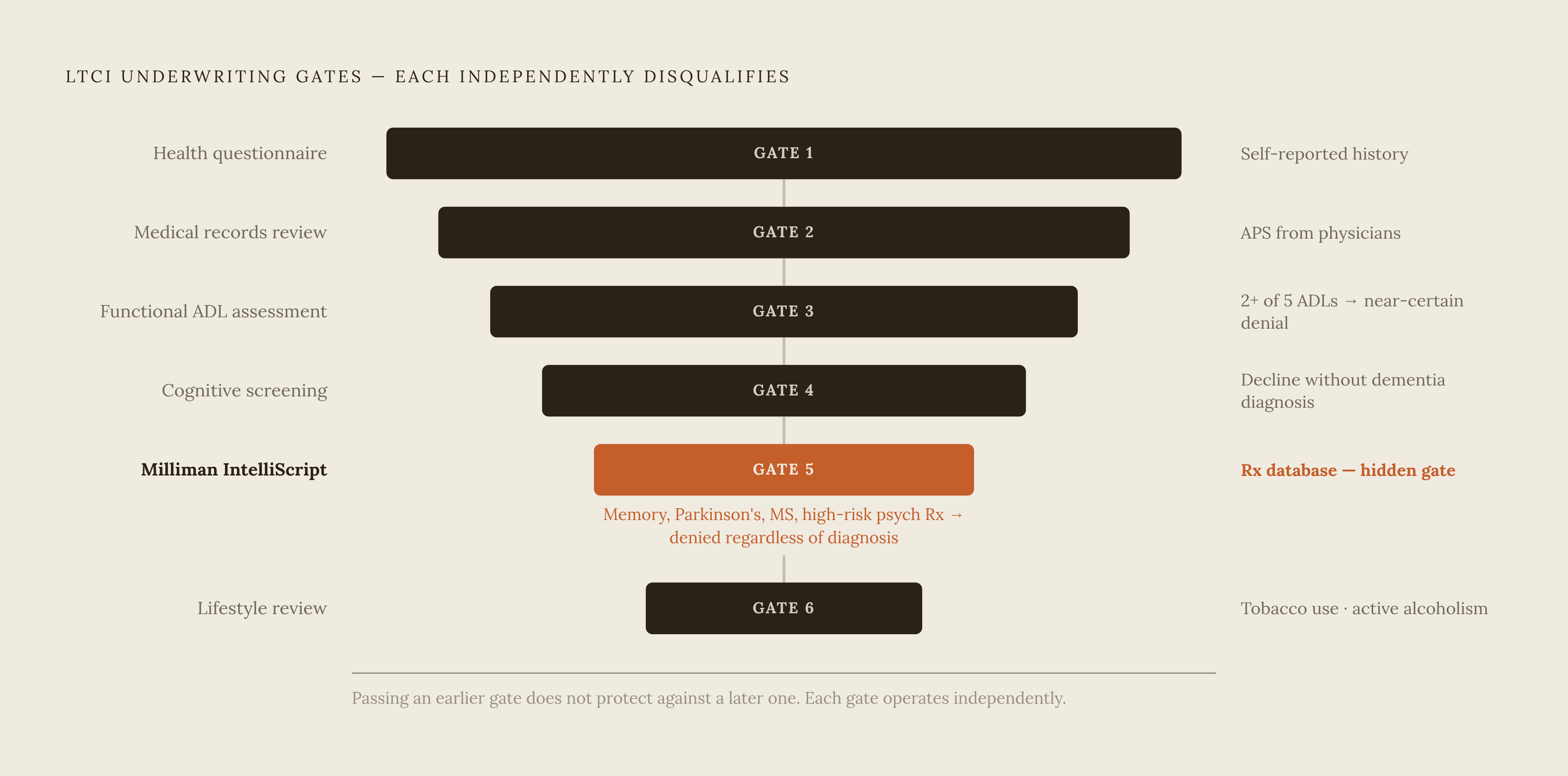
An applicant can clear the health questionnaire, pass the records review, and perform well on a cognitive interview, and still be declined because of a mechanism most applicants never think to ask about: the prescription database check. Insurers run these checks independently of everything discussed so far, and the results can override an otherwise clean application.
Milliman IntelliScript is the tool most commonly used for this purpose. Drugs prescribed for memory loss or dementia, Parkinson's disease, multiple sclerosis, or high-risk psychiatric conditions will typically produce a decline regardless of the actual reason the medication was prescribed, and each insurer maintains its own internal list of which drugs trigger that response.
This is where the mechanism becomes genuinely risky for applicants who have done nothing wrong. Refill patterns get scrutinized too: gaps in filling a prescribed chronic-disease medication read to underwriters as a sign the condition may not be well managed, even if the gap had an innocent explanation.
The practical response to all of this is straightforward. Getting a corrected record before the application goes in, rather than after a denial, can change the underwriting outcome.
Lifestyle factors that underwriters weigh: tobacco, alcohol, and documented substance history
Diagnosed medical conditions are not the only thing underwriters price into a decision. Tobacco use and a documented history of alcohol or substance abuse are independent underwriting factors, and they can produce a decline or a substantial premium increase even if your medical history is otherwise clean.
If you currently use tobacco, you typically face either outright denial or a much higher premium, and most insurers want you to show two to five years free of tobacco before they give you standard rates. Active alcoholism itself is listed as a straightforward disqualifier in HBK Wealth's underwriting guide.
Underwriters weigh lifestyle factors the same way they weigh the medical conditions discussed elsewhere in this piece. Substance use carries elevated risk of falls, liver disease, cardiovascular disease, and cognitive decline, each of which is a known driver of long-term care claims. Carriers treat tobacco and alcohol use as a measurable proxy for future care risk, the same way they treat an A1C reading or a cognitive screen result. Understanding the full taxonomy of disqualifiers, diagnosis-based, functional, cognitive, case-by-case, prescription-based, and lifestyle, only tells half the story. What an applicant can actually do with that knowledge before submitting an application matters just as much.
Steps applicants can take before applying to improve or clarify their position
Knowing where the disqualifiers sit changes what an applicant can do about them. If you take several concrete steps before an application goes in, you can meaningfully change the outcome, or at minimum avoid wasting time and generating adverse records that complicate a future attempt.
Applying earlier rather than later is the single highest-leverage move you can make. The window of insurability narrows every year, and what tends to close the door is not age itself but the conditions you pick up during your 60s. Most applicants submit in their 50s or early 60s for exactly this reason.
Requesting and reviewing an IntelliScript report before you apply lets you catch and dispute errors before they become the basis for a denial.
Actively managing any borderline condition improves how an application reads to an underwriter. Stable, well-controlled chronic conditions are evaluated more favorably than the same diagnosis accompanied by active complications, and documented stability, A1C records, regular physician visits, and an absence of hospitalizations, is evidence underwriters can act on directly.
You need to complete the application with full accuracy, more than many applicants realize. Carriers routinely cross-reference applications against pharmacy and medical databases, so you will not quietly get away with an inaccuracy.
Shopping across multiple carriers pays off if you fall into the gray zone discussed earlier. Underwriting standards for borderline conditions vary meaningfully by insurer, and a decline from one carrier may turn into a rated approval from another.
What traditional LTCI declines mean for long-term care planning
A decline from a traditional LTCI carrier is a signal to look at a different set of instruments, and applicants who understand what those alternatives actually offer are in a far stronger position than those who simply stop looking once the first denial letter arrives.
Hybrid long-term care products, which combine life insurance or an annuity with long-term care benefits, generally use more lenient underwriting than traditional standalone LTCI. The majority of new long-term care insurance policies sold in the United States today are hybrid products, a reflection of how many buyers simply cannot qualify for, or afford, traditional standalone coverage anymore.
If you are declined and cannot afford a hybrid product, Medicaid remains a real option, though it is a complicated one. Medicaid covers long-term care costs if you meet both financial and functional eligibility criteria, but the rules are dense, they vary substantially from state to state, and most families have no clear sense of which programs they qualify for or how to start the enrollment process. That gap between what exists and what families know how to access is where a traditional LTCI denial causes the most quiet damage, because so few people know where to find the options that remain. Finally, for families with assets to protect, annuities, trusts, and structured spend-down planning are worth a conversation with a financial planner in the financial planning context. If you know where to look, the benefits system does hold real money for families. Knowing where to look has always been the hardest part, and the right tools can finally make a difference there.