services that streamline Medicaid reimbursement for family caregivers of relatives
Most states pay family caregivers through Medicaid, but few families know how to access it.
Medicaid pays family caregivers in every state but one. Almost nobody knows it, because the mechanics never get explained anywhere a tired family would actually find them. Over 53 million Americans call themselves family caregivers now, and more than 34 million of them are looking after an adult 50 or older, usually while holding down a job or raising kids of their own on the side. The gap between "this benefit exists" and "families actually use it" comes down to information, not willingness. This piece walks through the mechanism itself, the obstacles sitting in front of it, and how to figure out where you actually stand in the process.
The legal hook underneath all of it is self-direction. Instead of Medicaid sending out a home health agency and whichever aide happens to be free that week, the program hands the care recipient, or their representative, the authority to choose, hire, and manage their own caregiver, including a relative. Once you understand that single design choice, the rest of the system starts falling into place on its own.
KFF's 2025 survey of state Medicaid programs, published in January 2026, found that every reporting state except Alaska allows self-direction in at least some circumstances, and every responding state pays family caregivers through at least one of its home care programs. Three federal authorities get you there: the HCBS State Plan Option, which casts the widest net; Community First Choice, also called 1915(k), for people who need an institutional level of care; and the Self-directed Personal Assistance Services State Plan Option. KFF's numbers also show that waiver programs for people with intellectual or developmental disabilities are where family caregiver payment shows up most often, which tracks once you think about how much of that care has fallen to parents and siblings by default rather than through any formal arrangement anyone set up on purpose.
There's a second layer to self-direction beyond the payment channel itself: a transfer of administrative weight onto a family that's usually already stretched to its limit. Forty-one states let participants set the actual pay rate for their caregiver, and 39 let them allocate their Medicaid budget across different authorized services, per KFF. Real control comes with real exposure, though. Payroll, tax withholding, timekeeping, and compliance all land on the participant as employer unless somebody else absorbs the load. A 2025 peer-reviewed study using 2021 Medicaid claims data found that over half of dually eligible beneficiaries 65 and older who receive personal care are already using self-direction, and that paying family members under these programs correlates with fewer Medicaid-financed inpatient days. The mechanism works, but whether an ordinary family can run it without help is a separate question, and it's the one the rest of this piece is really trying to answer.
The two payment models and what a caregiver can realistically earn
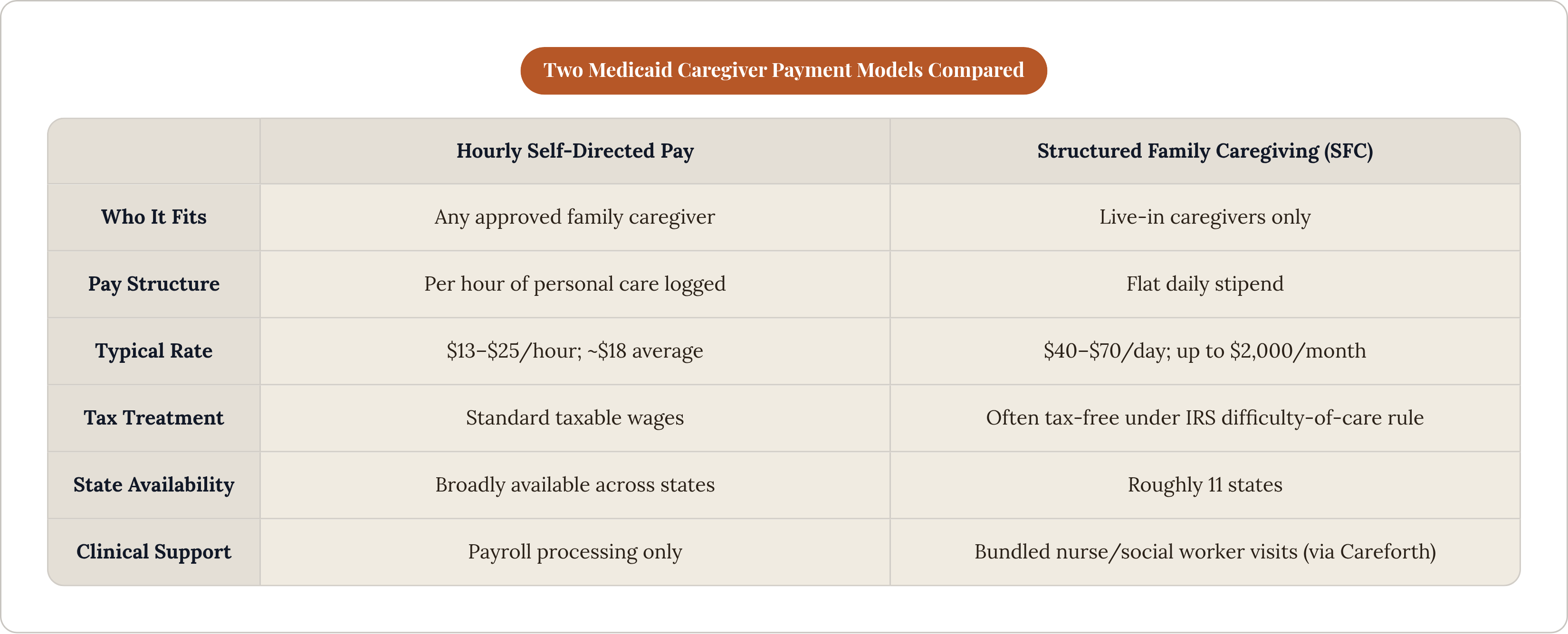
Clear eligibility and a second fork shows up almost immediately, because Medicaid doesn't run on one universal rate card. It pays through two structurally different models, and which one applies to your family changes the math considerably.
The first is hourly self-directed pay. The caregiver logs hours of personal care and gets paid per hour, the same way any home care aide would. Rates vary by state, generally $13 to $25 an hour. KFF puts the average Medicaid personal care rate around $18 an hour, which lines up reasonably well against the Bureau of Labor Statistics figure showing home health aides earned just under $17 an hour in 2024. California's IHSS program, one of the largest in the country with roughly 600,000 participants, pays $17 to $25 an hour depending on county. New York's CDPAP, processed through PPL, runs closer to $18 to $22.
The second model is Structured Family Caregiving, or SFC: a daily stipend for caregivers who live with the person they're caring for. It exists in about 11 states, pays $40 to $70 a day, and it's tax-free. Careforth, which specializes in this model, notes that eligible caregivers can earn up to $2,000 a month. FreedomCare's Georgia SFC program runs around $60 a day.
Tax treatment matters more than most families expect going in. Under the IRS difficulty-of-care rule, payments to a live-in caregiver can sometimes be excluded from taxable income entirely, though whether that applies to your household depends on specifics a tax professional needs to look at directly. A couple of guardrails are worth knowing before anyone builds a household budget around this income: some states flatly won't pay a spouse or the parent of a minor child, and the care recipient has to clear an income threshold to qualify at all, somewhere between $914 and $2,742 a month depending on the state. Families rarely check that number until somebody makes them.
What a fiscal intermediary does and why it's the linchpin of actually getting paid
The family clears eligibility, picks a program, the state approves hourly pay or a daily stipend. Now what happens? This is where the fiscal intermediary, sometimes called an F/EA (Fiscal/Employer Agent) or FMS provider (Financial Management Services), steps in. It's the piece of the whole system that decides whether the benefit on paper turns into an actual deposit in someone's checking account.
An FI sits between three parties: the Medicaid program, the care recipient acting as employer, and the caregiver acting as employee. It handles caregiver enrollment and background checks, processes timesheets, withholds and remits payroll taxes (Social Security, Medicare, income tax), and manages workers' comp and unemployment insurance. The participant keeps employer authority; they still decide who gets hired and what tasks get done. What they don't have to do anymore is file quarterly payroll tax forms on top of managing someone's medication schedule at 2am.
Medicaid pays the FI directly, and that's worth sitting with for a second, because it means the family isn't covering this layer out of pocket. Without an FI, a self-directing family is running a one-employee payroll operation from the kitchen table while also providing hands-on care, which is too much to ask of a household already stretched past its limit. The real bottleneck, more than eligibility itself, is usually figuring out which FI even operates in your state and how to get enrolled with them in the first place.
The major fiscal intermediary platforms operating nationally and what differentiates them
A handful of platforms have built national or near-national footprints doing this work, and they are not interchangeable. Picking one blind is a mistake worth avoiding.
Public Partnerships LLC, known as PPL, focuses entirely on self-directed care administration and supports roughly 50 self-direction programs across the country. The company has facilitated more than 500,000 participant and caregiver relationships and processed over $10 billion in goods and services payments. It doesn't assign caregivers or provide direct care; it's purely the administrative back end. As of April 1, 2025, PPL became the sole statewide fiscal intermediary for New York's CDPAP program, the largest consumer-directed program in the country. If you want a neutral processor while you run the caregiver relationship yourself, PPL is built for that.
FreedomCare operates as employer of record, handling payroll, taxes, and compliance, and it's often described as the largest platform by number of states served. Its standout feature is the InstaPay4Care app, which pays instantly after each shift instead of making caregivers wait out a normal payroll cycle. That matters a great deal for someone trying to cover groceries or gas between pay periods; it's the difference between managing and scrambling. FreedomCare also offers caregiver training and compliance support alongside the payroll function.
Careforth, formerly Seniorlink, specializes specifically in Structured Family Caregiving. It operates in 9 states as of late 2025, with Ohio marking its 11th expansion, and carries NCQA accreditation. What sets it apart is that the stipend comes bundled with monthly nurse and social worker visits, a dedicated coaching team, and a mobile app for tracking care. It's payroll processing plus clinical backup, which suits live-in caregivers looking for more than a paycheck.
Consumer Direct Care Network is another major FMS platform with a broad multi-state footprint, handling payroll, taxes, and compliance for consumer-directed programs at a scope similar to PPL's.
What all four have in common is where they stop. None of them touch eligibility or enrollment; they pick up the work once a care recipient is already enrolled in a self-directed Medicaid program. So what happens before that, when nobody's enrolled in anything yet?
The eligibility and enrollment navigation services that come before an FI can help
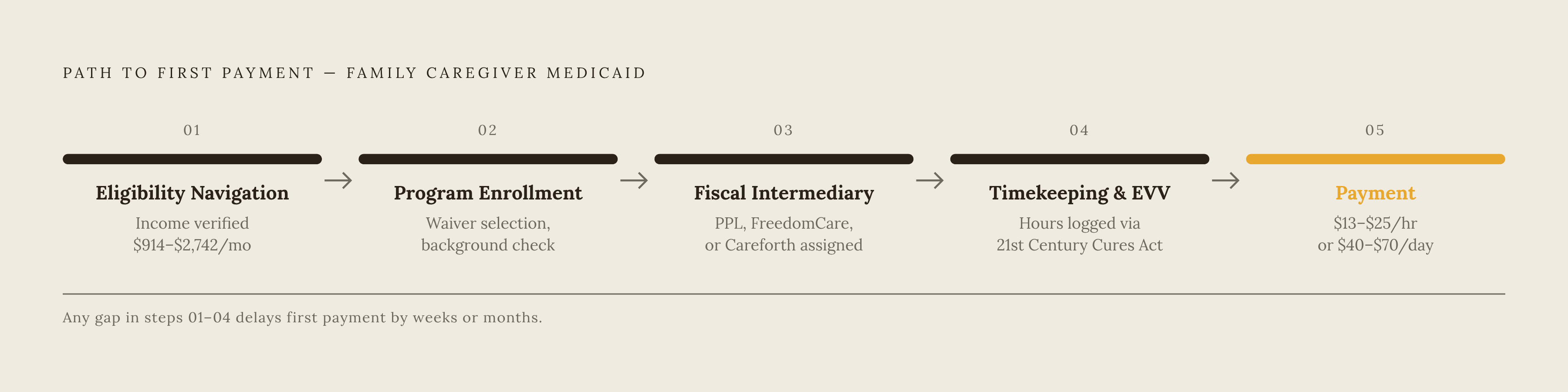
Before any fiscal intermediary can do a single thing, a family has to clear enrollment, and this is where a lot of caregivers quietly give up, often simply because the process is hard to get through alone.
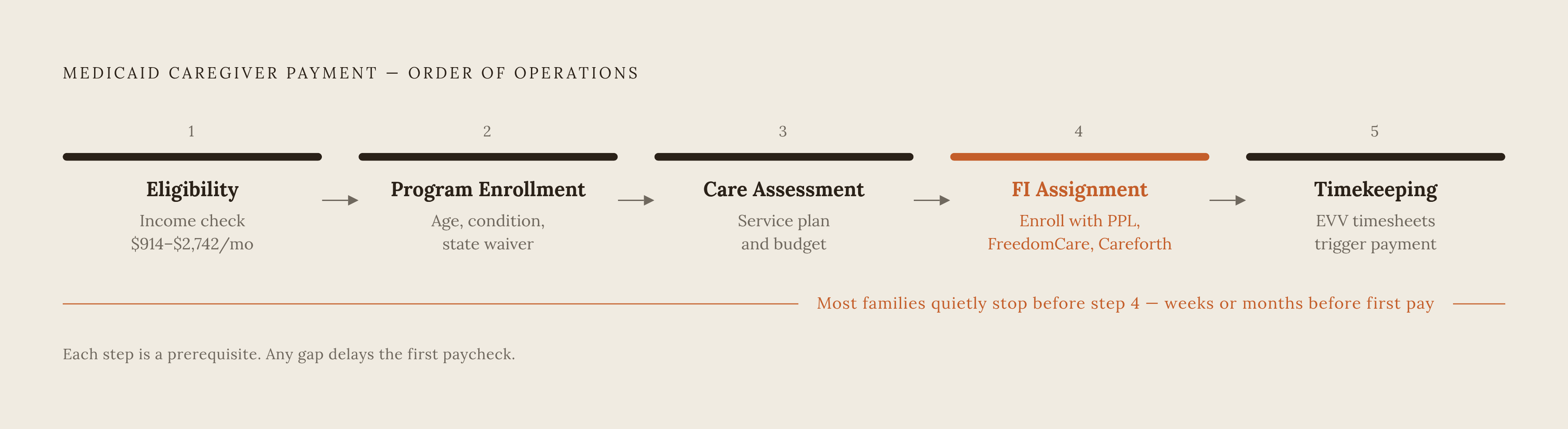
Step one is confirming the care recipient's Medicaid eligibility against income and asset limits, that $914 to $2,742 monthly range again, depending on the state. Step two is figuring out which specific program or waiver applies, given the recipient's age, condition, and state of residence, since names and structures shift from state to state with no real consistency. Then comes a care assessment to build a service plan and budget, plus caregiver-side requirements: background checks, basic training, sometimes formal provider certification.
Waiver programs often carry waiting lists, and a family that doesn't know to apply early can lose months, sometimes years, they didn't need to lose. State Medicaid agencies and local Area Agencies on Aging or ADRC offices are the official starting point, but they're frequently under-resourced for the one-on-one guidance a confused, exhausted family actually needs. That gap has opened room for Medicaid planning and benefits navigation services: nonprofit navigators, elder law attorneys who bill by the hour, and increasingly, digital tools built to answer the "where do I even start" question.
Some AI-powered benefits platforms operate in this exact gap, matching a family's situation against the Medicaid, caregiver compensation, and HCBS programs they likely qualify for, then walking them through the enrollment steps that follow. Some of these tools are free to use, and that matters more than it might sound like it should, because families chasing caregiver pay are frequently the same families who can't afford an elder law consultation to begin with. The order of operations runs: eligibility navigation, then program enrollment, then FI assignment, then timekeeping and payroll. Skip a step, or fumble one, and the first paycheck slides back by weeks, sometimes months.
Timekeeping and direct deposit tools that prevent payment gaps after enrollment
Getting enrolled feels like the finish line, but ongoing compliance is what actually decides whether a caregiver gets paid each period, and this is exactly the stage where otherwise well-run enrollments quietly stall out.
Most self-directed programs require verified timesheets on a set schedule, and a missed or incorrectly filed timesheet delays or cancels that period's payment outright. Layered on top is Electronic Visit Verification, or EVV, a federal requirement under the 21st Century Cures Act for personal care and home health services. EVV means logging, in real time, when a visit starts and ends, where it happened, and what services got delivered. It's now a prerequisite for Medicaid reimbursement in most states, and a family that's never heard of it risks having hours rejected after the fact, a rough thing to discover after weeks of unpaid work. FMS platforms and some state Medicaid portals provide EVV-compatible apps or phone-in systems for this, so it's rarely something a caregiver has to build or track manually.
Pay cadence varies by platform. Standard weekly or biweekly cycles are the norm across most FIs, though FreedomCare's instant-pay model exists specifically to solve the cash-flow squeeze for caregivers who can't float two weeks of unpaid work while rent is due. Mobile apps have become the default interface for nearly all of it: timekeeping, EVV logging, pay stub access, all in one place, which cuts down on friction for people already juggling a household's care and paperwork at the same time. Confirm your FI's timekeeping system and pay schedule at enrollment, not after the first missed check.
How to match the right service to where you actually are in the process
None of the services covered here compete with each other. They solve different problems at different points along a sequence, and mixing one up for another is probably the single most common way families burn time they don't have.
Benefits and eligibility navigation is for people who haven't started: you don't know which program applies, or whether your relative even qualifies yet. Medicaid waiver enrollment support is for people who know a program exists but are stuck in paperwork or parked on a waiting list. Fiscal intermediary selection matters once the recipient is enrolled in a self-directed program and needs payroll and compliance handled. SFC-specific platforms like Careforth apply narrowly, to live-in caregivers in one of the roughly 11 states offering that stipend model. Timekeeping and EVV tools are for caregivers already enrolled who just need the payments to keep landing without interruption.
State availability constrains every one of these steps. The first question worth asking is which programs even exist where you live; only after that does the payment model question start to matter. Medicaid serves roughly 4.5 million people through home and community-based services. That's a real number, but it's still a minority slice of the 53 million Americans doing caregiving work in this country right now.
That gap is most of the story, honestly. The bulk of families are still outside the system entirely, which is exactly why the navigation step, the one that happens before any fiscal intermediary or timekeeping app enters the picture, is where the largest number of people need help first.
If the care recipient isn't yet on Medicaid or connected to a waiver, that's your starting point, no way around it. If they're enrolled but no fiscal intermediary has been assigned yet, the state Medicaid agency or a navigation platform can point you to the right one for that specific program. And if the FI is already in place and payments are still inconsistent, the problem has probably moved downstream to timekeeping or EVV compliance rather than eligibility. Figuring out which of those three you're actually stuck in matters more than anything else here.