tools for determining eligibility under Medicaid self-direction rules, including the 1915(j) spouse provision
A guide to navigating Medicaid self-direction eligibility and spousal caregiver rules.

Medicaid self-direction lets someone getting home and community based services choose who gets hired to care for them, including, in some states, their own spouse. More than 1.5 million people used it in 2023 according to MACPAC, with early 2024 figures already past 2 million, and enrollment grew over 40% between 2016 and 2023 as the pandemic pushed families toward in-home care faster than most state agencies could keep up with. Every state and DC runs some version of the program. What actually decides your options is which federal authority funds it where you live, and what your state chose to do with the flexibility that authority hands over.
That second part is where families get stuck, and I've sat on hold with enough state Medicaid lines to know the frustration firsthand. So this piece walks through the five federal authorities that make self-direction possible, spends real time on 1915(j), the one authority that lets spouses get paid as caregivers, breaks down the two eligibility gates every applicant has to clear regardless of authority, and ends with a checklist for the questions worth asking before you ever pick up the phone.
The five federal authorities that fund self-direction, and why the differences matter for eligibility
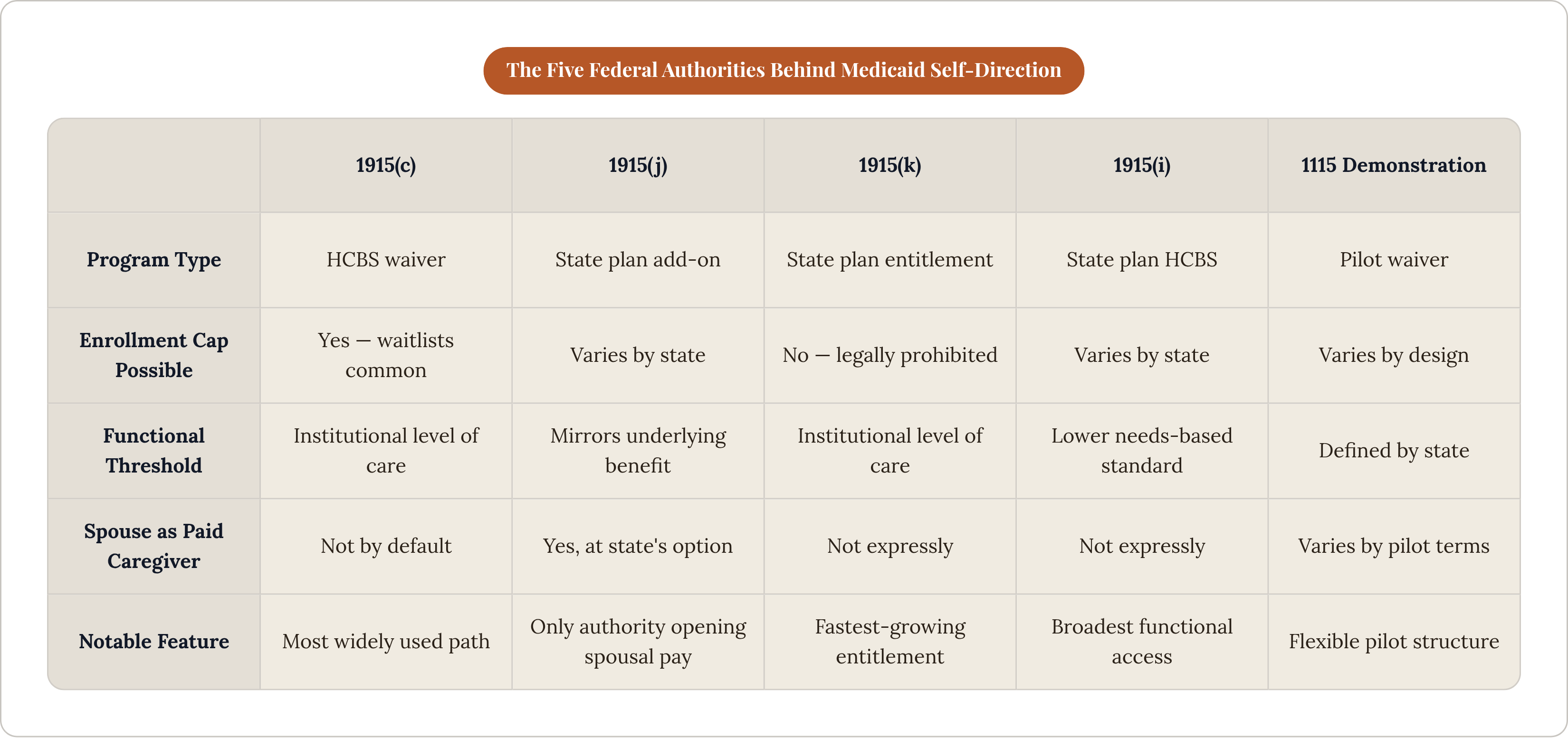
Medicaid self-direction runs through five separate federal authorities, and a state can adopt one, several, or stack them depending on what problem it's trying to solve. The 2023 Applied Self-Direction Inventory found roughly 90% of states lean on 1915(c) HCBS waivers as their main vehicle. That's the common path, but these five aren't interchangeable, and the gaps between them shape what actually gets offered on the ground.
1915(c) waivers do most of the work nationally. Most state programs run through one, though waivers can cap enrollment, which means waitlists happen, sometimes for years. 1915(j), the Self-Directed Personal Assistance Services option, sits on top of a state plan rather than standing alone, and it's the only federal authority that expressly lets participants hire legally liable relatives, spouses included. The next section gives it more room because it earns that room. 1915(k), Community First Choice, is a state plan entitlement, so no waitlist is legally possible, and it grew from 14% to 16% of states between 2019 and 2023. 1915(i) State Plan HCBS runs on a needs-based standard looser than the institutional level-of-care test most other pathways demand, and it climbed from 4% to 8% of states over that same stretch. Then there's the 1115 Demonstration Waiver, which gives states room to pilot approaches that don't fit neatly into the other four categories.
Why should a family trying to figure out whether Mom can hire her daughter care about any of this? Because the authority a state runs on sets the ceiling before individual eligibility even enters the picture. A 1915(c) waiver can cap enrollment; a 1915(k) program legally cannot. A 1915(i) program might take someone whose functional needs wouldn't clear the institutional bar required elsewhere. And only 1915(j) opens the door, at a state's option, to paid spousal caregiving. So the first move, before any form gets filled out, is figuring out which of these five authorities is actually operating in that state. That answer decides which rules govern everything that comes after.
What 1915(j) is and what it uniquely allows
1915(j) came out of the Deficit Reduction Act of 2005. It's an add-on, meant to sit on top of a state's existing personal care state plan benefit or an existing 1915(c) waiver, rather than function as a standalone program the way a 1915(c) waiver does. It's less new construction than a permit to renovate a house that's already standing.
So what does someone actually gain once a state adopts it? The ability to pick their own provider, a legally liable relative included. The ability to manage a cash budget instead of letting an agency dictate every line item. And the ability to buy goods or supports, not just wages, that increase independence or substitute for direct hands-on help. That third piece gets overlooked constantly, but it matters: a ramp, a shower chair, a tablet set up for medication reminders can sometimes come out of the same self-directed budget that pays a caregiver's wages.
States hold onto real flexibility even after adopting 1915(j). They can restrict it to certain counties, cap total enrollment, or limit it to people already enrolled in a specific 1915(c) waiver. There's a baseline that's easy to miss: the individual has to already be Medicaid-eligible and already receiving, or close to needing, state plan personal care or 1915(c) waiver services. Self-direction under 1915(j) is a delivery method layered onto services someone would already qualify for, not a separate eligibility category of its own. Participation is voluntary under federal rule, no exceptions; no state can force someone into self-direction who'd rather have an agency handle it.
The spouse provision: what federal law permits and what each state decides
The wording here matters more than almost anything else in this piece, so it's worth reading slowly. Federal regulation under 1915(j) lets a state permit participants to hire "any individual capable of providing the assigned tasks, including legally liable relatives," and the regulatory definition of legally liable relatives names a spouse specifically. That's the permission. Now the qualifier that changes everything: "at its option" means a state may allow this, but carries no obligation to. A state that hasn't adopted the 1915(j) spouse provision prohibits paid spouse caregiving outright, even while running other self-direction programs without a hitch.
Compare that to the default Medicaid personal care benefit. Under the standard state plan personal care benefit, with no self-direction layered in, paying a spouse simply isn't allowed. Of the five federal authorities, 1915(j) is the only door that opens this at all.
Why does spouse-caregiver availability swing so much from one state to the next? Some of it traces to history and administrative plumbing more than philosophy. California's In-Home Supportive Services program goes back decades, and states with that kind of long-established machinery tend to hit fewer bottlenecks when something like the spouse provision comes online. States with high self-direction enrollment, California and New York among them, generally got there by running state plan options without hard caps. States with lower enrollment lean more on capped 1915(c) waivers, restrict who counts as an eligible caregiver, or never adopted the spouse provision to begin with.
Here's the assumption that trips up more families than anything else: thinking that because self-direction exists in their state, the spouse provision must come bundled in automatically. These are two separate decisions a state makes, and it can say yes to one and no to the other without any contradiction. So what do you actually do with that? Call the state Medicaid agency or the local Area Agency on Aging, use the exact phrase "self-directed" or "consumer-directed" personal care option, and ask directly whether a spouse can serve as the paid caregiver under that option. Vague questions get vague, often wrong, denials back. Specific language gets specific answers.
The two independent eligibility gates every applicant must clear
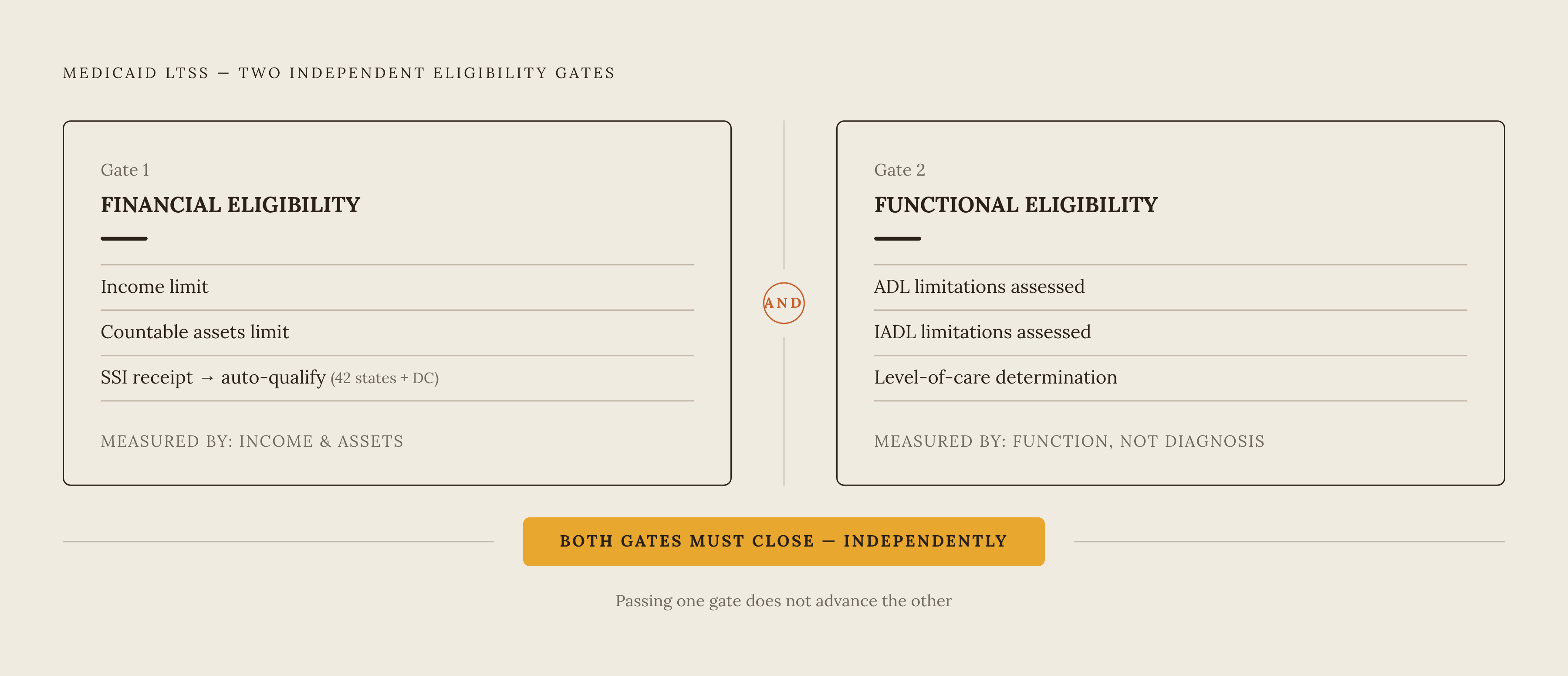
Two gates, not one. They run in parallel, not in sequence, and both have to close at the same time, independently of each other. Clearing one gets a family one gate out of two, not halfway to full eligibility.
Gate one is financial eligibility. LTSS users don't go through the MAGI-based income test most people recognize from ACA coverage; instead, eligibility runs on income-and-asset documentation tied to age (65 and up) or disability status. In 42 states plus DC, someone already receiving SSI is automatically financially eligible for full Medicaid benefits, LTSS included, so long as they also clear the functional gate. For everyone else, income and countable asset limits apply, and for married applicants, spousal impoverishment protections can shift how much of a couple's combined assets actually has to be spent down before Medicaid kicks in. Practically, that means gathering proof of income, Social Security statements, pension records, investment income, recent bank statements, property records, and any insurance policy with cash value, well before an application goes anywhere.
Gate two is functional eligibility, sometimes called a level-of-care determination, and here states look past diagnosis toward daily function. The standard question asks whether the person would need institutional-level care without home and community based services, though 1915(i) sets a noticeably lower bar, as covered above. The assessment doesn't just spit out a yes-or-no either; it generates the care plan itself, setting the hours and the specific services approved.
That produces a result worth sitting with for a second, because it cuts against how most people expect this to work. Someone with serious, complicated medical needs but no real limitation in daily activities might not qualify for LTSS at all, while someone with a fairly mild diagnosis but genuine trouble bathing, dressing, or transferring safely might qualify with little friction. Diagnosis and function sit on separate axes, and states are measuring the second one, not the first.
What trips families up here, over and over, is assuming that Medicaid coverage for other services, doctor visits, hospital stays, prescriptions, means automatic LTSS eligibility too. The functional gate stands on its own and has to close separately, regardless of what else Medicaid already covers.
The functional assessment tools states use to make level-of-care decisions
No federal standard dictates which tool a state must use, and the result is genuinely fragmented. A MACPAC-commissioned inventory found at least 124 different assessment tools in use across the country. That's not a typo. It's a real reflection of how far states have drifted from each other on a question you'd think would have one standard answer by now.
Most of these tools, whatever they're called locally, measure some combination of the same underlying domains. Activities of Daily Living, bathing, dressing, toileting, transferring, continence, eating, form the base layer almost everywhere. Instrumental Activities of Daily Living, managing medications, handling finances, arranging transportation, shopping, cooking, using a telephone, add a second layer that captures higher-order independence. Beyond that, many tools screen for cognitive status, behavioral factors, and medically oriented tasks that need a caregiver's direct hands-on involvement.
Three instruments come up often enough to name specifically. The Katz Index of Independence in ADLs is a simple, six-item checklist widely used as a baseline functional screen. The Lawton-Brody IADL Scale scores across eight tasks on a 0 to 8 range, catching higher-order function that a pure ADL tool like the Katz Index tends to miss. The Wisconsin Long-Term Care Functional Screen goes broader still, covering ADLs, IADLs, cognition, behavior, diagnoses, and specific indicators for mental health and substance use concerns.
MACPAC has flagged the transparency problem baked into all this variation. The opacity of assessment processes across states, in its own language, makes it genuinely hard to evaluate how well any given program meets the needs of the people it's meant to serve. Put bluntly: the same person, same limitations, same diagnosis, might qualify for services in one state and get turned away just across the border in the next. That's a structural consequence of 124 different tools measuring similar things 124 different ways, not some rare edge case.
So what can a family actually do with that? Find out, before the assessment happens, which specific tool the state uses, and read through the domains it covers. When documenting functional limitations, describe them in concrete, behavioral terms, "cannot transfer from bed to wheelchair without physical assistance," rather than letting a diagnosis alone carry the argument.
A layered eligibility checklist for self-direction and the 1915(j) spouse provision
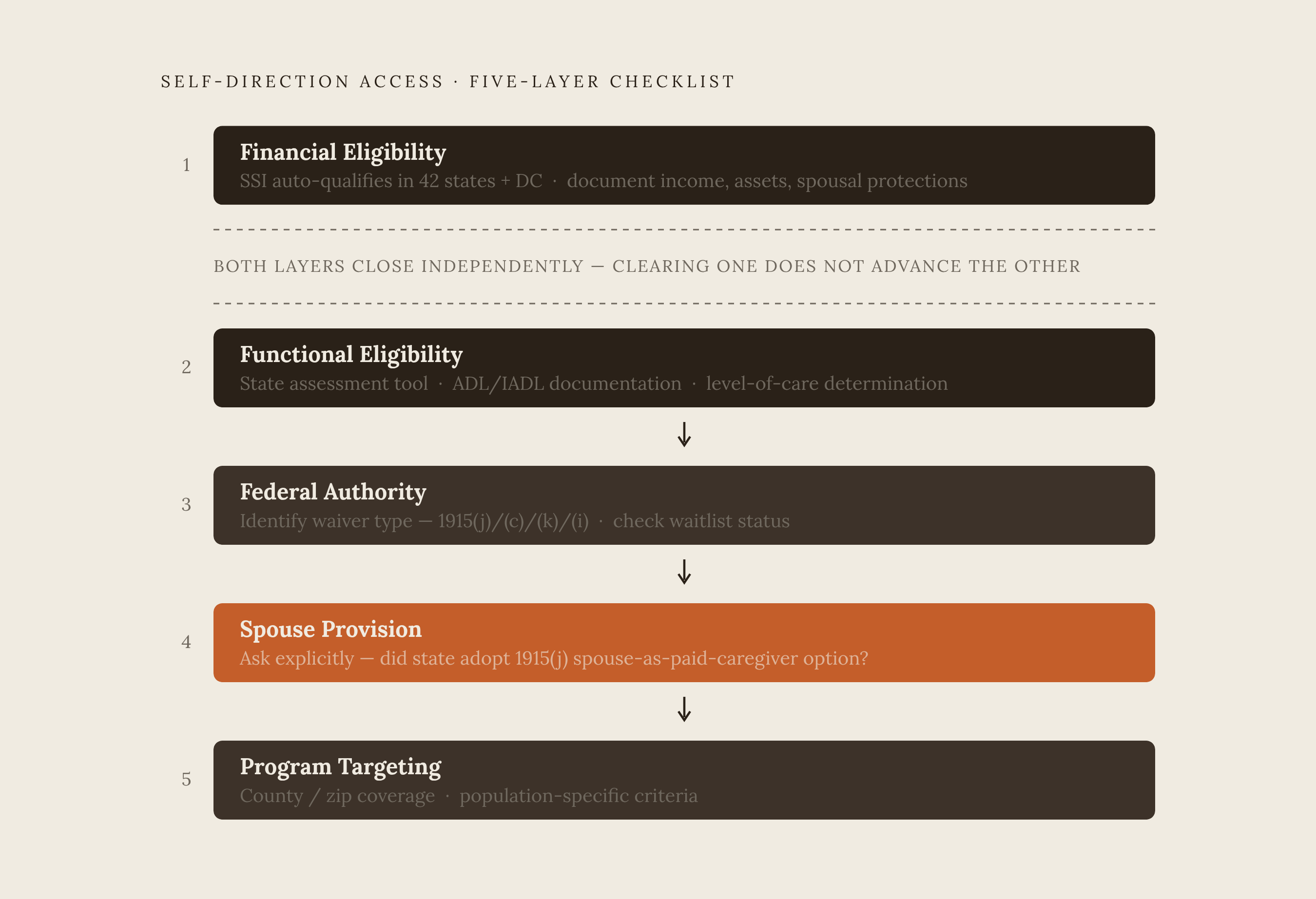
Everything above collapses into a sequence that's workable if you take it one layer at a time. Five layers, each resting on the one before it.
Layer one: confirm Medicaid financial eligibility. Check first whether the applicant already receives SSI, which grants automatic financial eligibility in 42 states plus DC. If not, document every income source and countable asset against the state's specific limits. For married applicants, find out whether spousal impoverishment protections shelter assets for the spouse staying in the community.
Layer two: confirm functional eligibility. Identify which assessment tool the state uses, usually findable through the state Medicaid agency site or an Area Agency on Aging. Write out ADL and IADL limitations in specific, concrete terms, what the person can't safely or independently do, and gather physician notes, prior assessments, and hospital discharge summaries to back it up. If the person's needs sit somewhere in the middle rather than at the severe end, ask whether the state's 1915(i) option might apply, given its lower functional threshold.
Layer three: identify which federal authority the state uses for self-direction. Ask directly whether the state runs a 1915(j), 1915(c), 1915(k), or 1915(i) self-direction option, since the answer sets the boundaries of what's even possible. If it's a 1915(c) waiver, ask about enrollment waitlists and how long they're currently running. If it's 1915(k), confirm there's no enrollment cap; that's a legal feature of the authority itself, not something a state can decide otherwise.
Layer four: verify the spouse provision specifically. Ask, close to word for word: has your state adopted the 1915(j) self-directed personal assistance option, and does it allow a spouse to be hired as the paid caregiver? If yes, follow up on training requirements, background checks, fiscal intermediary enrollment, and whether pay rates for legally liable relatives are capped differently than for unrelated caregivers. If no, ask whether some other authority, a 1915(c) waiver with a legally liable relative exception, for instance, permits paid spouse caregiving in that state some other way.
Layer five: confirm program-specific targeting rules. States sometimes restrict self-direction geographically, so confirm the applicant's county or zip code is actually covered. Check too for population-specific criteria layered on top, age brackets, diagnosis categories, current waiver enrollment, that can narrow things further.
Where to get state-specific answers and how AI-assisted tools can speed up the search
Three human channels do most of the heavy lifting. The state Medicaid agency has the definitive word on which authorities a state adopted and whether the spouse provision is live. The local Area Agency on Aging is often the practical entry point for the LTSS assessment itself, and staff there usually know which specific functional tool the state relies on. Aging and Disability Resource Centers exist specifically as single-entry points meant to help families navigate exactly this kind of layered mess.
Here's the limitation worth naming plainly, though: eligibility questions span financial and functional criteria across as many as five possible federal authorities, and a general phone call asking "do we qualify for help at home" often gets an incomplete or flatly wrong answer back. That's why the checklist above pulls its weight. It hands a family the specific vocabulary to ask a specific question, and specific questions get specific, checkable answers in return.
This is also where AI-assisted tools have started earning a real place, as preparation for that call rather than a replacement for the state agency itself. A well-built tool can map a household's income, assets, and functional profile against a given state's authority-by-authority criteria before anyone dials a number, flag which programs in that state are actually open versus sitting on a waitlist, and surface the one question most families never think to ask on their own: has this state adopted the 1915(j) spouse provision at all?
Families who show up at the state agency already knowing which authority governs their program, which functional tool to expect, and whether the spouse provision is even on the table tend to get the right determination on the first try instead of the third. Given the alternative, months of resubmitted paperwork and a caregiver going unpaid the whole time it drags on, that's worth the hour it takes to make the right phone calls first.