Personal Care Agreement Tools and Templates for Family Caregivers
How to formalize family caregiving with a written agreement that holds up legally.
More than 59 million Americans now care for an adult family member, up significantly over the past decade, according to a joint report from a nonprofit and a caregiving advocacy organization. Almost none of that labor happens under a written agreement. That gap is what this piece is about: the personal care agreement, the document that turns informal family caregiving into something a Medicaid caseworker, an IRS auditor, or a skeptical sibling has to respect. Get the sequencing wrong, sign the agreement after the money has already started moving, and no template on earth fixes it. Agreement first or payment first: that single ordering mistake is the fault line running under almost every problem this piece covers, and most families get it backward without realizing there was ever a right order to begin with.
Unpaid family caregiving carries an estimated annual value above $873 billion. Of the 59 million people doing it, only about 11 million are paid anything. The remaining caregivers, a substantial majority of the total, are effectively working a full-time, unpaid job, averaging 25 hours a week, with a quarter putting in more than 40, and one in five reporting poor health. About half report some negative financial hit from the role, and a quarter have taken on debt because of it. None of that labor is imaginary. The question this piece works through is how a family turns it into something recognized on paper, before Medicaid, the IRS, or a sibling asks for proof it was ever real.
What a personal care agreement is and what it is not
A personal care agreement goes by several names: family caregiver contract, elder care contract, personal services contract, depending on which attorney or state agency wrote the version in front of you. Same document, different letterhead. At its core it is a written agreement between a care recipient and the family member, usually an adult child, sometimes a grandchild or other relative, who provides paid care. Its job is narrow: define compensation, spell out duties, and give both people something to point to if the arrangement is ever questioned.
What it cannot do matters just as much, and this is where families get tripped up. A PCA does not grant medical decision-making authority (that requires a medical power of attorney), and it does not authorize access to health records (that requires a signed release). It has nothing to do with control over finances or legal affairs, which is the job of a durable power of attorney, and it does not cover skilled nursing work. Injections, wound care, and similar procedures sit outside what a family caregiver is licensed to do under this kind of contract.
So the PCA occupies one specific lane: compensation and duties for non-medical, hands-on care. Families treating it as a substitute for a power of attorney are the ones most likely to discover, mid-crisis, that the document they signed cannot do the job they needed it to do.
The three baseline legal requirements every PCA must meet
Three things separate an agreement that survives scrutiny from one that falls apart the moment someone asks a hard question about it.
It has to be in writing, first. An oral understanding between a parent and child, however clear to both of them, carries almost no legal weight once a sibling contests the estate or a Medicaid caseworker starts asking why money left the account.
Second, and this is the mistake families make more than any other: payments have to be forward-looking. Medicaid treats payment for care already given as a gift, not compensation, full stop. Consider the common scenario: a daughter has been caring for her mother for two years with nothing on paper, someone finally suggests formalizing it, and the family assumes signing an agreement now covers the back pay too. It does not, because the clock on legitimate paid care starts on the signature date, not before it. The clock on legitimate paid care starts on the signature date, not before it, and no amount of retroactive paperwork moves that line. If care is already underway, get the agreement signed now, but treat everything before that date as unpaid and unrecoverable.
Third, compensation has to be reasonable. It cannot exceed what an outside caregiver would earn for the same work in the same market. Market rate for comparable in-home care typically runs $18 to $35 an hour depending on region and level of care, and paying meaningfully above that range is a red flag that invites the exact scrutiny the agreement was supposed to prevent.
On execution: both caregiver and recipient sign and date it, notarization is strongly advised, and some states require it outright, sometimes with witnesses on top. Check the local rules before finalizing anything. They vary enough state to state that assuming a neighbor's template covers your situation is its own kind of risk.
Sections of a complete PCA template
A template is only as good as its sections, and most families do not realize what is missing until something has already gone wrong.
Party identification and the care setting come first, covering the full legal names of caregiver and recipient, the relationship between them, the address or addresses where care happens (home, medical appointments, adult day programs), and the recipient's date of birth, primary physician, medical conditions, and allergies. If a power of attorney or guardian is signing on the recipient's behalf, name that authority explicitly. Do not assume it is understood.
Scope of services is where thin templates fail. Every task gets listed by name: bathing, grooming, dressing, toileting, mobility assistance, meal prep tied to specific dietary restrictions, medication reminders, light housekeeping, laundry, transportation with mileage tracked, companionship, health monitoring, administrative work like bill coordination or provider calls. Equally important is stating what the caregiver will not do (skilled nursing, injections, wound care, unsupported lifting) as clearly as what they will. Hours language should build in flexibility rather than lock to a rigid figure. "No less than 20 hours a week" survives a bad week. A flat "25 hours" clause does not.
Schedule covers regular days and times, overnight care compensated separately from daytime hours if it applies, a written mechanism for changing the schedule by mutual agreement, and weekend or on-call expectations spelled out rather than assumed.
Compensation terms need actual numbers, including an hourly, daily, weekly, or monthly rate benchmarked to local market pay, a payment schedule, and a payment method (check or direct deposit, for reasons the documentation section below makes clear). Overtime needs direct treatment too. Federal wage law requires time-and-a-half after 40 hours for most live-out home care workers, though live-in rules vary by state. Mileage reimbursement and a holiday pay rate, if the family wants one, belong here rather than floating as unspoken assumptions.
Live-in arrangements need their own section. Does room and board count toward pay, or is it separate? If separate, name the proportional share of utilities, mortgage, insurance, and taxes item by item, not bundled into a vague "living expenses" line.
Record-keeping comes next, and it is not paperwork for its own sake. The caregiver keeps a daily log of duties and hours, plus written invoices for services rendered. As the next two sections lay out, this is the evidentiary backbone of the whole arrangement, and skipping it is the single most common reason an otherwise solid agreement fails under review.
Termination, backup care, and emergency procedures close it out. A common structure gives either party 14 days' written notice to end the agreement, with escape-clause language keeping it in effect until terminated in writing. Name a backup caregiver, someone who steps in when the primary is sick or on vacation, so a gap in care never turns into a gap in the record. Emergency procedures should be explicit: call 911 first, then notify the family, with contacts and numbers listed right in the document.
Medicaid's look-back period and the penalty for a missing agreement
An incomplete PCA is not sloppy paperwork so much as a financial penalty waiting to be triggered.
Medicaid's look-back period runs 60 months, five years, as of 2026, for nursing home Medicaid and, in most states, for home and community-based services (HCBS) Medicaid too, with California and New York as notable exceptions. During that window, Medicaid reviews financial transfers made by the applicant. Without a written agreement, informal payments to a family member do not read as compensation. They read as gifts. Gifts inside the look-back window can trigger a penalty period that delays eligibility, sometimes for months, leaving the family to cover care costs out of pocket while the clock runs.
The logic is not arbitrary, even if it feels that way to a family staring down a penalty. Medicaid treats payment for past care as a gift because there was no documented obligation to pay at the time the care happened. That is the entire reason the forward-looking requirement from the section above exists: an agreement signed after the fact cannot manufacture an obligation retroactively that was not there when the care was given.
New York applies its 60-month look-back to Nursing Home Medicaid but not to Community Medicaid, though a 30-month look-back has been under discussion for that program. Rules like this shift, so New York families in particular should confirm current state policy rather than assume either timeline applies by default.
Lump-sum arrangements deserve a harder look here, and families should be wary of them. Some states allow a prepaid lump sum calculated from a market hourly rate and the recipient's actuarial life expectancy, which sounds tidy on paper until the recipient dies earlier than projected and questions arise about how remaining funds are treated. Several states restrict or disallow the structure outright, and even where it is legal, reviewers tend to treat it as a likely disguised gift. Periodic payments, weekly or monthly, are the safer route by a wide margin, and they are what most PCA templates default to for exactly this reason.
The documentation triad that survives a Medicaid look-back review
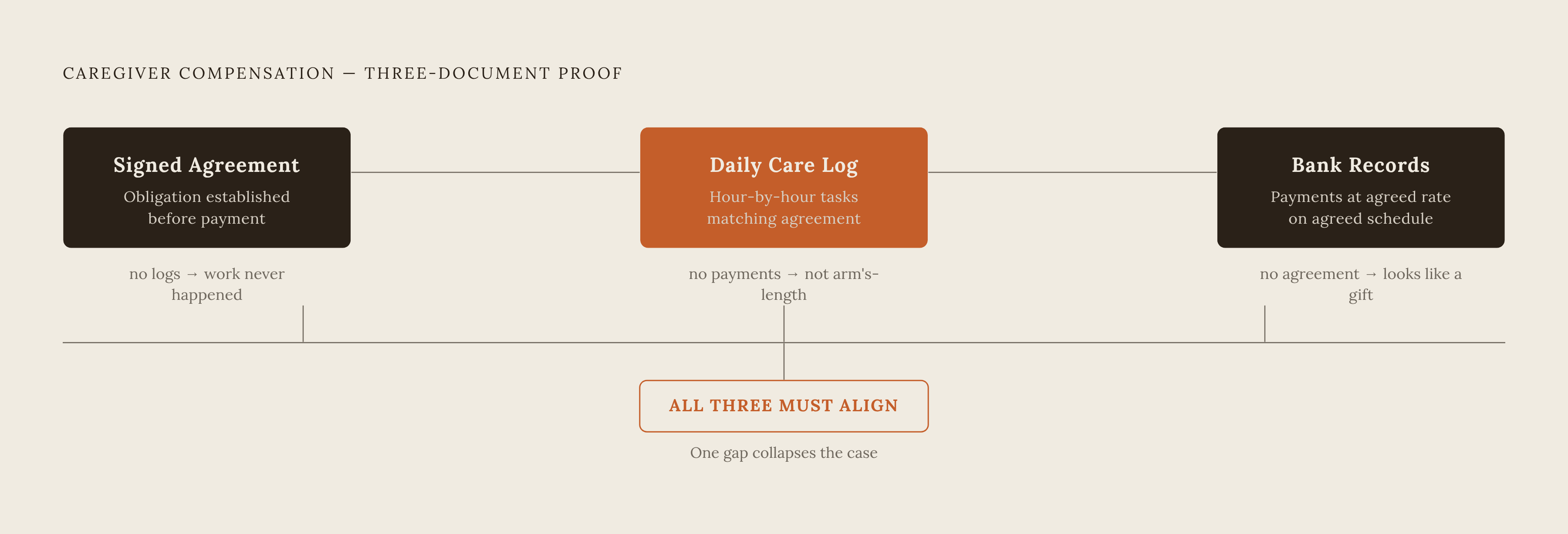
Three documents, together, prove that money paid to a family member bought actual care rather than moved assets out of an estate.
The agreement itself, signed and dated, and notarized where state rules require it, establishes that the obligation to pay existed before any payment moved. The daily care log establishes that the services named in the agreement were actually performed, hour by hour, task by task. The bank record, canceled checks or direct deposit statements, shows payment moving at the agreed rate on the agreed schedule.
All three have to show up together, and reviewers know what a gap looks like. A signed agreement with no logs behind it suggests the work never happened. Logs with no matching payments suggest the arrangement was not compensated at arm's length. Neither piece survives review alone. The proof lives in all three telling the same story at once.
The content of the log matters as much as its existence. Each entry needs the specific duties performed that day, hours worked, and any change in the recipient's condition: a structured record rather than a diary. Payment method carries real consequences too. Checks and direct deposit leave a trail a reviewer can verify against bank statements. Cash, however honestly handled, is close to undocumentable once someone asks for proof it happened, and families relying on cash are taking on risk they do not need to.
Tax and employment law obligations that kick in once a family member is paid
Formalizing payment solves one problem and opens another immediately. The moment a family member gets paid for care, tax and employment law apply, whether the family expected that or not.
Under IRS rules, a directly hired family caregiver becomes a household employee once payments cross $2,800 in a year (the 2026 threshold). Past that line, the care recipient or family, acting as employer, has to withhold and remit Social Security and Medicare taxes, issue a W-2 by January 31 of the following year, and cover the employer's share of payroll taxes on top of that. None of it is optional past the threshold, and the caregiver's pay counts as taxable income regardless of the family relationship involved.
Overtime rules apply too, and they are not uniform across states. FLSA requires time-and-a-half after 40 hours a week for most live-out home care workers, but live-in rules differ by state, with live-in rules differ by state, with some states applying stricter standards than the simple federal weekly threshold. The agreement should spell out the overtime formula directly rather than leaving it to whatever the family assumes is fair.
Some families try structuring the caregiver as an independent contractor instead, handling their own taxes and receiving a 1099 rather than a W-2. That label is not the family's to choose by writing it into the contract. The IRS determines employee versus contractor status based on the actual working relationship, not what the paperwork calls it, and misclassifying a caregiver is a common and expensive mistake once tax authorities or courts examine the relationship. Families reaching for the 1099 route to avoid payroll tax paperwork are, more often than not, setting up a liability they will not discover until an audit finds it for them.
A written agreement's protection of sibling relationships and the estate
The tax questions are mechanical, solvable with the right paperwork and a calendar reminder. What happens between siblings is not, and it is arguably the harder problem a PCA solves.
According to AARP research, roughly one in three people 50 or older have experienced family conflict tied to inheritance at the time of a loved one's death. One sibling provides years of hands-on care, the estate splits evenly among everyone anyway, the caregiving sibling feels shortchanged for labor nobody else did, and the other siblings insist the will should be honored exactly as written. That pattern repeats across families often enough that it should be treated as the default risk, not the exception. Once the parent has died and the will is read, there is no clean fix for that argument.
A signed, transparent PCA gets ahead of it before it can start. Compensation becomes a contractual obligation tied to defined work. Any reduction in the estate from years of paid caregiving gets documented and explained while everyone involved is still alive to understand why, rather than appearing as a surprise in probate. Sharing the signed agreement with all siblings at the outset addresses this concern directly: transparency early kills the suspicion of a backroom deal later, before it has a chance to take root.
The agreement protects the care recipient too, in a related but distinct way. It establishes that payments to a family member were compensation for defined services at a fair market rate, not evidence of financial exploitation, a distinction that matters enormously if an elder abuse investigation or family dispute ever puts those payments under a microscope.
What to look for in a template
Not every template circulating online covers what actually needs covering, and the gap between a solid one and a thin one is most visible exactly where the stakes are highest: scope of services, overtime treatment, and record-keeping.
A usable template hits every substantive section already covered here: party identification, scope of services, schedule, compensation and overtime, record-keeping, termination, backup care. It draws an explicit line between what the caregiver will do and what falls outside the role, rather than leaving that boundary implied. It uses flexible hours language instead of a fixed number that snaps under real-world variation, and it leaves room for state-specific execution steps: notarization, witnesses, whatever a given state requires. A static PDF that has to be retyped from scratch is a poor substitute for something editable a family can actually fill in and adjust.
Agiled offers a free caregiver agreement template, available in Word and PDF, reviewed by its editorial team and updated as recently as June 2026, covering the scope-of-services detail this kind of agreement depends on. Families weighing Medicaid eligibility alongside a caregiver agreement can also check other resources, such as Brevy, a service that helps families navigate Medicaid eligibility and enrollment, which often surfaces caregiver payment programs that can formalize and fund a family care arrangement. State Medicaid agencies and elder law resources list caregiver payment programs that can formalize and fund a family care arrangement. Those programs only work, though, if the written agreement already exists and meets Medicaid's documentation standards before the money starts moving. Agreement first, payment second: that sequencing is the thread running through every section here, and it is the one detail no template, however well built, can fix after the fact if a family gets it backward.