Respite Care Options and How to Fund Them
Finding respite care and paying for it requires navigating multiple funding sources.

Respite care is short-term, temporary relief for the primary caregiver. Duration ranges from a few hours to several weeks. The care recipient receives supervision, companionship, personal care (bathing, dressing, mobility assistance), homemaker tasks, medication management, and, in some arrangements, basic clinical tasks such as wound care and vital sign monitoring. Some providers carry specialized training in dementia-related behaviors: wandering, agitation, acute confusion. When the care recipient's presentation is complex, a training gap can end a placement prematurely, and nobody tells you that in advance.
Respite care takes four main forms: in-home respite, adult day programs, short-term residential stays, and facility-based or hospice respite. When insurance does not cover the needed type, families typically piece together funding from Medicaid HCBS waivers, the National Family Caregiver Support Program (accessed through local Area Agencies on Aging), VA Caregiver Support benefits for veterans' families, and state lifespan respite networks. The Medicare GUIDE program provides up to $2,500 per year in respite benefits, but only for beneficiaries with a documented dementia diagnosis. Nonprofit and faith-based organizations offer free or sliding-scale coverage in many areas; the Eldercare Locator at eldercare.acl.gov and the ARCH National Respite Network locator are the practical starting points for finding what exists in a specific location.
What respite care is not deserves equal treatment, because misclassification carries real consequences. It is not ongoing home health care. It is not a permanent placement. It is not a substitute for a comprehensive care plan. A payor authorizing respite is not authorizing long-term care, and conflating the two generates billing errors that can jeopardize future coverage. The error is common enough to state plainly rather than assume families already understand the distinction.
The measurable case for respite is established. ARCH National Respite Network's research shows that caregivers who received four or more hours of respite per week saw self-reported burden decrease over time; those without any saw it increase. That is a dose-response relationship. The more useful question, though, is whether the system makes respite accessible enough to matter. For most families, candidly, it does not, at least not without sustained effort to navigate a landscape that seems almost deliberately opaque.
What are the different types of respite care?
The type of respite available depends on the care recipient's needs, the caregiver's schedule, and what the setting can realistically accommodate. This typology matters beyond mere categorization: it is functionally predictive of which programs will pay, because funders authorize specific types, not respite as a general concept.
In-home respite brings a professional caregiver into the household through a home health agency, hospice organization, or caregiving network. The care recipient stays in familiar surroundings. The caregiver leaves, sleeps, or tends to their own life. For care recipients who cannot be transported, this is often the only viable option.
Adult day programs operate through senior centers or similarly structured facilities, providing socialization, structured activity, supervision, and varying levels of medical oversight during daytime hours. For caregivers who need coverage during working hours without requiring an overnight absence, this tends to be the most practical entry point. It is also among the best-covered types across multiple funders — a rare piece of good news in this landscape.
Short-term residential stays involve temporary placement in an assisted living community or memory care unit, ranging from a few days to several weeks. The care recipient receives a furnished room, meals, ADL support, and access to facility programming. This option suits extended caregiver absences: recovery from surgery, a family commitment that cannot be rescheduled, or the kind of sustained break that a few hours simply cannot provide. It is also the most funding-constrained type, which creates particular frustration because it is often the type families need most urgently.
Facility-based or hospice respite occurs in a skilled nursing facility or hospice inpatient unit. It applies specifically when the care recipient has complex medical needs or has enrolled in hospice. Eligibility rules here are distinct from the other types and, within the Medicare context, more clearly defined than most anything else in this space.
One category that rarely surfaces in funded-care discussions: informal respite provided by neighbors, family members, or faith communities. It carries a substantial share of actual burden relief in practice. Because informal respite falls outside formal funding structures, it tends to disappear from policy conversations even as it remains, for many families, the only relief they ever get.
What respite care costs out of pocket, by type
The Genworth Cost of Care Survey 2024 puts the national median cost of adult day care at approximately $100 per day. Homemaker services run about $188 per day on a 40-hour-week basis. A home health aide averages roughly $195 per day. Assisted living comes in at approximately $194 per day; a semi-private nursing home room averages around $305 per day. Those are medians; geographic variation pushes costs substantially higher in most urban markets.
The figure that reframes the entire conversation is 24-hour in-home care, averaging roughly $817 per day nationally. For a caregiver who needs someone to cover a week while recovering from a procedure, that number is prohibitive by any ordinary standard. It also makes the case, more viscerally than any policy argument, for why funded alternatives function as necessities rather than conveniences for the families who cannot absorb that figure.
For shorter breaks, per U.S. News reporting from April 2026, non-medical in-home caregivers average approximately $35 per hour. A few hours of coverage three times a week is mathematically manageable for some. Full-time coverage is another matter entirely.
A 2026 U.S. News survey of 302 caregivers found that the largest single group, 30.2%, spent between $1,001 and $5,000 on care in the past year; roughly 24% spent more than $5,000. Those figures look modest in isolation. They compound with lost wages, restructured careers, and the absence of employer-sponsored caregiver benefits that most workers have never had.
The cost differences between care types are substantial enough, and the gap between private pay and funded care wide enough, that identifying the right type and the right funder can determine whether respite is feasible at all. That is not a hypothetical observation; it is the deciding variable for a large portion of the families who eventually piece together coverage.
What Medicare covers and where it stops
Medicare's respite coverage is narrow. Caregivers either expect too much from it or dismiss it before checking the pathways that do exist. Both errors cost money.
The primary coverage is tied to Part A's hospice benefit. When a Medicare beneficiary is enrolled in hospice, Medicare covers up to five consecutive days of inpatient respite care in a Medicare-certified facility, on an occasional basis, with no statutory cap on how many times that benefit can be used across the enrollment period. The beneficiary may owe up to 5% of the Medicare-approved cost. Outside of hospice enrollment, traditional Medicare does not cover respite at home, in assisted living, or in community settings.
Two exceptions warrant attention. The Medicare GUIDE program, launched in July 2024 and designed to run eight years, provides up to $2,500 per year in respite benefits for Medicare recipients with a documented dementia diagnosis. Covered types include in-home care, adult day programs, and facility-based respite, making it the only Medicare pathway for non-hospice respite and one of the few funded options spanning multiple care settings for a defined population. It is a significant exception, and one that frequently goes unmentioned in general caregiver conversations.
Medicare Advantage plans have also begun incorporating adult day services and non-medical respite as supplemental benefits. This is plan-dependent, rather than a guaranteed Medicare entitlement. Plans within the same county can differ substantially. The only reliable way to know what a specific plan covers is to read its Evidence of Coverage document, not the marketing summary.
For the large majority of caregiving situations, Medicare is relevant in two circumstances: hospice enrollment and a dementia diagnosis under GUIDE. Families outside both will need a different funding source.
How Medicaid funds respite, and why the state you live in changes everything
Medicaid is, in aggregate, the largest source of respite funding for eligible individuals. Nearly all states cover some form of respite through Home and Community-Based Services (HCBS) waivers, structured to help people receive care in home and community settings rather than nursing facilities. In-home respite and adult day services are the most commonly covered types under these waivers.
The complexity lives in the variation. What qualifies as respite, how many hours are authorized per year, whether a waiting list exists, and how quickly services can begin all differ by state and, in some cases, by waiver program within a state. A caregiver in one state may have access to robust funded options with manageable wait times; a caregiver across the state line may encounter minimal coverage and waitlists extending years into the future. This is the structural reality of a Medicaid system administered at the state level with federal parameters but substantial state discretion, and it is genuinely maddening to watch families discover it for the first time when a care need has already become urgent.
Medicaid eligibility is income- and asset-based, which leads many middle-income families to self-disqualify before they investigate. That reflex is frequently wrong. Spousal impoverishment protections, state-specific income disregard rules, and waiver-level provisions shape eligibility in ways that are intuitive only to people who work with these waivers daily. Income threshold alone is an unreliable basis for ruling yourself out. The only way to know what actually counts, under a specific waiver in a specific state, is to ask someone who works with it directly.
The practical starting point: contact the state Medicaid office or a State Health Insurance Assistance Program (SHIP) counselor to identify which waivers exist and to establish waitlist status before concluding that coverage is unavailable. Waitlists can run long. Getting on one early matters more than most families realize until they have already waited.
VA benefits for caregivers of veterans
Veterans' families represent one of the populations most likely to leave funded respite unclaimed. The benefit is poorly publicized outside VA channels, and the enrollment process is far from self-evident.
The VA Caregiver Support Program offers respite care through two distinct pathways. The Program of Comprehensive Assistance for Family Caregivers (PCAFC), expanded under the MISSION Act to include eligible veterans of all service eras, provides the more robust benefit tier. For those who do not qualify for PCAFC, the Program of General Caregiver Support Services (PGCSS) provides a broader baseline of caregiver support with fewer eligibility thresholds.
VA respite coverage can include in-home care, adult day health programs, and short-term residential stays, making it one of the more comprehensive single funding sources by sheer span of covered types. The VA also operates its own adult day health care centers and contracts with community providers, though actual availability depends on geography and the veteran's enrollment status.
Eligibility is tied to the veteran's VA enrollment and disability rating; in some programs, the caregiver must be formally registered in the system as well. Families who assume coverage requires a service-connected condition, or who are simply unaware that the Caregiver Support Coordinator role exists, routinely pay out of pocket for care the VA would have authorized. The first call should go to the local VA Caregiver Support Coordinator, before incurring any private-pay costs. That sequencing matters.
State lifespan respite programs, the NFCSP, and nonprofit options
Federal policy has created a series of funding streams that reach caregivers through state and local intermediaries rather than directly. These programs are less visible than Medicare or Medicaid. They cover gaps both of those systems leave open, and for many families they are the only funded option available.
The Lifespan Respite Care Program, reauthorized in 2025, funds state-level networks designed to coordinate respite across agencies and reduce the fragmentation that makes the system so difficult to navigate. States implement these funds differently. The stated goal is a single access point where a caregiver can identify available, affordable respite without contacting a dozen agencies independently. Whether that goal has been realized varies by state. Some networks are quite useful; others exist largely on paper.
The National Family Caregiver Support Program (NFCSP), administered through the Older Americans Act, provides federal grants to states for caregiver services including respite. In practice, these services are accessed through local Area Agencies on Aging. ARCH National Respite Network's findings on NFCSP participants mirror the broader research: caregivers who received four or more hours of respite per week through the program showed measurable decreases in burden over time. That finding matters when making the case to a skeptical family member that enrollment is worth the administrative effort.
Nonprofit and faith-based organizations, including Easter Seals affiliates, local hospices, and faith communities, offer free or sliding-scale respite in many areas. Coverage is hyperlocal and inconsistently publicized. Two practical starting points for finding what actually exists in a specific location: the Eldercare Locator at eldercare.acl.gov and the ARCH National Respite Network's respite locator.
Which funding source covers which type of respite
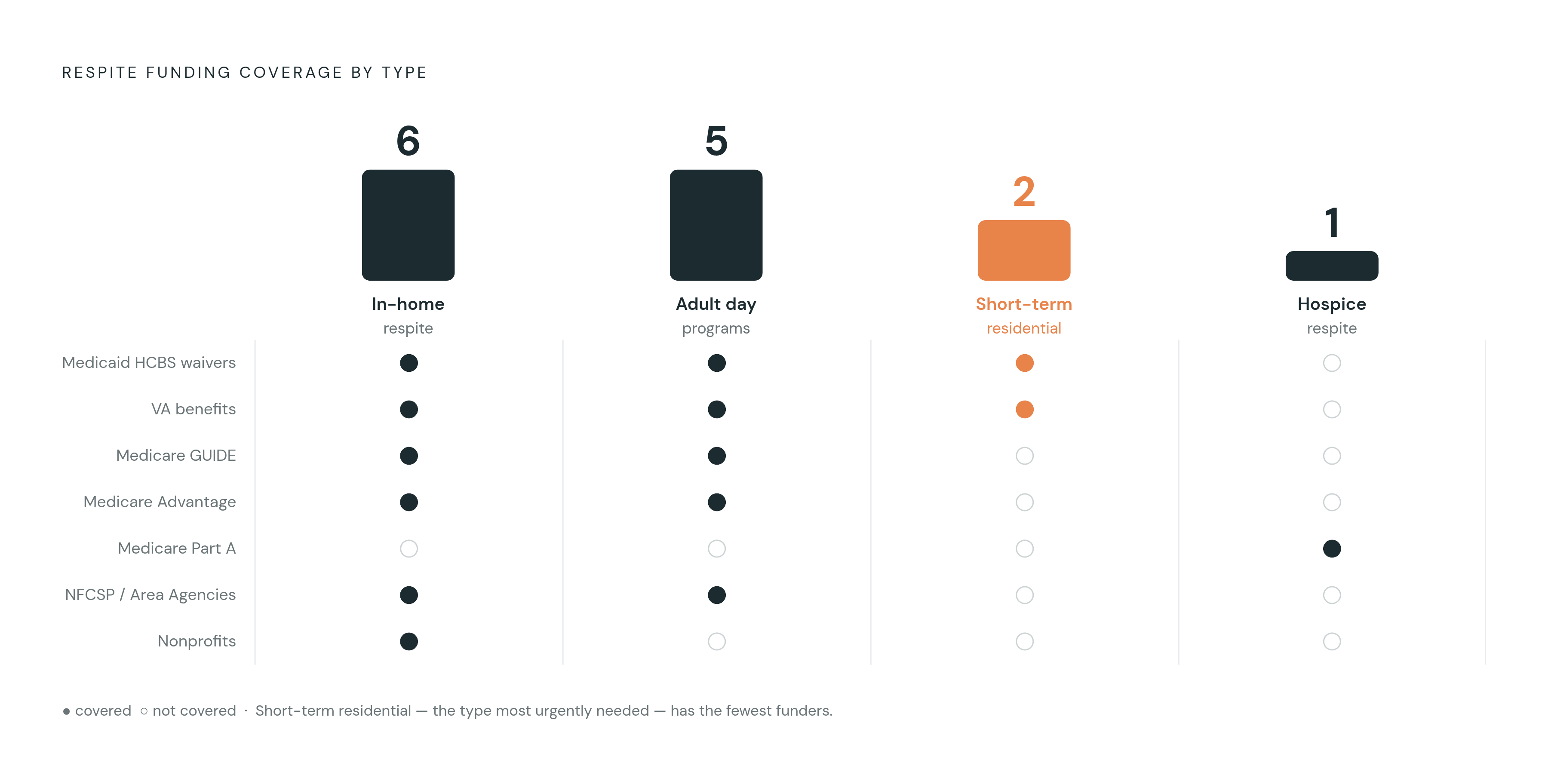
Mapping funders to types reveals, more clearly than any narrative summary, why caregivers who rely on a single source so often find it insufficient.
In-home respite has the widest funding coverage. Medicaid HCBS waivers cover it in most states. VA benefits cover it for eligible veterans' families. The Medicare GUIDE program covers it for beneficiaries with a dementia diagnosis. Some Medicare Advantage plans include it as a supplemental benefit. The NFCSP covers it through Area Agencies on Aging. Nonprofits provide it in select areas. Traditional Medicare, outside of GUIDE, does not.
Adult day programs are similarly well-covered: Medicaid HCBS waivers, VA adult day health care, the Medicare GUIDE program, some Medicare Advantage plans, and the NFCSP. This type tends to carry strong multi-funder support, which makes it a practical first option for caregivers who need daytime coverage and have yet to identify a primary funding source.
Short-term residential and assisted living stays are the most funding-constrained category. Some Medicaid waivers cover them on a state-dependent basis; the VA covers them in some circumstances; traditional Medicare and the NFCSP generally do not. This is precisely where a benefits review conducted before the need becomes urgent pays off most, because discovering the funding gap after a placement begins forecloses options. Private pay or a patchwork of sources is the realistic expectation, and families who discover this mid-placement are rarely positioned to respond well.
Facility-based and hospice respite operates in a different administrative world. Medicare Part A covers up to five days of inpatient respite care for hospice-enrolled beneficiaries, with the cost-sharing caveat noted above. Medicaid covers hospice respite for dual-eligible beneficiaries under parallel rules.
No single funder covers all four types. An October 2024 SeniorLiving.org survey of 1,765 adults found that 47% of caregivers receive no formal support despite 88% reporting they need more. That gap is partly structural and partly a function of caregivers being unaware of which combinations exist to pursue.
How to find out what you actually qualify for without sorting through every program yourself
Eligibility rules, waiver availability, and covered types vary enough by state and individual circumstance that a generic checklist accomplishes little. The same caregiver, supporting the same person, may qualify for entirely different resources depending on which side of a state line they live on. That variability is an argument for getting a personalized review rather than attempting to reconstruct the entire landscape independently.
Several entry points are worth knowing by name. The Area Agency on Aging, found through the Eldercare Locator, is the most broadly applicable first contact for older adults and their caregivers regardless of income level. SHIP counselors are trained specifically in Medicare coverage questions and can clarify what a specific plan actually covers. The VA Caregiver Support Coordinator is the right first call for any veteran's family. The ARCH National Respite Network's respite locator is designed to surface community programs by geography.
Any benefits conversation moves faster with the right information assembled in advance: the care recipient's diagnoses, current insurance coverage including Medicare plan type, Medicaid enrollment status, VA enrollment if applicable, and a realistic estimate of how many hours of respite per week are actually needed. Those inputs determine which programs are relevant and in what combination.
AI-assisted benefits discovery tools have become useful for caregivers who are uncertain which programs exist in their state, or who have assumed their income disqualifies them from everything. These tools narrow the field quickly. They do not replace a counselor's review, but they reduce the number of dead ends considerably.
Most caregivers who successfully access respite piece it together from more than one program, over time rather than all at once. The funding landscape is genuinely fragmented, the administrative burden is real, and the alternatives, paying privately for care that would have been covered or going without it entirely, are worse. That is the honest summary of where things stand.