The Enrollment Stages Medicaid Self-Direction Software Must Own Completely to Keep Eldercare Families Paid
A six-stage map shows where family caregiver pay actually stalls.
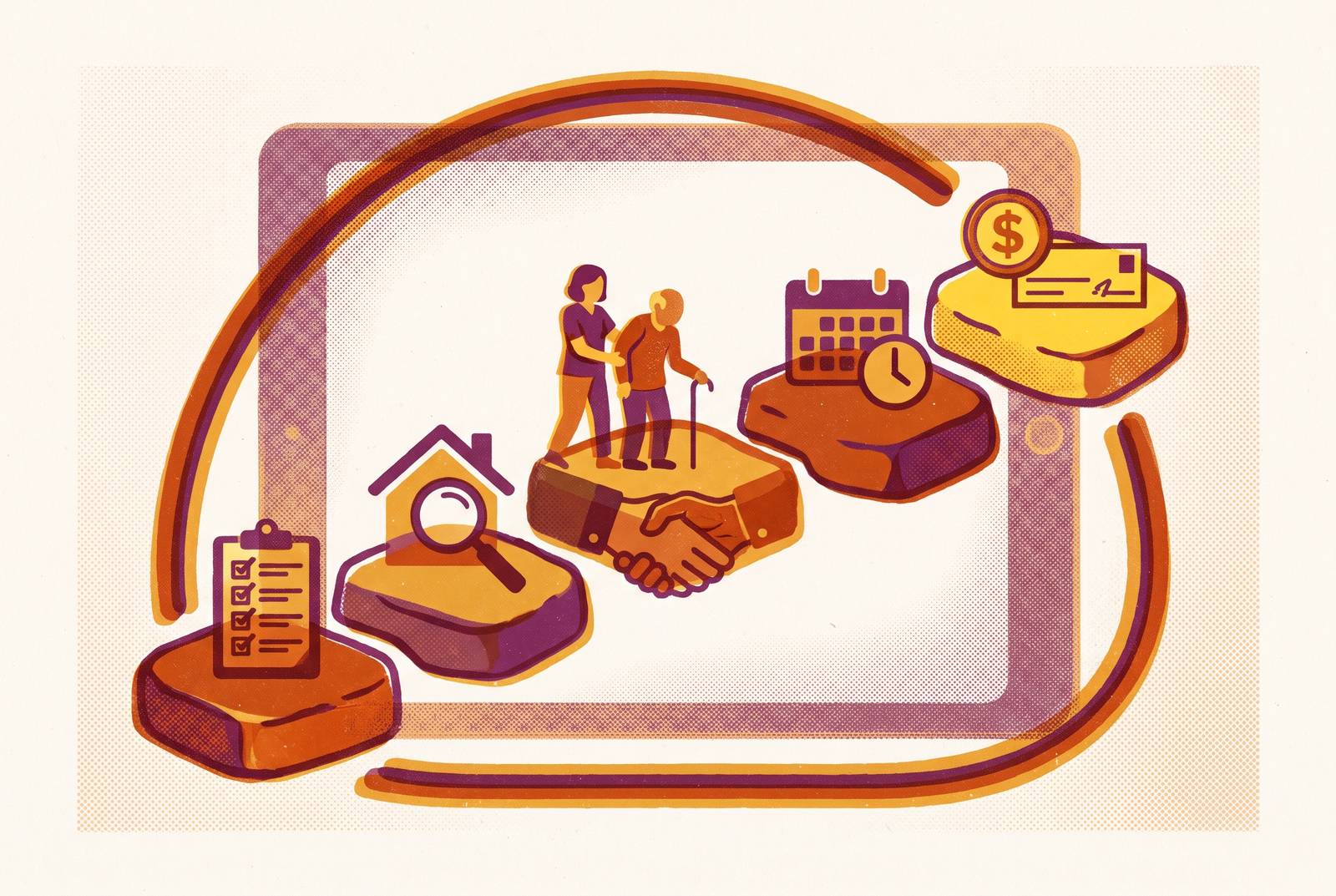
An AI platform for family caregivers to get paid through Medicaid self-direction must support the entire path from Medicaid eligibility to ongoing payroll compliance. Program matching alone is not enough. Eldercare families need software that tracks all six enrollment stages, connects each handoff, and combines AI guidance with human expertise when an unresolved requirement threatens payment.
Why eldercare families who qualify for Medicaid self-direction still don't get paid
A family can qualify for self-direction without being ready for payroll. These are different administrative states, with different requirements. Self-direction lets the person receiving care, or their representative, recruit, hire, and supervise workers, including relatives where program rules permit. That control makes paid family caregiving possible and places employer responsibilities on a household.
MACPAC’s June 2025 report documents broad state flexibility over which populations and services qualify, which forms of authority participants receive, and whether relatives can be paid. A family may know self-direction exists without knowing which program applies, whether its chosen caregiver qualifies, or which paperwork comes first. What happens while those questions remain unresolved? Care may continue even as enrollment stalls, leaving the caregiver unpaid because eligibility has not yet become an operational payment arrangement.
The six sequential stages that stand between a family and a paycheck
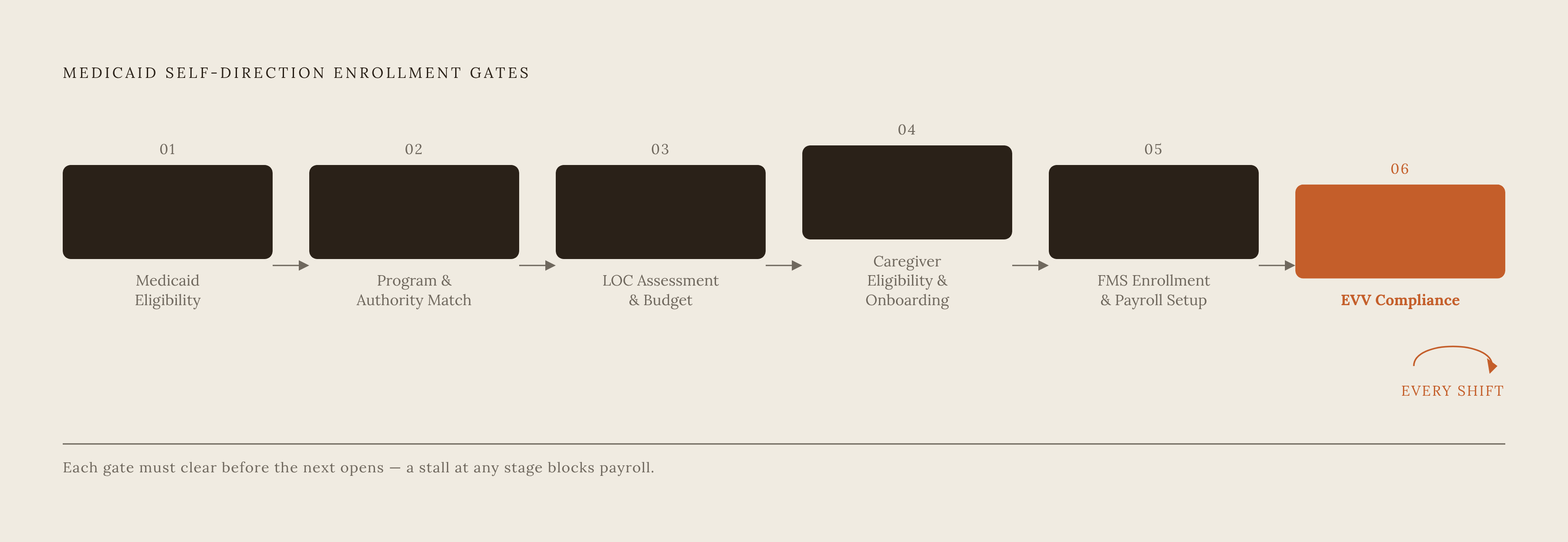
The enrollment path has six gates, each dependent on the last. First comes Medicaid eligibility, followed by matching the family to the right waiver or state-plan authority. The level-of-care assessment then establishes authorized care and the budget. Caregiver eligibility and onboarding precede Financial Management Service enrollment, while electronic visit verification completes the path into ongoing payroll compliance.
Each gate has its own requirements and responsible parties. MACPAC identifies beneficiary advocacy organizations, case management entities, information and assistance professionals, FMS agencies, managed care organizations, and support brokerages among the organizations involved. A family can complete the task in front of it while a separate prerequisite still blocks payment. Tracking must establish whether a form was submitted and whether its acceptance has opened the next gate.
Stage one and two: confirming Medicaid eligibility and matching the right federal authority
Medicaid coverage is the first prerequisite for self-direction. If the person receiving care is not enrolled, that enrollment must come before access to the benefit. Having coverage, though, does not tell a family which self-direction rules apply. Four federal authorities can support these services, including 1915(c) HCBS waivers, 1915(j) Self-Directed Personal Assistance Services, 1915(k) Community First Choice, and the 1915(i) HCBS state plan option.
The authority changes which family arrangements are permitted. Under 1915(j), a state may choose to pay legally liable relatives, including a spouse, the parent or guardian of a minor child, or a legally assigned caretaker relative. It may also choose not to. Under Community First Choice’s self-directed model, qualified family members may be hired, but the person appointed as the care recipient’s representative cannot also be the paid caregiver.
For a household, those distinctions determine who can do which job. A family may have active Medicaid coverage yet select a pathway that excludes its intended caregiver. Even a family that otherwise qualifies cannot get into a waiver if it has no open slots. Does this program, under this authority and the state’s rules, allow the caregiving arrangement this family has in mind?
Stage three: how the level-of-care assessment sets the budget and shapes every payment that follows
The level-of-care assessment translates care needs into authorized hours and an individual budget. It is a financial gate as well as an eligibility decision. The state or its managed care plan evaluates how much help the person needs, and that determination sets the paid work available through the program. If a household needs more care than the authorized amount, that need alone does not make the extra care payable.
MACPAC documents variation in how states determine budgets. One state changed its process to make it more consistent across self-directed beneficiaries, while two states made theirs simpler by setting minimum and maximum HCBS worker wages for specific services. Families, meanwhile, may not understand what an assessment measures or which documentation supports the requested level of care. That information gap can leave an underestimate uncontested. Once the budget is set, later payroll enrollment cannot expand it, and correcting an amount that is too low requires a formal reassessment.
Stage four: caregiver eligibility rules and the onboarding steps that most commonly delay first payment
An approved budget does not make every relative eligible for employment. The rules for who can be a caregiver depend on the state and program. Some pathways permit spouses, while others exclude them or restrict relatives who live with the person receiving care. Can the chosen person legally fill the paid role, and have they completed the requirements to enter it?
Ohio Department of Medicaid rules illustrate how family roles can conflict. In Ohio’s consumer-direction framework, the person receiving care is the employer of record. A representative may help with employer tasks but cannot also serve as the caregiver. Access also depended on program timing, with self-direction taking effect on the Ohio Home Care Waiver on October 1, 2024, and the MyCare Waiver on November 15, 2024.
Michigan’s Home Help Program illustrates a different boundary. It is a Medicaid State Plan benefit without a waitlist or nursing-facility level-of-care requirement, but it excludes spouses and parents of minor children from paid caregiving. Even a relative who is eligible must complete the background checks, medical care certification classes, and documentation the program requires. Incomplete paperwork can restart the onboarding clock.
Stage five: FMS enrollment and the payroll infrastructure families must navigate to get paid at all
The Financial Management Service handles payroll for work that has been approved. It processes wages, withholds taxes, and manages workers’ compensation. Under the fiscal employer agent model, the participant keeps full employer authority, and the agent handles payroll and tax withholding. Approval to hire a relative does not complete enrollment with that agent. The family still has to establish the payment arrangement.
New York’s CDPAP experience makes that distinction concrete. During the April 2025 PPL transition, most payment holds were caused by incomplete onboarding steps. Silence from the payment system could mean enrollment remained unfinished.
MACPAC relays a state Medicaid official’s account of difficulty paying different rates for the same service because administrative systems normally associate one service type with one rate. Software support must distinguish an unresolved family requirement from a system-side obstacle, because those problems require different responses.
Stage six: EVV compliance and why a missed clock-in can undo a completed payroll cycle
The 21st Century Cures Act mandates electronic visit verification for Medicaid personal care services, including self-directed visits. The FMS or the participant’s EVV platform must record all six required data elements for each visit before that record can support payroll. Providing the care and documenting a payable visit are separate obligations.
New York’s CDPAP uses EVV to confirm that a caregiver’s visit occurred so payroll can be processed correctly. A missed or incorrect entry can lead to delayed pay and repeated exchanges with the fiscal intermediary. A late clock-in, forgotten clock-out, or wrong device or location can create a documentation gap even when care was delivered.
This gate reopens with every shift the caregiver works. Unlike initial caregiver approval, EVV compliance cannot be finished once and set aside. A family can navigate the earlier stages successfully and still encounter a payment interruption months later because visit documentation remains a recurring condition of payment.
What “owning” a stage means and why partial coverage fails families
Owning a stage means taking responsibility for its completion and handoff. Software must surface the relevant questions, validate answers against program rules, route the output forward, and alert the family when something is incomplete or rejected. Displaying a form does not meet that standard. A stage is complete when the next stage can accept what it produced.
MACPAC notes that beneficiaries may find it hard to tell which of the many organizations helping them does what. Separate tools can reproduce that confusion if each shows only its own portion of the process. An eligibility tool may work correctly while leaving the family to transfer information into a separate FMS portal and EVV app. Complete ownership requires a shared view of all six stages, including the specific dependency blocking progress and confirmation that each handoff has succeeded.
How can AI help family caregivers enroll in Medicaid self-direction without a navigator?
AI-guided support can take a general explanation of a program and use it to build an enrollment path for a family. To do this, it can use the family’s Medicaid status, state, care relationship, and care needs. Those details allow program matching to address the rules that apply to the household. Names such as CDPAP, CDASS, IRIS, and CFSS do not answer that question on their own. The matched pathway must explain whether the caregiver arrangement the family has in mind is allowed.
Families still need human expertise when the next step calls for judgment. Assessment preparation, FMS documentation review, and EVV troubleshooting connect information to action in ways a static FAQ cannot. An AI-guided platform should bring those forms of help into the same enrollment path so the family can get help without starting another, separate process. The platform provides support within the state, program, and payment requirements that still govern the outcome.
The platform aims to help families receive regular W-2 income for authorized caregiving hours, paid on an FMS payroll schedule. Access to respite also supports sustained care. Neither outcome should be confused with completing an online application. The practical test for the platform is whether it helps the household resolve the requirements between program discovery and dependable payment, including the obligations that recur after enrollment.
What eldercare families should do at each stage to protect their enrollment status
For families applying this framework, the first task is to establish the correct entry point. Check that Medicaid coverage is active before starting a self-direction application. If the person receiving care is not enrolled, start there. Then identify the federal authority behind the proposed program and whether its rules permit the family relationship to be paid. A spouse’s eligibility should never be assumed from the fact that another relative can qualify.
For the assessment, gather documentation of all care tasks before the evaluation. The authorized hours will constrain later payment. If the assessment understates the care required, contesting it calls for a formal reassessment. Before caregiver onboarding, confirm the applicable background checks, medical certification classes, and documentation requirements. Completing those requirements in advance protects the interval between caregiver selection and the first paycheck.
At the FMS stage, complete banking setup, tax documentation, and all other enrollment forms before care begins. Payroll readiness requires confirmation. Once visits begin, treat every clock-in and clock-out as payroll documentation. Track all six stages in a single place.
Sources
- Chapter 5: Self-Direction for Home- and Community-Based Services
- Medicaid Self-Direction & Consumer-Directed Services (2026)
- How to Get Paid as a Family Caregiver (2026 Guide)
- Ohio Consumer Direction: Paid Family Caregiver Guide (2026)
- Paying family caregivers: self-direction in medicaid personal care - PMC