From Adult Child to Paid Medicaid Caregiver for an Aging Parent in Eight Documented Steps
A step-by-step path to getting paid through Medicaid self-direction.

An adult child can get paid to care for an aging parent through Medicaid self-direction when the parent qualifies, the state program permits family hiring, and the caregiver completes worker enrollment. This guide explains eight steps from finding the right program to receiving a first paycheck through a fiscal employer agent. AI-powered enrollment support can help families find programs and get documents ready, but payment depends on what the program decides about eligibility, assessment, and enrollment.
Why adult children who already provide unpaid care are the right candidates for Medicaid self-direction
If you already help an aging parent bathe, dress, prepare meals, or move around the home, self-direction may offer compensation for work you already do. KFF’s 2025 Medicaid home care survey found that all states that responded pay family caregivers in some cases, and nearly all allow some self-direction. Payment takes the form of hourly W-2 wages for authorized care, rather than compensation for every hour a family spends helping.
Under the 1915(j) personal assistance and Community First Choice options, the person appointed to direct services as the parent’s representative cannot also be the paid caregiver. Living with the parent does not itself create that conflict where the state allows family hiring. For an eligible family, the path from being unaware of the option to receiving a first paycheck consists of eight concrete steps.
How can you find the Medicaid program that pays you to care for your elderly parent?
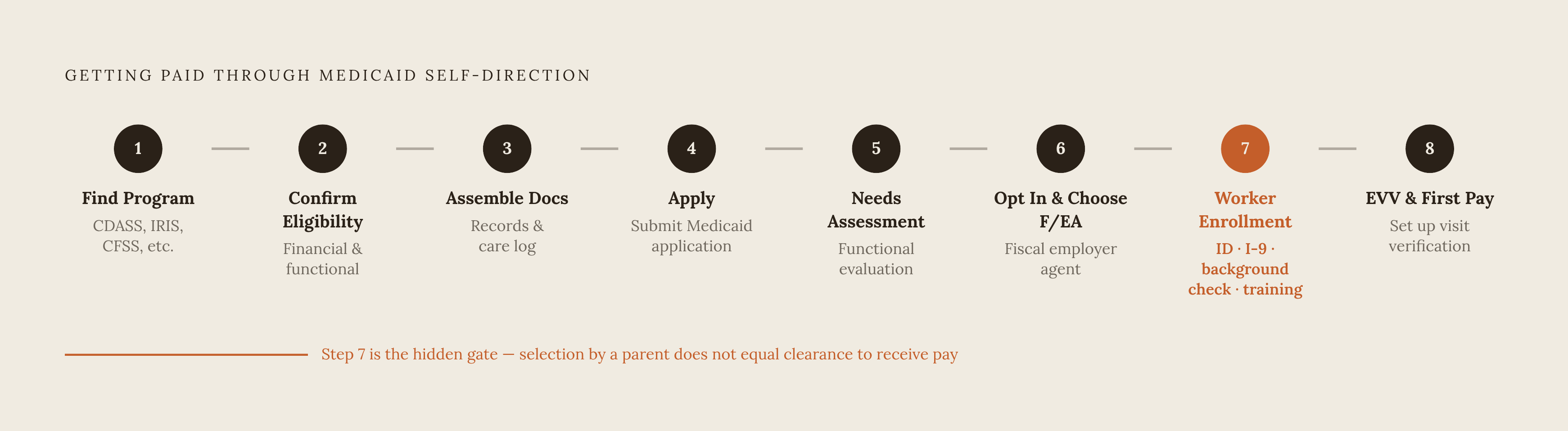
Start with your state Medicaid agency and ask which self-directed program permits an adult child to care for an aging parent. Names differ considerably. Colorado has CDASS, Wisconsin has IRIS, and Minnesota has CFSS, while Alabama’s option is called Personal Choices. These distinct programs are illustrative entry points. Finding the correct name tells you which agency handles the process and which requirements apply.
Those names come from different federal routes, which include the HCBS State Plan Option under 1915(i), the Community First Choice Option under 1915(k), and the Self-Directed Personal Assistance Services State Plan Option under 1915(j). States also use home- and community-based services, or HCBS, waivers. The route affects who qualifies and how long they wait, so ask these two questions right away. Does this program allow the parent to hire an adult child? Is there a waitlist?
Standard 1915(c) waivers can have waitlists lasting months or years. Also ask whether the person who plans to be the caregiver must become a certified Medicaid provider, since some states require this before they will pay.
Confirming the parent's Medicaid eligibility — financial and functional — before any application
Once you identify the program, establish whether your parent can meet its two eligibility tests. The first concerns finances. Each state sets income and asset thresholds for its HCBS waiver programs, and those thresholds can change. Ask the state agency for the current limits that apply to the specific program rather than treating a general Medicaid figure as definitive.
What if your parent owns a home? A primary residence is typically exempt from asset counting, and a homeowner’s eligibility depends on meeting the applicable requirements. The agency still needs to evaluate the parent’s income and countable assets under the applicable rules.
The second test concerns functional need. Most HCBS waiver programs require a nursing-facility level of care, supported by documented needs for help with daily activities such as bathing, dressing, meal preparation, and mobility. The 1915(i) state plan option is an important exception because it does not require nursing-facility level of care. A parent with moderate impairment may therefore have a way to qualify even if their needs seem to fall below a waiver’s functional threshold.
Assembling the documents before filing the Medicaid application
Document gathering can run in parallel with those eligibility conversations. For your parent, assemble government-issued identification, existing insurance cards, and proof of income, including Social Security award letters and pension statements. Add bank statements and property records for the asset review. Current physician contact information and a medication list support the care-related parts of the process. If someone will act on your parent’s behalf, include the relevant power of attorney or guardianship order.
Start a daily care log immediately. Record what help your parent needs and how often, rather than waiting until an assessment appointment is scheduled. This log serves a different purpose from a bank statement. Financial records support one eligibility test, while the care log provides evidence for the functional assessment and the hours decision that follows. Detailed preparation reduces the back-and-forth that commonly delays applications.
The person who plans to be the caregiver should also gather government-issued identification to use later for worker enrollment. Separately, a live-in caregiver should raise the IRS difficulty-of-care exception with a tax professional before enrollment is finalized. Some qualifying Medicaid payments can be excluded from taxable income.
Submitting the Medicaid application and what happens during the review period
Send the application to the state Medicaid agency using one of the ways it accepts applications. Many states accept applications online, by mail, or in person at the county Department of Social Services or an equivalent office. The records assembled earlier now support a formal financial review. The functional assessment is typically scheduled separately and can become the slowest part of the process, so request scheduling as early as possible.
How long should a family plan to wait? Several weeks to a few months is a useful estimated planning range for a Medicaid determination. The full interval from application to first paycheck can run several months because a financial decision does not complete the care plan or worker enrollment. Silence during review is not, by itself, a denial. Equally, an approval letter is not necessarily permission to begin billing for care.
Do not quit outside employment before both the care plan and worker enrollment are approved. A waiver waitlist creates another distinction that is easy to miss. Your parent may qualify for Medicaid but still have to wait for self-directed services. If that happens, ask the agency about interim options and whether Community First Choice or another state plan option could bridge the gap.
Requesting the functional needs assessment and understanding how authorized hours are set
A Medicaid case manager or assessor evaluates the parent’s ability to perform daily activities, including bathing, dressing, grooming, mobility, meal preparation, and medication management. The home assessment addresses both eligibility and the amount of care the program will authorize. Those are related but distinct decisions. Qualifying for services does not settle how many hours will be paid.
Attend the assessment and use the daily care log to explain what assistance is needed and how often. Ask which factors influence the authorized hours and whether the budget is expressed per week or month. Thorough documentation can support an hours determination that reflects the parent’s needs, but it does not guarantee a particular award.
The resulting care plan sets the boundary for billable work. When a family gives more help than the authorized amount, even help that is needed, those extra hours do not automatically become paid time. This is why the assessment deserves sustained attention rather than being treated as a single appointment to get through.
Formally opting into self-direction and selecting a fiscal employer agent
The parent, or the person representing them, must affirmatively choose the consumer-directed option, typically during the care plan meeting with the Medicaid case manager. This is the employment pivot. The parent formally names the adult child as the caregiver, and the program connects the family with a fiscal employer agent, or F/EA, sometimes called a fiscal intermediary.
The F/EA handles the administrative work behind payment, including worker enrollment, payroll, tax withholding, and payroll reports. Check which intermediary the program now uses, since families may not have a choice of agencies. New York’s CDPAP move to Public Partnerships LLC in April 2025 shows why older information about an intermediary may no longer explain how to enroll.
Before naming the paid worker, resolve any representative-role conflict identified earlier. If the adult child holds power of attorney or guardianship, ask the state whether that authority conflicts with serving as the paid caregiver under the chosen option. A family relationship and a legal representative role are not the same thing. The employment arrangement needs to fit both the program’s family-hiring rules and its restrictions on who directs services.
Completing caregiver worker enrollment — paperwork, background check, and required training
The adult child’s worker enrollment is separate from the parent’s Medicaid application. Finish it through the F/EA before expecting pay to start. The caregiver usually needs government-issued identification, a Social Security number, I-9 employment eligibility verification, and a background check. Background-check requirements vary by state. The fact that you already provide the care does not replace these employment steps.
Most states also require basic caregiver training before the first billable hour. The training often covers safe transfers, infection control, emergency procedures, and how to keep records of the care given. Finish the training the program requires and get any Medicaid provider certification the agency said was needed when you first asked.
What distinguishes being selected from being ready to work for pay? Selection identifies whom the parent wants as a caregiver, while completed worker enrollment satisfies the program’s hiring requirements. Both are necessary parts of the arrangement. A family can have a parent who has been approved, a caregiver who has been chosen, and a fiscal intermediary, yet still have enrollment steps left to finish. Until those requirements are complete, the intended employment arrangement has not reached the point where payment can begin.
Setting up electronic visit verification and receiving the first paycheck
Electronic visit verification, or EVV, links the care that was given to payroll. Federal law requires states to use EVV for personal care services, and caregivers must record their visits digitally through an app, phone call, or device. Set up the program’s system before expecting to be paid for covered visits. For each care session, the check-in and check-out records document that authorized care was delivered. The F/EA collects those records and processes payroll, typically biweekly, although schedules vary by state and program.
Only care within the authorized plan is billable. Do not assume that undocumented help will receive retroactive payment, and keep care logs and EVV records consistent with the plan. Hourly rates depend on the state, program, and authorized care level, so another family’s wages may tell you little about what you will earn. Pay usually comes as W-2 income on which federal income tax, Social Security, and Medicare taxes are due. The difficulty-of-care exclusion discussed earlier can change how federal income tax applies to live-in caregivers who qualify, though Social Security and Medicare taxes generally still apply depending on the employment relationship.
For families who want help without a navigator, an AI-powered enrollment support tool can help find self-directed programs that may fit and guide them as they get documents ready. Its useful role is concrete. It can support the search and paperwork, while the state program determines eligibility and authorized care and the F/EA handles worker enrollment and payroll. That distinction keeps enrollment assistance separate from a promise of approval or pay.
There is also a reason not to postpone an eligible application. KFF’s 2025 brief describes large cuts in federal Medicaid spending under the 2025 reconciliation law, with estimates covering the next decade and optional home care benefits at particular risk of cuts by states. Families who qualify now should enroll. The documented process is navigable today, even though its timing and paid hours depend on the program your family enters.