What Eldercare Families Lose When They Rely on a Caseworker to Navigate Self-Direction Enrollment
Relying only on a caseworker can cost families time, pay, and appeals.
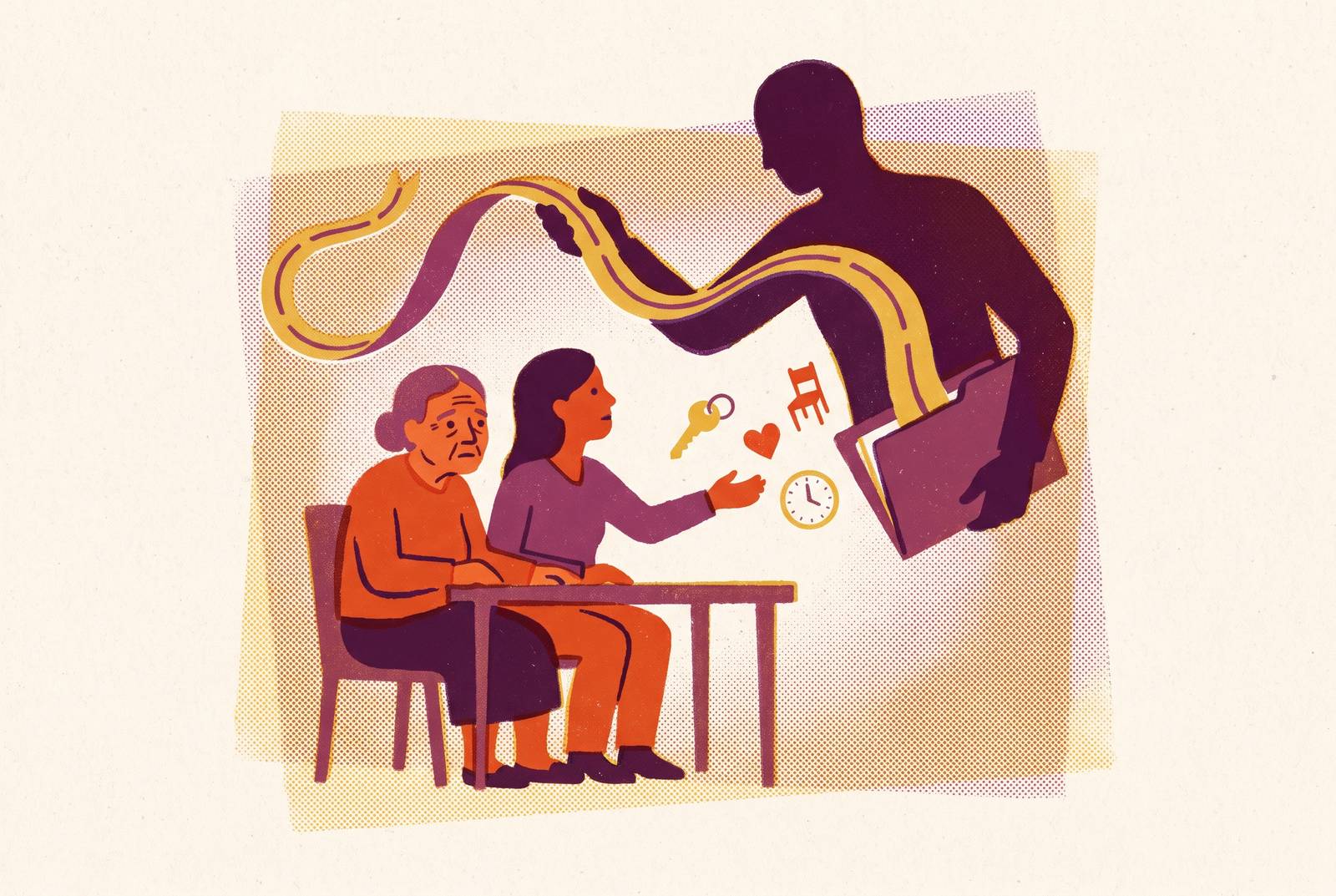
Medicaid self-direction can let family caregivers get paid to care for an elderly parent, but access depends on the program’s eligibility and family-provider rules. Families relying only on a caseworker risk missing options, losing waiting-list time, and accepting wrongful denials. Independent advocates and AI-assisted benefit discovery tools can work alongside caseworkers to help families find programs that may fit their needs and enroll in them.
What self-directed HCBS actually is and what it offers eldercare families
Self-direction is a Medicaid delivery model that gives beneficiaries control over their home- and community-based services, or HCBS, rather than placing those decisions with a home care agency. Employer authority lets a beneficiary recruit, hire, train, schedule, and dismiss a worker, potentially including a family member. Budget authority lets the beneficiary choose approved goods and services within the budget they are given and their person-centered service plan. The distinction changes what a participant can control. The Medicaid and CHIP Payment and Access Commission’s June 2025 report explains that states may offer either authority or both, with different requirements.
These choices have measurable consequences for care. The Cash and Counseling Demonstration across Arkansas, Florida, and New Jersey found that self-directing participants were more likely to receive paid care, reported higher satisfaction, and had comparable or better health outcomes than participants receiving agency-directed care. The demonstration also found that self-direction reduced nursing home admissions by 40%. Health Affairs Scholar’s 2025 study found that over half of dually eligible beneficiaries 65 and older who received personal care used self-direction. Access to this model is therefore not a marginal concern in eldercare.
Why caseworkers alone cannot reliably surface self-direction as an option
Yet the person helping a family find their way through Medicaid may not know every self-directed option well. Caseworkers operate across programs whose rules differ on eligible populations, services, budget control, and paid family care. Their responsibilities also pull in different directions. They support beneficiaries while enforcing eligibility rules and meeting program integrity requirements, often with large caseloads. Proactive benefit discovery competes with those duties.
MACPAC’s June 2025 report identifies a wider support system that includes beneficiary advocacy organizations, information and assistance professionals, financial management services agencies, managed care organizations, and support brokerages. The report says families may find it hard to tell which of these groups does what. That confusion can make a caseworker seem like the only way to get help, even when others know more about a particular program. A caseworker’s silence about an option does not establish that the option is unavailable.
How uneven state-by-state design turns the caseworker knowledge gap into a geographic lottery
The cost of that knowledge gap depends partly on where a family lives. MACPAC’s December 2024 slides describe multiple federal authorities that states use, sometimes concurrently, to administer self-direction, each with different requirements for eligibility, family providers, contracting, and payment. State choices shape both the support available and the route into it. Whether families hear about self-direction also depends on how much states do to tell people about it.
The contrast between 1915(c) waivers and 1915(k) Community First Choice makes the stakes concrete. Waivers can limit enrollment slots and maintain waiting lists, while Community First Choice offers an entitlement without an enrollment cap or waitlist in states that adopt it. A family hearing only about a waiver may never learn that a no-waitlist pathway could exist. Geography can narrow access within a state, too, because some waivers serve only specified regions. Rural families face another mismatch: self-direction is used least in rural areas, though it could help where there are too few direct care workers by allowing family members to provide care.
The first concrete loss: families who don't get on waiting lists early enough forfeit irreplaceable queue time
When a program limits enrollment, discovering it late has a cost that better information cannot later erase. Nationally, HCBS waiting lists hold hundreds of thousands of people, and waits can stretch into years. During that wait, the person who needs care may go without the program’s services while a relative cares for them without pay. Queue time is a resource families cannot replenish. Families who learn about a waiting list only when care becomes urgent have lost the chance to join it earlier.
Raising future waiting-list needs before a family sees an urgent problem is often outside the typical scope of case management. The consequences of that missing conversation still fall on the family. Someone who discovers self-direction a year or two into unpaid caregiving has already supplied substantial uncompensated care. Eventual enrollment cannot retroactively reimburse that period, so a successful application does not repair every loss that preceded it.
How can family caregivers get paid through Medicaid self-direction when they don't know which relatives qualify?
Even a family that enrolls in time may not learn who can be paid. Consider the relative already providing daily help who understands self-direction as a way to choose an outside worker and overlooks it as a possible source of compensation for their own work. Whether that relative qualifies depends on the particular program. States may rule out paying spouses or legally responsible relatives, and programs within the same state may have different rules on which relatives can be paid.
MACPAC’s December 2024 slides note that over 50% of self-directing individuals hire a relative or someone they know when they have the opportunity. The June report also notes that allowances for paid family caregivers have grown since the COVID-19 pandemic, so an answer from an earlier caseworker contact may no longer describe a family’s options. Health Affairs Scholar’s study confirms that the restrictions differ by state and program authority. For the person already doing the work, the relevant question is therefore specific to their relationship and the program under consideration. Months or years of missed compensation cannot be recouped simply because the family eventually learns the rule.
The third concrete loss: caseworker application errors that produce wrongful denials families don't know to challenge
A further loss occurs when a family reaches the application stage but receives an incorrect decision. The Pennsylvania Health Law Project has published guidance warning that County Assistance Office caseworkers often misapply the special MAWD income rules when reviewing waiver applications. People who qualify can consequently be denied. The guidance also describes wrongful terminations affecting long-term waiver participants when computer system errors compound caseworker mistakes.
The burden becomes clearer in the experience of Lori Harter, a physical therapist in Indianapolis. Harter learned that her son Elliot had lost Medicaid coverage from his case manager after the fact, with no notice from the state. Months of phone calls, paperwork, and answers that did not agree followed, taking as much work as a second job. This example illustrates the work a family can face after coverage is terminated. The administrative decision does not end the problem.
For families without independent guidance, the harder question is whether a decision should be challenged at all. An official denial may appear conclusive when the family has no separate understanding of the applicable rules. Unlike elapsed waiting-list time, a wrongful decision can be challenged through an appeal. But that route offers little protection to a family that never learns an error may have occurred.
What additional funding sources families miss when waiver enrollment is delayed or denied
Delayed or denied enrollment can also block access to waiver-funded home modifications, equipment, and community services. Medicare excludes structural home modifications such as stair lifts, ramps, or grab bars from coverage, while Medicaid HCBS waivers under Section 1915(c) provide more public funding than any other source for home accessibility modifications for low-income people with disabilities. Medicare Part B does cover medically necessary, prescribed durable medical equipment, including wheelchairs, hospital beds, and certain power chairs. Families may miss that narrower equipment pathway when their attention remains fixed on a failed waiver application.
Other resources have their own eligibility gates. The FY2026 Specially Adapted Housing grant helps veterans who qualify, while the USDA Section 504 Home Repair program offers loans and grants to low-income homeowners in rural areas. ABLE accounts provide tax-advantaged savings usable for home modifications and, as of January 1, 2026, are open to people whose disability began before age 46. These are distinct resources separate from Medicaid waivers, and an account for savings is distinct from a grant. A standard caseworker interaction does not automatically cover any of these resources, leaving families with another discovery task.
The mental health cost of system-navigation failure that falls on caregivers doing this alone
That discovery work adds to a burden that is already separate from hands-on care. Clinicians specializing in psychotherapy for family caregivers have observed that system-navigation difficulties frequently surpass caregiving tasks, relationship challenges, and employment stress as reasons people seek help. One analyzed caseload over six months found that 54.5% of caregiver clients cited frustration with navigating the healthcare system as their primary reason for seeking help. The finding is limited to the analyzed caseload. It nevertheless identifies navigation itself as a source of distress rather than treating all strain as an unavoidable consequence of caregiving.
Research also identifies documentation, paperwork, and benefits navigation as care-management stressors with direct financial consequences. A family may therefore be handling both the loss of support and the work required to contest it. That burden is not a personal failing. The 2025 AARP Caregiving in the U.S. Report documents that tens of millions of Americans provide care for adults, yet peer and community resources remain underused by families who do not know to look for them.
What families can do to fill the gaps a caseworker alone cannot cover
The lesson for families is to supplement caseworker contact with independent discovery and review. The first step is to seek entry onto HCBS waiver waiting lists as early as possible, before the need feels urgent. Timing deserves its own conversation with the caseworker. Families should also ask which Medicaid authority governs each proposed program and whether a no-waitlist state plan option exists in addition to a waiver. This separates the question of which services a program offers from the question of how soon a person can access them.
The next step is to ask, in writing, which family members may be paid under each program discussed. A general assurance that a program offers self-direction is not enough to resolve that question. If an application is denied, families should request independent verification from a beneficiary advocacy organization or legal aid program, particularly when complex waiver income rules are involved. Review provides a separate check on the decision. It keeps the caseworker’s determination open to challenge.
Free tools designed for complex benefit searches can rapidly surface Medicaid self-direction pathways, waivers, and supplemental funding sources a family may qualify for. Platforms that combine discovery with human enrollment support address both finding an option and following through. These tools identify possibilities whose eligibility remains to be determined. Their useful distinction is whether they only surface programs or also guide families through enrollment.
More caseworker training would not, by itself, remove large caseloads, divided responsibilities, or the complexity of state program design. Peer and community resources can also help families approach navigation with support.
Sources
- Chapter 5: Self-Direction for Home- and Community-Based Services
- Paying family caregivers: self-direction in medicaid personal care - PMC
- Medicaid and CHIP Payment and Access Commission Self-Direction for Home- and
- 1 Preparing to Unwind from the Pandemic: Expanding Self- Direction
- Medicaid’s Home Care Support for Family Caregivers in 2025