How a Family Caregiver Gets Credentialed as a Paid Provider Under a Medicaid Self-Directed Waiver
A relative can be paid only after clearing these steps in order.
A family caregiver becomes a paid provider under a Medicaid self-directed waiver through program enrollment. The care recipient must qualify, choose self-direction, and establish employer authority, while the caregiver meets relationship, background-check, training, and fiscal intermediary requirements. Understanding that sequence turns a possible benefit into an authorized arrangement for paid care.
Why standard Medicaid does not pay family caregivers — and what changes that
Standard Medicaid does not pay relatives for personal care as a matter of course. Under its agency-directed structure, the agency chooses workers and sets their schedules. Self-direction changes who controls those decisions. MACPAC's June 2025 report defines self-direction as a beneficiary-controlled home and community-based services model that gives the individual authority over providers and the amounts, duration, and scope of services.
Three federal authorities create routes into this arrangement. The 1915(c) HCBS Waivers let states design home and community-based programs with their own provider requirements, subject to federal approval. The 1915(j) Personal Assistance Services authority lets participants set worker qualifications and training, and lets states allow legally liable relatives to be paid. The 1915(k) Community First Choice authority is another way to get self-directed services, and state program rules decide whether family members can take part.
Medicare does not pay family caregivers, although it covers part-time or intermittent skilled home health care through certified agencies. The person must be able to enter a Medicaid program that permits self-directed family care.
Two things the care recipient must establish before a family caregiver can be enrolled
The first eligibility decision concerns the care recipient. Before a caregiver can enroll, that person must meet a financial test and then a functional level-of-care assessment. To qualify financially, the person must meet the nursing-facility-level rules that apply to their income and assets. For South Carolina's Community Choices Waiver, the 2026 income limit is $2,982 a month under nursing facility rules, with income deposited into an Income Trust excluded from the count.
Assets require a separate look from monthly income. The primary home and one vehicle are typically excluded from countable assets, but the remaining allowance is low and varies by state. A care manager or nurse assessor then evaluates whether the person needs a nursing-facility level of care. That assessment also shapes the service hours and budget against which the caregiver will eventually be paid.
The recipient or representative must explicitly request self-direction because most programs otherwise route people into agency-directed care. Timing is another constraint, as 1915(c) waivers allow states to cap enrollment and many maintain waitlists. The practical response is to apply early and have the required documentation complete.
Which family members a state may — and may not — allow as paid caregivers
Can the particular relative providing care be paid? That question runs parallel to the recipient's eligibility, rather than waiting until every other step is finished. The answer depends on the relationship, the federal authority funding the service, and the state's choices under that authority. MACPAC's report says states have wide room to decide which relatives can be paid, and the rules differ both between states and within a state.
Adult children and non-spousal relatives are commonly permitted. Spouses face a different test because programs have historically treated spousal care as an ordinary marital duty. Under 1915(j), a state may let legally liable relatives be paid, including spouses and parents of minor children.
South Carolina illustrates how these rules can narrow further. Its waiver allows adult children and other relatives who are not “legally responsible” for the participant, while spouses may be paid only if not legally responsible and upon request. Parents or stepparents of minors are excluded. Because “legally responsible” can mean different things by state and program, families should request a written determination from the state Medicaid agency when their status is unclear.
Employer authority enrollment — how the care recipient becomes the legal employer
Under employer authority, the care recipient or designated representative takes on the legal employer role. The state does not become the caregiver's supervisor. The recipient selects the worker, sets tasks and schedules, and supervises the care, while the family caregiver is accountable to that person.
Employer authority is not the same as budget authority. MACPAC's report distinguishes choosing who provides care from deciding how a monthly service budget is distributed. States may offer one model or both.
What happens when the recipient cannot carry out an employer's duties? A designated representative may act on their behalf because of cognitive impairment, age, or medical status. A family member may be considered for that role, but states differ on whether one person can serve as both representative and paid caregiver, and some prohibit it. Families should verify that arrangement with the program before completing employer-authority paperwork through the state Medicaid agency or administering managed care organization.
The background check and what disqualifies a family caregiver
The background check is the first caregiver-specific screening requirement. A family relationship does not create an exemption. Paid caregivers are treated as employees and must pass the required criminal background check, even when they have already provided unpaid care for years.
Disqualifying offenses are set by the state. South Carolina's waiver rules require a paid attendant to have no known conviction for abuse, neglect, or exploitation of adults or children, no crime against another person, and no felony conviction of any kind. This illustrates why checking only for felony convictions would miss part of the standard. Other states determine their own scope and exclusions.
Some programs also check a Medicaid provider exclusion registry. A person excluded from federal health care programs generally cannot enroll as a paid caregiver unless OIG grants a waiver. Most caregivers pass screening without a problem, but the time it takes varies. The practical step is to initiate the check early through the program's process, which in some cases is managed by the fiscal intermediary.
Training requirements — what the program requires versus what credentials you can buy
The relevant standard is the training required by the program paying the caregiver. Most self-directed personal care programs do not require a professional license, CNA credential, or Home Health Aide certification. A purchased course counts only if the program accepts it.
The commonly cited 75-hour rule belongs elsewhere. The home health aide training rule in 42 CFR 484.80 is a Medicare home health agency condition of participation. It applies to aides working for certified home health agencies. Treating it as a universal requirement confuses two different care arrangements.
Under 1915(j), participants have authority to train workers and specify their qualifications. In some programs, the person receiving care therefore formally trains the family caregiver. Ask the state program or fiscal intermediary for its training requirement in writing before paying for a course. Where the program provides required training at no cost, that route avoids buying a credential the program may not recognize.
How can a family caregiver get paid without handling all the payroll paperwork?
A fiscal intermediary supplies the financial administration behind self-direction. This state-contracted entity handles payroll processing, tax withholding, and compliance paperwork on behalf of the care recipient as employer. MACPAC's report establishes that states must provide financial management services to support people managing self-directed care. Administrative help does not transfer control over daily care away from the recipient.
The caregiver still has an enrollment step to complete. This usually means proving their identity, setting up direct deposit, and sending in background-check results. Under South Carolina's self-directed attendant care rules, the recipient or appointed employer of record directs the work and sets the schedule, while the contracted intermediary pays the attendant. The caregiver receives a regular paycheck with taxes withheld.
Documentation continues after enrollment through the program's timekeeping process. Where required, electronic visit verification, or EVV, verifies the time and location of care, usually through a phone app or landline call. It is part of payment administration. Compensation begins only after intermediary enrollment is complete and services are authorized, so prior unpaid family care is not a reserve of billable hours.
The complete sequence from first contact to first paycheck
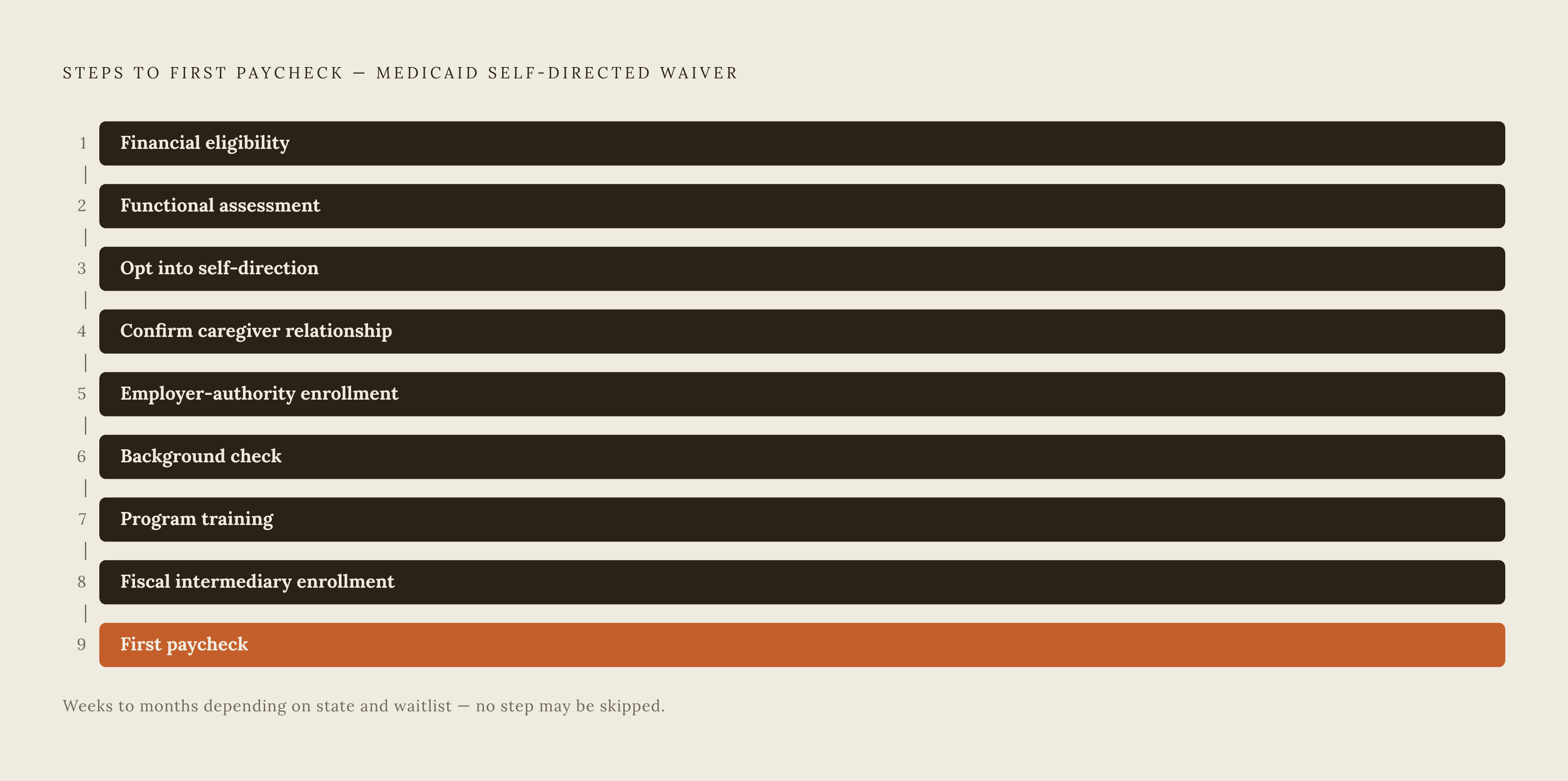
For a family tracking progress, the sequence begins with the recipient's eligibility. Contact the state Medicaid agency or local Area Agency on Aging to establish the financial requirements and the applicable functional standard. Ask for HCBS waiver services with self-direction. Complete the care manager's functional assessment so that the program can establish the authorized level of care and service hours.
The next stage establishes who may direct and deliver care. Complete employer-authority enrollment for the recipient or permitted representative. Confirm that the proposed caregiver's relationship is allowed under that particular program, obtaining a written determination if “legally responsible” status is uncertain.
Start the background check early, get the training requirement in writing, and use training from the program when it is available. Submit the identity, banking, and background-check documentation required by the fiscal intermediary. Set up EVV if the program requires it.
Once enrollment is confirmed and services are authorized, deliver and document the approved care. The first paycheck follows the first completed pay period after fiscal intermediary enrollment is confirmed. From first contact to payment, families should plan for weeks to months, depending on the state, waitlist status, and how quickly documentation is gathered.
Three variables that change the process depending on who you are and where you live
The first variable is the recipient's population category. Programs for adults with intellectual or developmental disabilities, elderly adults, and children with medical complexity have different waivers and rules. The AAP's 2025 Advocacy Action Guide notes that most states have enabled paid family caregiving for seniors and adults with disabilities, but only a small number have done so for children. Parents therefore need to investigate the specific pediatric pathway their state has opened.
The second variable is the program's federal authority. Under 1915(c), states set training standards and provider qualifications subject to CMS approval, while 1915(j) gives participants authority to specify worker qualifications and train workers. The third variable is the state's own elections, including which relatives it permits, whether enrollment is capped, and which fiscal intermediaries it contracts with. These choices change the requirements without erasing the underlying sequence.
Research in one state is not transferable approval. A caregiver who moves to another state, or looks into care for someone in another state, should start the program research over. The state Medicaid agency and local Area Agency on Aging are the starting points for identifying the rules that apply to the recipient's actual circumstances.
What to do before the process starts and where to get help navigating it
Before formal enrollment, establish which waiver programs are active in the state, whether a waitlist applies, and whether the proposed family relationship is permitted. A local Area Agency on Aging is a free starting point for connections to HCBS waiver intake and information about consumer-directed options. The state Medicaid agency is the authoritative source for program-specific training, background checks, and approved fiscal intermediaries.
AI-assisted benefit discovery can make the first round of research easier. These tools can find programs a family might qualify for and point out self-directed options they might otherwise miss. That discovery function is different from the fiscal intermediary's payroll and compliance role. It should not be confused with an eligibility decision or a promise that software completes every enrollment requirement.
The central obstacle is often finding the right program and knowing to request self-direction. Once the recipient qualifies, the relationship is permitted, and the required enrollment steps are complete, authorized family care can become paid work. The system is opaque, but the path is defined.