Home Health Care vs Home Care Key Differences
Understanding which care type your insurance covers prevents costly gaps in support.
A hospital discharge planner says a patient will need "home health" after surgery. A neighbor recommends a "home care" agency that helped her mother for three years. A Medicaid caseworker mentions a waiver program that covers one but not the other. Within a single conversation, a family can hear both terms used as if they were synonyms, and the stakes of that confusion are not academic: a wrong assumption at the moment of hospital discharge, a new diagnosis, or a fall can mean days or weeks without the right kind of help in place. Agencies, insurers, and care coordinators do not even use the terms consistently from one state to the next. A family comparing two options on paper may be comparing two entirely different systems without realizing it. The distinction is this: home health care is medical care ordered by a doctor, and home care is nonmedical support with the tasks of daily living. Everything else in how these services are staffed, billed, and paid for flows from that single line.
What home health care is and what it actually covers
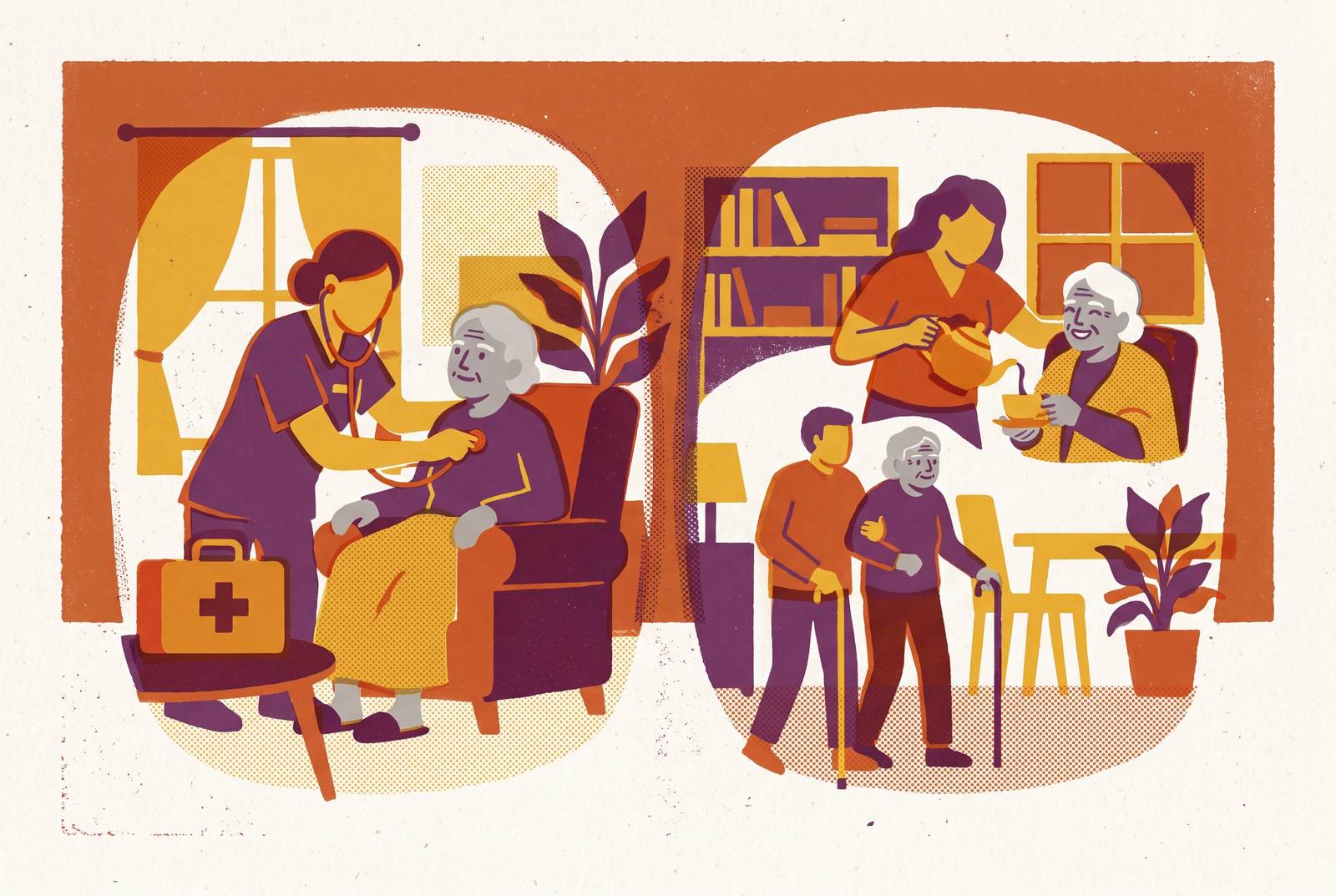
Home health care is skilled, physician-directed medical treatment delivered in a patient's home, aimed at treating a condition, supporting recovery from surgery or illness, or managing a chronic disease. A physician or authorized practitioner has to establish and periodically review a plan of care before any service begins, so a patient or family member cannot simply call an agency and request home health visits the way they might request a home care aide. The covered services include skilled nursing (wound care, injections, IV therapy, monitoring of serious illness, patient education, and in some cases catheter care), physical therapy for gait training and strength rebuilding after surgery or stroke, occupational therapy for retraining daily tasks and adaptive equipment use, speech-language pathology for speech and swallowing rehabilitation, and medical social services. Home health aide services are also covered, but only under a condition families frequently misunderstand: aide visits are a dependent benefit, only covered while the patient is also receiving a skilled service like nursing or therapy. An aide cannot be the only service a patient receives under the home health benefit. That matters because it's the seed of a coverage gap discussed later in this piece: once the skilled service ends, the aide visits that depended on it end too, regardless of whether the person still needs help getting dressed or bathed.
Home health care is episodic by design. It is built around clinical goals, not around how a family feels about the level of support in place, so it ends when those goals are met or when the patient no longer meets the clinical criteria for skilled care, not when a family decides the help is no longer needed. Under Medicare, a physician has to recertify a patient's eligibility every 60 days for the care to continue, which keeps the benefit tied tightly to an ongoing medical need rather than functioning as an open-ended support service.
What home care covers
A family arranges home care based on a person's safety needs and preferences, covering nonmedical support with the ordinary tasks of daily life. There's no referral required, no clinical plan of care, and no recertification cycle. The services typically include personal care such as bathing, dressing, grooming, toileting, and mobility assistance, along with meal preparation, light housekeeping, companionship, supervision, errands, transportation to appointments, and medication reminders.
That last item deserves a precise distinction, because it's one of the most common points of confusion families run into. A home care aide can remind someone to take a pill sitting on the counter. That aide cannot administer medication, meaning draw it up, inject it, or manage a dosing schedule that requires clinical judgment, because that crosses into a task that requires licensing and falls on the home health side of the line. The boundary is a matter of what license the task legally requires, not how trustworthy or experienced a given aide is.
Home care is also structured differently in terms of duration. Where home health is episodic and ends on a clinical timeline, home care is flexible and ongoing, scaling from a few hours a week of help to around-the-clock coverage, and it can continue for years as a person's needs evolve. There's no eligibility test beyond need and ability to pay: any older adult who would benefit from regular help with daily activities qualifies, in the sense that no diagnosis or physician order stands between a family and arranging it.
How the medical/nonmedical line reshapes the care team
Once the medical/nonmedical distinction is clear, the question of who actually shows up at the door follows directly from it, because the two workforces are trained, licensed, and regulated for fundamentally different jobs. On the home health side, the care team includes licensed nurses (RNs and LPNs), certified nursing assistants, physical therapists, occupational therapists, speech-language pathologists, and medical social workers, all carrying out services ordered under a physician's plan of care. Medicare-certified agencies providing these services have to meet strict federal and state standards covering caregiver qualifications, clinical practice, and recordkeeping, which is part of why the home health benefit comes with the structure and paperwork it does.
The home care team looks different. It includes home care aides, personal care aides, and companions, and their credentialing varies widely depending on where a family lives. There is no federal training mandate for nonmedical personal care aides, and state requirements range from minimal to fairly structured, so the qualifications of a home care aide in one state may bear little resemblance to those in another. Families hiring home care also have a choice that home health does not offer: hiring through an agency, which typically brings a vetted and insured worker, versus hiring privately, which shifts more of the vetting, scheduling, and liability responsibility onto the family itself.
None of this makes one workforce more valuable than the other. It makes them suited to different tasks. A home care aide, however experienced and capable, cannot legally perform the clinical work a nurse or therapist is trained and licensed to do, and recognizing that boundary is part of how a family identifies which kind of care they're actually looking at.
How insurance covers each type of care
Medicare covers home health care at $0 to the patient, but only when four conditions are met together: a physician orders the care, the patient is homebound, the need is for intermittent skilled care, and a Medicare-certified agency delivers it. "Homebound" has a specific meaning here: leaving home has to require considerable and taxing effort, though brief absences for medical appointments, religious services, adult day care, or family events don't disqualify a patient from the benefit. Durable medical equipment carries a coinsurance cost even under this benefit, while the core covered services do not. Medicare Advantage plans vary by carrier, and some offer supplemental in-home aide hours beyond what traditional Medicare provides, so check the specifics plan by plan.
What Medicare does not cover under home health is explicit: 24-hour-a-day home care, meals delivered to the home, and custodial personal care when that's the only care a person needs. The exclusion is categorical, built into how the benefit is defined, so it cannot be appealed or negotiated around case by case.
Medicaid covers home care in many states through home and community-based services waivers, with eligibility based on income and assets. Long-term care insurance policies cover nonmedical home care once the policy's benefit triggers are met. Certain VA programs cover in-home aide services for eligible veterans and, in some cases, their family caregivers. Outside of those, private pay remains the default, and the national median cost of home care in 2026 is paid most commonly out of pocket, making the funding programs covered later in this piece worth a family's attention. The confusion between these two services extends to benefits themselves: a family that doesn't know whether it needs home health or home care may end up pursuing the wrong application entirely, or missing eligibility for a program it actually qualifies for. Brevy's free benefits navigator is built around that exact problem, helping families identify which programs apply to their specific situation once the terminology is clear.
The coverage gap that opens when home health ends
Picture a patient discharged from the hospital on a Friday afternoon after a hip replacement. A home health agency is lined up for skilled nursing visits and physical therapy, the physician's order is in place, and for several weeks, everything functions as it should. Then the clinical goals are met: the wound has healed, the physical therapist signs off on the gait training, and the home health episode ends, exactly as it was designed to. What often hasn't happened is any plan for the fact that the patient still can't reliably shower alone, still needs help preparing meals, and still shouldn't be left unsupervised for long stretches during the day. The clinical need has resolved. The daily-living need hasn't.
This is where the dependent-aide rule from earlier becomes a real problem rather than a technical footnote: once the skilled service ends, the aide visits tied to it end automatically, even when the person's need for help with bathing or dressing stays exactly the same. Home health is episodic and goal-oriented by design, not a failure of the system, but a family that doesn't know this in advance experiences the transition as a sudden and unexplained loss of support. The common mistake is treating home health and home care as a sequence, waiting until the home health episode fully concludes before even beginning to look into nonmedical help, which guarantees a gap between the two.
The fix is to treat the two as potentially parallel rather than strictly sequential, arranging nonmedical home care before the home health episode ends, while skilled visits are still happening, which turns what would otherwise be a reactive scramble into a continuous handoff. A person can receive Medicare-covered skilled nursing visits on some days and privately arranged personal care on others in the very same week, and neither arrangement interferes with the other. The two systems run on separate tracks, and nothing prevents a family from building a comprehensive plan that recognizes it needs both.
How to tell which type of care a family needs
Which type of care is better is the wrong question, since that framing assumes a hierarchy that doesn't actually exist between two services built for different purposes; the better question is what this person actually needs right now, and the answer tends to fall fairly clearly on one side of the medical/nonmedical line once a family looks closely at the situation. Someone just discharged from a hospital, rehab center, or skilled nursing facility, or recovering from surgery, a stroke, or a significant illness, is describing a home health situation, particularly if a doctor has already indicated that skilled nursing or therapy is needed, or if the person requires wound care, injections, IV therapy, or monitoring of a medical condition at home. In that case, the next step is to ask the hospital discharge planner or primary care physician for a home health referral, since the physician's order initiates the Medicare benefit.
A different picture points toward home care instead. A person who is medically stable but struggling with bathing, dressing, preparing meals, or being safely alone during the day fits that description, as does a situation where family caregivers need relief or simply can't consistently provide the level of help required. The need here tends to be ongoing rather than tied to a specific medical event, and the next step looks different too: contacting home care agencies, estimating the number of hours needed, and identifying the payer, whether that's a Medicaid waiver, long-term care insurance, a VA benefit, or private pay.
A third pattern is common enough to deserve its own recognition: both kinds of care are needed at the same time. Someone in the middle of a home health episode may still need daily personal care beyond what the aide visits cover, or a home health episode may be winding down while the underlying need for support continues well past it, which is exactly the transition point described in the previous section. Because needs change over time, as a person's condition evolves or the family's capacity to provide unpaid care shifts, revisiting the arrangement periodically matters as much as getting it right at the start. Most families, if they stay in caregiving long enough, end up needing both forms of care at some point, which raises the next practical question: how to pay for the kind of care Medicare has already ruled out.
Finding funding for home care that Medicare won't pay for
Most families assume that once Medicare has excluded custodial home care from coverage, the only remaining option is to pay for it entirely out of pocket. That assumption is often wrong, but the funding programs that exist go unclaimed constantly, largely because the system that administers them is fragmented and opaque enough that finding the right one takes real effort.
Medicaid home and community-based services waivers are the most widely available option, covering personal care and in-home aide services for people who meet income and asset eligibility limits. These programs exist in most states, though the program names, eligibility rules, and number of covered hours differ significantly from one state to another. Michigan illustrates the pattern well: the state's Home Help program and MI Choice waiver function as the two primary Medicaid pathways for home care, each with its own application process and covered services, and a family researching options in one state can't assume the same program names or rules apply elsewhere.
A second category, caregiver compensation programs, is arguably the most underused benefit in the entire system. Some Medicaid waiver programs allow a family member, including an adult child, to be paid directly as the person's home care provider, turning what would otherwise be unpaid family labor into a compensated role. Many families never learn these programs exist, simply because no single source reliably informs them at the moment they need to know. Veterans' benefits offer a parallel path: certain VA programs cover in-home aide services for eligible veterans, and in qualifying programs, compensate family caregivers directly as well. Long-term care insurance remains the fourth major avenue, triggering a benefit for nonmedical home care once a policy's criteria, typically the inability to perform a defined number of activities of daily living, are met.
Knowing that these programs exist is only half the problem; matching a specific family's situation to the right one is harder, since eligibility rules, state-by-state variation, and overlapping programs make it easy to miss a benefit that's actually available. That is the gap a tool like Brevy is built to close, helping families check eligibility against Medicaid, VA, and caregiver compensation programs in one place. Understanding the distinction between home health and home care was never just a matter of vocabulary. It determines which door a family needs to knock on, and whether the help they eventually receive arrives on time or after a costly, avoidable gap.