Federal and State Caregiver Assistance Hotlines
Navigating fragmented federal and state systems leaves caregivers searching for help.
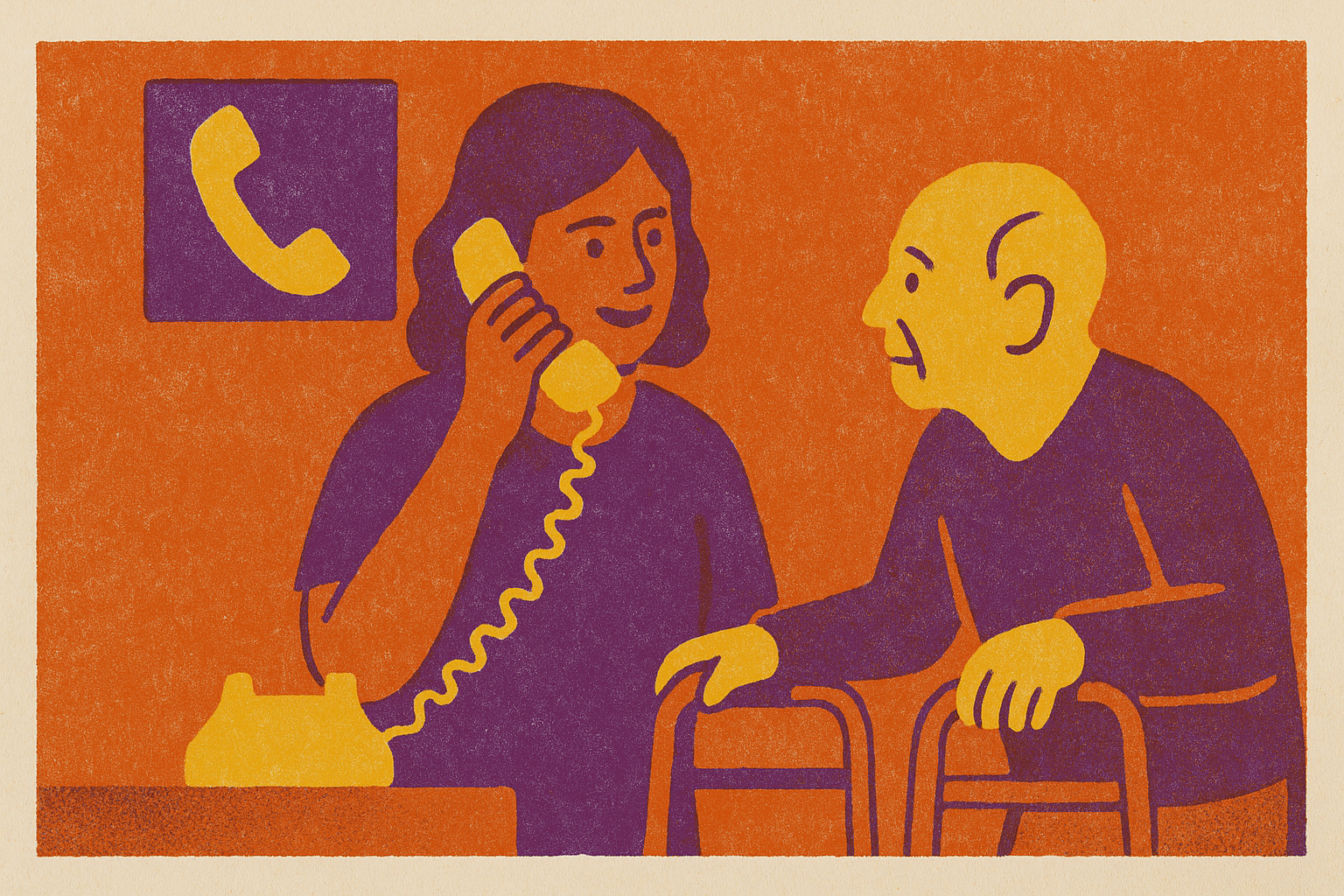
A caregiver dialing for help after a difficult night rarely knows which of three separate systems they are about to enter. They search a phrase like "caregiver support hotline," find a number, and call it, hoping it will know what they need before they can fully explain it. The United States has no single caregiver hotline. It runs a layered architecture of federal lines, state agencies, and nonprofit lines, all nominally pointed at the same caller but rarely coordinated with one another in practice. A caregiver reaching for the most visible number often lands on a layer that cannot resolve the specific problem in front of them, because that layer was never built to answer that particular question. The mismatch is the predictable output of a system assembled incrementally across federal, state, and local funding streams, each with its own mandate, its own grant cycle, and its own idea of what a caregiver call sounds like. Allegany County, New York offers a small but telling data point: the Office of the Aging reported a sharp year-over-year increase in front-desk telephone calls through mid-2025, a sign that more caregivers are reaching out precisely as the system is being asked to absorb that volume without a clear single point of entry.
How the federal layer was built
The federal government built the funding architecture underneath caregiver support and maintains two specific national lines, but it was never designed to deliver services directly to caregivers. That work happens at the state and local level, the foundation for everything that follows. The National Family Caregiver Support Program, authorized under Title III-E of the Older Americans Act and administered by the Administration for Community Living, is the backbone of the federal layer. Congress funds it, ACL distributes grants to every state, territory, and participating tribal organization, and states pass that money down to local Area Agencies on Aging, which are the entities that actually deliver training, counseling, support groups, and respite care to a caregiver's door. None of those core services carry an income test, so eligibility at the federal level is not means-tested, a detail that matters because it means the barrier most caregivers hit is not financial qualification but simply not knowing the program exists.
The Eldercare Locator, funded by ACL and administered by USAging, is the primary federal intake line, reachable at 1-800-677-1116. It connects older adults and caregivers to local services including meals, transportation, and home care across the country by routing callers to their local area agency on aging or a local aging and disability resource center based on zip code. That is the whole function: a referral and connection service, not a direct service provider. The Eldercare Locator will not provide counseling, will not enroll a caller in benefits, and will not resolve a state-specific Medicaid or long-term care question. Those needs sit one layer down, in the state system described in the next section.
The VA Caregiver Support Line, at 1-855-260-3274, available Monday through Friday from 8 a.m. to 8 p.m. ET, stands as the most fully developed single-agency federal caregiver line in the entire architecture. It serves caregivers, family members, friends, Veterans, and community partners seeking information related to caregiving for a Veteran, covering the Program of General Caregiver Support Services, the Program of Comprehensive Assistance for Family Caregivers, and VA In-Home and Support Services. Callers can also use it to check the status of a PCAFC claim moving through the four-step review or appeal process. What makes the VA line instructive is not that Veterans receive better treatment as a matter of policy preference, but that the line demonstrates what becomes possible when a single federal agency owns a defined population and a defined set of benefits end to end. No comparable federal program provides that same comprehensive benefit set to the general caregiver population. There is no single program on the other end of the line for non-Veteran caregivers to connect to.
Funding data from HHS TAGGS shows that NFCSP grant disbursements vary substantially by state size, and the size of that grant determines how much a local area agency on aging can staff and operate. Two callers in different states reaching what looks like the same federal program can end up with meaningfully different levels of service, simply because the grant behind their local AAA was larger or smaller. The federal layer also continues to change shape. In June 2026, ACL posted a new funding opportunity, HHS-2026-ACL-AOA-CGNS-0032, titled "Advancing State Implementation of the National Strategy to Support Family Caregivers," offering up to $490,000 over 24 months to states that integrate caregiver support across agencies and tribal entities. That the federal government is still funding integration work in 2026 shows this system remains under active construction in 2026.
The state layer
Most caregiver calls that make it past the federal referral stage land somewhere in the state layer, and this is where the architecture stops being uniform. Four state models make the pattern visible. Florida routes callers through a single statewide entry point, the Elder Helpline at 1-800-963-5337, which sends them by ZIP code to the appropriate regional Aging and Disability Resource Center, then layers in specialized numbers for elder abuse (1-800-962-2873), the long-term care ombudsman (1-888-831-0404), Medicare fraud through SHINE (1-800-963-5337), and elder legal help (1-888-895-7873). California takes a similar approach through the California Aging & Adult Information Line at 1-800-510-2020, which links callers to local aging and caregiver services and also connects them to eleven regional Caregiver Resource Centers offering free counseling, respite, and training statewide. Illinois routes NFCSP access through its Senior HelpLine at 1-800-252-8966, backed by 13 Area Agencies on Aging statewide that handle NFCSP grants and caregiver respite, again with no income test attached.
Across all three, a single statewide intake number routes by geography, and behind it sits a cluster of specialized lines addressing abuse, legal questions, ombudsman complaints, or memory care. A caregiver who only knows the main number may never learn that the specialized lines exist. The breadth of a state's support system is often invisible until someone tells the caller to ask about it specifically. That invisibility is not a minor inconvenience. For a caregiver dealing with a specific crisis, financial exploitation, a nursing home complaint, a legal question about guardianship, that invisibility shapes whether they ever reach the office equipped to handle it or get general information and give up before finding the right desk.
Some states go a step further and layer condition-specific lines on top of the general intake system, adding capability but also adding one more thing a caregiver has to already know about. New Jersey runs Care2Caregivers at 1-800-424-2494, a free confidential line built specifically for anyone caring for someone with memory issues. Massachusetts routes callers through MassOptions to the Family Caregiver Support Program, free for non-paid caregivers age 18 and older caring for someone age 60 or older, or for anyone caring for a person with Alzheimer's disease or a related dementia. Arizona staffs a dedicated Caregiver Resource Line at 1-888-737-7494, Monday through Friday from 9 a.m. to 4 p.m., with trained volunteers offering information, local resources, and emotional support. A line like Care2Caregivers is often better equipped to handle a dementia-specific question than a general state intake number staffed to triage a much wider range of needs. But a caregiver who has never heard of it will call the main line instead and may walk away with a more generic answer than the one actually available to them two phone numbers away. That gap, between the line a caregiver finds first and the line built for their specific situation, is the problem the next layer of the system exists to patch.
Where nonprofit and specialized lines fit in the architecture
National nonprofit and condition-specific lines exist to handle what neither the federal nor the state layer is built to provide: deep expertise in a single condition, availability outside business hours, and language access that goes well beyond what a state intake desk can staff. The Alzheimer's Foundation of America helpline offers memory screening alongside caregiver support, giving callers a resource built around one disease. SAMHSA's National Helpline, reachable at all hours in English and Spanish with a TTY line at 1-800-487-4889, serves caregivers managing a family member's mental health condition or substance use, backed by interpreter access for callers who need it. Family Caregiver Alliance provides caregiver education, fact sheets, and state-by-state support resources that function as a kind of index across the whole system. The ARCH National Respite Network, at 703-256-2084, helps caregivers locate respite care specifically, a need that often gets lost inside a broader intake call.
Language access is where this layer does something the state system, constrained by local staffing and budget, generally cannot match. The Alzheimer's Association helpline offers interpreter capacity across more than 200 languages. SAMHSA's National Helpline covers English and Spanish, and the SAMHSA-funded 988 Lifeline offers interpreter services in more than 240 languages. That matters beyond the raw numbers: research on Latino caregivers has found that language barriers can intensify health consequences for the care recipient and hinder connection to formal services, a problem that often worsens when a person with cognitive decline loses English as a second language even after decades of using it. A state intake line answered by a small regional staff is simply not positioned to offer that same range of interpreter access on demand. The national nonprofit layer carries much of this weight.
The 988 Suicide & Crisis Lifeline, reachable by dialing or texting 988 or by TTY at 711, and the Crisis Text Line at 741741, serve as the emotional-distress safety net for a caregiver near the edge of burnout. Neither is caregiver-specific, but both are available to anyone, at any hour, which makes them a backstop the rest of the architecture does not otherwise provide. The 211 system, operated in part by United Way and other local organizations, works as the universal fallback: a caregiver unsure which specialized line applies can call or text 211 and get routed toward local services without first having to diagnose their own situation. Rural caregivers depend on this layer more than most. A March 2026 scoping review in Rural and Remote Health identified device gaps, fragmented hand-offs between providers, limited respite availability, and travel costs as structural barriers facing rural caregivers, conditions under which a phone line may be the only entry point into the system. That raises the stakes on the question the next section answers directly: which number does a caregiver actually call first.
The practical decision map: which number to call first based on what you need
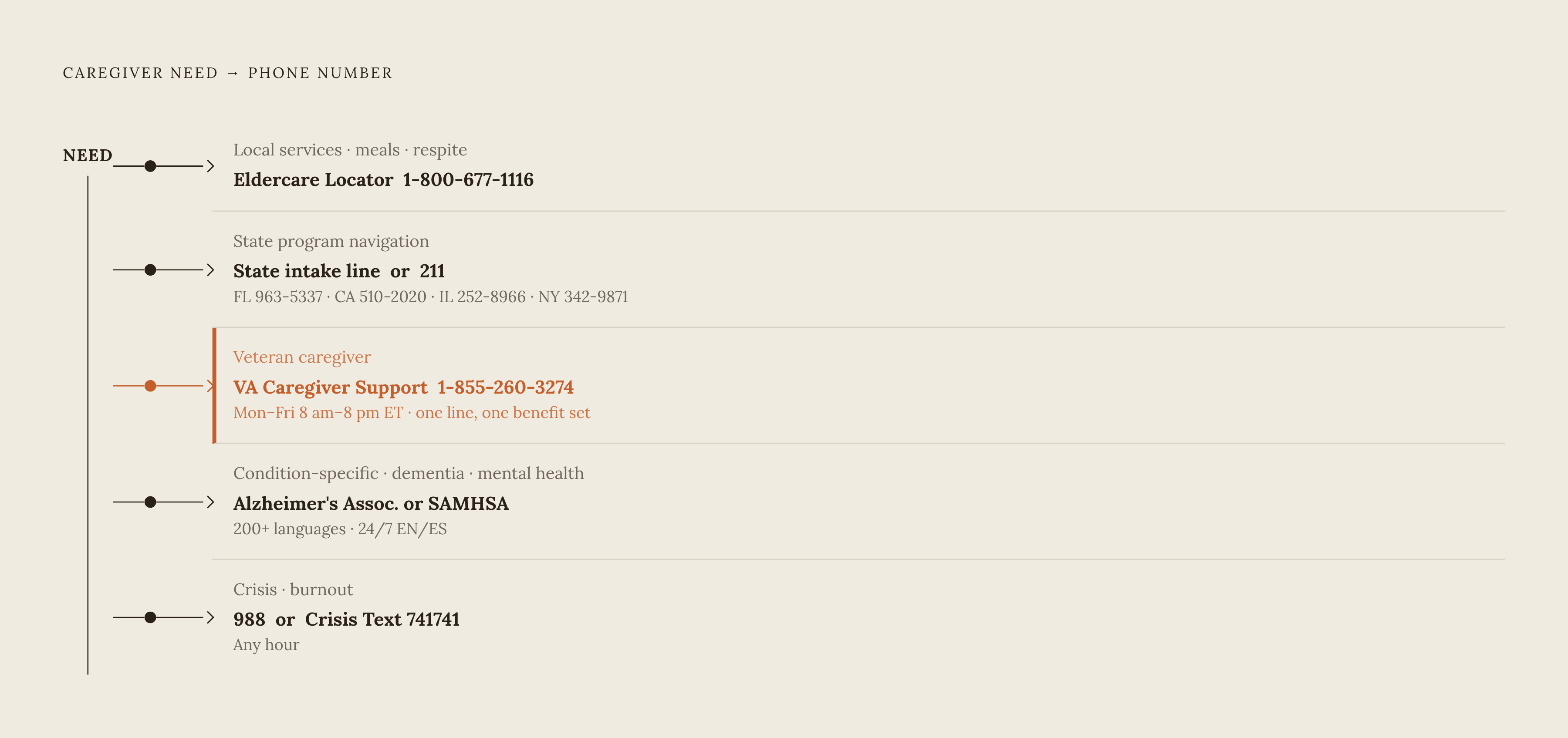
The nature of the need determines which number belongs on the other end of the call. One might argue that a caregiver should not have to diagnose their own problem before being allowed to ask for help, and that argument has real force. But until the system consolidates further, the most reliable path runs through matching the need to the layer built to answer it.
A caregiver trying to find local services, meals, transportation, home care, or respite, should start with the Eldercare Locator at 1-800-677-1116. It routes by ZIP code to a local area agency on aging, which is the correct entry point for NFCSP-funded services and the one place in the federal layer actually designed to make that connection.
A caregiver trying to navigate a state-funded caregiver support program should go straight to that state's intake line rather than starting federal: Florida at 1-800-963-5337, New York at 1-800-342-9871, California at 1-800-510-2020, Illinois at 1-800-252-8966. For states without a listed line, 211 or the Eldercare Locator will route the call to the right regional office.
A caregiver supporting a Veteran has the clearest path in the entire system: the VA Caregiver Support Line at 1-855-260-3274, staffed Monday through Friday from 8 a.m. to 8 p.m. ET, is the single federal line built around one population with one defined set of benefits, and it remains the correct first call for anything touching PGCSS, PCAFC, or VA In-Home and Support Services.
The VA line works cleanly while the rest of the system requires this kind of decision tree. Because it was built around one population and one benefit structure from the start, while the general caregiver population is served by a federal layer that funds, a state layer that delivers, and a nonprofit layer that specializes, three systems built at different times for different reasons that were never fused into one. Caregivers calling for the first time will not have had the chance to learn that distinction. The practical answer matches the need (local services, state program navigation, Veteran-specific support, condition-specific guidance, or crisis-level distress) to the layer built for it, rather than assuming any single number can absorb the whole range of what a caregiver is carrying when they finally decide to call.
Sources
- VA Caregiver Support Program Home
- The Program of Comprehensive Assistance for Family Caregivers
- Florida Caregiver Resources 2026: Hotlines, ADRCs, Call Ladder
- Caregiver Supports and Resources
- California Caregiver Resources Directory (2026)
- NJ Caregiver Programs 2026: Money, Hours, Respite, Legal
- Family Caregiver Support
- Support for Caregivers - Illinois Department on Aging