Why Most Family Caregivers Who Qualify for Medicaid Pay Never See a Dollar

Medicaid can pay family caregivers, but qualifying is not the same as getting paid. Enrollment caps, waiting lists, relationship exclusions, and separate caregiver requirements can block payment at successive stages. AI-assisted benefit discovery can help families find Medicaid self-direction programs and work out what they require, but it cannot lift the limits that keep eligible families out.
Why most eligible family caregivers never collect Medicaid pay
All 50 states offer at least one Medicaid-funded program through which a family member can be paid, yet the vast majority of family caregivers go unpaid. Programs exist, and money supports home care. KFF’s 2025 HCBS survey reports that millions of people get Medicaid-covered home care services each year. The contradiction is not between a promised program and an imaginary one, but between a funded system and the families who cannot reach its payments.
What, then, does it mean to qualify? A recipient may meet a program’s eligibility rules but have no funded place, while the relative who provides care may have to meet a separate set of rules. Each approval answers only part of the question. Families can qualify and still go unpaid because of decisions made by the federal government, states, and those who run the programs, with more at stake than a single application problem.
How HCBS waivers are built to cap participation, not expand it
Home and community-based services waivers, which fund more family caregiver pay than any other source, let states limit how many people they serve. The KFF survey explains that states may cap the number of people receiving waiver services and use waiting lists when demand exceeds available slots. All states offer home care through waivers, most commonly 1915(c) waivers. The cap is part of the program’s design. It permits a state to limit service to an approved number of people who meet its requirements.
That distinction makes enrollment a form of rationing. A caregiver and a loved one may satisfy every applicable eligibility criterion and still have no available slot. More complete paperwork cannot resolve that shortage. The limits on places come before the hurdles in applying, so easier applications alone would not make funded services available to every eligible family.
The survey notes that the 2025 reconciliation law is estimated to reduce federal Medicaid spending substantially over a decade, with broad implications for home care and family caregiver support. It also expects low take-up of new waivers created by the law. States must demonstrate that those waivers will not increase average waits for people needing an institutional level of care, while confronting the federal spending cuts.
The waiting list as the system's most concrete obstacle
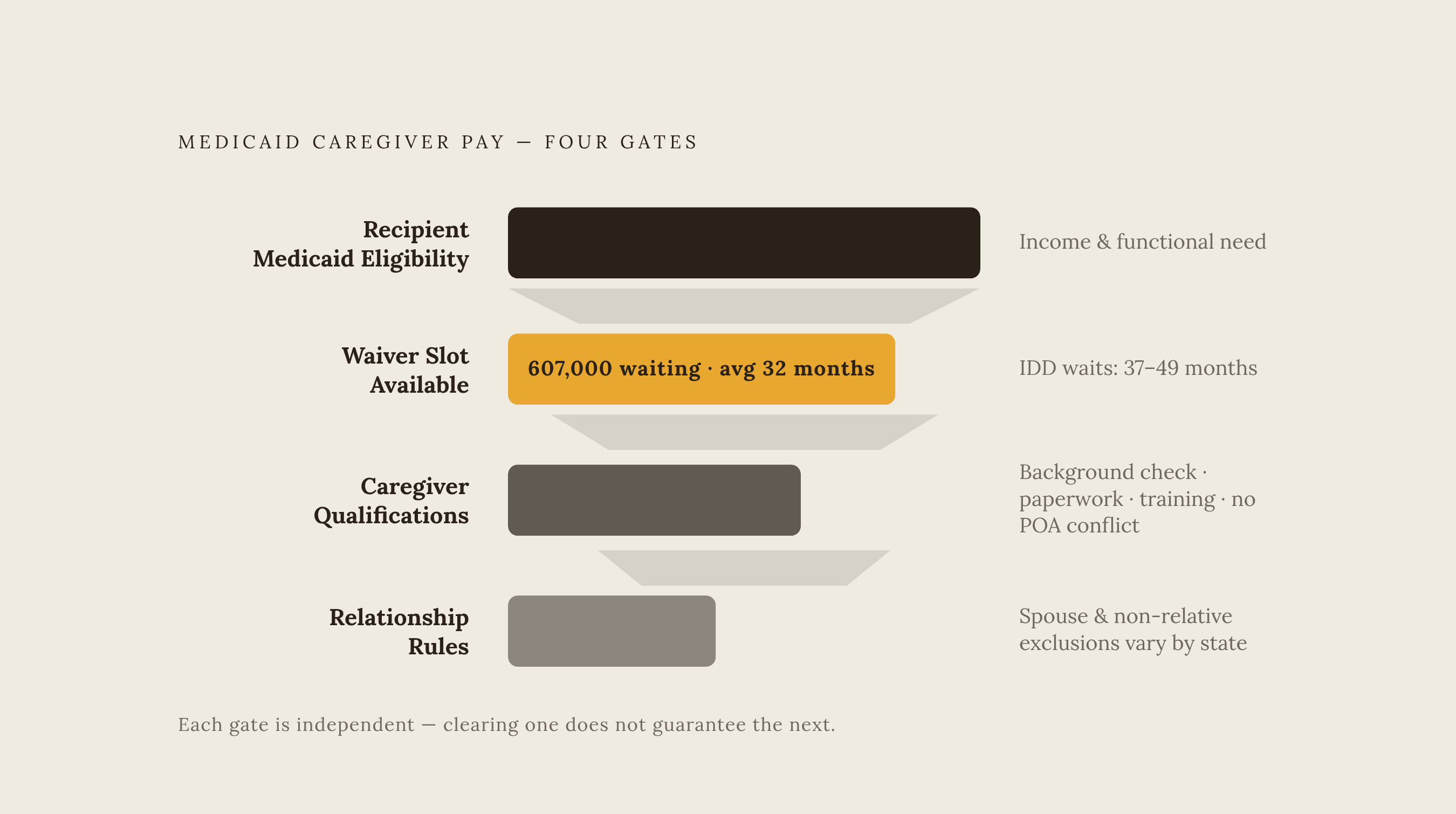
The KFF survey counted roughly 607,000 people on Medicaid home care waiting lists in 2025, up from the prior year. People with intellectual or developmental disabilities made up the large majority. Among responding states reporting the measure, the average time from application to service access was approximately 32 months. When caregiver pay depends on those services, a family cannot count on getting money soon just because it qualifies.
For people with intellectual or developmental disabilities, the average wait was 37 months overall. In states that added people to lists without screening for eligibility, it rose to 49 months. That difference also limits what the totals establish. A waiting list that includes unscreened applicants is not a count of people whose eligibility has already been determined.
State examples show how those limits operate. Indiana’s Family and Social Services Administration filled all its federally approved waiver places in April 2024 and started a waiting list. Florida’s iBudget pre-enrollment list held tens of thousands of individuals as of early 2026, with families in the lowest-priority categories facing waits of 7–15 years. Texas’s STAR+PLUS Waiver had a substantial interest-list backlog as of late 2025 against a fixed number of enrollment spots. These lists do not measure identical systems. Their size reflects both constrained capacity and state decisions about who enters the queue.
Why where a caregiver lives determines whether she ever gets paid
The KFF survey identifies six states that do not screen for eligibility among any waivers, namely Florida, Iowa, Oklahoma, Oregon, South Carolina, and Texas. Together, they account for more than half of all people on waiting lists nationwide. A larger list can reflect a different screening policy as well as unmet demand, so list totals alone cannot establish a family’s likely wait.
Structured Family Caregiving, which pays a family member a daily stipend, is available in only 11 states as of 2026. Those states are Connecticut, Georgia, Indiana, Louisiana, Massachusetts, Missouri, Nevada, North Carolina, Ohio, Rhode Island, and South Dakota. That is not the full map of caregiver pay. Families in other states may have other ways to get paid through Medicaid, but they cannot count on the same model or the same way of being paid.
The peer-reviewed study Paying family caregivers: self-direction in Medicaid personal care found that only a small fraction of self-directed beneficiaries resided in small towns or rural areas. That finding exposes an access problem for families most dependent on informal care because professional alternatives are unavailable nearby, though it does not establish why participation was low.
The two-tier eligibility gauntlet that screens out caregivers who made it through the waitlist
Some states prohibit the person serving as Power of Attorney for a Medicaid beneficiary from also being that person’s paid caregiver. The restriction can catch the family member already doing the care and handling legal responsibilities. Caregiving ability is not the deciding factor. A role assumed to help a loved one can become a barrier to payment.
This is a second eligibility gauntlet, separate from the recipient’s approval. The recipient must meet Medicaid financial eligibility rules and get a place in the services that would pay for care. The prospective caregiver must then satisfy caregiver-side requirements, including a background check, employment paperwork, and, in some states, training or certification. These steps can take weeks or months. Each introduces a possible disqualification even after the recipient has obtained a waiver slot.
Some states also require specific medical care certification classes before a family member can be paid. Families must also find time for training and a way to attend, on top of filling out forms. The key distinction is between two approvals, not two versions of the same application. A recipient’s authorization establishes access to care, but it does not establish that a particular relative can be employed to provide it.
Relational exclusions that cut out spouses and non-relatives by rule
Some state Medicaid programs do not allow spouses to be paid caregivers, while others prohibit payment to non-relatives. Two equally capable people can therefore receive opposite answers because of their relationship to the recipient. Documented need and low income do not override a rule that bars the proposed caregiver’s relationship.
The spouse exclusion and the Power of Attorney restriction operate on different grounds, but both filter caregivers by who they are. One concerns a personal relationship, while the other concerns a legal role. When a family discovers such a restriction after recipient enrollment, the expected source of income may disappear even though the need for care remains.
Pay rates, administrative friction, and the opaque payment infrastructure caregivers face once enrolled
Family payments under Structured Family Caregiving are usually around $40 to $70 per day, while Medicaid self-directed programs generally pay by the hour at wages that differ a great deal from state to state. Structured Family Caregiving typically passes only part of the stipend through to the family caregiver. The program’s stipend is not necessarily take-home pay. Without knowing what reaches the caregiver, a family cannot reliably forecast the income enrollment will produce.
Payment also depends on an administrative chain. Financial Management Service agencies, or third-party fiscal intermediaries, handle payroll and taxes, so payments take more time and caregivers must rely on agencies they do not control. States may require caregivers to clock in and out through a phone app. Once enrolled, caregivers still have paperwork and other tasks to keep up with.
Connecticut shows how budget management can affect continued access. A NASHP report describes a minority of people using the state’s consumer-directed service as engaging family caregivers as paid personal care assistants. That finding is narrower than a measure of everyone who could potentially use family care, but it shows that access to consumer direction does not automatically produce family employment. Participants must also manage their care allotment. The same report states that those who continually exceed their budget may lose access to the self-directed option entirely.
What caregivers lose while they wait or go unpaid
A significant share of family caregivers experience high financial strain from out-of-pocket care costs, reduced work hours, or both. Lower-income caregivers are substantially more likely to experience the full range of financial impacts. Waiting does not suspend those costs. A family can remain responsible for providing care throughout a period when the program offers no corresponding income.
Millions of family caregivers rely on Medicaid for their own health coverage, so the person seeking services for a loved one may also depend on the same system for personal medical care. These are separate needs within one household. Barriers to paid caregiving sit within that broader reliance, rather than affecting only an optional source of earnings.
Financial precarity also compounds the emotional burden of care. Family caregivers report high rates of burnout, emotional stress, depression, and anxiety, with isolation adding to the strain. Those consequences do not all originate in Medicaid policy. Still, unpaid or underpaid care leaves families with less money as they cope with those strains.
Findings from the Cash and Counseling Demonstration Program give reason to question whether limits on caregiver pay always save money. Its findings show that consumer-directed programs can help people stay healthier without increasing fraud. Evidence on self-directed care also associates it with lower emergency room use, fewer Medicaid-financed inpatient days, and reduced Medicaid hospital expenditures. That evidence calls into question an accounting that treats unpaid family care as free while leaving out the costs passed on to caregivers, nursing facilities, and emergency care, though it does not prove that every expansion pays for itself.
Where caregivers who want to get through the system should actually start
Before filling out forms, families seeking pay should find out how the program works and what both the recipient and caregiver must do to qualify. HCBS waivers, Structured Family Caregiving, and consumer-directed personal care differ in eligibility rules, payment mechanisms, and permitted caregiver relationships. Applying to the wrong program advances no useful queue. For someone seeking payment to care for an elderly parent, the relevant question is which state program permits that arrangement and what approvals each person needs.
Once the appropriate route is identified, applying early addresses the waiting-list clock. The wait usually counts from when a family applies, even if it first needed care before then. Relationship rules deserve equally early attention. Checking whether the program permits a spouse, parent, or non-relative can prevent a late disqualification, while checking Power of Attorney restrictions, background checks, training, and employment paperwork addresses the separate caregiver track.
AI-assisted benefit discovery tools can help organize this research. Their practical use is to surface potentially suitable programs, state relationship and income rules, and required documentation in a structured starting point. For a family researching without a navigator, that can reduce the burden of assembling information across agencies. The useful comparison is not which tool promises payment, but which helps distinguish program availability, recipient eligibility, caregiver eligibility, and payment arrangements.
A discovery tool can accelerate program identification, but a clear map is not an enrollment slot or a payroll approval. Families still need approval for both the recipient and the caregiver before they can count on the income. The system rewards preparation at each transition, making knowledge of the full sequence one of the few advantages caregivers can bring to it.