CDPAP Caregiver Requirements in New York
Eligible family members can get paid through New York's CDPAP program to provide informal care.
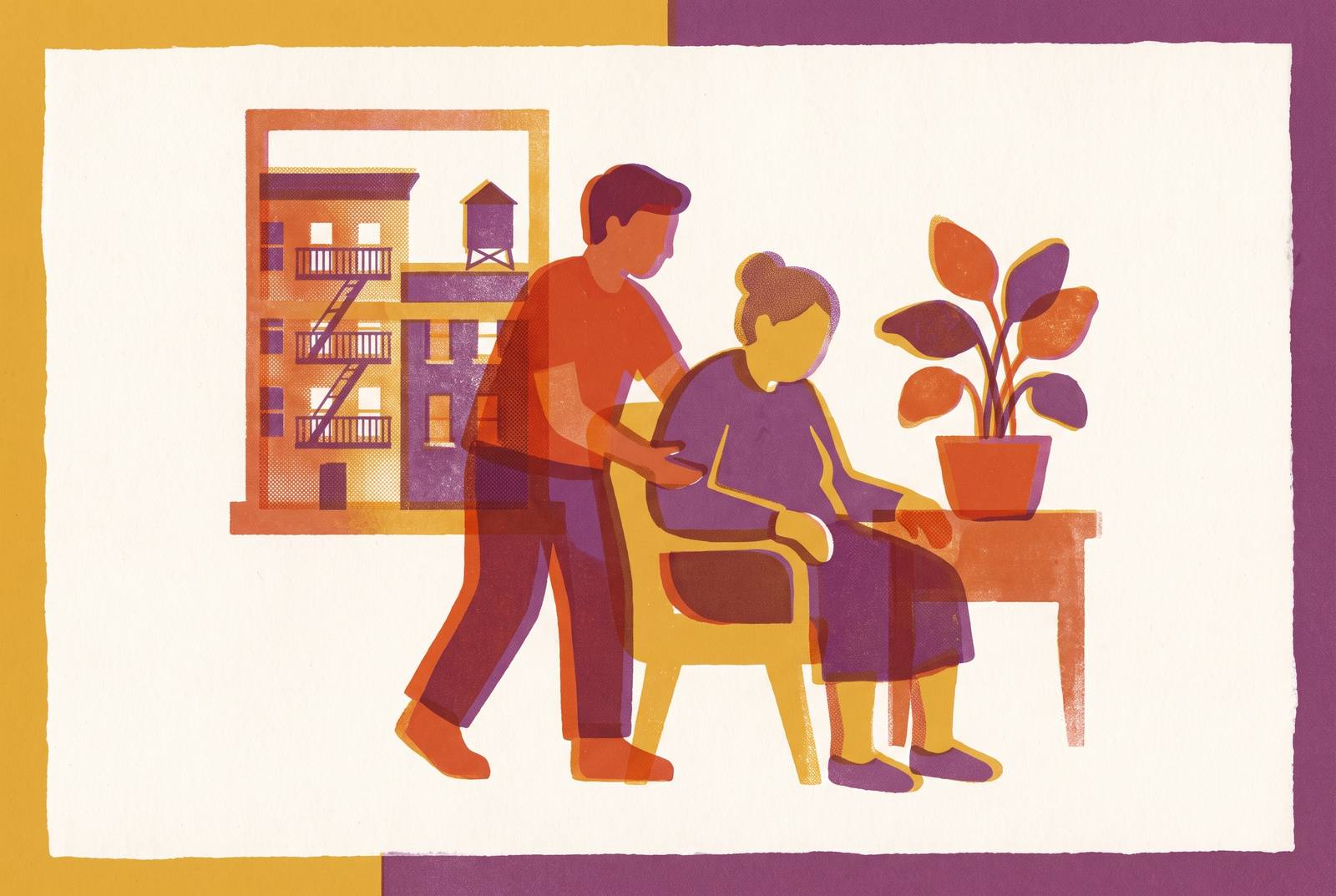
A daughter who has spent two years helping her father get dressed, manage his medications, and get to doctor's appointments may have no idea that New York Medicaid could be paying her for that work right now. The Consumer Directed Personal Assistance Program, known as CDPAP, is a New York State Medicaid program that lets eligible individuals hire their own personal assistant, including family members and close friends, and have Medicaid pay that person directly for care they may already be providing. The person receiving care, called the consumer, recruits, hires, trains, and supervises their own personal assistant. The rest of this guide walks through every requirement that governs who can become a paid personal assistant, in the order a family would actually encounter them: the eligibility floor, the one relationship that disqualifies a caregiver, the health documentation, the 2026 training mandate, and the pay and benefits that follow once those boxes are checked.
Who the caregiver requirements apply to
CDPAP runs on two separate eligibility tracks, and confusing them is one of the fastest ways a family stalls out before ever reaching the caregiver questions this article is built around. One track belongs to the consumer, the person receiving care. The other belongs to the personal assistant, the person providing it. Meeting the requirements on one track does not substitute for meeting the requirements on the other. A family can be fully informed about caregiver eligibility and still get stuck if the consumer side isn't settled first.
On the consumer side, a person needs active New York Medicaid, a state-approved assessment of need, a medically stable condition, and either the ability to direct their own care or a qualified designated representative who can do it for them. As of September 1, 2025, most new applicants age 21 or older must also clear Minimum Needs Requirements: needing at least limited assistance with three or more Activities of Daily Living, or supervisory assistance with two or more ADLs if the consumer has a documented Alzheimer's or dementia diagnosis. Consumers who were authorized for or already receiving CDPAP before that date may carry Legacy Status. They continue to be assessed and reassessed under the prior PCS/CDPAS criteria.
Once the consumer side is settled, the caregiver requirements covered in the rest of this piece, age, work authorization, health documentation, training, and the disqualifying relationships, apply specifically to the personal assistant and are assessed and processed through PPL's onboarding. Understanding each requirement matters because most eligible families never apply. Services that specialize in navigating state-specific caregiver payment programs, such as Brevy, can help clarify which requirements apply to a given family's situation and whether they're already met, turning a vague assumption into a concrete answer.
The basic eligibility floor every personal assistant must clear
The baseline requirements to become a CDPAP personal assistant are lower than most people expect. Any adult who is legally authorized to work in the United States can serve as a personal assistant. No nursing license is required. No home health aide certification is required. No prior caregiving experience is required.
The age floor is 18. There is no certification requirement because the consumer, or their designated representative, is responsible for training the personal assistant in the specific tasks laid out in the plan of care. That structure reflects the founding premise of CDPAP: the person receiving care, or the person who knows them best, is in the best position to decide who should provide it and how, rather than deferring that judgment to a licensing board.
Residency adds one geographic wrinkle. A personal assistant living just across the state border isn't automatically excluded just because her own address falls outside New York State.
None of this is an accident or a gap in oversight. The low credentialing bar is a deliberate policy choice, and it's the reason CDPAP works for families in the first place, letting an adult child, a sibling, or a neighbor who is already providing informal, unpaid care become a paid, formally employed personal assistant without first acquiring a credential that has nothing to do with the relationship or trust already in place. That simplicity only pays off if someone actually confirms the concrete requirements are met. Verification tools built around caregiver program eligibility can confirm age, work authorization, and residency status in minutes, which turns a hesitant "I think I might qualify" into a clear yes or no before a family invests time in the rest of the enrollment process.
The one relationship that disqualifies someone, and the family members who are explicitly allowed
Most families assume a spouse can be paid as a personal assistant under CDPAP. A consumer's spouse cannot serve as their paid personal assistant under any circumstances. That single exclusion is the sharpest restriction in the entire caregiver eligibility structure, and it surprises people precisely because nearly every other adult family member is permitted to serve.
The reason traces back to how New York Medicaid classifies legally responsible individuals. Under what's known as the legally-responsible-relative doctrine, Medicaid does not pay for care that a caregiver is already legally obligated to provide, and spouses fall into that legal category by virtue of the marriage itself. The same logic extends to the designated representative, whoever holds that formal role in the consumer's CDPAP plan. One person cannot occupy both roles at once, a rule that catches families off guard when the most natural choice for "the person directing care" and "the person providing care" turns out to be the same relative.
Set those two exclusions aside: the list of who is permitted opens up considerably. Adult children 18 or older, siblings, grandchildren, nieces, nephews, aunts, uncles, in-laws, step-relatives, half-siblings, and parents of consumers age 21 or older can all serve as paid personal assistants. Living under the same roof as the consumer doesn't disqualify an otherwise eligible relative either.
For the subset of families where the spouse genuinely is the only practical caregiver, CDPAP isn't the only program in play. Brevy can surface that kind of alternative pathway for families in that specific situation, pointing toward Veteran-Directed Care or other programs when CDPAP's spousal restriction rules out the option a family had assumed was available.
Health documentation that personal assistants must provide before starting work
Before PPL will let a personal assistant start working and receiving pay, that person has to submit a short list of health documentation. This isn't a test of clinical competency. It functions as a public-health safeguard built into New York's employment rules for anyone working in home care, regardless of the specific tasks they'll perform.
Three pieces of documentation make up the core requirement. Tuberculosis screening comes first: a TST (the standard PPD skin test) or an IGRA QuantiFERON blood test, conducted within the previous 12 months. Rubella immunity has to be documented through a Rubella Lab Report showing immune status, and rubeola, more commonly known as measles, requires its own Rubeola Lab Report.
These requirements apply the same way regardless of whether the personal assistant is a family member who has been providing informal care for years or a friend stepping into the role for the first time. The employment relationship that forms once someone is onboarded through PPL triggers the same documentation standard across the board, with no exception carved out for relatives. All of it gets submitted as part of PPL's broader onboarding process, alongside the standard employment paperwork: Form I-9, a W-4, an offer letter, and the Personal Assistant Agreement.
Most of this documentation can be obtained through a routine visit to a primary care provider or an urgent care clinic, and the practical lesson for families is timing. A missing rubella titer or an expired TB test is a small thing on paper, but it can hold up weeks of pay for someone who has already started providing care.
Training requirements that took effect in 2026
Starting in 2026, every CDPAP personal assistant has to complete required training through the Nevvon portal, accessed through either PPL@Home or Time4Care, and the deadline for completing it depends on exactly when the person started working. This is one of the newest layers of caregiver requirements, and it's recent enough that a meaningful number of people currently working as personal assistants may not realize it applies to them.
Anyone who began working in CDPAP during 2025 was required to complete the Nevvon training by March 31, 2026. For a personal assistant who started in late 2025 and hasn't checked their compliance status since, the practical move is to log into the Nevvon portal through PPL@Home or Time4Care and confirm where things stand, rather than assume the requirement doesn't apply because no one mentioned it at the time of hire.
The training itself runs through the Nevvon portal, and it is a compliance requirement tied directly to continued employment through PPL. Because PPL is the sole fiscal intermediary statewide, there's no alternate processor or backup enrollment path for a personal assistant whose training lapses. Missing the required window puts both compliance status and pay at risk, which makes this one of the more time-sensitive items on the entire list of caregiver requirements, even though it's also one of the easiest to resolve once a family knows it exists.
What Personal Assistants Are Paid and How Hours Are Authorized
Clearing every requirement, age, work authorization, health documentation, training, leads to something concrete: formal W-2 employment through PPL, with a defined wage floor, overtime protections, and a benefits package that the prior multi-fiscal-intermediary system in New York never offered in any consistent way.
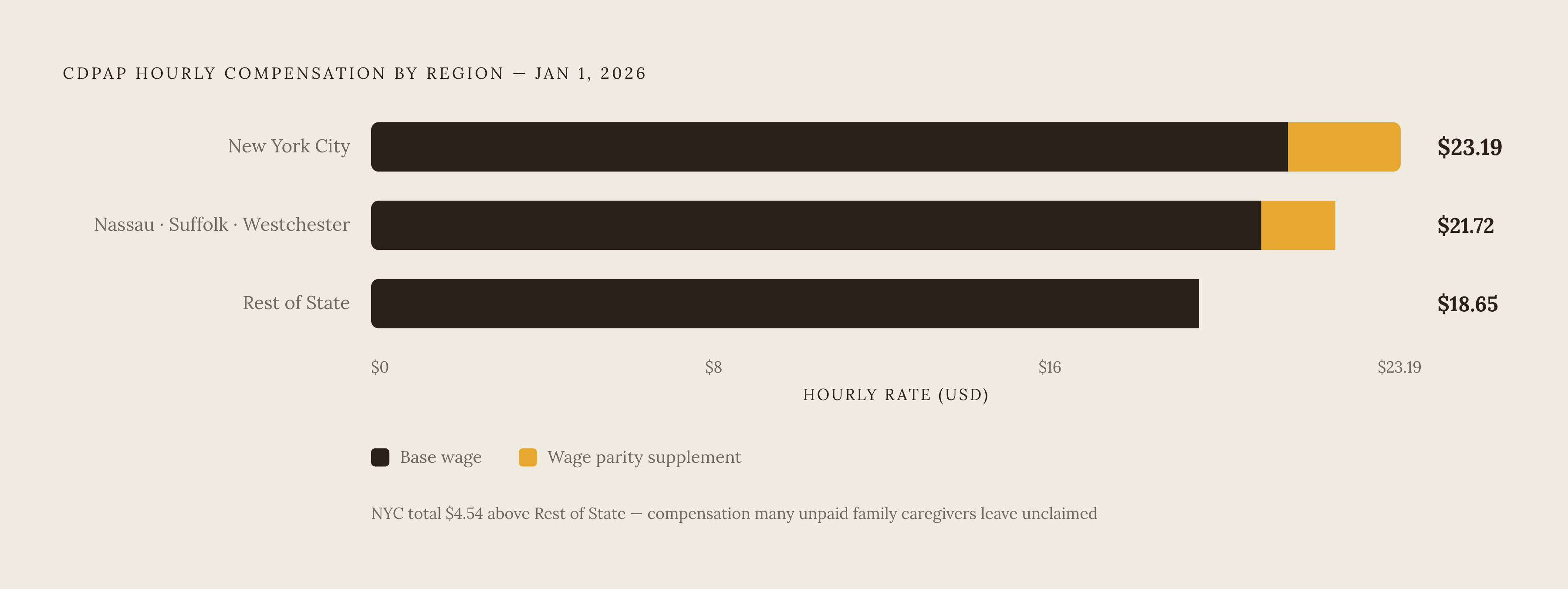
Effective January 1, 2026, base wages for CDPAP personal assistants are $20.65 an hour in New York City, $20.05 an hour in Nassau, Suffolk, and Westchester counties, and $18.65 an hour across the rest of the state. On top of that base, a wage parity supplement adds $2.54 an hour in New York City and $1.67 an hour in Nassau, Suffolk, and Westchester; the rest-of-state rate carries no parity supplement. Combined, total minimum compensation as of January 1, 2026 comes to $23.19 an hour in New York City and $21.72 an hour in Nassau, Suffolk, and Westchester.
Beyond the hourly rate, PPL provides paid time off that accrues based on hours worked, up to 56 hours a year, along with holiday pay, overtime, a health benefits plan for full-time workers, and a 401(k) plan. Federal overtime rules apply on top of all of this, so a personal assistant who works beyond the standard full-time threshold in a single week earns a premium overtime rate for every additional hour.
How many hours a personal assistant actually works comes down to the consumer's state-approved assessment of medical and functional need, not a statewide cap. There's no fixed weekly ceiling on CDPAP hours: authorized hours can run from just a few hours a week to full live-in coverage, depending entirely on what the assessment documents. For personal assistants who live in the same home as the consumer, qualified Medicaid waiver payments are excluded from gross income under federal tax rules once the live-together test is met. That exclusion can meaningfully reduce a live-in caregiver's tax liability, and it's the kind of benefit that goes unclaimed simply because nobody mentioned it during onboarding.
Moving From Meeting the Requirements to Getting Enrolled
Understanding every requirement covered so far is necessary, but it isn't the same as getting paid. The families who actually reach a paycheck are the ones who move through consumer assessment, PPL registration, health documentation, and training without losing momentum at any single handoff along the way.
The sequence runs in a specific order. First, confirm the consumer has active New York Community Medicaid. Then complete PPL registration, which bundles the I-9, tax forms, offer letter, and health documentation covered earlier into one onboarding package. Finally, complete the Nevvon training within whatever window applies based on the personal assistant's start date.
The most common points of failure cluster around three things: health documentation that's missing at the moment PPL onboarding begins, a Nevvon training deadline nobody realized was approaching, and confusion over exactly which relatives are excluded under the spouse and designated-representative rules. A platform built to walk families through state Medicaid caregiver enrollment can map both tracks at once, clarifying which requirements belong to the consumer's side and which belong to the caregiver's side before a family starts assembling paperwork for the wrong one.
The shift to PPL as the sole statewide fiscal intermediary has added its own friction: longer wait times and a single point of contact serving a very large consumer population statewide. That makes arriving at each step already prepared more valuable than it would have been under the prior system, where multiple fiscal intermediaries spread the volume out. Brevy helps family caregivers identify which programs they actually qualify for, CDPAP among them, and guides them through enrollment, addressing the same opacity and complexity that cause most families to miss benefits they already qualify for, and the platform is free to use. For a daughter who has been dressing her father every morning for two years without ever being paid for it, the gap was never a lack of care. It was a lack of knowing which five or six requirements stood between the care she was already providing and a paycheck for it.
Sources
- How to Get Paid as a Family Caregiver in New York (2026)
- New York CDPAP 2026: Consumer Directed Personal Assistance Guide
- CDPAP Program Explained - Learn about CDPAP Home Care in NYC and NY State: including the meaning of CDPAP and CDPAS, Caregiver Requirements, Maximum Hours, Rules and Regulations, and CDPAP Agencies • CDPAP Program Explained - Learn about CDPAP Home Care in NYC and NY State: including the meaning of CDPAP and CDPAS, Caregiver Requirements, Maximum Hours, Rules and Regulations, and CDPAP Agencies
- Consumer Directed Personal Assistance Program (CDPAP)