How Eldercare Families Are Escaping the Medicaid Paperwork Trap With Full-Cycle Enrollment Technology
Automation links five separate gates families must pass to get paid caregiving through Medicaid.

End-to-end Medicaid enrollment automation for family caregivers means guiding a family from eligibility discovery through program selection, functional assessment, care plan approval, and caregiver registration. Full-cycle enrollment technology makes a lengthy process navigable by connecting those stages while preserving Medicaid’s requirements. Its value depends on whether it supports the family through the first paycheck, with human help when an automated route fails.
Why Medicaid enrollment for eldercare families is a multi-stage journey, not a single application
The state Medicaid agency, assessor, care coordinator, and fiscal intermediary each control part of the route to paid family care. Their decisions have separate criteria and timelines. Approval at one stage does not automatically trigger the next. A family can therefore make substantial progress without knowing who must act next or what remains unresolved.
State variation makes that fragmentation harder to navigate. MACPAC describes 56 different Medicaid programs in the states, D.C., and five U.S. territories, all of which must meet the same basic federal rules. California’s Medi-Cal / IHSS route is structurally different from New York’s CDPAP or Texas’s STAR+PLUS / CFC. The program name is only the first difference. The relevant office, eligibility rules, forms, and sequence of decisions also depend on where the care recipient lives.
What, then, does “approved for Medicaid” actually establish? It does not by itself establish that a particular relative can receive payment for a particular set of care tasks. That requires further decisions about the program, the person’s care needs, and the caregiver’s role. Coverage and caregiver employment are different milestones. Treating them as one application hides the handoffs where families most need guidance.
The five gates families must pass in sequence before a caregiver earns a paycheck
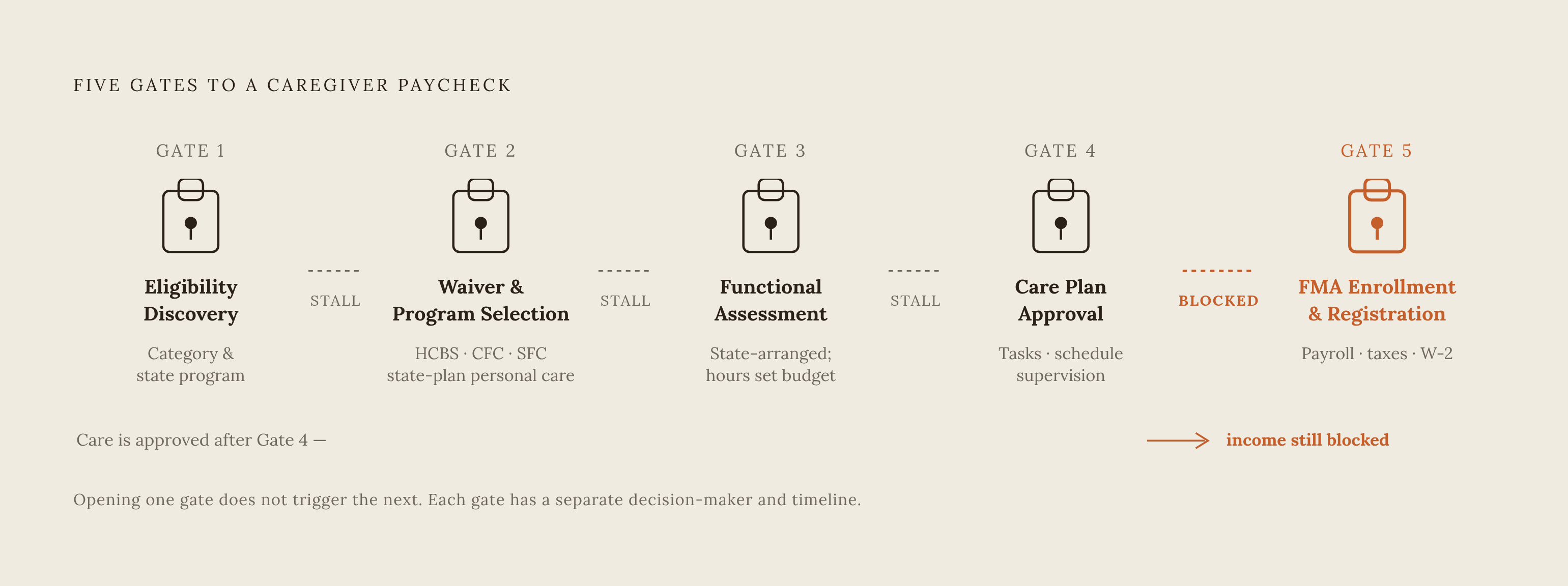
Think of five locks on one door. Each lock requires a different key, and opening one does not release the others. Gate 1 is eligibility discovery, which identifies the relevant eligibility category and state program. Even the state-plan routes, which include the HCBS State Plan Option, Community First Choice, and Self-Directed PAS, differ from one another. Their different eligibility floors make a generic Medicaid screening an incomplete starting point.
Gate 2 is waiver and program selection. HCBS waivers, state-plan personal care, and Community First Choice fund different services and apply different caregiver rules. Local names include Colorado’s CDASS, Wisconsin’s IRIS, New York’s CDPAP, Minnesota’s CFSS, Alabama’s Personal Choices, and Oklahoma’s CDPASS. Spouse eligibility and co-resident adult-child eligibility vary, while under 1915(j) and CFC, the recipient’s representative cannot also be the paid caregiver.
Structured Family Caregiving is another route families can take. The payment structure differs from hourly caregiver employment. This model pays a tax-free daily stipend rather than an hourly wage, so families considering it should not read the wage-based sequence as an exact description of their route.
Gate 3 is the state-arranged functional assessment. The assessor determines approved care hours, which shape the budget and the caregiver’s paid workload. Families receiving fewer hours than they need face a separate appeal process that can add weeks or months. Gate 4 then requires formal approval of a care plan specifying tasks, schedule, and supervision before caregiver registration can be completed.
At Gate 5, families go through financial management agency enrollment and caregiver registration. The fiscal intermediary handles payroll, taxes, and compliance, while the caregiver completes separate onboarding. Any representative-versus-worker conflict must be resolved where that restriction applies. Payment generally arrives as regular W-2 wages. Delays at this final lock therefore delay income even after the care arrangement has been approved.
What makes the journey fail — the specific friction points between gates
The discovery gap begins before a family submits anything. A family that does not know which waiver, office, or eligibility category applies may struggle to find where to start. Social workers may help with insurance choices, but no centralized information system resolves the whole journey. Changing course can then feel prohibitively burdensome. A family may remain in a poorly fitting program because restarting appears harder than continuing.
Once enrollment is active, the handoff gap becomes central. A care plan does not move toward approval on its own once the functional assessment is done. Each agency or contractor handles its own task but may leave the family to work out the next step. Progress can stop without an explicit denial. Help with the application alone therefore cannot clear every delay.
Administrative requirements create another source of failure. Reporting rules, automated data checks, and narrow exemption processes can exclude people who qualify, with older adults, people with disabilities, and family caregivers facing heightened risk. Eligibility is not the same as successful verification. A system may fail to recognize an eligible person, leaving that person to navigate an exemption or correction process that is itself difficult to access.
Waitlists are a separate constraint. HCBS waitlists hold hundreds of thousands of people nationally, with average waits measured in years. Software cannot create a funded slot. Technology’s usefulness therefore depends on whether it can prevent avoidable stalls within the active enrollment process while distinguishing those stalls from a funding delay.
What software can handle the entire Medicaid application process for family caregivers?
Full-cycle software must link the work at all five gates and go beyond giving an eligibility result. At gate 1, AI-assisted tools can pull income information from payroll systems or benefits records, calculate MAGI thresholds where relevant, and match a recipient’s circumstances to state programs. Those functions reduce the initial research burden. They support eligibility discovery, with the decision remaining in the state’s hands.
At gate 2, guided intake questions can identify the local program name, permitted caregiver relationships, and the fit between a family’s circumstances and available tracks. An AI assistant can help here when it bases its answers on state-specific rules. A list of possible benefits is not enough. The next step must connect discovery to enrollment support, including the relationship restrictions that could otherwise force a restart later.
At gate 3, technology can help families record the care they need before the assessment and show them ways to appeal when approved hours fall short. Preparation gives the family organized records with which to present the scope of care. This guides families through a requirement while leaving approval to the assessor.
At gates 4 and 5, document collection and reminders can connect care plan approval to fiscal intermediary onboarding. Optical character recognition can pull the needed information from uploaded files so there is less work to do with the documents. The family still needs the required approvals. Remembering each document and next step need not rest entirely on the person already providing care.
These functions are useful only if families can access them. Mobile applications, phone, text, fewer application questions, live navigation, and language support address different barriers for older adults and caregivers with limited technology experience. No single interface fits every family’s circumstances. A platform’s state coverage is a separate dimension, since completing one state’s process does not establish that it can navigate another’s rules.
The New York CDPAP consolidation as a warning about what full-cycle technology requires to work
New York’s CDPAP consolidation shows why a centralized system is not necessarily a complete support system. The program served hundreds of thousands of patients and caregivers through hundreds of fiscal intermediaries before they were brought under Public Partnerships LLC, or PPL. Registration became a critical transition point. At peak transition, tens of thousands of consumers were still trying to complete it, while support-line waits were significant and callbacks frequently went unreturned.
Thomas Grimes, a Schenectady quadriplegic who has used CDPAP since 1997, described the difficulty. “The transition has been extremely, extremely difficult for not only me, but for my personal assistants to transition over”. His account included continuing registration complications and the near-impossibility of reaching PPL. Families needed help completing a process on which their care arrangements depended.
The case sharpens the distinction between centralization and continuity. Moving a complex process into one system can concentrate failures if human support does not grow with the task. Multiple contact channels help only if they lead to reachable assistance. Full-cycle technology works when it escorts families through every gate with human backup at each failure point, from the initial application through the final registration step.
How to evaluate whether a platform covers the full cycle or just the front door
For families evaluating a platform, the five gates provide a practical test. Does it identify state-specific programs, waiver types, and caregiver relationship rules, or return a generic answer? Does it continue through assessment preparation, care plan submission, and fiscal intermediary enrollment? The endpoint should be explicit before enrollment begins. “Application complete” and “caregiver ready for payroll” describe different levels of support.
Document handling makes that distinction concrete. Does the platform collect and process income verification, assessment records, and the care plan at the stages where they are needed? Or does the family still have to handle every document on its own after getting advice at the start? A strong eligibility assistant may be useful at the front door without providing the continuity a family needs afterward.
Human escalation deserves an equally specific question. When an assessment requires an appeal, a representative-versus-worker conflict emerges, or a program is not accepting enrollments, who can help? A family should ask whether that person is reachable by phone or message and within what timeframe. “Support available” leaves too much undefined for this process. The New York experience makes reachability an essential part of the operating model.
Finally, does support continue through renewals, changes in care needs, and new verification requirements? AI-powered discovery combined with guided enrollment is a credible full-cycle approach when it demonstrates those functions. State breadth and gate continuity should be evaluated separately. A service that works in one state may meet a family’s needs now, while families or organizations in several states need proof that the help carries through under each state’s local rules.
What families should do now, before the January 2027 policy changes add another layer
The One Big Beautiful Bill Act introduces work or approved-community-activity verification for a large share of adults on Medicaid starting January 2027. Qualifying family caregivers are exempt, but must prove that exemption through the process their state designs. Families still entering Medicaid could therefore face the existing enrollment sequence and a new documentation requirement in close succession.
The practical response is to begin with the applicable program track and its state-specific name. Families should find out whether HCBS waiver self-direction, Community First Choice, Structured Family Caregiving, or another route fits their needs. Next comes the intended caregiver’s relationship to the recipient. Establishing that the relationship is permitted, including any representative-versus-worker restriction, reduces the risk of reaching registration with an arrangement the program cannot accept.
Families should then begin the functional assessment process as early as possible because approved hours set the limits of hourly paid care. While care plan approval is underway, they can identify the fiscal intermediary and begin preparing caregiver registration paperwork. Preparation can overlap even when approvals remain sequential. That distinction allows families to reduce avoidable delay without assuming registration can be finalized before the care plan is approved.
Starting earlier does not shorten an HCBS waitlist. With national waits averaging roughly 32 months, it starts the clock, leaving payment before January 2027 uncertain. Families overwhelmed by the sequence can use enrollment support that stays involved through every gate. Where a funded route is available, that support can help turn an uncertain process into a predictable path to approved care and a caregiver’s first paycheck.