Medicare Advantage vs Medicare Supplement Plans
Understand the structural differences and trade-offs between managed care and supplemental coverage.

Medicare Advantage vs Medicare Supplement plans is a choice between two structures. Medicare Advantage takes over how Original Medicare coverage is delivered, while Medicare Supplement insurance, or Medigap, adds to it. The right fit depends on health needs, finances, provider relationships, and mobility. Brevy can help with the benefits-discovery and enrollment work that follows, but understanding that structural choice comes first.
How Medicare Advantage and Medigap are structurally different
With Medicare Advantage, a private insurer takes over the delivery of Part A and Part B benefits through its own network and rules. Most plans also bundle prescription drug coverage. The plan therefore shapes both how care is covered and how a person gets access to it.
With Medigap, Original Medicare is still the primary coverage. The supplemental policy pays down the deductibles, copays, and coinsurance that Original Medicare leaves behind. It does not take over the delivery of Medicare benefits. A person cannot hold Medicare Advantage and Medigap at the same time, so choosing between them means choosing one coverage structure. Because the structures serve different purposes, asking which is better in the abstract misses the decision that matters.
What Original Medicare actually leaves unpaid, and why both options exist
The Part B premium in 2026 is $202.90 per month, paid regardless of which path a person chooses. That premium does not eliminate the deductibles, copays, and coinsurance due when someone receives care. More importantly, Original Medicare has no annual out-of-pocket cap. During a serious illness, those costs can accumulate without an annual limit.
Both options respond to that exposure, but they do so through different mechanisms. Medicare Advantage sets its own rules for cost-sharing and caps what a person pays for covered in-network care. Medigap pays specified costs left unpaid by Original Medicare. Comparing the two paths requires understanding these gaps alongside each plan’s advertised premium. Services such as Brevy, which help people verify eligibility for Medicare and related benefits, can also help clarify how those paths align with a person’s health profile and finances before Annual Enrollment begins.
How Medicare Advantage covers those gaps — and what it adds and restricts
Medicare Advantage bundles benefits with a yearly cap on costs and premiums that are often low. Its in-network out-of-pocket maximum is capped at $9,350 in 2026. Once the applicable maximum is reached, covered in-network services cost nothing for the rest of the year. Most plans include Part D prescription drug coverage, and many add dental, vision, hearing, and fitness benefits unavailable under Original Medicare.
The trade-off lies in how the plan organizes access. Most HMO plans restrict care to their provider network, while PPOs offer some out-of-network coverage at higher cost. Referrals may be required for specialists. Many services, including some post-acute care, also need prior authorization, which can make people wait for care. That issue deserves closer attention before comparing costs because it can matter most during a serious health event.
The package also requires ongoing attention. Networks, formularies, copays, and even which plans are offered can change each year at Annual Enrollment. Plans are tied to a geographic service area, creating complications for frequent travelers and people who divide their time between states. Total Medicare Advantage plan offerings declined for the second consecutive year heading into 2026, with a notable drop in PPO options as carriers increasingly favored HMOs to manage costs. The relevant choice is therefore a specific local plan.
How Medigap covers those gaps — and what it does and does not include
Medigap offers standardized supplemental benefits rather than a bundled replacement for Original Medicare. Most states use ten standardized plan letters, A through N, although Massachusetts, Minnesota, and one other state use their own standardized structures and require a separate look. Every insurer selling Plan G must offer the same benefits, so people can compare prices and how much they can rely on each carrier. Plan F also covers the Part B deductible but is available only to people who became eligible for Medicare before January 1, 2020. Plan N offers lower premiums than Plan G, with small copays for some office visits and emergency room visits not resulting in admission, and does not cover Part B excess charges.
Provider access follows Original Medicare, allowing a person to use any doctor or hospital accepting Medicare anywhere in the United States, without specialist referrals. That nationwide access suits travelers and people living in more than one state. Medigap does not include prescription drug coverage, so a separate Part D plan is required for that coverage. It also does not include dental, vision, or hearing benefits.
The other important distinction concerns approval for care. Medigap enrollees on Original Medicare face no prior authorization requirement for Medicare-covered services. The HHS Office of Inspector General found that Medicare Advantage insurers denied more than half of prior authorization requests for the most expensive types of post-acute care, including the majority of requests for long-term care hospital and inpatient rehabilitation facility stays. When skilled nursing facility denials were appealed, Medicare Advantage organizations overturned the vast majority in the enrollee’s favor. Initial denials delayed post-acute care by several days on average.
Those findings identify a specific structural risk. AHIP, the insurer trade group, argues that many denials stem from errors in providers’ paperwork and that evidence of waste in post-acute care calls for a closer look. The Better Medicare Alliance says that health plans have chosen to drop millions of prior authorization requirements across markets since 2024. Still, the OIG’s overturn-rate data raises doubts about how requests are first reviewed that paperwork problems alone cannot explain. Problems with initial reviews are particularly consequential when a person needs care after a serious illness.
CMS rules that take effect in 2026 require a response to urgent requests within a set short window and to standard requests within 7 calendar days. Once approved, a decision must be honored except in cases of fraud or clear error. These rules change parts of the process, but prior authorization is still required. The reader must weigh how each approach fits their needs: a managed bundle with a cap on spending or supplemental coverage with a wider choice of providers.
How costs actually compare when you factor in total spending, not just premiums
A lower premium is a real financial advantage, but it is only one part of annual spending. Medicare Advantage often has no extra premium beyond Part B. A person who uses little care can therefore spend less in a typical year under a low-premium plan. With more care, however, specialist copays, outpatient surgery coinsurance, and daily hospital copays add up. During serious illness, that spending can approach the $9,350 in-network out-of-pocket maximum.
Plan G shifts more of the cost into a regular premium. Once the annual Part B deductible is met, out-of-pocket exposure is essentially zero for Medicare-covered services for the rest of the year. That makes the cost of using covered care more predictable, though premiums and separate drug coverage still have to be paid. Someone with a serious hospitalization or post-acute care need may consequently spend far more under Medicare Advantage than under Plan G. That possibility is not a guarantee that Plan G produces the lower total for every person.
Predictable benefits also do not mean a fixed premium forever. Plan G premiums have risen sharply in recent years, with increases varying significantly by state. Large increases can erode affordability over time even when the policy’s benefits remain stable. A separate Part D premium adds to the cost, while most Medicare Advantage plans include drug coverage without an extra plan premium. People should therefore compare what they are likely to spend in a full year under each structure, including premiums, based on their health and how much care they use.
The four personal factors that determine which structure fits
The first question concerns health and utilization, including how often someone needs care and whether procedures or specialist visits are likely. Chronic conditions or frequent treatment may make Medigap’s flatter cost profile more attractive. Chronic Condition Special Needs Plans, or C-SNPs, grew sharply heading into 2026 and offer a purpose-built Medicare Advantage option for people with specific chronic conditions.
A person also needs to weigh how well they can afford costs that change. Medicare Advantage provides a ceiling, but the route to that ceiling depends on the services a person uses. Medigap makes it easier to know what a person will spend month to month, though premiums can rise over the years. For enrollees who are also family caregivers, another financial dimension may matter. Because Brevy’s eligibility screening includes caregiver payment programs, it can identify support that may help offset out-of-pocket costs under either Medicare path.
A person also needs to weigh how much disruption to provider relationships they could accept. A preferred doctor, specialist, or hospital outside a local Medicare Advantage network can mean changing providers or facing higher out-of-network costs where coverage is available. A provider’s participation today also does not establish participation next year. A plan’s network needs to support the care relationships that matter to that person.
Frequent travel, wintering in another state, or spending substantial time outside a plan’s service area can make geographic restrictions important. Medigap’s access to Medicare-accepting providers nationwide removes that service-area constraint. People who get all their care locally have less reason to weigh those travel concerns. Together, these four questions reveal a personal profile rather than a universal ranking.
The switching asymmetry that makes the initial choice more consequential than it appears
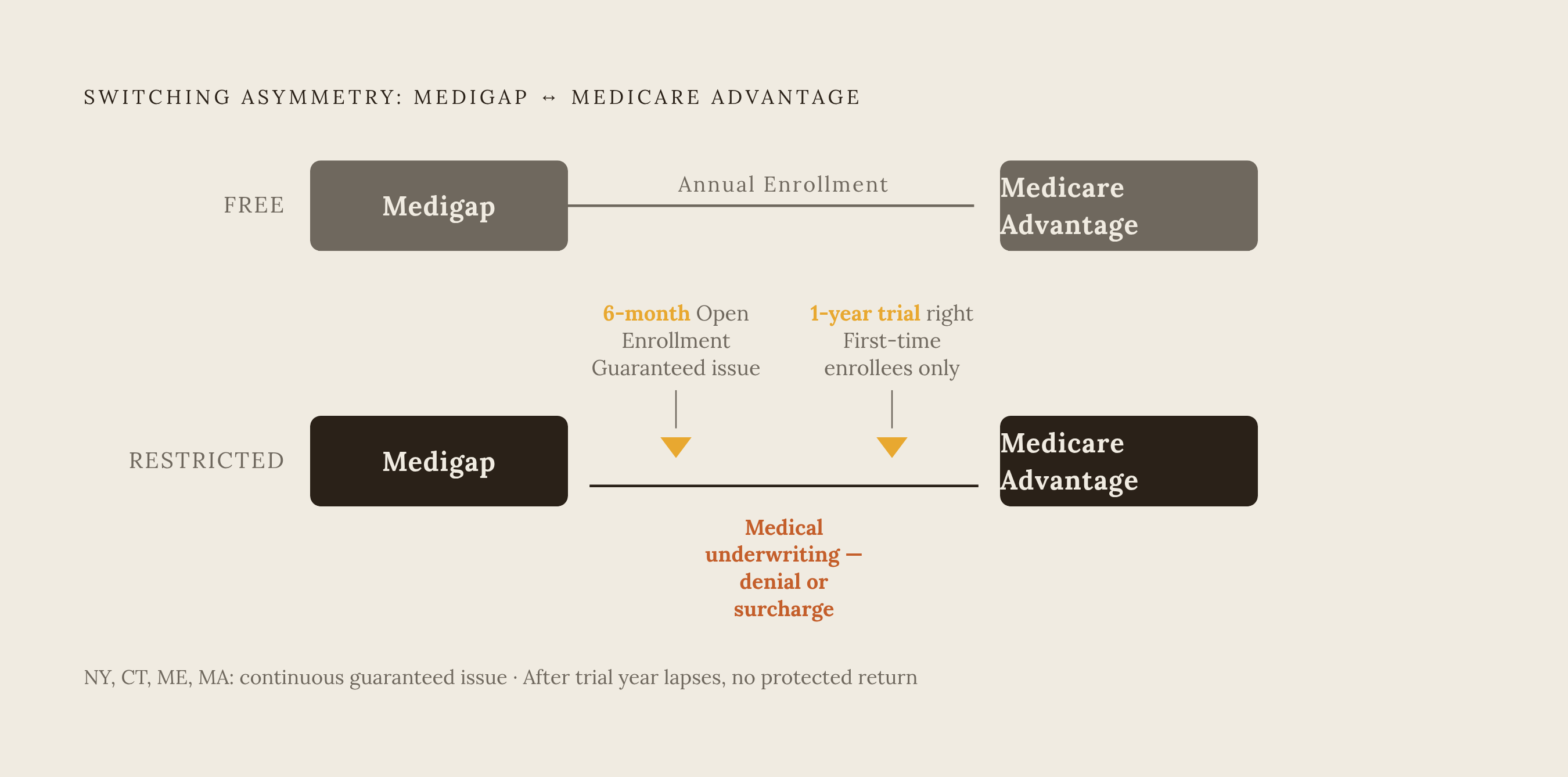
Moving from Medigap to Medicare Advantage is allowed during Annual Enrollment. Moving back to Original Medicare does not necessarily mean a person can obtain Medigap. In most states, an application outside protected enrollment circumstances can face medical underwriting. Insurers may reject an applicant or charge significantly higher premiums because of health conditions developed while on Medicare Advantage.
The six-month Medigap Open Enrollment Period begins in the first month a person is both 65 or older and enrolled in Part B. During that window, an insurer cannot deny coverage or charge more based on health status. A separate trial right gives someone who first joins Medicare Advantage when first eligible for Medicare a one-year window to return to Original Medicare with guaranteed access to an eligible Medigap plan sold in their state. Plans C and F remain unavailable to people who became Medicare-eligible on or after January 1, 2020. After that trial year, the protection lapses.
State rules can change the calculation. New York, Connecticut, Maine, and Massachusetts provide continuous or annual guaranteed-issue protections for all beneficiaries 65 and older. Delaware, Illinois, Minnesota, and Rhode Island have enacted more limited expanded protections. Many people switch successfully, but access should not be assumed where underwriting applies. This asymmetry gives someone uncertain about future health a structural reason to consider starting with Medigap, and makes initial Medicare eligibility and the Medigap Open Enrollment window the best time to decide carefully.
How to navigate this decision and where to get help that actually works for you
The next step is to separate coverage selection from benefits discovery without treating them as unrelated. First, use the four personal factors to identify the structure that fits. Then consider whether chronic conditions, caregiver status, or limited income may open access to Medicaid, Medicare Savings Programs, or caregiver compensation programs. Those benefits can add an important financial dimension to the coverage decision. Finding them and completing enrollment are distinct tasks.
Brevy is a useful starting point for that discovery and enrollment work. Its free AI-powered benefits assistant finds Medicare, Medicaid, and caregiver compensation programs that people qualify for and helps them through enrollment. It combines AI-powered guidance with human expertise and has enrolled thousands of families in benefits they did not know existed. That scope is particularly relevant when someone is both a Medicare beneficiary and an unpaid family caregiver.
State Health Insurance Assistance Programs, or SHIPs, provide free, federally funded one-on-one counseling in every state through trained, unbiased counselors who are not selling a plan. Licensed independent insurance brokers can compare premiums from different carriers for the same Medigap plan letter, and those who represent multiple carriers can compare more choices than those who work with a single insurer. Timing still matters because acting within the six-month Medigap Open Enrollment Period preserves the most options. The system’s structure is complex, but understanding it and choosing the right help turns a confusing decision into a manageable one.