Medicare Advantage vs Original Medicare Cost Tradeoffs
Choosing between them means weighing monthly savings against unpredictable illness costs.

Choosing between Medicare Advantage and Original Medicare in 2026 is a bet on your health trajectory. The choice is between paying less each month and having a better idea of what serious illness will cost, if Original Medicare is paired with Medigap. Brevy offers a free starting point for finding benefits that may change that calculation before you commit to either path.
What you actually pay under each path, before a single claim is filed
Both paths start with the standard Part B premium of $202.90 a month in 2026. Part A is premium-free for the vast majority of beneficiaries, including those with 40 or more work quarters. With Original Medicare, people who use care also pay a large Part A deductible for each benefit period and a small annual Part B deductible. The first distinction, then, is between what you pay to maintain coverage and what you pay when you need it.
With Original Medicare, the costs include Part B, a standalone Part D plan for drugs, and Medigap coverage if the person chooses it. Medigap commonly adds meaningfully to the monthly bill, with the amount depending on the plan and state. Before counting that difference as savings, though, beneficiaries need to know about all the help they can get. A free benefits navigation service like Brevy can help people find out what they qualify for under both Medicare tracks and supplemental programs before they enroll.
The structural trade at the heart of the decision: monthly cost versus catastrophic exposure
Medicare Advantage keeps monthly costs low, but beneficiaries pay costs that vary with their care up to a set cap. Original Medicare alone has no comparable ceiling on Part B coinsurance, so major surgery or cancer can generate tens of thousands of dollars in cost-sharing. Original Medicare plus Medigap is a different proposition from Original Medicare without it. With Plan G, essentially all Medicare-approved costs are covered after the annual Part B deductible, exchanging much of that uncertainty for a known premium.
Medicare Advantage offers an important protection of its own because federal law requires a cap on in-network spending. KFF’s 2026 Medicare Advantage cost data put the average in-network cap at $5,421 overall. HMO and PPO caps differ, and combined in-network and out-of-network caps run considerably higher. That makes the cap both a safeguard and a measure of the risk a beneficiary retains. Low use favors Medicare Advantage’s smaller fixed bill, while serious illness can make Medigap’s higher premium worthwhile.
Under CMS’s 2026 figures, Part D has a cap that does a good deal to limit what people pay out of pocket each year, whether they have an MA-PD plan or a standalone Part D policy. But built-in drug coverage is not automatically cheaper. KFF’s 2026 Part D data show that the share of MA-PD plans with no drug deductible fell from roughly two-fifths in 2025 to less than one-fifth in 2026. Because the comparison depends on personal health and finances, enrollment specialists can work through both scenarios, a service Brevy offers with its AI-powered eligibility tool.
Where Medicare Advantage variable costs actually accumulate, and for whom
The $15 average Medicare Advantage supplemental premium is not the number that predicts a frequent user’s total bill. That number comes from the plan’s copay schedule and daily coinsurance requirements, applied to the care the person actually receives. A specialist appointment, outpatient surgery, and each physical therapy session can each come with a charge. Each may look manageable in isolation, yet repeated care makes them accumulate. The Summary of Benefits therefore matters more to a beneficiary with a chronic condition than the headline premium does.
The spending cap must also be read correctly. It is a ceiling, and reaching it means paying substantial cost-sharing in addition to premiums. Whether that total is more than the cost of Medigap depends on which supplemental premium it is compared with. Estimating a likely year of visits and services helps show how far the beneficiary may move toward the ceiling. Someone who has several conditions, sees specialists, or needs post-acute care faces different costs from someone with few claims.
The decline in no-deductible drug plans means a benefit that helped justify enrollment in 2025 may no longer support the same calculation in 2026. Millions of Medicare beneficiaries were forced to change Medicare Advantage plans for 2026 because of withdrawals, service area reductions, and benefit restructuring. Prior authorizations obtained under an old plan do not transfer to the new one, so obtaining approval can begin again. Medicare Advantage’s strongest cost fit is consequently the healthy, locally rooted, low-utilization beneficiary.
How prior authorization denial patterns translate into real cost and care delays
Prior authorization makes part of the cost calculation depend on how quickly a plan approves care. KFF’s 2026 data show that roughly four in five Medicare Advantage enrollees are in plans requiring prior authorization for at least one service. HHS OIG posted two reports on June 11, 2026, examining denials of post-acute care after a hospital stay. The reports found denials of roughly two-thirds of requests for long-term care hospital stays and more than half of requests for inpatient rehabilitation facility stays. These are services sought at a point when patients already have substantial care needs.
OIG data show that two-thirds of Medicare Advantage denials were overturned when challenged. The reports also found that naviHealth handled half of the requests for skilled nursing facility admission among the organizations reviewed and denied a higher share than those that handled requests themselves. Enrollees overturned nearly all of its skilled nursing facility denials on appeal. Those findings raise concerns about the accuracy of initial decisions, although appeal results alone do not explain every denial.
A KFF representative noted that some denials stem from provider-side documentation errors, but added that the unusually high rates in the OIG reports “seem to undercut that point. The financial mechanism is more direct than the debate over individual decisions. OIG found that delays in authorization for post-acute care requests averaged five to six days. A delayed transfer can extend time in a more expensive acute setting, where daily cost-sharing may accumulate. Appeals can take weeks to months, and the patient goes without the requested service while challenging the decision.
The network and travel constraints that change the calculus for specific groups of beneficiaries
Cost protection is useful only if the coverage also fits where a person receives care. Original Medicare works with any provider in the country that accepts Medicare, which includes the vast majority of non-pediatric physicians. It has no referral requirement and no network to check before each appointment. That freedom matters most to someone who sees specialists in different places.
Medicare Advantage HMO plans usually cover care only from in-network providers, but they make exceptions for emergency care, out-of-area urgent care, and temporary out-of-area dialysis. PPO plans allow out-of-network care but impose materially higher cost-sharing. A person who remains in one service area and whose doctors participate may find either structure workable. However, networks change from year to year. A physician who participates at enrollment may not participate the following January, even if the enrollee has not chosen a different plan.
Snowbirds and dual-state residents face a more specific mismatch. Emergency coverage outside the network does not mean scheduled specialist visits, follow-up care, or non-emergency hospitalizations in a second state are covered under most HMO plans. Frequent travelers and people seeking a particular specialist or academic medical center therefore have more to consider than the annual premium difference. Their decision turns on whether the plan covers the care they expect in the places they expect to receive it. Check the provider directory for your specific doctors before enrolling.
The switching asymmetry that makes the initial choice harder to undo than it appears
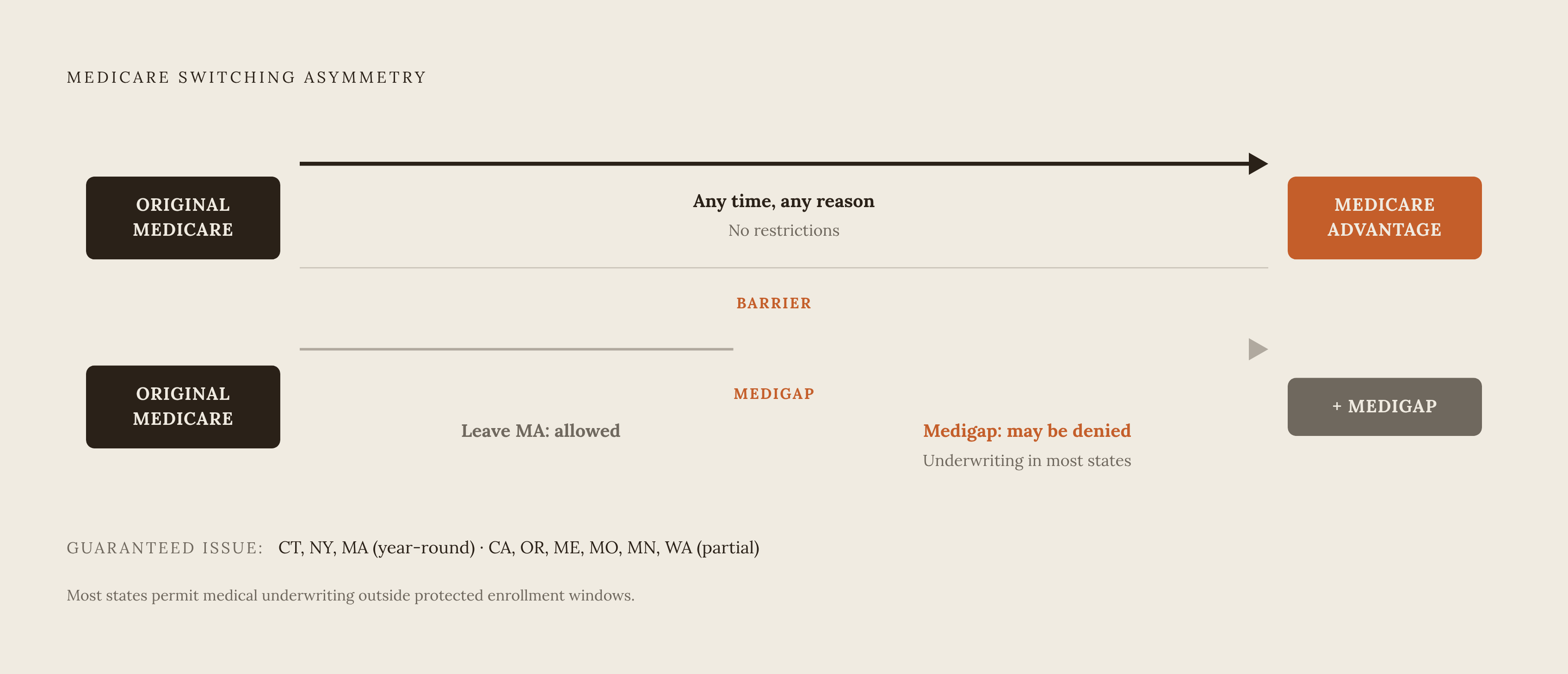
For new Medicare beneficiaries, the 12-month federal trial right is a real, one-time safety net. It gives an initial Medicare Advantage choice some reversibility, making a trial at first enrollment different from a switch attempted after a later diagnosis. But the window is short, and the clock starts at enrollment. The short window matters before someone first chooses a plan, when they may be in better health and have better coverage options.
Moving from Original Medicare to Medicare Advantage is straightforward, but obtaining Medigap when moving back can be harder. In most U.S. states, access to Medigap outside protected enrollment windows can involve medical underwriting. An insurer may charge more or deny coverage because of health history. The missing supplement is what can turn an apparently reversible choice into lasting financial exposure.
State protections change this risk. Connecticut, New York, and Massachusetts require insurers to sell Medigap to any Medicare beneficiary year-round without medical underwriting. Other states, including California, Oregon, Maine, Missouri, Minnesota, and Washington, have more limited protections, such as birthday rules, anniversary windows, or partial switching rights. The practical concern is a beneficiary choosing Medicare Advantage at 65, developing a serious condition by 67, and then finding Medigap unavailable or unaffordable. This is a reason to weigh future flexibility before illness makes it more valuable.
A practical framework for matching the two paths to your actual situation
A useful decision framework rests on four variables, which are health trajectory, geographic mobility, tolerance for administrative friction, and ability to carry a Medigap premium. Start with Brevy’s free eligibility and benefits discovery tool before committing to either coverage path. Its AI-powered platform surfaces Medicare, Medicaid, and supplemental benefit programs for which a beneficiary qualifies, then provides enrollment guidance. That discovery is particularly relevant when programs may pay the Part B premium or subsidize Medigap costs, changing the baseline comparison. It can also help family caregivers managing enrollment for a parent or spouse make the available choices concrete.
With that baseline established, Medicare Advantage is likely the better fit for someone in good health who expects low use and stays in one service area year-round. The fit is stronger when key physicians are in-network and the beneficiary is comfortable with prior-authorization requirements. Bundled drug, dental, and vision coverage can also be convenient, provided the actual benefit amounts meet the person’s needs. But the comparison still has to move beyond the bundle. Use the plan’s copay schedule to work out the cost of expected visits and services, since the average supplemental premium alone cannot tell you what total spending will be.
Original Medicare plus Medigap is likely to work better for someone who expects regular specialist visits, imaging, or post-acute care, or who needs to get care across states. Plan G covers essentially all Medicare-approved costs after the $283 annual Part B deductible, so it is much easier to know what covered medical care will cost. Compare the Medigap premium with the Medicare Advantage out-of-pocket cap, then use expected utilization to assess where the costs cross. If underwriting could keep someone from getting Medigap later, the comparison should also weigh what it is worth to buy that freedom early. The system’s complexity is itself a cost, so make the discovery step specific now by using Brevy to identify eligible benefits before comparing the two paths against your own care needs.