The Free Eligibility Tool Family Caregivers Use to Sort Out a Parent's Medicare and Medicaid Benefits
A quick online screen shows which benefits a parent may qualify for.

A free online eligibility checker can help family caregivers estimate which Medicaid benefits and Medicare cost-saving programs an aging parent may qualify for, using their state, income, household size, and eligibility category. It gives a fast starting point without charging for help, but the state Medicaid agency makes the final decision. A useful “likely eligible” result identifies which benefit to pursue and what to do next.
Why Medicare and Medicaid eligibility is genuinely confusing for family caregivers of aging parents
A hospital phone call raises a question the family has not had to answer before. A parent will need help with bathing, dressing, and meals at home, but who pays? Having Medicare does not settle the question. The answer depends on whether the care includes a skilled medical service, whether the parent qualifies for Medicaid, and which Medicaid pathway applies.
The confusion comes from the structure of the programs. Medicare is federal and uniform, while Medicaid is a state-federal partnership with different income rules, asset tests, eligibility categories, and application timelines. Seniors and people with disabilities face different thresholds from working-age adults, and nursing-home Medicaid differs from community-based coverage. The same parent may qualify for one pathway but not another. That is why a general rule about savings or income can be accurate in one setting and misleading in another.
What Medicare actually covers for an aging parent, and where it stops
Medicare Part B covers doctor visits, outpatient care, and durable medical equipment, as well as certain home health services. Home health aide visits qualify only when the parent also receives skilled nursing or therapy and is certified as homebound. Covered home health services have no out-of-pocket cost.
Medicare does not pay for a caregiver whose only role is helping with bathing, dressing, meals, or supervision. It also does not pay for 24-hour care or pay a family member to provide care.
Some Medicare Advantage plans offer limited in-home support through Special Supplemental Benefits for the Chronically Ill, or SSBCI. These benefits serve enrollees with serious chronic conditions, but eligibility is narrow and support varies by plan. They are not a general personal-care benefit. When a parent needs help on an ongoing basis without a skilled medical need, families turn toward Medicaid to pay for care that Medicare leaves uncovered.
How Medicaid fills the gap Medicare leaves — and why the rules differ so much by state
Medicaid is the main payer for long-term personal care. Many caregivers think the same low asset limit applies everywhere, though states may set higher limits and some no longer have asset tests. Income, household size, and eligibility group also change the answer. The same financial circumstances can produce different results in Texas, California, and Florida.
The lookback rule needs equally careful interpretation. The 60-month lookback established by the Deficit Reduction Act of 2005 applies to nursing-home Medicaid and Home and Community-Based Services, or HCBS, waivers. Community-based aged, blind, and disabled Medicaid, commonly called ABD Medicaid, generally has no lookback on asset transfers. A lookback is not a blanket prohibition on applying. Medicaid applications are free and can be submitted throughout the year, with most processed within weeks, although disability-based applications may take longer.
Rosa, 68, in California, illustrates the cost of applying the wrong rule to the right person. She believed savings held in a CD would disqualify her, so she avoided applying for two years. Under California’s Medi-Cal rules on the ABD pathway described in her case, no asset test applied. Her savings did not affect eligibility. The mistaken assumption cost her thousands in out-of-pocket medical bills.
How can a free online tool check a senior’s Medicare and Medicaid eligibility?
A free eligibility calculator translates state-specific rules into a manageable set of questions. It asks for the parent’s state, household size, gross monthly or annual income, assets, marital status, and eligibility group. The categories distinguish adults 19–64, children, pregnant applicants, people age 65+, and people with disabilities. Those distinctions select the relevant rules. A useful estimate therefore depends on more than entering an income figure.
The result can show income against the applicable limit, the parent’s federal poverty level percentage, state-specific notes, a Medicaid phone number, and an application link. Some notes address work requirement timelines. SSI recipients can receive an instant result because SSI enrollment qualifies a person automatically for Medicaid in most states. For a parent who already has Medicare, screening can also point toward programs that help pay Medicare costs. That is different from treating Medicare and Medicaid as interchangeable coverage.
What happens when the income appears too high? In the tool example, a Texas senior above the nursing-home income cap receives an explanation of a Qualified Income Trust, also called a Miller trust, as a qualifying step. The result also notes that gifts made in the past five years are reviewed. The family still needs to check every result with the state Medicaid agency, which has the final say.
The highest-value benefit most caregivers overlook — Medicare Savings Programs and Extra Help
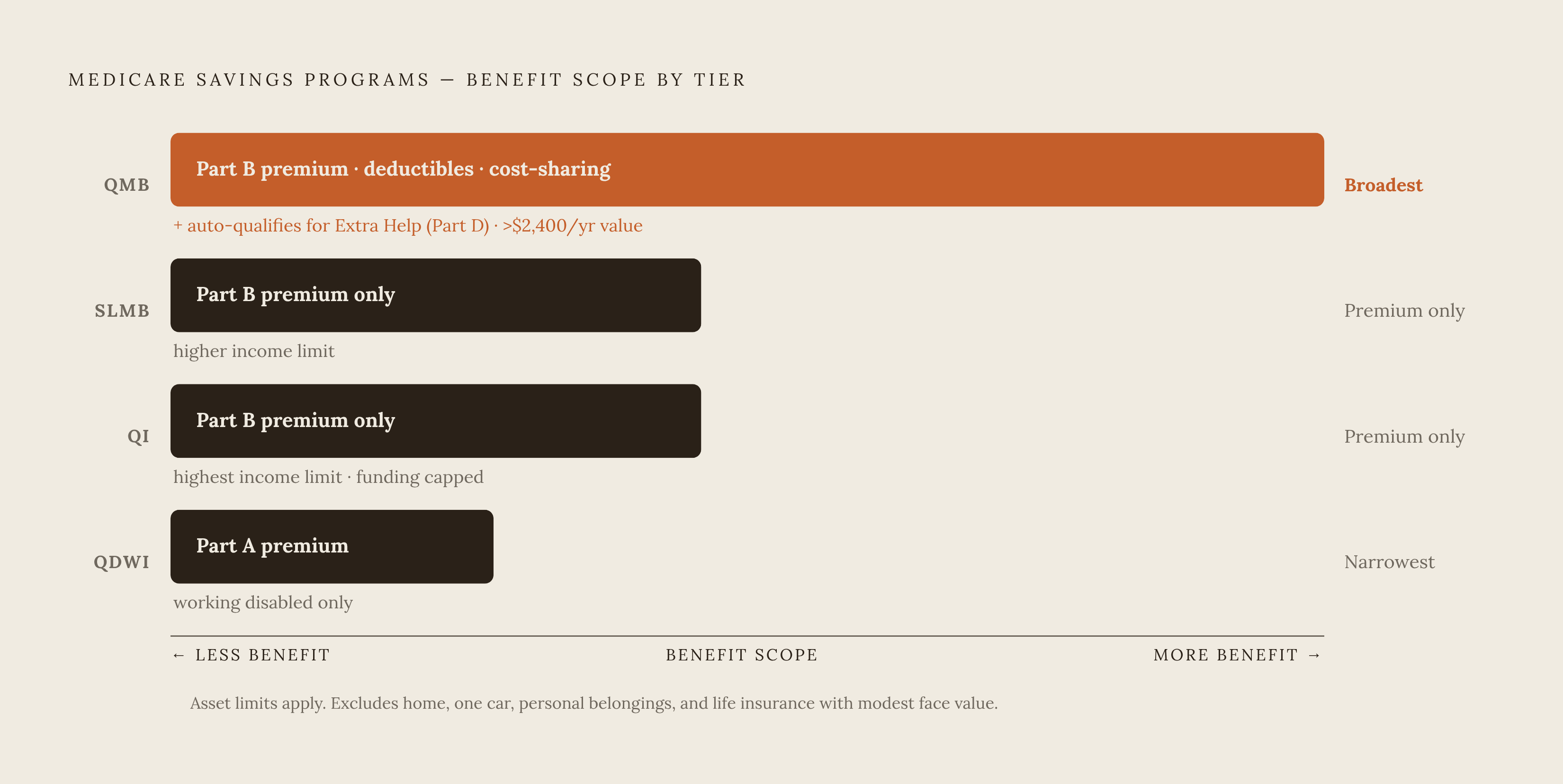
Qualified Medicare Beneficiary, or QMB, coverage is often the highest-value result for a parent with Medicare and limited income. It eliminates the Part B premium, deductibles, and most cost-sharing, costs families may already be absorbing, with more than $2,400 in annual savings before other benefits are considered. A Medicare Savings Program can thus save a parent money right away, even if the parent is not looking for long-term care. Yet far fewer people are enrolled than could qualify.
Other Medicare Savings Programs serve different income ranges or needs. Specified Low-Income Medicare Beneficiary, or SLMB, has a somewhat higher individual income limit than QMB, while Qualifying Individual, or QI, has the highest individual limit of those three tiers. Both have higher limits for couples and cover the Part B premium only. Qualified Disabled and Working Individuals, or QDWI, covers the Part A premium only. The tiers are not equivalent benefits.
The 2026 asset limits are modest for individuals and somewhat higher for couples, but not everything a parent owns counts. Exclusions include the home, one car, personal belongings, and life insurance with modest face value. Some states also set limits above the federal floors. A parent who is just above a general limit may therefore still qualify. For families comparing savings with an asset limit, the distinction between total assets and countable assets is consequential.
Enrollment in QMB, SLMB, or QI automatically triggers Extra Help, the Low-Income Subsidy for Part D prescription drugs, without a separate application. Sarah, who cares for her disabled brother on Medicare, discovered that he qualified for QMB. Coverage of his deductibles and copayments reduced family out-of-pocket costs and helped him receive regular care. The financial case extends beyond one premium.
The Program of All-Inclusive Care for the Elderly, or PACE, offers a companion option in dozens of states and Washington D.C. as of 2026. It covers Medicare and Medicaid services plus adult day care, transportation, dental care, and caregiver support, including respite. For a parent who qualifies for both Medicare and Medicaid, there is no monthly premium, deductible, or copay. Availability is not the same as individual eligibility. Still, it broadens the question from who pays a medical bill to what support the parent could receive.
How Medicaid’s self-directed care programs can pay a family member who is already providing care
Medicaid self-directed care can turn unpaid family caregiving into a regular W-2 paycheck. Nearly every state has a self-directed option, though who can use it depends on the program and the family’s circumstances. KFF’s 24th survey of state Medicaid officials, completed between April and August 2026, found that all responding states except Alaska allowed self-direction in at least some circumstances.
The program’s name changes across state lines. These programs include CDPAP in New York, CDASS in Colorado, Personal Choices in Alabama, and other state self-directed care programs. The same survey found that 40 responding states with self-direction allowed enrollees to establish caregiver payment rates. All states with self-direction had financial management services. These services help families use the paid-care pathway, but each family caregiver still has to qualify.
For a caregiver pursuing this route, the practical step is to ask for “self-directed care” or “consumer-directed personal assistance” by name. Caseworkers rarely volunteer the option, so a general request for home care may not bring it into the conversation. Awareness is a real barrier to participation. Among programs reporting self-direction rates, most reported that fewer than a quarter of people were self-directing care. An eligibility estimate can open the inquiry, but the family still needs to ask about the specific care option.
What to do after the tool returns a result — and where the process can break down
A “likely eligible” result is a prompt to act toward obtaining benefits. The next step depends on what the screen identifies. For an MSP result, the recommended action is to apply through the state Medicaid agency. For likely community Medicaid eligibility, it is to contact that office and explicitly ask about self-directed or consumer-directed personal care. These are separate questions, even when the same agency handles them.
A result just above the income limit also deserves follow-through. The recommended action is to apply anyway, because some income may be excluded, a Medicaid spend-down may apply in some states, or state limits may exceed the federal floor. The estimate cannot resolve every exception. Its value is in identifying the relevant threshold and pathway, rather than encouraging a family to rule itself out based on one number.
A denial requires scrutiny rather than an assumption that the calculator was wrong. The Medicare Rights Center’s account of Ms. G describes a Medicaid office that miscalculated her income and used an outdated MSP income limit in its denial letter. A counselor caught the error. For a denied applicant, the recommended response is to request the reason in writing and compare the limit used with the current year’s figure.
Free help is available for that follow-through. State Health Insurance Assistance Program, or SHIP, counselors can walk through results at no cost, while the Medicare Rights Center National Helpline offers one-on-one support with MSP applications and appeals. An AI-assisted platform combining eligibility screening with guided enrollment support addresses the same handoff between an estimate and a completed application. Neither approach replaces the agency’s decision. Their role is to help the caregiver continue through the process.
There is also a time-sensitive change for some adult children providing care. H.R. 1, the One Big Beautiful Bill Act, P.L. 119-21, and the CMS interim final rule implementing it require states to introduce Medicaid community engagement requirements for the expansion population no later than January 1, 2027. These require a substantial monthly minimum of qualifying work, education, or community service. They are not a universal requirement for seniors. The caregiver’s own expansion Medicaid coverage may be affected.
Exemptions include pregnant individuals, caregivers of children 13 years of age and under or of a disabled individual, and medically frail individuals. Educational enrollment at least half-time counts as a qualifying activity, with exemptions for students, including full-time students, determined under the same categories that apply to other enrollees. Adult children who have expansion Medicaid and care for a family member should check whether they qualify for an exemption. A family’s benefits inquiry may begin with one aging parent, but completing it can require decisions about both the person receiving care and the person providing it.