Why Medicaid Eligibility Varies so Much by State and How to Check Yours for Free
Federal rules set the floor, but your state decides who qualifies.
Medicaid eligibility varies by state because federal law sets a common foundation while states decide much of who qualifies and what care is covered. To check eligibility for free, start with healthcare.gov or your state’s Medicaid portal, then confirm with the state agency. Seniors and family caregivers who need help understanding both Medicare and Medicaid can also get free, personalized guidance from a SHIP counselor.
How Medicaid's federal-state design creates fundamentally different programs in every state
Medicaid divides responsibility between the federal government and the states. Federal law requires coverage for certain groups, including children, pregnant women, some people with disabilities, and nursing home residents, subject to eligibility rules. States fund their share of the program and have authority over many other coverage decisions. That authority extends beyond setting an income limit. It includes who can qualify, which services are available, and what conditions apply.
This structure explains why a national program has no single eligibility answer. Medicaid has 50 state programs, plus D.C., that work within federal rules. So a rule about coverage in one state may say little about what the same person can get in another. Checking eligibility means asking whether someone has a low income and whether their state covers someone in their circumstances. The first major fork in that inquiry is Medicaid expansion.
Why expansion status is the single biggest dividing line between states
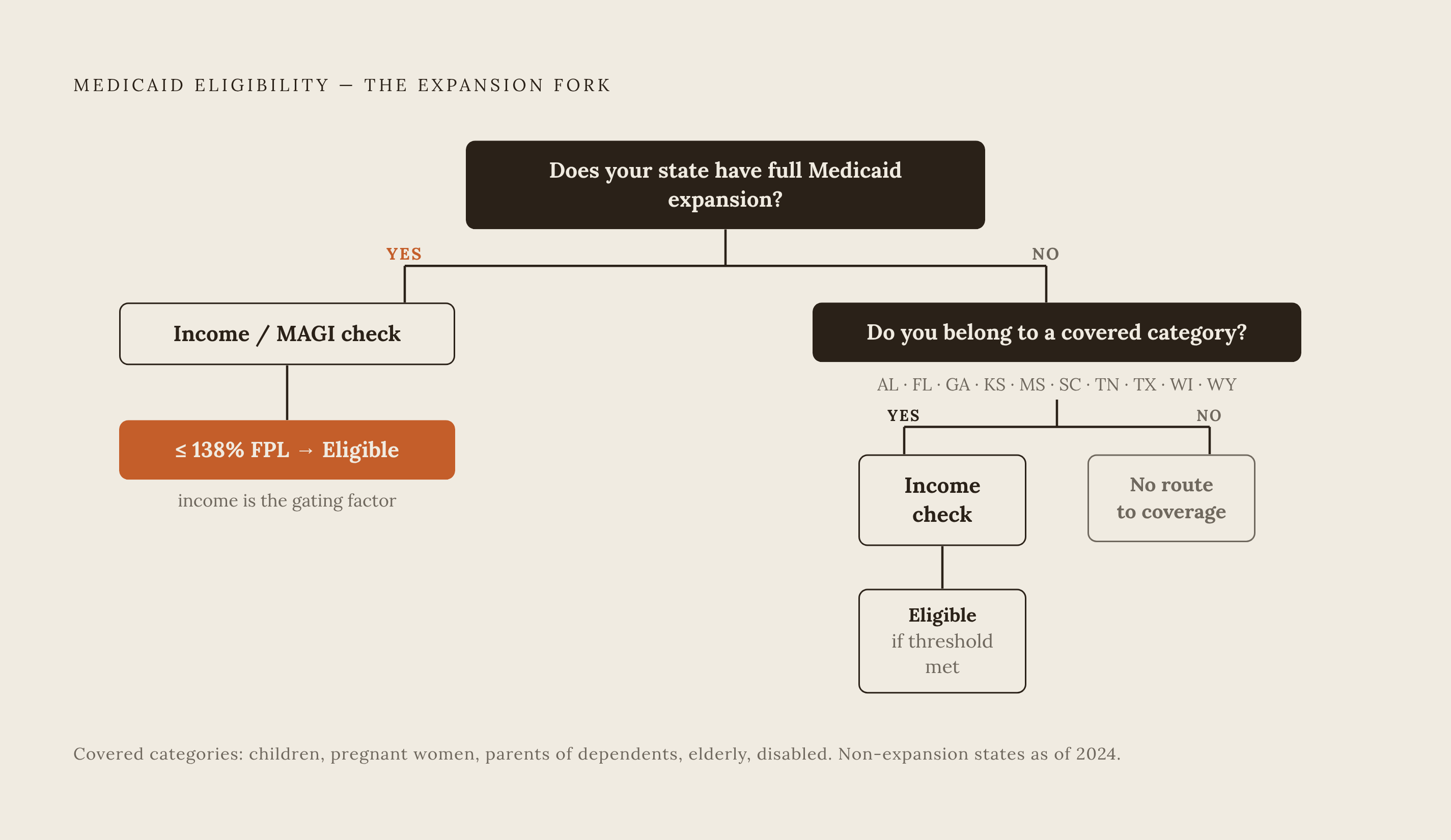
In a full-expansion state under the ACA, low-income adults have a route to coverage without qualifying as a parent or belonging to another covered group. In a non-expansion state, low income alone may provide no route at all. The distinction comes before the income calculation. If the state does not cover the person’s category, comparing earnings with a threshold cannot settle eligibility.
The brief’s late-2026 list of states without full expansion includes Alabama, Florida, Georgia, Kansas, Mississippi, South Carolina, Tennessee, Texas, Wisconsin, and Wyoming. But that label needs qualification for two states. Georgia offers narrow coverage through Pathways, which requires a monthly threshold of work or qualifying activities. Wisconsin’s BadgerCare Plus covers adults up to the poverty line.
Texas illustrates the practical divide for a parent. Someone just above its very low parent income limit may have no coverage through that category, while the same person with the same income could receive comprehensive Medicaid coverage in a full-expansion state. The income has not changed, but the available eligibility route has. For an adult without a child at home or another qualifying condition, the divide can be sharper still. Outside full expansion and the limited exceptions, there may be no category the person can qualify under.
How income thresholds diverge even within expansion states
States use the federal poverty guidelines in different ways, and some use higher baselines, so the income limit still depends on where a person lives and their coverage category. Household size also belongs in that calculation. An income figure detached from those details is not a reliable eligibility test, even when it appears in a general explanation of Medicaid expansion.
What, then, does knowing that a state expanded accomplish? It establishes an important route to coverage. A person still needs the threshold for their household and the category under which they are applying. This is why a state-specific screener is more useful than treating a national income standard as a universal answer.
The contrast is wider for parents in non-expansion states. Texas sets an extremely low limit for a parent in a family of three, South Carolina sets a substantially higher one, and Kansas falls between them. Here, the category and household size are the same. The state’s threshold changes the result. The free tools described in the final section provide a way to examine the applicable rules without relying on a dollar figure borrowed from another state or household.
Why eligibility categories and asset rules add more variation on top of income
Income is only one part of the assessment. Medicaid uses separate rules for different coverage categories, and those rules can change the income threshold, the treatment of assets, and who counts in the household. Age and disability can therefore change which questions an application needs to answer. Two people with similar incomes may not be assessed under the same rules.
For adults 19–64 covered through expansion, there is no asset test. Income is counted using MAGI rules, rather than treating savings as an additional qualification barrier. That distinction is easy to miss. Someone who assumes Medicaid always requires an asset test may rule out expansion coverage for the wrong reason. Conversely, the absence of an asset test for expansion adults does not establish the rules for every other Medicaid category.
This difference matters most for seniors and families who need long-term care. Long-term care coverage can involve asset rules that do not apply to standard expansion coverage, so a general Medicaid income screening cannot answer every question about that care. The relevant inquiry becomes which program is being considered and which financial rules belong to it. For a family in that position, the lesson is to ask about the specific care pathway rather than assume that either income or savings alone decides the case.
How Medicaid covers home care differently by state — and why that matters most for family caregivers
For caregiving families, coverage of home and community-based services can be more consequential than eligibility for basic medical coverage. These services include personal care and custodial care, which Medicare generally does not cover over the long term. The distinction shapes where families seek help. Having Medicare does not, by itself, answer whether someone can receive ongoing help at home or whether a relative can be paid to provide it.
KFF identifies Medicaid as the primary payer for home care in the United States. Yet qualifying for Medicaid does not mean a person gets a home care waiver slot. HCBS waivers are optional benefits, and states can cap enrollment. Waitlists therefore belong in any realistic account of access. A person may meet the financial rules and still have to go through a separate process to get the services their family needs.
The rules for self-directed care also vary by state. These programs let the enrolled person choose, and sometimes pay, a family member to provide care. KFF’s November 2026 survey, its 24th annual survey of state Medicaid officials, was done April–August 2026. The survey found that every state that responded pays family caregivers through Medicaid home care programs, and all but Alaska let enrollees direct their own services. Those findings establish that family caregiver payment is widespread, with eligibility subject to rules about the relative and care arrangement.
The same survey found that most states let enrollees set caregiver payment rates, and a similar number allow budget authority over the allocation of dollars across authorized services. Consumer-directed or self-directed programs that pay by the hour include CDPAP in New York, IHSS in California, Michigan Home Help, and Missouri CDS. Hourly rates vary by state. So do rules about which relatives can be paid. Colorado, Wisconsin, and Oregon let spouses be paid, while many other states bar spouses but let adult children and other relatives be paid.
Knowing whether a state “pays caregivers” requires checking whether the person needing care qualifies for the relevant program, whether a slot is available, and whether that program permits payment to the relative providing care. Expansion status cannot answer those questions on its own because basic coverage and waiver access are separate decisions.
The emerging variables that will shift eligibility further in 2027
Eligibility rules also change over time, adding a further dimension to state variation. Several states are set to add work requirements in 2027, while pressure on federal funding for optional HCBS benefits leaves covered hours and which programs will be available in doubt. A work requirement affects the conditions attached to coverage, while changes to a home care program may affect what an enrolled person can receive.
Nebraska’s health and human services agency says work requirements began on May 1, 2026, and renewals twice a year for expansion adults are set to begin January 1, 2027. Those dates describe separate changes. They also illustrate why an eligibility answer needs a date as well as a state. Qualifying under one set of conditions does not settle what a later renewal will require.
Congress.gov lists the Home and Community-Based Services Access Act as introduced in August 2026 but not passed as of November 2026. The bill would make HCBS a mandatory Medicaid benefit, but that proposal is not an available entitlement. For families considering coverage, the practical response is to check current eligibility and ask the agency or navigator about changes that apply to their program.
How can seniors and family caregivers check Medicaid eligibility for free?
The best free starting point for a state-specific Medicaid check is healthcare.gov or the state’s own Medicaid portal. These tools look at income, household size, and coverage category together, so a family does not have to work out each rule on its own. Their answer is preliminary. Only the state Medicaid agency can issue a final eligibility determination, so a screening result is a starting point for enrollment.
Someone with questions about an elderly parent’s Medicare benefits and Medicaid eligibility can get free help that looks at the parent’s own needs. A SHIP counselor can look at how both programs apply to a person, including dual eligibility, at no cost. Counselors are available in every state through shiphelp.org. This can help when someone has questions about both medical benefits and long-term personal care. The Medicare-versus-Medicaid distinction needs to be resolved before an answer about one program is treated as an answer about the other.
Families who need application help can call 211 or find a free enrollment navigator through LocalHelp.Healthcare.gov. The practical sequence is to begin with an official screener, then take the result and any unresolved questions to the agency or a navigator. There is no need to pay for that assistance. When a financial rule is unclear, the relevant question is which eligibility category the person is being assessed under. When home care is the goal, the inquiry needs to name that service explicitly.
For caregivers, the next question should be whether the person receiving care qualifies for a self-directed HCBS waiver. That process requires a separate waiver application and assessment as well as basic income screening. It also requires attention to the state’s rules about paid relatives and available slots. A positive result for ordinary Medicaid coverage does not complete this process.
AI-assisted benefit discovery tools can complement this work by surfacing waiver programs, self-directed care options, and other caregiver compensation programs that standard screeners may not flag. They serve only as discovery aids. Their useful role is to help families identify programs to ask about, especially when they do not know those programs exist. The next step remains concrete and free, which is to ask the state agency or a navigator to assess the relevant coverage and, where needed, the separate home care pathway.