When Your Spouse Is Your Caregiver Medicaid Self-Direction Can Write Them a Paycheck
Spouses can be paid through some self-directed Medicaid programs.
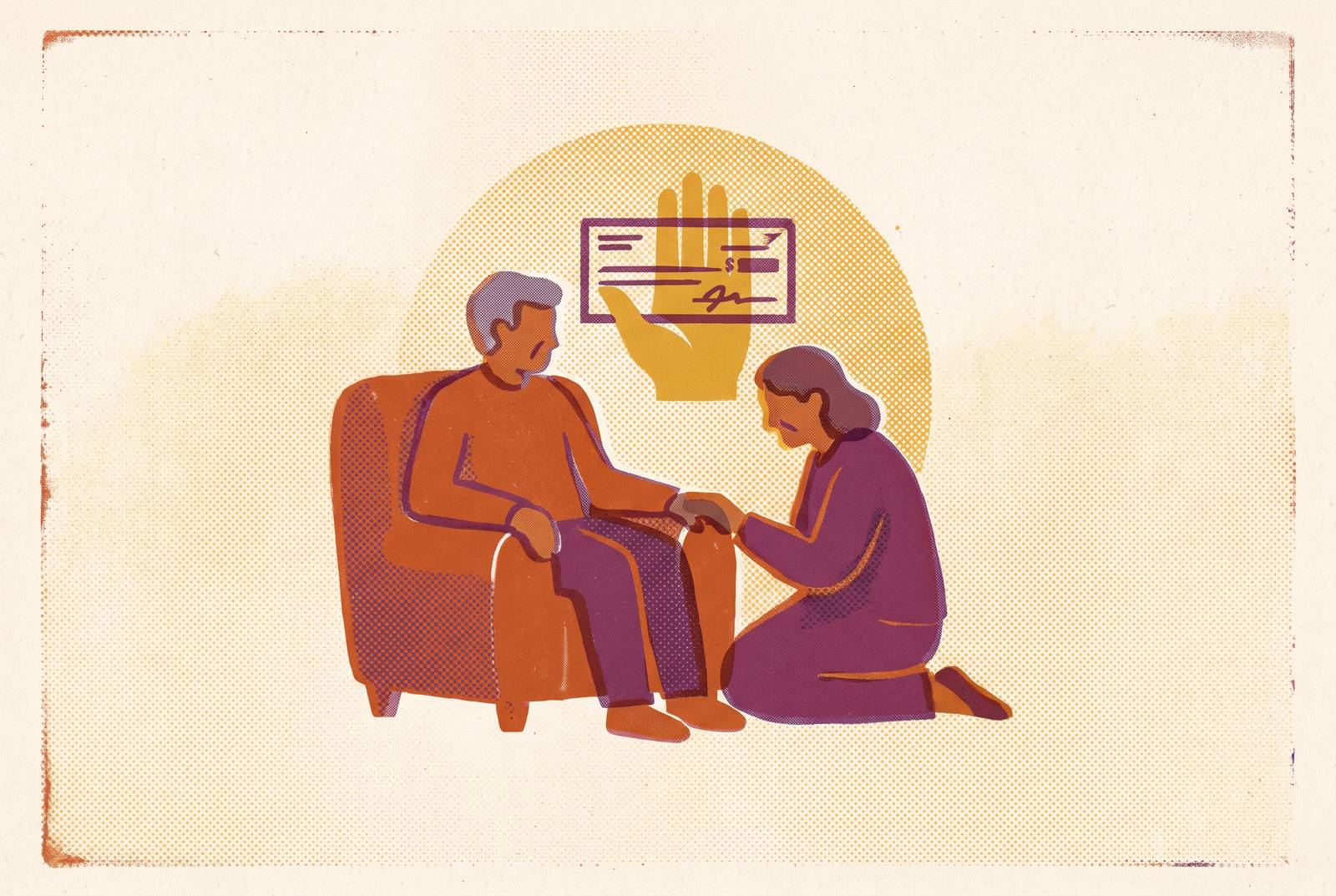
Medicaid can pay a spouse for caregiving through certain self-directed programs, even though its standard personal care benefit excludes spouses. The answer depends on the program’s legal authority, the state’s rules, and formal enrollment. AI-assisted benefits screening can help families find a possible route and navigate the paperwork, but the route to a paycheck begins with identifying a program that permits spousal pay.
Why the standard Medicaid home-care benefit turns spousal caregivers away
42 CFR 440.167 excludes legally responsible relatives, including spouses, from paid work under Medicaid’s state plan personal care services benefit. That exclusion is a deliberate feature of the benefit. Its underlying assumption is that caring for a spouse is an ordinary marital duty, so paying for that care would duplicate an existing responsibility. The rule bases eligibility for paid work on the caregiver’s relationship to the care recipient. A program may therefore pay a neighbor’s adult child while refusing to pay a spouse who gives the same care.
What, then, does a caseworker’s “no” establish? It may establish only that a spouse cannot be hired under the standard personal care benefit. The answer can be correct within that benefit without describing every Medicaid pathway available to the household. That distinction is the starting point for a more useful question about which rules govern the application.
How self-directed waivers operate under a different legal authority and why that changes everything for spouses
Section 1915(j) of the Social Security Act creates a separate authority for self-directed personal assistance services. Under that authority, a state may allow legally liable relatives, including spouses, to be paid caregivers.
Under 42 CFR 441.450, 1915(j) services are a state plan option separate from the standard personal care benefit. Although self-direction is often discussed together with waivers, the terms are not interchangeable. Section 1915(c) home- and community-based services, or HCBS, waivers provide a parallel route because a state may define “family member” differently for its waiver than for its standard benefit. That difference can open paid caregiving to a spouse whom the standard benefit excludes.
The state still has to choose that opening. Federal permission does not require every state or every self-directed program to pay spouses, which explains why a similar household can receive a different answer across a state line. Community First Choice also allows a budget model through which a qualified family member can be hired. However, it shares an important restriction with 1915(j). The participant’s representative cannot simultaneously be the paid worker, so a spouse who directs care for an incapacitated partner needs a different person to hold the representative role before taking the paid role.
Which states actually allow a spouse to be paid through self-direction, and what the state-by-state variation looks like
Florida’s 1915(c) LTC waiver, FL.0962.R02.03, approved effective April 1, 2025, expressly allows recipients to select a legally responsible person for participant-directed option, or PDO, services. That category typically includes a spouse. The managed-care plan pays for the required Level 2 background screening. It also serves as the fiscal/employer agent, although it may subcontract that role to a vendor with reasonable notice.
Missouri’s Consumer Directed Services program does not allow a spouse to be the paid attendant. The contrast is sharp, but not contradictory. Federal law makes spousal pay available as a state choice rather than a nationwide entitlement, and Missouri has not exercised that choice for this program. A family cannot infer permission from the words “consumer directed” alone.
New Mexico’s Mi Via self-directed 1915(c) waiver illustrates another feature of state variation. A participant can hold an individual budget and hire a Legally Responsible Individual, a category that may include a spouse. Approval is essential to that arrangement. The services must appear in the participant’s approved Service and Support Plan and Authorized Annual Budget. Permission therefore rests not just on the family relationship but also on the approved care arrangement.
Even in permissive states, spouses typically must provide care beyond ordinary marital duty, pass a background check, complete required training or certification, and work through a fiscal intermediary. These conditions narrow the practical question. It is not simply whether a state pays family caregivers, but whether a particular program permits this spouse to provide the authorized services.
How do you enroll in Medicaid self-direction and reach the first paycheck?
Families normally begin with the state Medicaid agency, a local Area Agency on Aging, or an Aging and Disability Resource Center. A family should ask specifically for the self-directed or consumer-directed option and whether it permits a spouse to be paid. A general inquiry may miss that distinction. An AI-powered benefits screening tool can help find programs that may fit the family, check for waitlists, and show which paperwork comes first. Those functions are useful precisely because finding a potentially suitable program is only the beginning.
The person who needs care must first meet Medicaid’s rules for financial eligibility. For HCBS waiver and long-term care Medicaid programs, income limits in most states are tied to a percentage of the SSI Federal Benefit Rate, while broader Medicaid pathways use the Federal Poverty Level. Assets are also tightly limited. But when a married person applies, separate rules protect the community spouse, as discussed below.
Most self-directed HCBS waiver programs also require a Nursing Facility Level of Care determination. A nurse or care manager assesses the person’s functional needs and establishes the authorized weekly care hours. Financial eligibility alone is not enough. Enrollment in the appropriate program and any waitlist must also be addressed before the spouse can reach paid work. A waitlist is especially important to identify early because an available legal pathway does not necessarily mean an immediately available place.
Once the program’s requirements are established, the spouse completes caregiver paperwork, background screening, and any required training. The process typically takes several weeks to a few months from first application to first paycheck. A prompt start reduces the period of unpaid care for which Medicaid provides no retroactive compensation.
The program assigns, or the participant selects, a fiscal intermediary, also called a fiscal/employer agent, to handle payroll, tax withholding, workers’ compensation, and compliance. Electronic visit verification systems track hours under rules that took effect in 2020, or 2021 for most states. These administrative steps turn an approved arrangement into paid employment. They also establish the payroll records behind the caregiver’s next question about taxes.
How the pay is taxed, and why the live-in rule makes most spousal caregivers eligible for a significant exclusion
IRS Notice 2014-7 gives a federal income tax break for qualifying Medicaid waiver payments to caregivers who live with the person they care for. It treats those payments as “difficulty of care” payments that can be excluded from gross income under IRC Section 131. For spouses sharing a home, the living arrangement fits that requirement. The exclusion can shelter most or all qualifying wages from federal income tax. The pay remains real compensation even when it receives this favorable treatment.
Without an applicable exclusion, self-direction pay is earned income ordinarily subject to federal income tax, Social Security, and Medicare taxes. The fiscal/employer agent handles withholding and issues a W-2. The Feigh case and subsequent IRS guidance also allow caregivers to treat the excluded payments as earned income for purposes of the Earned Income Tax Credit and the Additional Child Tax Credit. That preserves an important possibility for eligible households.
Caregivers should weigh what they save in taxes now against any change in the wages that count toward their Social Security earnings record and future benefits. The tax exclusion and retirement-credit question should not be treated as interchangeable. Separately, Medicaid payments made directly to an approved family caregiver are not transfers by the care recipient. They therefore do not affect the recipient’s Medicaid eligibility as a transfer of the recipient’s own money.
How Medicaid’s spousal impoverishment protections shield the household’s assets and income during enrollment
When a spouse applies for a self-directed HCBS waiver, the couple can keep more than a single person’s Medicaid asset limit. Federal spousal impoverishment protections preserve a share of household resources for the spouse remaining at home. Those protections address a specific risk. One spouse’s need for long-term care should not leave the other without protected assets and income. The couple’s home is separately protected as well.
The Community Spouse Resource Allowance, or CSRA, lets the community spouse keep assets within a range set by the federal government, with the amount varying by state. Medicaid carves out that protected share before counting what remains for eligibility. Income has a separate protection. The Minimum Monthly Maintenance Needs Allowance, or MMMNA, protects income for the community spouse within a federally set monthly range for 2026. These are distinct mechanisms, so an asset calculation alone cannot explain the household’s full position.
Since 2014, these protections have extended to married couples using HCBS waivers in addition to those in nursing home placements. The current authorization runs through September 2027. That date gives families a reason to consider enrollment while the protection is authorized, without assuming what will happen afterward. Families need to determine how the allowances apply to the couple’s circumstances under the state’s rules.
Compensation from the care recipient for care provided before enrollment can be treated as a gift rather than earned income and can trigger Medicaid’s look-back rules. That is a different transaction from Medicaid paying an enrolled caregiver directly.
What being paid actually delivers beyond the paycheck — and what it costs if the opportunity is missed
Formal caregiving pay can provide more than current income. Depending on the program and applicable tax treatment, it may contribute Social Security earnings credits and provide access to workers’ compensation, paid sick leave, vacation time, or mileage reimbursement for transportation services. These benefits are not uniform across programs. Their availability contributes to the value of the particular arrangement and must be assessed separately from the wage. The Social Security treatment deserves attention because the caregiver’s future income is also at stake.
Ohio’s program shows why benefit details need careful reading. It allows overtime pay for self-directed hourly caregivers working beyond 40 hours per week. Spousal caregivers, however, are themselves capped at 40 paid hours per week unless an exception permits more. A broad statement about overtime would miss that restriction. The useful comparison is between the benefits and limits that apply to the spouse’s own role.
Enrollment also gives the caregiver’s work formal recognition. That recognition links the work to training, workplace protections, and possible future benefits, so it goes beyond the household’s private duties. Going unpaid can mean missing those supports as well as wages. Because Medicaid does not compensate the earlier caregiving period retroactively, delay can leave costs that later enrollment will not erase.
For families unsure where to begin, AI-assisted benefits screening offers a practical way to organize the search. The useful criteria are specific, including state-by-state program matching, spousal eligibility screening, waitlist information, and guidance through the enrollment sequence. Technology can help a family navigate those questions without first mastering the entire system. The next step is to identify a suitable self-directed program and ask the administering agency whether it permits the spouse’s paid role, what approval requires, and how enrollment can begin.
Sources
- How to Get Paid to Care for Your Spouse (2026)
- How to Get Paid to Care for Your Spouse in New Mexico (2026)
- How to Get Paid to Care for Your Spouse in Florida
- Get Paid to Care for Your Spouse in Ohio (2026)
- How to Get Paid to Care for Your Spouse in Missouri (2026)
- Medicaid Self-Direction & Consumer-Directed Services (2026)