What the Free Medicare and Medicaid Eligibility Checker Shows You in Under Two Minutes
A two-minute check sorts your likely Medicare and Medicaid pathways.

A free Medicare and Medicaid eligibility checker can show seniors and family caregivers their likely coverage pathways, the income and asset rules that apply, and where state differences need closer review, in under two minutes. The result gives families a clearer route to benefits and enrollment support.
Why checking Medicare and Medicaid eligibility online takes two minutes but finding the right answer on your own can take weeks
Income rules, asset limits, and household definitions vary by state and program, so finding a number is not the same as finding the rule that governs a particular person. A family looking into coverage for an older parent may find information for working-age adults without realizing that it describes a different pathway. More reading can leave them with more answers that seem to conflict.
A checker shortens this search by matching personal circumstances to coverage categories before presenting the relevant rules. That is a narrower task than deciding an application, but it resolves an important preliminary question. Which rules should this household be reading? Without that sorting step, a person may miss a prescription subsidy or a way to get paid family care while trying to find out whether Medicaid applies at all.
What the checker actually asks for and why each field matters
The useful inputs are those that change the calculation. State tells the checker whose rules to use, while household size helps it choose the income standard to compare against. Income supplies the amount to test against that standard. Eligibility category distinguishes someone seeking income-based coverage from someone whose age, blindness, disability, or long-term care needs point toward another route.
Why does the category deserve as much attention as income? Because the same income amount can lead to different conclusions under different programs. State and category therefore work together, while household size and income give the checker the information needed for the comparison. An asset threshold becomes useful only when it belongs to the applicable pathway.
This also sets a limit on what a brief check can establish. A small set of inputs can produce a useful estimate without resolving every condition of enrollment. The result should make clear what the check can and cannot tell the household. In particular, a state-variation warning tells the reader where the initial calculation needs a more specific answer.
The three coverage pathways a checker surfaces and what distinguishes them
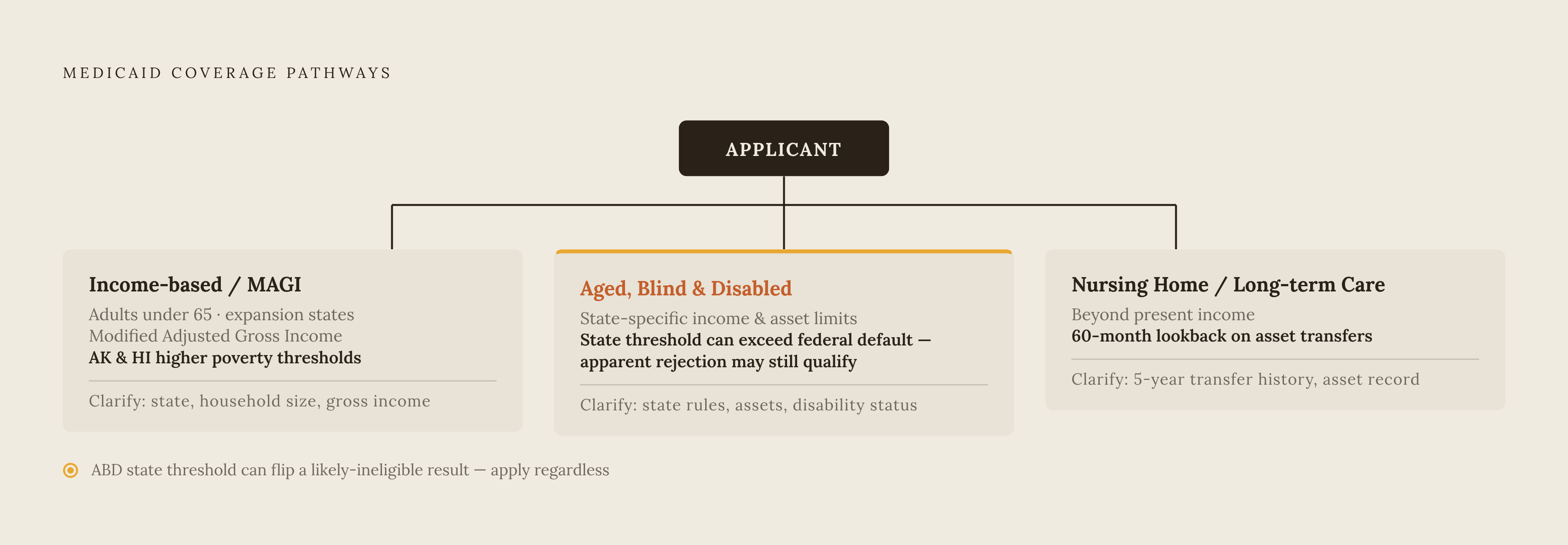
The three pathways here are Medicaid routes. The income-based route uses Modified Adjusted Gross Income, or MAGI, for adults under 65 in expansion states. Alaska and Hawaii use higher poverty guidelines, which the calculator adjusts for automatically. This route answers an income-based coverage question. It is not the default test for every senior.
The Aged, Blind, and Disabled pathway, usually shortened to ABD, is more relevant to many caregiving families. Its rules require attention to the state’s applicable income and asset standards rather than an assumption that a federal default settles the question. A checker using only federal defaults may report “likely not eligible” even when a state’s actual threshold is higher. The warning accompanying that result can therefore be as consequential as the estimate itself.
The nursing home and long-term care pathway introduces a different kind of inquiry. A 60-month lookback on asset transfers applies, so the question extends beyond present income to financial history. The checker flags this route separately because it is not the same calculation as the income-based track. Which pathway appears in the result changes both what the family needs to clarify next and the number against which its income is measured.
How state variation can flip a result — and what the checker flags when it does
A threshold is only useful if it governs the applicant. For ABD coverage, a higher state threshold can change an apparent rejection into a reason to pursue an application. The crucial distinction is between exceeding a default number and exceeding the applicable state limit. Those are not necessarily the same finding. A good checker makes that distinction visible in plain language.
This is why a state warning should not be read as a minor qualification attached to an otherwise definitive answer. It identifies a possible change in outcome. Conversely, a favorable estimate does not eliminate the need to establish which state program and rules apply. The checker’s contribution is to narrow that inquiry so the family is not asking an agency to explain the entire system from scratch.
Starting July 2026, states must post the hourly payment rates for home care services on their Medicaid websites. That requirement makes it easier to check rates in each state. It gives families another concrete reference when examining the programs their eligibility result points toward.
What dual eligibility means in practice, and why the checker often reveals it when nothing else did
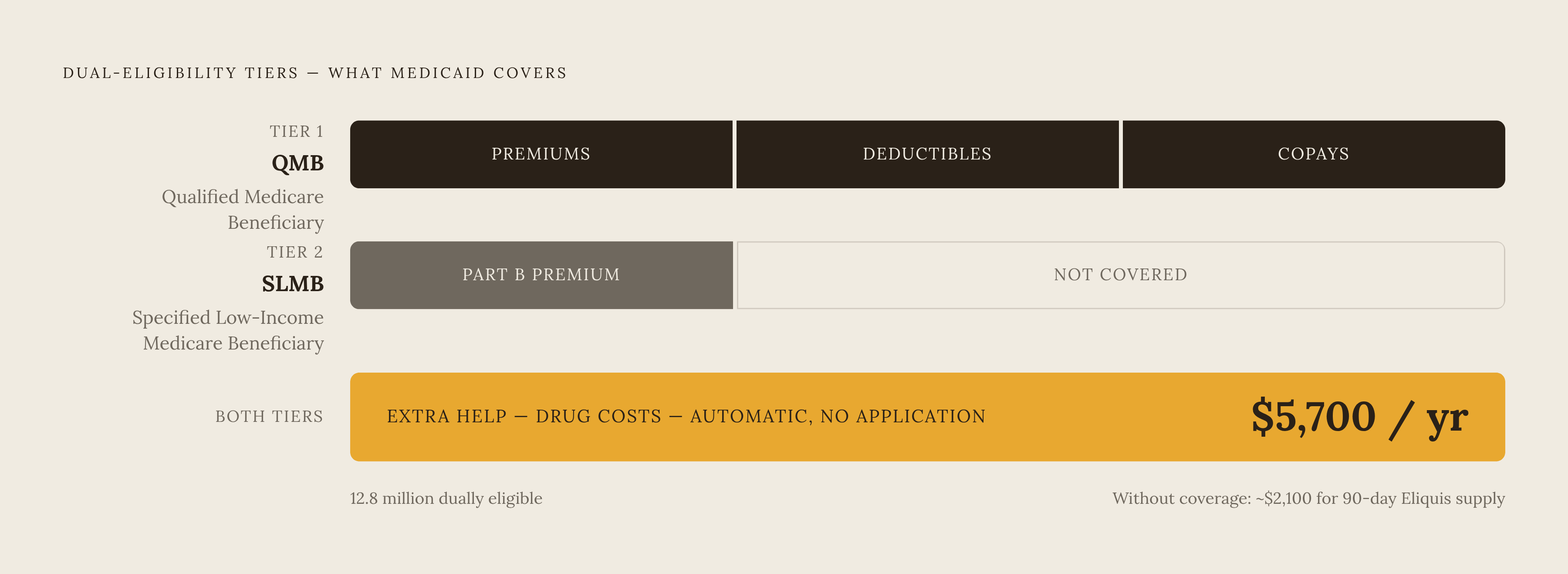
Nearly 12.8 million people are dually eligible for both programs, yet face some of the most fragmented care in the U.S. A checker can show eligibility for both programs when someone has been researching each program separately. Families then need to establish which level of assistance applies. Dual eligibility is not one uniform package.
For Qualified Medicare Beneficiaries, or QMB, Medicaid covers full Medicare cost-sharing, including premiums, deductibles, and copays. For Specified Low-Income Medicare Beneficiaries, or SLMB, it pays the Part B premium only. Any Medicaid or Medicare Savings Program enrollment also triggers full Extra Help with drug costs, with no separate application required. Social Security values that help at roughly $5,700 a year.
Community Catalyst describes Katie Dunmore, a South Carolina woman on a fixed income, whose Eliquis prescription for a heart valve condition would have cost about $2,100 for a three-month supply out of pocket. After her doctor helped her access Medicare and Medicaid coverage, she could fill it each month without choosing between her health and her bills. Mrs. E’s case shows the reverse. A recertification paperwork delay outside her control caused her to lose Medicaid and Medicare Savings Program enrollment for three months, despite no change in her finances.
What the checker points caregivers toward — paid family caregiver programs and self-directed care
For family caregivers, a Medicaid result can open a question they may not have thought to ask. Could the care already being provided qualify for payment? KFF focus groups found that caregivers often struggled to make ends meet and reduced hours at other jobs because of caregiving demands. Eligibility discovery therefore has consequences beyond medical bills. It can identify a route toward support for the work of care itself.
KFF’s 24th survey of state Medicaid officials, completed between April and August 2026, found that every state that responded pays family caregivers through Medicaid home care programs. Forty-seven of 48 responding states allow enrollees to self-direct home care in at least some circumstances. Alaska is the only state that does not permit self-direction under any program. All states with self-directed programs let enrollees select, train, and dismiss caregivers, which KFF calls “employer authority.”
The scope still depends on the program. In 2026, Indiana added self-direction for people with intellectual/developmental disabilities and traumatic brain or spinal cord injuries, while New York extended it for adults 65 and older and people with physical disabilities. New Mexico added it for children who are medically fragile, technology-dependent, and Washington, D.C. added it under its state plan personal care benefit. Pay rates also vary by state and program. AI-powered eligibility tools, along with people who help with enrollment, can help families go from finding a possible route to completing enrollment, while making clear that an estimate is no promise of payment.
What else a confirmed Medicaid eligibility status unlocks — home care, equipment, and home safety funding
Caregiver pay is only one possible consequence of Medicaid enrollment. Home- and community-based services, or HCBS, waivers can help people get home care and safety upgrades meant to help them stay at home. The particular benefit and its availability still need to be established.
The distinction between equipment and modifications is especially important. Medicare is more likely to cover durable medical equipment that has been prescribed, including walkers, hospital beds, and wheelchairs. It does not cover home modifications such as ramps, stairlifts, walk-in tubs, roll-in showers, or widened doorways, despite advertisements claiming otherwise. An equipment benefit does not answer the question of how to pay for structural changes.
There can be a cap on slots, so eligible applicants may wait months or years before they can get benefits. For veterans, additional funding layers can include VA grants up to $126,526 for home modifications and USDA loans up to $40,000, as well as Medicaid HCBS waivers, ABLE accounts, and IRS medical-expense deductions. These are distinct sources with different purposes, each requiring more than a checker result to access.
Financial assistance programs that don't require Medicaid eligibility — and how the checker helps caregivers find them too
What if the Medicaid result is unfavorable? The National Family Caregiver Support Program provides respite care, counseling, support groups, and training, with no income test for its core services. It serves people in all 50 states through local Area Agencies on Aging. A useful eligibility check also points to resources like these outside Medicaid.
The VA’s Program of Comprehensive Assistance for Family Caregivers pays primary family caregivers of eligible veterans roughly $1,896–$3,793 monthly, depending on location and care level, plus CHAMPVA health coverage, 30 days of free respite, and mental health counseling, all tax-free. Under expanded eligibility rules, veterans from all service eras qualify if they have a service-connected disability rated 70% or more and need in-person personal care services for at least six continuous months. This eligibility requires a separate inquiry that a Medicaid estimate does not resolve.
Nebraska offers a Caregiver Tax Credit of 50% of qualifying expenses up to $2,000, or $3,000 for those caring for veterans or individuals with dementia. Oklahoma expanded its Caring for Caregivers Tax Credit in 2026 to include mileage as a qualifying expense. The federal Credit for Caring Act, which would have created a $5,000 caregiver tax credit, has not been enacted as of 2026.
How to read your result and what to do in the next 48 hours
If it says “likely eligible,” verify eligibility with the state Medicaid agency, which makes the final determination. Use the USA.gov Medicaid finder to find the official portal where you can apply. The checker and the official portal serve different purposes. One helps identify the likely pathway, while the other leads into the state’s application process.
If the result flags a higher state threshold or another state-specific rule, make that distinction part of the conversation with the agency. An estimate based on a federal default should not be mistaken for a final state decision. Use the identified pathway to establish which documents the agency needs for that route before the application conversation.
It does automatically, without a separate application.
For help going from an estimate to enrollment, including finding paid caregiver programs in the state, seek AI-guided enrollment support along with help from a person.