When There Is No Caseworker in the Room How AI Guides an Aging Family Through Every Medicaid Enrollment Decision
A guide to how AI helps families navigate Medicaid enrollment.

AI-powered guidance on Medicaid self-direction enrollment helps family caregivers find the right state program, learn who qualifies, gather the documents they need, and take the steps toward paid care. It reduces the guidance burden without replacing state approval, human assessments, or required paperwork. Its value lies in filling a structural gap, because families often need to make enrollment decisions before they can find a knowledgeable caseworker.
Why aging families rarely have a knowledgeable guide at the moment they need Medicaid
A family sits with an aging parent who needs help bathing and preparing meals. Someone is already giving that help without pay. Choosing which office to call depends on something the family cannot yet answer. Does the parent need to enroll in Medicaid, get a home care waiver, or get help making benefits already in place work together?
There is no single doorway into this system. The Centers for Medicare & Medicaid Services runs Medicare, and state agencies run Medicaid. The programs require separate applications, and no single form establishes eligibility for both. Even enrollment in managed care plans operated by the same parent organization can leave care misaligned or duplicative.
The Commonwealth Fund’s focus groups found that people struggled to understand program rules and materials, learn what was covered, and find case managers who knew the rules and responded when asked for help. Participants also found provider directories unreliable. Workforce shortages, fragmented services, and administrative burden make consistent caseworker support unavailable to many families precisely when they need it.
What Medicaid home care for aging families actually covers, and why that scope is hard to map
KFF’s 2025 survey found that more than 5.1 million Medicaid enrollees use home care. These services support daily activities such as eating and bathing, as well as preparing meals and managing medications. Medicaid paid for two-thirds of all home care spending in the United States in 2023. The scope extends well beyond paying a caregiver. Training, support groups, and respite care can also support families, but they involve separate enrollment tracks and requirements.
Will original Medicare pay for a ramp? No, and it does not cover stairlifts or widened doorways either. Medicaid home-and-community-based services, or HCBS, waivers can pay for changes that make homes safer for people who qualify and want to stay out of institutions.
Coordination becomes more complicated when someone qualifies for both programs. Medicare fully covers an initial period of skilled nursing, then applies a daily coinsurance that Medicaid covers for dual eligibles. After Medicare coverage ends, Medicaid’s long-term care coverage can provide a further pathway. That transition is not guaranteed, however, if the facility lacks Medicaid certification or has limited Medicaid beds. Coverage depends on the setting as well as eligibility.
How can a family member get paid through Medicaid, and which model applies?
Consumer-directed care and Structured Family Caregiving organize payment differently. Under consumer direction, the Medicaid enrollee acts as the employer and selects, trains, and can dismiss the caregiver, including an eligible family member. The caregiver receives an hourly wage. KFF’s 2025 survey found that nearly all reporting states permit self-direction in at least some circumstances, and all of those states allow enrollees to select, train, and dismiss caregivers.
Under Structured Family Caregiving, the agency is the employer. Used in a subset of states, including Georgia, Indiana, and Ohio, it pays a daily stipend to a provider agency. The agency passes a portion to the live-in family caregiver after covering care coordination, nurse oversight, and periodic home visits. Visit frequency varies by state.
New York uses CDPAP, California uses IHSS, and Michigan uses Home Help. A search for a generic “family caregiver program” may therefore miss the relevant local program. Finding its name is only the beginning. The recipient must qualify for Medicaid and typically meet a nursing-facility level of care, rather than qualify solely by being elderly or disabled.
Adult children can often be paid, but some programs do not allow spouses or parents of minor children to be paid. Under federal self-direction options, an appointed representative directing care cannot also be the paid caregiver, a distinction that becomes important when a relative holds guardianship. Many HCBS waivers have enrollment caps and waiting lists.
The enrollment process step by step, and where families stall without guidance
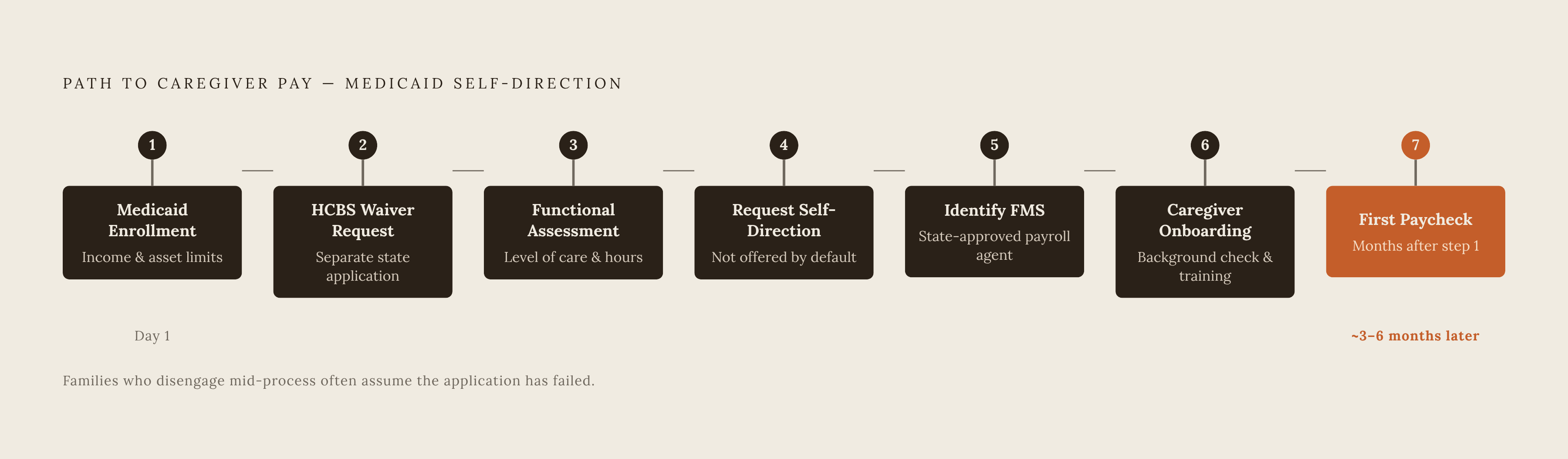
For a family pursuing the self-directed waiver pathway, the first step is Medicaid enrollment for the person receiving care. If that person is not enrolled, the application must first clear income and asset limits. The second step is to ask the state Medicaid agency for HCBS waiver services through a separate request. A family can therefore complete one application without reaching the program it actually needs.
The third step is a functional assessment by a care manager. This determines the level of care needed and, for hourly care, the authorized hours that shape caregiver pay. A parent reluctant to seem helpless may minimize daily struggles and omit help already being provided. That understatement can reduce the support authorized.
The fourth step is specifically requesting consumer-directed or self-directed care, which is not offered by default. The fifth is identifying the state-approved Financial Management Service, or FMS, that disburses caregiver wages through payroll. Payment does not simply arrive directly from Medicaid. The sixth step involves caregiver onboarding, including a background check, required training, and payroll setup, each with its own timeline. Only then comes the seventh step, the first paycheck, which may arrive several months after the process began.
Without timeline guidance, that interval can look like failure. A family may disengage because it assumes an application has gone wrong, even when further stages remain. Other families stall earlier because they never requested a waiver or self-direction. These distinct breakdowns require distinct guidance.
What AI guidance actually does at each stage, illustrated by real deployments
Kern Family Health Care deployed Careforce’s conversational AI program Angelica for Medi-Cal reenrollment outreach in Bakersfield during 2025–2026. Angelica contacted members when coverage needed renewal, addressing the first enrollment step as it recurs in a new cycle. Kern Family’s renewal rate reached a level plan officials had feared would fall significantly after automatic renewals ended. The example shows how AI can supply repeated renewal contact at a scale difficult for caseworker staff to match.
OCHIN chose Attuned Intelligence as a preferred partner in November 2026, making it available across a network that serves millions of patients. The deployment material also identifies Lynn Community Health Center in this context. The guidance helps families with questions about eligibility and which documents to gather, much like the questions they face when asking for waivers, going through assessments, and seeking self-direction. Its purpose is to free human enrollment staff for cases requiring judgment.
What happens when a question exceeds that role? CareBridge Copilot, released in January 2026, illustrates a boundary. When given a prompt about a child harming himself, it asked whether anyone was in danger, directed the user to contact their BCBA, and surfaced instructions to call 911. Educational limits, escalation pathways, and human oversight were part of its design.
That example concerns ongoing caregiver decision support. Its relevance is how the system handles a question it should not resolve alone. Taken together, these deployments demonstrate separate functions, including renewal outreach, document guidance, eligibility questions, and escalation routing. They do not establish that one tool automates the entire seven-step process. The evidence supports help with specific steps where too few people are available to guide families.
How AI-assisted enrollment platforms serve families navigating multiple programs at once
A family seeking caregiver pay may also need respite, a safer bathroom, and help understanding Medicare coverage. Those needs do not fit one application. A platform serving this situation has to map overlapping benefits.
Dual eligibility makes this coordination especially important. KFF identifies dually eligible individuals as a disproportionate share of spending in both programs, while these individuals experience confusion and duplicative or misaligned care. They may be enrolled in HCBS, have Medicaid cover their Medicare skilled nursing coinsurance, and get long-term care coverage after Medicare ends. Home modifications and caregiver training come with more requirements to meet. A veteran’s family may also get help from VA caregiver programs, which have a separate system to work through.
An AI-assisted enrollment support platform addresses this category of problem by surfacing potentially applicable programs and guiding families through their enrollment requirements. The distinction is breadth, not simply faster answers. It must work with each state’s program names, eligibility rules, rules on which relatives can be paid, and ways of paying them, without expecting families to know those details ahead of time. For a home care agency evaluating enrollment software, those functions are more informative than a broad claim of automation. The agency needs to identify which decisions and paperwork tasks the system supports, and where it hands responsibility to a person.
What AI guidance cannot do, and how the best systems handle those limits
AI cannot replace a knowledgeable caseworker’s judgment. That objection is valid, but it addresses a stronger claim than the evidence supports. The practical comparison is often between guided navigation and a family proceeding without an informed guide. Even when a family has no informed guide, the system needs firm limits on which decisions it can make.
Human care managers are still responsible for functional assessments. AI can prepare families to describe the care being provided and avoid understating need, but it does not conduct the assessment. Appeals and disputes likewise require human advocacy. A system can flag possible grounds for appeal and explain the process without representing the family before a state agency. Explaining a decision pathway is not the same as having authority within it.
Access to the technology also has unresolved constraints. The CareBridge example illustrates a funding framework without a service code or vendorization category suited to these tools. Access may consequently depend on out-of-pocket payment or health plan adoption. A useful tool is not automatically an accessible one.
The strongest design treats these boundaries as part of the service. Eligibility screening, document checklists, timeline explanations, and renewal reminders can operate at scale, while human enrollment staff or state agency contacts handle decisions requiring their authority. CareBridge’s escalation logic illustrates this distinction in a caregiving context. Trust depends on knowing when to route a question onward.
What families should do right now, given the policy changes already in motion
A family already giving unpaid care can start before it knows every Medicaid rule. It does need to establish the recipient’s current coverage and the next application required. The practical course is to begin with an income and asset eligibility check if Medicaid enrollment has not happened. For someone already enrolled, the next question is whether an HCBS waiver and self-directed care have been specifically requested.
Policy changes add urgency without making the outcome predetermined. KFF’s analysis estimates that the reconciliation law passed July 4, 2025, will reduce federal Medicaid spending by $911 billion over the next decade. Home care is exposed because most HCBS programs are optional for states, which may cut them in response to reduced federal funding. New work and reporting requirements for part of the Medicaid population begin in January 2027. People who are confused about those rules face another risk of losing coverage, including dually eligible individuals.
The lesson for families is to pursue available benefits now. Before the functional assessment, they should identify which relatives the state program permits to receive pay and prepare to describe the full scope of care already provided. They should also locate the state-approved FMS before expecting wages, so payroll arrangements do not become a post-approval surprise. AI-assisted enrollment guidance can help surface additional pathways across Medicaid, Medicare, and other benefit sources. The step available today is concrete, which is to establish Medicaid status and ask the state agency specifically about HCBS waivers and self-direction.