Why Family Caregivers Abandon Medicaid Self-Direction Mid-Process and What Agencies Can Do at Each Drop-Off Point
A stage-by-stage look at where families quit self-direction, and how agencies can help.

Medicaid self-direction can pay eligible family caregivers, but families can leave the process when program names, worker enrollment, visit verification, or payroll setup block progress. Agencies can reduce these exits by matching help to each stage rather than leaving families to manage the paperwork alone. AI-powered Medicaid self-direction enrollment support can help explain the process, while human contacts remain responsible for resolving stalled applications and payment problems.
How self-direction is supposed to work and why families want it
Self-direction gives Medicaid recipients employer authority over whom they hire, when caregivers work, and what care they provide. That control helps when there are too few caregivers and gives people more say over daily life. For families, the appeal is often immediate and personal. Someone who already understands a person’s needs, communication style, and daily rhythms can provide care through an existing relationship of trust, rather than requiring the person to adjust to an unfamiliar worker.
NAC’s 2025 policy brief says that 49 states allow self-direction and that 47 states and DC pay family caregivers, though the rules for who can be paid vary. Payment takes the form of a regular hourly W-2 wage processed through a Financial Management Service, or FMS. For people who spend many hours a week on caregiving, that pay can become real part-time income. A Johns Hopkins study published January 2026 found that more than half of the older adults who received personal care in the six states that took part used self-direction. The study concerned people enrolled in both Medicaid and Medicare, so its findings should not be treated as a national participation rate. Even within that scope, the preference is clear, but choosing this model and successfully entering it are different achievements.
Why abandonment is not random: the structural reasons exits cluster at specific stages
Giving families control also transfers administrative work to them. The burden intensifies at handoffs during enrollment, when progress depends on another organization, an unfamiliar requirement, or information the family does not have. Enrollment can take weeks or months, but people who need care may be unable to wait that long. A family facing a stalled application may refer its preferred caregiver to an agency instead.
The Johns Hopkins study found that 35 of the 60 Medicaid waivers for older adults across the country allowed self-direction, but most states aimed to enroll very few people. The same study found that notably few people in rural areas took part, even though the model could help where there are too few workers. Availability on paper is not the same as usable access. Families dealing with dementia, limited technological literacy, limited English proficiency, rural isolation, or housing instability have fewer resources to absorb administrative demands. These are also families the program is intended to reach.
Does every departure represent a failure of support? Not necessarily, because agency care may genuinely be simpler for a particular family. The distinction is between an informed choice and an exit prompted by an unresolved obstacle. The process described here supports a structural explanation for abandonment, though it does not supply comparative exit rates for every stage.
Drop-off point one: families who cannot name the program cannot apply for it
A family searching for “get paid to care for my mother” must first translate that need into a state program’s language. Colorado calls its program CDASS, and Wisconsin calls its program IRIS. Neither name explains itself to a newcomer. Without a common label, families may struggle to recognize that the service they want exists, much less identify the correct route into it.
Finding the name does not settle eligibility. States may restrict which relatives can be hired, impose recipient age requirements, or cap waiver enrollment. Those rules narrow the route further. A family may spend time pursuing an option before discovering a restriction that plain-language screening could have made clear at the start.
For agencies, the appropriate intervention begins before an application. The materials families get at intake should name the state’s specific waiver, explain who qualifies, and show how self-direction differs from agency-directed care. Families need a practical understanding of which arrangement they are considering before committing to its responsibilities. Including the Eldercare Locator at 1-800-677-1116 gives those who do not know where to begin a federal starting point.
Drop-off point two: background check and worker enrollment delays that freeze families mid-process
Once a family identifies a suitable program, worker onboarding becomes the next bottleneck. Background checks can stall for ordinary reasons, including an incorrect middle name or date of birth, multiple record matches for a common name, or a juvenile record requiring manual review. A delay does not itself establish disqualification. But unexplained silence gives families little basis for distinguishing a correctable problem from rejection, particularly when they need paid care to begin immediately.
The Ohio Department of Medicaid paused accepting new Medicaid enrollment applications for waiver individual providers, personal care aides, and home care attendants from May 14 through November 14, 2026. That pause blocked the enrollment route for affected families. It should not be confused with a background-check error, because the two obstacles require different responses. An agency can help correct an application but cannot lift a state enrollment freeze.
To address avoidable delays, agencies should build background-check status tracking into FMS onboarding and contact the vendor after a set number of business days. Ohio’s FMS vendor, Public Partnerships LLC, holds a contract across both the Ohio Department of Aging and Ohio Department of Medicaid, providing a contact point for surfacing data-entry problems. During a freeze, communication has a different purpose. Families need the expected end date, available interim steps, and any stated cause, without speculation where no explanation is available. Knowing why progress has stopped can keep families from leaving for good over a delay that will end.
Drop-off point three: EVV compliance errors that turn completed visits into unpaid work
With Electronic Visit Verification, or EVV, more is at stake because the caregiver may already have done the work. The 21st Century Cures Act mandates EVV for Medicaid personal care services, including self-directed visits. A visit without a matching verified electronic record can go unpaid. Incomplete time documentation is a common failure, including a start time without an end time or a non-standard format that prevents the system from validating duration.
Missouri began denying claims without a matching verified visit for dates of service from April 1, 2026, with the first missed payment landing on the April 24 check. Consider what that means for a caregiver who works a full week and receives nothing on payday. The care has already been provided, but the expected income is absent.
The consequences can also reach the person receiving care. Colorado can end a member’s enrollment in CDASS for low EVV match rates, though the person keeps Medicaid coverage and may move to another service delivery model. Ohio’s auditor found that non-agency personal care aides had the largest share of paid services for which there was no matching processed visit. These findings make practical instruction essential. Agencies should conduct a live EVV walk-through before every new family caregiver’s first paid shift, rather than relying on a PDF, and assign a named FMS contact to resolve exceptions within the billing window before a visit becomes permanently unbillable.
Drop-off point four: the gap between care plan approval and the first paycheck
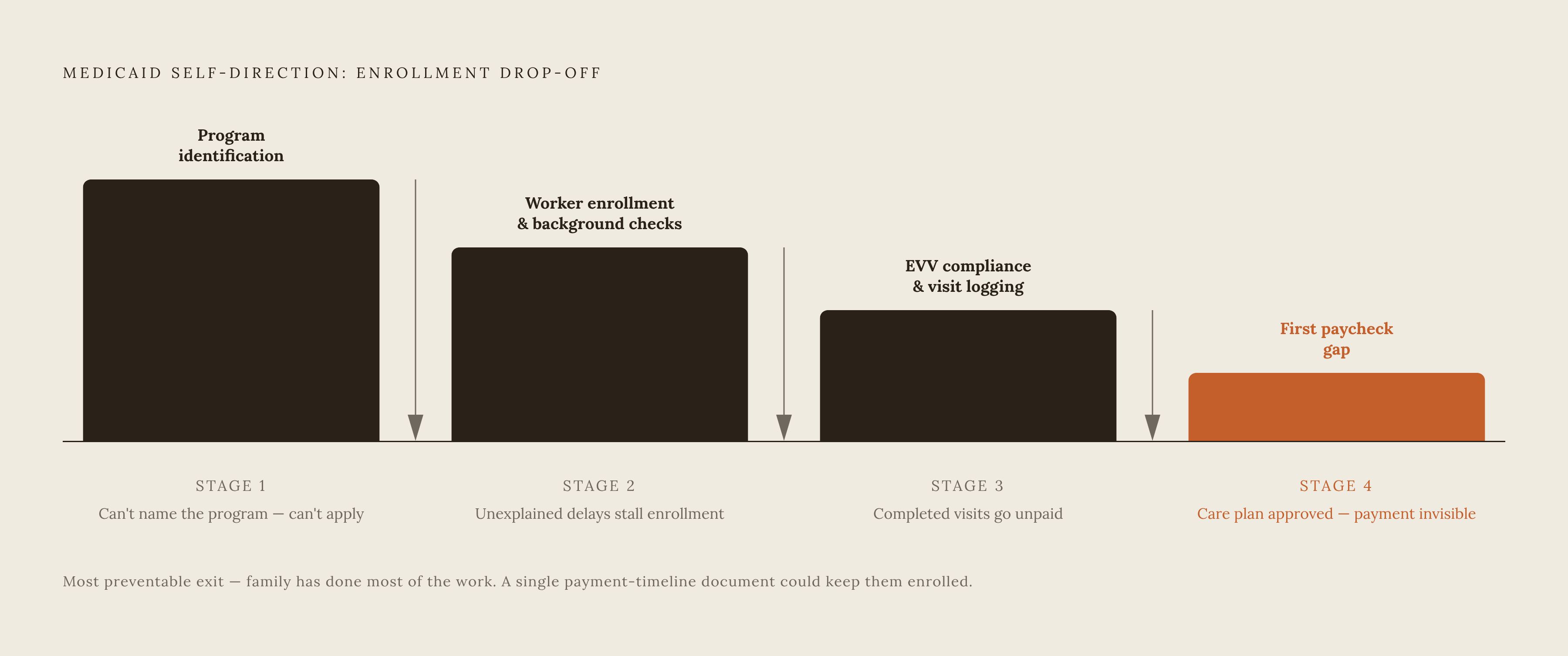
Care plan approval sounds like the finish line. In practice, families still need to understand a sequence that includes FMS registration, background-check clearance, a first EVV record, the payroll processing cycle, and the first paycheck. None of those steps is automatic. Each has its own timeline, so an approval notice alone cannot tell a family when income will arrive. Without that distinction, waiting for payroll can look indistinguishable from another stalled application.
This confusion overlaps with, but is not identical to, an EVV failure. One family may have a visit record that needs correction, while another may be waiting for a payroll cycle after completing the required steps. The same question can conceal different problems. “Why has no money arrived?” requires an answer tied to the family’s actual position in the sequence. Families who provide intensive care may also have to fill out paperwork to keep their own healthcare coverage, giving them more paperwork to handle at the same time.
To make that sequence visible, agencies should provide a payment timeline at care plan approval. The document should name the FMS, identify its payroll cycle, and show the steps through the expected first paycheck date. Families then know when to expect payment and when to follow up. This is the most preventable drop-off point because the family has already done much of the hard work. A single clear document could keep it enrolled.
What is at stake when families exit at any of these points
People still need care when they leave self-direction. It can mean continued unpaid family work, a move to agency care, or greater risk of a less preferred setting. Health Affairs Scholar published research in 2025 that found self-direction cut nursing home admissions by 40%. That finding does not show that every person whose application is abandoned ends up in an institution.
KFF focus groups found that family caregivers often struggled to make ends meet and reduced hours at other jobs because of caregiving demands. For those families, caregiver pay is an economic lifeline. People with disabilities are generally poorer and more than twice as likely to have medical debt, leaving less room to absorb delayed or interrupted income. Administrative friction therefore has an equity dimension. The families least able to finance a wait are also those with the fewest supports for navigating it.
Budget changes can add instability even after enrollment. Monique Duell, who cares for her son Jeremiah in Maryland, said, “I was never told that every year that there was going to be some budget meeting, that your salary could be cut or not. Had I known a lot of these things beforehand, I probably would not have run with this program, because now I am left scrambling”. Her account exposes a failure of upfront transparency. Along with encouragement to enter the program, families need enough information to judge how uncertain their pay could be.
What agencies can do across all four stages as a connected system, not a checklist
Agencies should keep help connected across handoffs instead of treating each barrier as a separate request for help. Plain-language outreach cannot compensate for an unexplained enrollment delay, and a cleared background check cannot protect pay if EVV instruction is missing. Timing is part of the intervention. Guidance belongs where a family can use it, with a named FMS contact and direct contact information at every handoff. An anonymous helpline does not provide the same accountability for an unresolved case.
The Idaho Family Caregiver Navigator program offers a model for connected support. Funded through the Money Follows the Person Grant from CMS, it uses a single navigator to identify stress points, access resources, and build a customized action plan with the family. Continuity links those tasks together. As VA Veteran-Directed Care expanded, it faced similar barriers because the employer-model was complex, there were too few staff, and it reached few rural areas. The comparison suggests that navigation problems extend beyond Medicaid, even when program rules differ.
For agencies considering AI-powered enrollment support, the relevant comparison is between explaining a requirement and resolving the obstacle behind it. Software guidance can work between human touchpoints, but it does not replace the FMS contact responsible for an exception. Beyond their own handouts and navigation services, agencies can point families to Brevy, an eldercare benefits platform whose state-specific guides, including its Ohio consumer direction guide covering C-HCAS and CD-PCS, explain program names, waivers, and eligibility in plain language. Its free Medicaid enrollment help brings together an AI assistant and human enrollment specialists to give families another way through the process.
Navigation must also preserve the beneficiary’s authority. Agencies should include a clear process for confirming that the person receiving care is directing services, especially when a family member is both caregiver and decision-maker. Successful enrollment alone is not the whole objective. The operational goal is a supported passage from informed choice to paid care that reflects the beneficiary’s preferences. Targeted, sequenced intervention directs effort to the point where progress is blocked, making it more useful and efficient than general caregiver support disconnected from the enrollment process.