How AI Is Removing Every Manual Touchpoint Between an Elderly Parent's Care Needs and Medicaid Enrollment
AI can speed Medicaid paperwork for families, but not approvals.
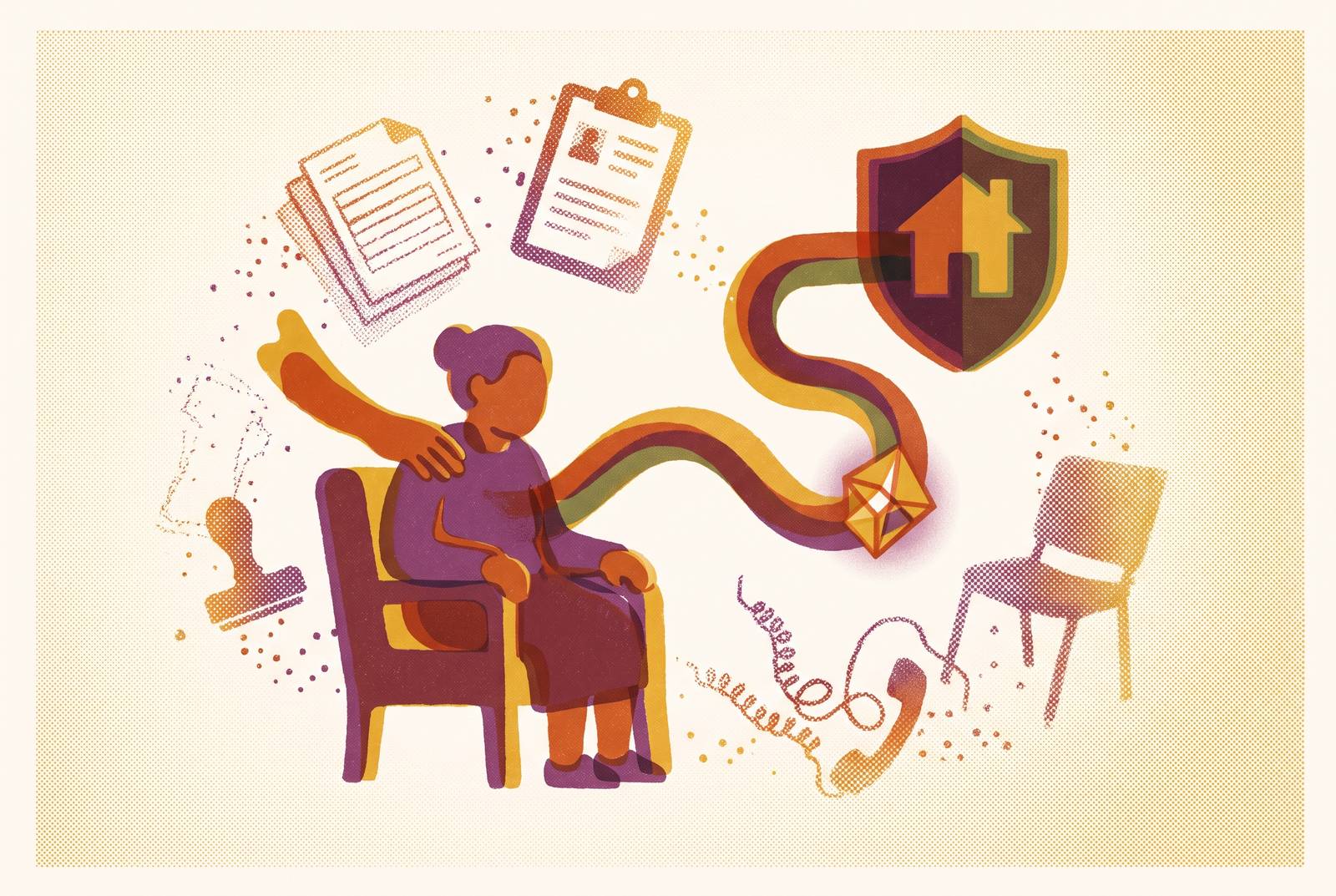
End-to-end Medicaid enrollment automation for family caregivers now pairs AI-assisted screening, document preparation, outreach, and renewal tracking with human enrollment support, while people still make some decisions. These tools can remove paperwork between an elderly parent’s care needs and access to benefits, including paid family caregiving. The key is matching the tool to the task while keeping specialists involved in assessments, appeals, and complex eligibility questions.
Why Medicaid enrollment has always been a manual obstacle course for elderly parents and their caregivers
For a family seeking paid caregiving through Medicaid self-direction, enrollment is a pathway. It runs through Medicaid enrollment, a home- and community-based services (HCBS) waiver request, a functional assessment, a self-direction election, and fiscal employer agent selection. Each step has work to do and its own waiting period. The paperwork is only part of the burden. A family must also understand which step comes next and what separates health coverage from approval for caregiver pay.
The timeline from starting an application to receiving a first paycheck can stretch across several months. Families can complete their responsibilities and still face a long wait. Meanwhile, older eligibility systems must handle mandatory work-requirement documentation that takes effect in Medicaid expansion states in 2027, along with semi-annual renewals for Medicaid expansion adults under new federal rules. Those rules apply to the expansion population and do not cover elderly beneficiaries as a whole. But they add work to systems already responsible for serving people with complex care needs, increasing the pressure to automate routine administration.
What software can handle Medicaid enrollment workflows today?
AI is entering Medicaid through distinct tools operating at the state, health-plan, and provider levels. Their functions are not interchangeable. Kern Family Health Care in Kern County, California, deployed Angelica, a conversational AI program built with software from San Francisco startup Careforce, to contact members when renewals were due. Angelica speaks more than 30 languages and can answer extended questions. That makes it a tool for sustained renewal outreach.
Document extraction addresses a different bottleneck. AI-enabled tools take unstructured information from forms and documents and put it into a standard form as machine-readable data that can pre-populate online applications. Eligibility workers previously had to enter that information by hand. Entity resolution then compares names, addresses, phone numbers, and dates of birth to assemble scattered records into one trusted profile. When elderly applicants have records at several agencies, this can help workers find information that matters for eligibility.
Provider-side verification serves another purpose altogether. Prosper AI deploys voice agents that call payer lines, including state Medicaid programs, navigate automated phone menus, wait on hold, speak with representatives, and write structured benefits information back into the electronic health record without human involvement. This verifies benefits rather than completing a family’s self-direction application. The Urban Institute’s November 2025 report found that few state Medicaid documents explained how AI and automation were used, and many said nothing about them. The deployment picture is therefore centered on managed care organizations and other operational settings, rather than a clearly documented statewide enrollment system.
Where real-world deployments have produced measurable enrollment gains
Kern Family’s experience provides a concrete renewal result. Following Angelica’s deployment, its Medi-Cal renewal rate reached 94.9% in April 2026, relieving officials who had anticipated a significant drop after automatic renewals ended. The plan also redirected full-time staff from outreach to more complex work, including making patient information complete and current. That is an outcome, not merely an efficiency projection. It does not, however, establish that the same software completes every step toward paid family caregiving.
Waymark launched Waymark Compass, an SMS-based AI care navigator that works in nearly all languages spoken by Medicaid patients and helps enrolled patients with care, benefits, and community resources. Waymark physicians supervise every clinical interaction. A peer-reviewed study in JMIR AI in 2025 looked at thousands of Medicaid patients and found fewer acute care events with Waymark’s AI-guided care recommendations than with community-based teams following care management protocols alone.
Pyx Health rolled out an AI-powered navigator in November 2025 to help members find benefits, including food assistance and housing support, while also working on a Continuous Activation Platform to make digital access easier. Code for America partnered with Anthropic in May 2026 to build a SNAP Policy Navigator that helps government caseworkers find answers in state policy manuals. The latter targets policy lookup, not family-facing Medicaid enrollment. These cases do not supply equivalent evidence of enrollment gains. Their common operational pattern is narrower and more useful, with AI absorbing repetitive contact, navigation, and information-retrieval work while people handle more complex situations.
How AI is specifically helping elderly parents and family caregivers reach self-directed Medicaid programs
All reporting states except Alaska allow Medicaid enrollees to self-direct home care in at least some circumstances, and those states allow enrollees to select, train, and dismiss their caregivers. Depending on the program, an adult child or spouse can be paid for care already being provided. Structured Family Caregiving is another Medicaid-funded option available in a subset of states, paying adult children, siblings, and, in some states, spouses for daily care. Availability is not the same as approval.
Families who learn that paid family caregiving is available still have to move through the five-step pathway to reach these programs. Document extraction can cut the work of getting ready, entity resolution can link records, and conversational guidance can help explain the next step in the paperwork. These functions support the pathway without replacing its assessments or decisions. California’s health care services agency proposed AI-powered “Advocates” in April 2026 that would securely access data through Medi-Cal Connect, identify rising risks, alert members to services they qualify for, and guide enrollment.
Brevy is one option for families seeking this combination, pairing AI-assisted eligibility screening with human enrollment specialists who handle document gathering and form pre-population free of charge. Its support covers the self-direction steps, including waiver requests, assessments, elections, and fiscal agent selection, so families do not navigate them alone. This differs from a health plan’s outreach system or a provider’s benefits-verification agent. The practical distinction is who receives the help and how far it extends. Earlier preparation can start the enrollment clock sooner, but it does not eliminate program waiting periods.
What Medicaid can actually pay for in a home-based care arrangement — and why AI makes finding it easier
Caregiver wages are only one part of home-based support. Through HCBS waiver programs, Medicaid can pay for personal care aides, home health nurses, meal delivery, adult day programs, home safety modifications, and caregiver support while the recipient remains at home. Financial eligibility rules in most states allow a single senior to earn up to $2,982 per month in 2026. Care needs, the program that applies, and the enrollment requirements still to be met also shape how a person gets services.
Federal Medicaid rules require medically necessary medical supplies, equipment, and appliances as part of the state-plan home health benefit, so a waiver is not needed for that coverage. Relevant needs can include a wheelchair, hospital bed, or incontinence supplies at home. This distinction has practical value for care planning. A family looking only for a waiver may overlook a benefit available through the state plan.
Home modifications also have several possible funding sources. These include Medicaid HCBS waivers, VA housing grants through SAH and SHA for eligible veterans, USDA Section 504 Home Repair grants for rural homeowners 62 and older, and nonprofits such as Rebuilding Together. These are not all Medicaid benefits, and state benefit caps and individual waiver limits vary. A family navigating manually must discover separate programs, applications, and renewal cycles. An AI platform holding a unified profile of needs and eligibility can surface relevant options proactively, shifting the question from “Which program should the family know about?” to “Which programs fit this parent?”
The governance gap that follows when AI moves faster than oversight
That broader discovery role makes transparency essential. The Medicaid and CHIP Payment and Access Commission’s June 2026 Report to Congress devoted a chapter to automation in prior authorization, finding potential to reduce administrative burden and promote cost-effective care, but also risks to beneficiaries. It identified limited transparency into automated decisions and little federal guidance on their use. The commission called for closer oversight and for managed care plans to share more about how they use these systems. Prior authorization is distinct from enrollment, but both raise questions about how automated systems influence access.
The Urban Institute report also found limited detail on methods, equitable implementation, and oversight in state documents. Sparse documentation leaves the public with an incomplete account. It makes deployment harder to evaluate. What is being optimized, and for whose benefit? An outreach system designed to connect eligible people with services serves a different purpose from one used to identify which patients are financially favorable to cover.
Stanford economist Mark Duggan, who has studied Medicaid for approximately 27 years, identified that cherry-picking risk and said, “when you have a new technology like this, you need to police it”. A system could handle records correctly while being used to reach only certain people or find those who would be financially favorable to cover. Enrollment gains alone cannot answer whether access is being supported equitably.
Trust creates a separate constraint on adoption. CMS Administrator Dr. Mehmet Oz said at HIMSS26 that the biggest challenge in deploying AI to Medicare beneficiaries is that they do not trust it. A KFF survey found that only a minority of Medicare enrollees aged 65 and older trust AI “a great deal” or “a fair amount” to access medical records and provide personalized health advice. Those findings are about Medicare beneficiaries and do not directly address Medicaid enrollment. Still, they raise a relevant question for eldercare navigation, because a capable tool cannot help a family that declines to use it.
As of November 2026, CareSource Foundation’s charitable arm was seeking AI tools with a track record and readiness to scale through nonprofit-led partnerships. It offered up to $500,000 a year for two years, with concept papers due January 6, 2027. Such funding can support tools with demonstrated readiness. It is not a substitute for the oversight and disclosure needed to understand how those tools affect beneficiaries.
Where human judgment still matters — and what caregivers should do now
Initial screening, document collection prompts, multilingual outreach, renewal reminders, form pre-population, and plain-language explanations are repeatable forms of assistance. Complex household finances are different. So are waiver waitlists, conflicting agency records, eligibility appeals, choices between self-direction models, and judgments about whether a nursing facility level-of-care assessment accurately reflects a parent’s needs. These are the situations where caregivers should still expect human help.
An AI-assisted eligibility platform offers a practical starting point by surfacing programs the household likely qualifies for before specialist time is spent on the exceptions. That first list should include paid caregiver programs, HCBS waiver services, durable medical equipment, and help to pay for home modifications. Tool selection should follow the intended use. Careforce’s outreach, Prosper AI’s payer verification, Waymark’s care navigation, and Pyx Health’s benefits navigation address different parts of the process. None of those functions, on its own, demonstrates start-to-finish handling of a family’s Medicaid self-direction pathway.
Attuned Coverage and similar platforms help with renewals by using AI-assisted document tracking. The 2027 move to semi-annual renewals makes that function more valuable for Medicaid expansion adults, but it should not be presented as a new renewal schedule for every elderly parent. Caregivers should also verify that enrollment support is grounded in program policy rather than relying on a general-purpose consumer chatbot. Vals AI found that general-purpose models get benefits-related questions wrong at a meaningful rate. The next action is to build the household’s likely benefits inventory with a purpose-built tool, then bring human enrollment help to the decisions and exceptions that stand between that inventory and care.