When Every Medicaid Enrollment Step Runs Automatically the Family Caregiver Just Shows Up to Provide Care
Automation can absorb Medicaid's paperwork chain, though state capacity still varies.
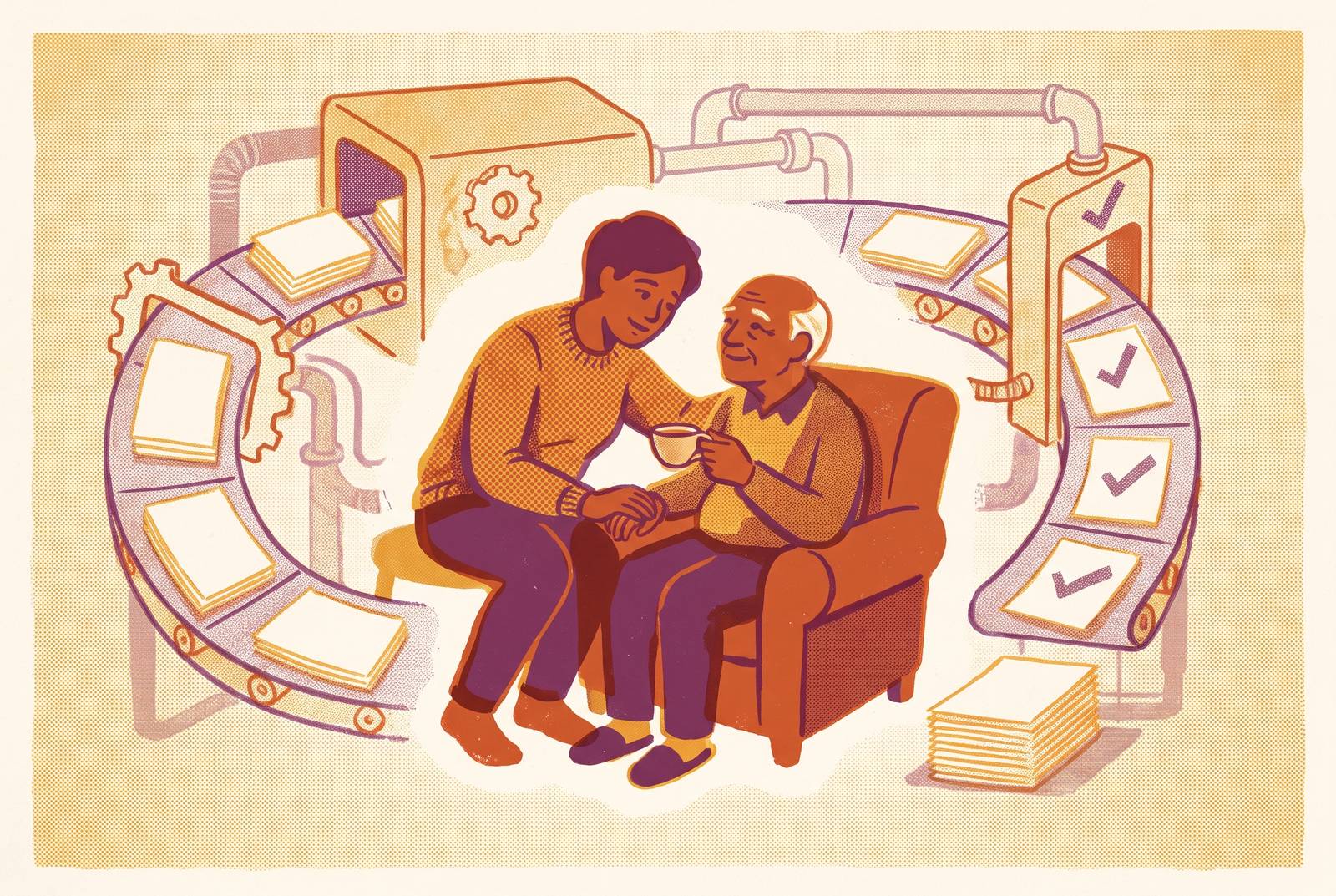
End-to-end Medicaid enrollment automation for family caregivers means handling eligibility checks, document routing, and follow-ups so families do not have to coordinate every step themselves. Its purpose is to return time and attention to care. Consumer-facing tools can help with parts of this work today, but state capabilities vary, and automated guidance is not the same as an official eligibility decision.
Why family caregivers carry an administrative load that belongs to the system, not to them
A health crisis creates two jobs at once. Someone must provide care, and someone must work out how to secure support for it. Usually, those jobs fall to the same family member, who encounters Medicaid intake while already managing acute emotional stress. The timing compounds the burden. The system asks for sustained administrative attention precisely when the caregiver has the least to spare.
KFF's 2026 survey of Medicaid home care programs describes financial and emotional strain among family caregivers, including people who have not pursued possible compensation. One caregiver knew her father qualified for a part-time paid caregiver through Medicaid and was curious whether she could receive payments for the work she was already doing, but had not investigated the possibility. That gap is not simply a lack of knowledge. Without proactive guidance, discovering support becomes another task assigned to the person already providing it, rather than a responsibility the enrollment system absorbs.
What the Medicaid enrollment process actually demands from a caregiver managing it alone
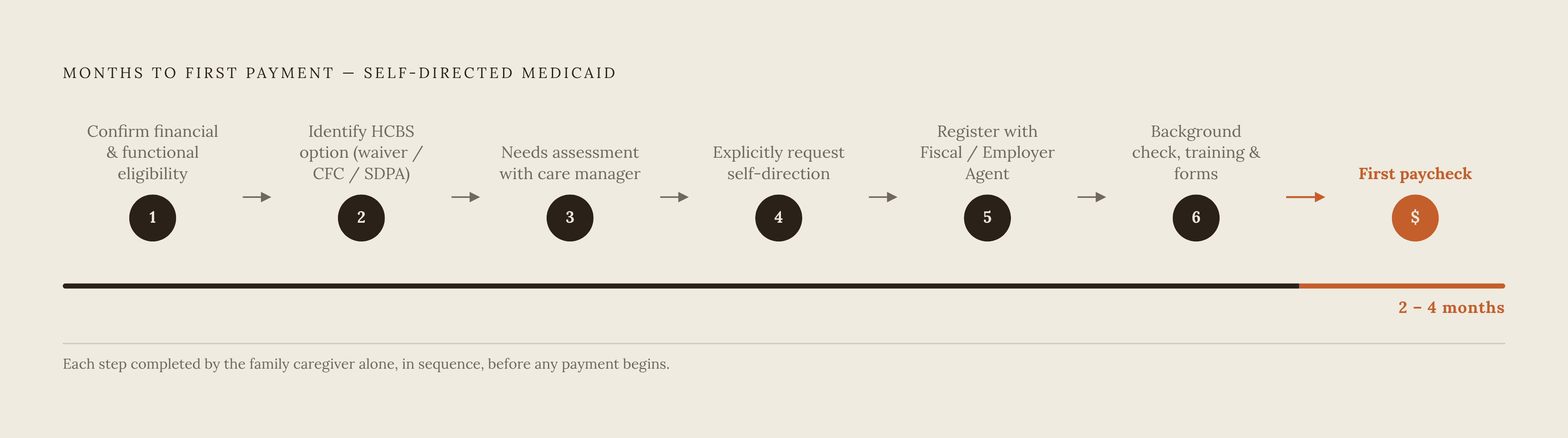
The first task is confirming the care recipient's financial and functional Medicaid eligibility. The caregiver must then identify the applicable home- and community-based services option, which may be an HCBS waiver, Community First Choice, or self-directed personal assistance services. The right route depends on the state and care population. The next step is to request and complete a functional needs assessment with a care manager.
Self-direction requires a separate, explicit request because it is not the default. The caregiver must also select and register with a Fiscal/Employer Agent, or F/EA, which handles payroll and taxes. The caregiver must also undergo a background check, meet training requirements, and fill out enrollment forms. Each stage has its own documentation, timeline, and responsible organization. Without assistance, the caregiver must initiate the sequence and keep it moving.
The path from application to first paycheck typically takes two to four months. During that time, the caregiver provides care without pay while also handling intake. What looks like a single application is therefore a chain of handoffs. That chain of handoffs leaves work for the caregiver even when a form goes digital.
How automated eligibility checks remove the first and most disorienting barrier
Does the person receiving care qualify at all? Until that question has an answer, the caregiver cannot confidently choose a program or proceed with enrollment. Automated eligibility determination can replace research into rules and income thresholds with a decision, where the state supports that capability. The benefit extends beyond a shorter wait. It helps the family see what to do next while care continues.
State capacity remains uneven. Close to half of states report that they cannot conduct automated real-time eligibility determinations on new applications, or that fewer than a small fraction of those determinations are automated. For many families, manual intake is therefore still the default. The technical possibility of an immediate answer should not be confused with its availability in every Medicaid program.
AI-assisted consumer tools offer a different, earlier form of help. They can instantly check information against program rules to see whether someone is likely to qualify under waivers, state plans, Community First Choice, and Structured Family Caregiving before the family contacts an agency. That is preliminary eligibility guidance. Even with that distinction, narrowing the possible routes reduces the research and uncertainty the caregiver must manage alone.
What automated document routing and data matching mean for the caregiver doing intake paperwork
After eligibility comes the evidence needed to support it. Document collection and submission are common points where applications stall, as caregivers gather, organize, and route materials for review. Automated routing shifts the work of directing those materials to the system, while data matching can reduce what families must submit at all. Those are different forms of relief. One handles the handoff, and the other removes a request for information the system can obtain elsewhere.
States are using AI more often to review uploaded documents, pull information from them, and improve data matching. Some are also using AI tools to help enrollees update contact information. State self-reporting shows that 29 states now conduct most renewals through ex parte processes, which re-check eligibility using available data in place of resubmitted information. That renewal model demonstrates the value of reuse. It does not establish that new applications receive the same treatment.
Following the 2025 reconciliation law, California's Department of Health Care Services committed to using automated verification processes as much as possible. The department also committed to a streamlined renewal form and online platform for the affected population that cannot be renewed automatically using available data. This is a concrete institutional commitment, with fully operational automation across enrollment still to be demonstrated. Its significance lies in assigning more verification work to the state.
How automated follow-ups replace the caregiver as the person who has to remember everything
Submitting an application does not end the work. Someone must keep track of the application, watch for requests for more information, and follow up when it is unclear what to do next. Without support, that monitoring belongs to the caregiver. With automated status notifications, document request alerts, and deadline reminders, a platform takes over the work of remembering what is due. Instead of calling simply to learn whether an application has moved, the caregiver receives an update and an explanation of what comes next.
Automated periodic income checks, combined with limited response time, can cause procedural disenrollments and churn, meaning eligible people lose coverage because they cannot meet the process requirements in time. Well-designed automation therefore needs human-readable notices and reasonable response windows. An alert is not sufficient if the recipient cannot understand it or act on it.
Renewal makes that distinction especially consequential. During the Medicaid unwinding period, limits on how much paperwork the system could handle caused many people to lose coverage even though their eligibility had not changed. Better-timed outreach could have prevented many of those losses. The useful measure of follow-up automation is therefore whether it helps people complete the required action.
What the financial stakes are once automation gets a caregiver through enrollment
Medicaid self-directed programs pay family caregivers by the hour for work they already do. The relevant program and state determine the route, so a single national pay figure would obscure the distinctions a family needs to understand. Automation opens access to that support by reducing enrollment work. It does not determine the compensation available.
Structured Family Caregiving offers a different payment model. It pays a tax-free daily stipend to a live-in caregiver and is available in 11 states as of 2026. Those states are Connecticut, Georgia, Indiana, Louisiana, Massachusetts, Missouri, Nevada, North Carolina, Ohio, Rhode Island, and South Dakota. The tax-free stipend is distinct from hourly wage income.
AARP's 2026 study of caregiving expenses found that caregiving costs take up nearly a third of average household income and put more strain on lower-income families. Roughly half of family caregivers report a negative financial impact, including debt, stopped savings, or difficulty affording food. Medicare does not pay family caregivers, and it pays for short-term skilled home health only through certified agencies. Medicaid and the VA are therefore the operative pathways described here, and access depends on navigating enrollment.
How reducing administrative load connects to caregiver health, not just caregiver income
Payment is not the only resource at stake. Administrative work consumes attention and energy that a caregiver also needs for rest and care. Chronic stress weakens the immune system, disrupts sleep, and can contribute to high blood pressure, heart disease, and chronic pain. Removing paperwork alone does not show that health has improved in a way that can be measured. It does, however, remove one source of demand from people already managing another person's needs.
The KFF survey found that all responding states covered respite care, which gives caregivers paid breaks, while training and support groups were more limited. Reaching those supports requires access to the system in the first place. Administrative help can therefore serve two purposes, reducing the work of applying and helping families reach relief beyond compensation.
KFF focus groups found that caregivers wanted to avoid making their loved ones feel like a burden. Visible exhaustion and paperwork stress can make that wish harder to sustain. When the caregiver no longer has to coordinate every administrative handoff, there is one less competing demand on the attention they can give to another person.
Where automation still falls short and what caregivers and advocates are pushing for instead
Which side of the process is being automated? A system can automate the state's verification work, or it can automate demands that an enrollee repeatedly prove eligibility. Those designs distribute responsibility differently. The second can leave families doing just as much work under tighter deadlines. Automation needs to reduce that work as well as turn requests into digital notices.
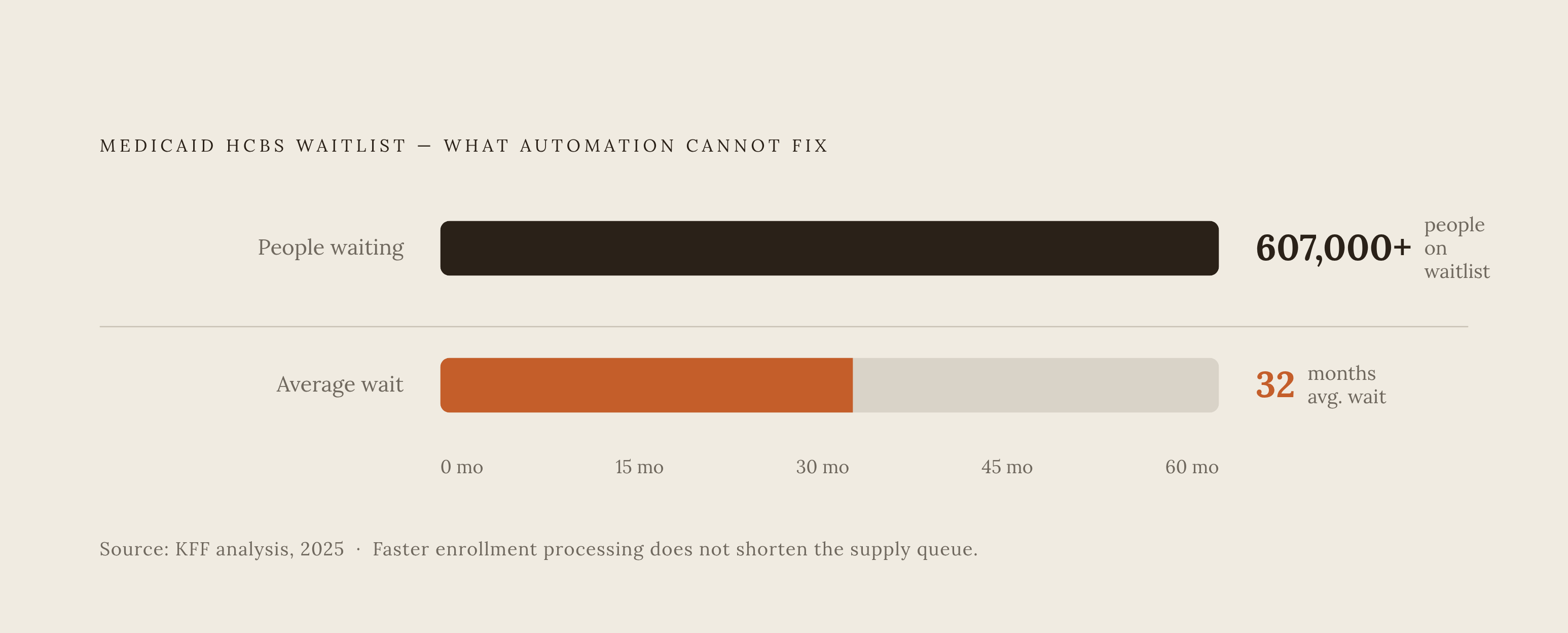
Waitlists impose a separate limit. More than 607,000 people were on Medicaid HCBS waitlists nationally as of 2025, with an average wait of 32 months. Faster processing cannot resolve a supply constraint or move a family up a list by itself. The typical two-to-four-month enrollment-to-paycheck timeline is therefore not a promise for someone awaiting access to a waitlisted service.
The KFF survey also identifies pressures heading into 2027, including slower state revenue growth, the 2025 reconciliation law's changes to Medicaid financing, and increased federal scrutiny of payments to family and friends who are not registered as Medicaid providers. These pressures describe the environment while leaving the outcome open. No enrollment tool, however capable, can make those two conditions equivalent.
How do caregivers get Medicaid enrollment help without handling every step alone?
Caregivers should seek help that does the enrollment work as well as explaining it. A caregiver should first confirm the care recipient's financial and functional Medicaid eligibility, then identify the applicable self-direction program. Asking explicitly for the self-directed or consumer-directed option is essential because it is not automatically offered. Knowing the sequence reduces avoidable uncertainty. It also makes clear which tasks a tool or support organization will actually take over.
An Area Agency on Aging is one practical point of contact. A benefits navigation platform that runs eligibility checks and routes documents can also take on some of the intake work. Identifying an F/EA early delegates payroll, taxes, and much of the ongoing compliance paperwork.
AI-assisted benefits platforms can now give families instant eligibility guidance across Medicaid, self-direction, and caregiver compensation programs without making them look up every rule for their state. The useful comparison is between the tasks actually handled, including checks, routing, and follow-ups, and those still left to the family. With those administrative steps automated or delegated, the person who entered caregiving during a crisis has more room to provide care instead of staying on hold or trying to remember whether a form was submitted.