A Side-by-Side Look at Self-Direction Enrollment Tools Built for Families With No Medicaid Background
This comparison shows where each enrollment tool's help ends.

AI-powered Medicaid self-direction enrollment tools can reduce paperwork for family caregivers, but their value depends on how far their help extends beyond finding a possible benefit. This comparison distinguishes screening, guided applications, and end-to-end support by the work each leaves to the family. Families need to know whether a tool supports caregiver enrollment and payroll onboarding, and clearly discloses where that support ends.
Why families without Medicaid background face a steeper enrollment climb than the tool comparisons suggest
Families new to Medicaid must first understand which system could pay for care. Original Medicare does not pay family members to give care or pay for long-term in-home custodial services. A family that assumes Medicare covers long-term home care may never discover Medicaid home- and community-based services, or HCBS, as a possible pathway.
Medicaid health coverage and HCBS enrollment are distinct, with HCBS requiring a separate application and both financial and functional eligibility tests. There is also no single national paid-caregiver program with one set of rules for families to learn. A local program name may offer little indication that paid family caregiving is even an option.
MACPAC’s June 2025 chapter on self-direction explains that states have broad flexibility over the populations served, the relatives who can be paid, and whether participants receive employer authority, budget authority, or both. A description from another state is therefore an uncertain guide. Families must learn program structure, eligibility rules, and local requirements at the same time. Without that baseline, they cannot readily distinguish help that explains a pathway from help that moves an application through it.
What the enrollment process actually requires, from first question to paid caregiver
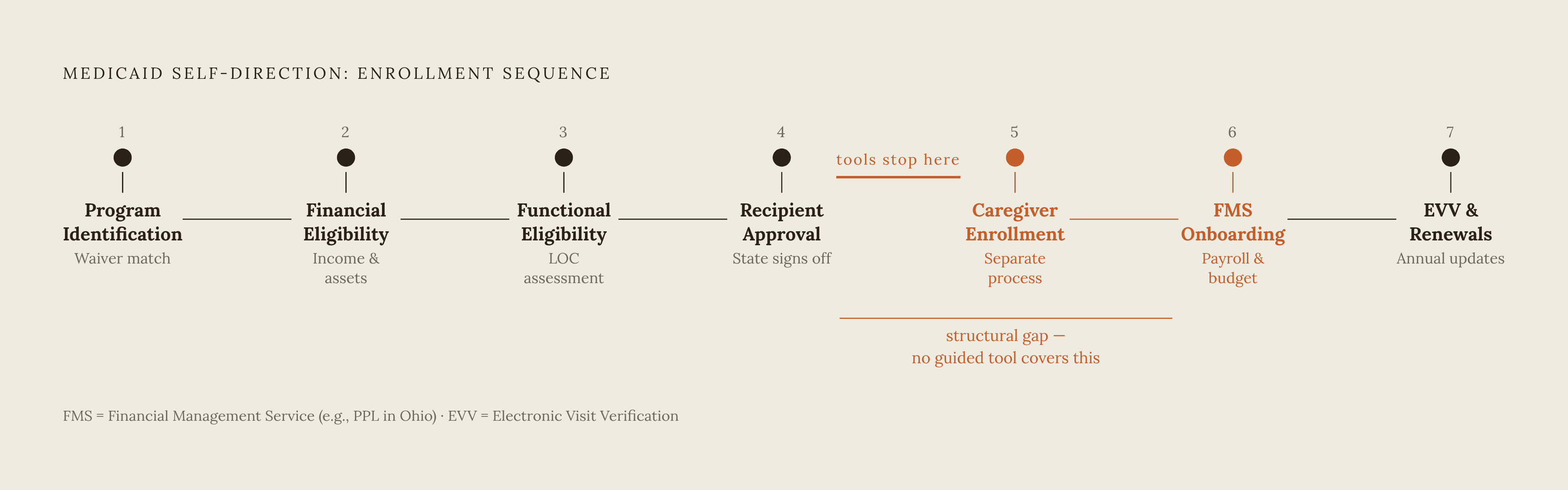
Enrollment begins by matching the household to a program. That requires the state, the care recipient’s population category, and the care situation. MACPAC’s chapter says states may have different waivers for different groups, including aging, physical disability, and intellectual or developmental disability. The relevant pathway must also permit the proposed family caregiving arrangement.
Eligibility then divides into two separate tests. Financial eligibility depends on income and assets, while functional eligibility depends on records that show a need for help with daily activities. Passing one does not establish the other. The state or its designee conducts the functional assessment and determines level of care, making assessment preparation and supporting documentation distinct parts of the application process.
Approval for the care recipient does not enroll the caregiver. The family member must separately enroll as a paid worker and complete Financial Management Service, or FMS, onboarding. Ohio Medicaid’s self-direction portal identifies Public Partnerships LLC, or PPL, as its FMS, handling payroll, employment taxes, budget management, and enrollment support. The family receives wages processed by the FMS.
Paid work also brings verification and recurring requirements. The 21st Century Cures Act mandates Electronic Visit Verification, or EVV, for Medicaid personal care services, including self-directed visits, although a live-in caregiver exemption exists that families must know to claim. After they first enroll, families must keep up with renewals, annual assessments, and plan-of-care updates. Wisconsin’s March 2026 SDS manual also places person-centered planning, goal-setting, and service plan development within the support provided by interdisciplinary team staff.
How tools are built along a spectrum of automation depth, and why shallow tools feel complete when they aren’t
Automation depth describes how far a tool extends through that sequence before responsibility returns to the family. It is not a count of features. A screener may automate an early eligibility check, while a guided-application tool organizes documents and instructions for the state application.
At the shallow end, the output is orientation. A list of possible programs and a preliminary financial result can help a household decide whether to investigate further. Yet neither establishes functional eligibility nor completes an application. Families without Medicaid experience may mistake the specificity of the result for evidence that enrollment has begun.
Mid-range tools add scaffolding through document checklists, state-specific prompts, and submission instructions. Deeper tools may gather documents through a conversation, track status, and help families through later steps. The distinction becomes consequential after care-recipient approval. Does support extend to enrolling the caregiver and completing FMS onboarding, or has the tool finished its work before paid employment can begin?
Every kind of tool has a reasonable point in the process where its help ends. A family may discover a service’s boundary only after committing documents, time, and expectations to it. Automation depth becomes a useful comparison only when the stopping point is visible before the family relies on the tool.
What screener-first tools handle and where the family takes back the work
Screener-first tools address a real barrier to access. Many caregivers do not know that a paid pathway exists, and a short screening process can provide a directional answer in minutes. These tools usually ask for state, age, diagnosis category, and current Medicaid status. Those inputs help identify possible programs and check basic financial criteria against published thresholds.
The result may be a yes-or-no answer or a likely-or-unlikely indication. Its value is speed and low friction, especially for a family still deciding whether to pursue Medicaid self-direction. Some screeners also provide multilingual access. That can make the first encounter with an unfamiliar program more accessible, without requiring the family to commit to a full application service.
With most screeners, families still have to handle functional documentation, assessment preparation, the state-specific application, and submission. Caregiver enrollment and FMS onboarding remain separate work as well.
What does “you may qualify” mean to someone who has never applied? It may sound like progress toward approval when it is actually an invitation to begin. A clearly framed screener can still be useful on its own terms. At this tier, however, the family’s remaining workload is essentially the full application process.
What guided-application tools handle and the step where most still stop short
Guided-application tools move beyond identifying a possible pathway to organizing the work of applying. They typically provide document checklists keyed to state requirements, prompts for application information, and step-by-step submission instructions. Some also offer application status tracking and assessment preparation guidance. This is a meaningful reduction in application friction.
The caregiver usually retains responsibility for submission and follow-up. Even so, knowing which functional records to gather or which state form to complete can reduce confusion that a screener leaves unresolved. The tool is addressing the application itself. But its help often ends when the care recipient is approved.
That endpoint leaves a structural gap before wages. MACPAC’s chapter explains that information-and-assistance entities, support brokers, and FMS agencies have roles that can be difficult to distinguish. A guided tool that omits the FMS step leaves the family to untangle those roles after approval. The missing work is not another field on the recipient’s application, but the caregiver’s separate route into paid employment.
Ohio makes the distinction concrete through its waiver arrangements. The state’s portal designates PPL as the FMS for both the Ohio Home Care Waiver and MyCare Waiver. Its enrollment support and payroll functions involve separate onboarding after state approval.
How can AI help a family caregiver get paid through Medicaid without handling all the paperwork alone?
AI-assisted end-to-end tools aim to extend support through the transition that guided applications often leave uncovered. They can gather documents through a conversation, track application status in real-time, help prepare the application for the family’s state, and guide the caregiver through enrollment. Some also support FMS onboarding.
The presence of AI does not establish that depth. A product built primarily for eligibility discovery may still reach families only at the first stage, however sophisticated its conversation feels. FMS support can also depend on state partnerships. Coverage in some states does not make a tool end-to-end for households elsewhere.
Human enrollment specialists can address the boundary between general automation and local coordination. In this model, AI handles orientation, document collection, and status tracking, while specialists address state-specific nuance and FMS coordination. Wisconsin’s manual describes a wider support role that includes person-centered planning and help connecting with peers. Software alone does not replicate that scope.
Some responsibilities cannot be transferred to a tool. A state-designated assessor conducts the functional assessment, the FMS processes payroll through its own system, and caregivers use the required EVV method where applicable. Renewals also require updated documentation that software can prompt families to provide but cannot complete on their behalf. The practical comparison is therefore both procedural and financial, including whether human enrollment support is included or reserved for an additional service tier.
How program structure in specific states shapes what any tool can realistically deliver
Ohio has HCBS waivers that let people use self-direction with employer authority, budget authority, or both. Employer authority lets people choose and manage workers, while budget authority lets them decide how to spend within the allowable service plan.
Ohio’s two waiver pathways also show why infrastructure counts. PPL uses the same MyAccount portal for the Ohio Home Care Waiver and MyCare Waiver, but the waivers have separate contact lines. A tool without a connection to PPL’s onboarding infrastructure cannot complete caregiver enrollment merely by preparing a state application. General state coverage does not establish coverage of this handoff.
Wisconsin places the process within a different institutional structure. The state’s manual routes Self-Directed Supports through managed care organizations, or MCOs, and their interdisciplinary teams. The manual’s Etta example describes a member who needed care to remain at home and hired her daughter through this option. That outcome involved team support through person-centered planning.
Program infrastructure can change after a tool is built. New York’s CDPAP consolidation to a single fiscal intermediary in 2025–2026 illustrates how back-end changes can make onboarding instructions outdated. MACPAC’s chapter also identifies limited state data-reporting and analysis capacity in self-direction, complicating efforts to keep rules current. A tool’s state coverage depends on which parts of that state’s specific program structure it supports.
The questions families should put to any enrollment tool before trusting it with their application
Families comparing tools should ask about their own case. State, population category, and relationship to the care recipient define that case. “Where does your help end, exactly?” A useful answer names both the last step the service completes and the first step the family must handle alone.
Families should next ask about help with recipient approval and caregiver enrollment. Does the service support both, and which FMS does it support in the family’s state? Families need a clear answer on what help they will get with onboarding. Providing a contact number is different from helping the family work through the FMS process, even if both are described as enrollment support.
Relationship rules also need attention before an application begins. Families should ask how the tool handles restrictions on spouses, co-residents, and legally responsible relatives in the relevant program. MACPAC’s chapter notes that some federal authorities prohibit a representative from simultaneously serving as a paid worker. An otherwise promising pathway may therefore fail because of the proposed arrangement.
Does support include renewals, annual assessments, and plan-of-care updates, and is human enrollment help included at no additional cost or sold separately? These answers expose obligations that a feature list can hide. A family that establishes the handoff before committing can judge a tool by how far it actually helps them toward a paycheck, rather than discovering its stopping point mid-process.