The Three Medicaid Enrollment Bottlenecks Automation Must Solve Before a Family Caregiver Can Get Paid
Automation must link eligibility, worker enrollment, and billing.
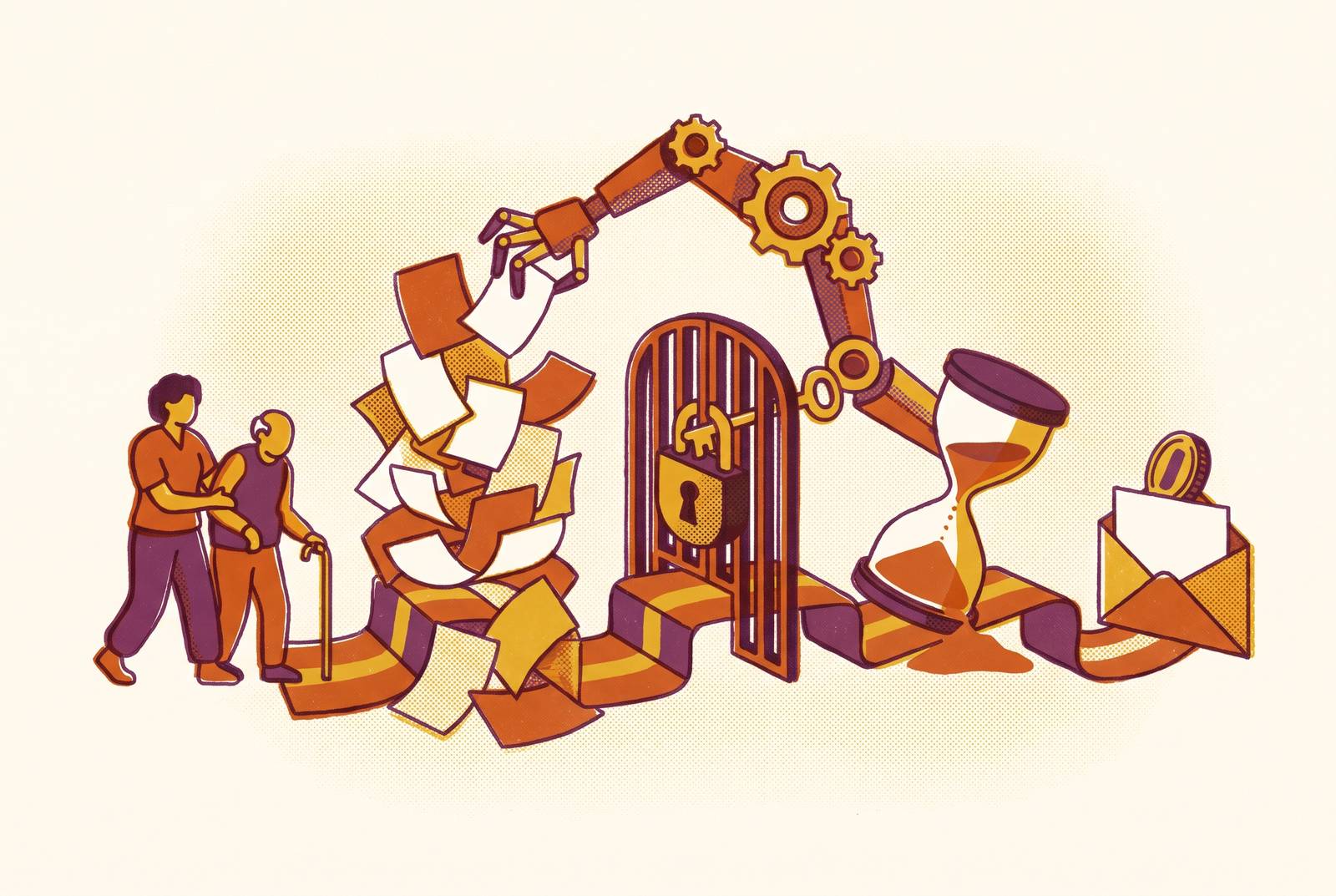
End-to-end Medicaid enrollment automation for family caregivers must connect three tasks, which are establishing the care recipient’s eligibility and service plan, enrolling the caregiver as a paid worker, and keeping each visit compliant and billable. Software that handles only applications cannot secure the path to payment. The necessary architecture treats enrollment and ongoing compliance as one connected process.
Why family caregivers are the last to get paid in a system built to serve them
A family caregiver can provide full-time care for nearly a year without knowing payment is possible. The work has already begun, but the payment pathway has not. That gap is not necessarily a failure of intent. Medicaid is the primary payer for self-directed home- and community-based services, yet providing care does not automatically trigger compensation. Families must first navigate a procedural system separate from the daily work of caring.
Self-direction is not a marginal option within personal care. Kuang & Miller (2025) find that over half of dually eligible beneficiaries 65 and older receiving personal care use self-direction. The Cash and Counseling demonstration found that self-directed participants were more satisfied, had health outcomes as good as or better than those receiving agency-based care, and were less likely to enter a nursing home. The model has a substantial foundation. Access to its benefits, however, depends on clearing three gates before the first dollar moves.
Those gates also differ by location. MACPAC’s June 2025 report describes how much freedom states have to choose program authorities, who programs serve, which services they cover, and whether family members can be paid caregivers. This produces variation across and within states.
Bottleneck one — Medicaid eligibility and service-plan approval
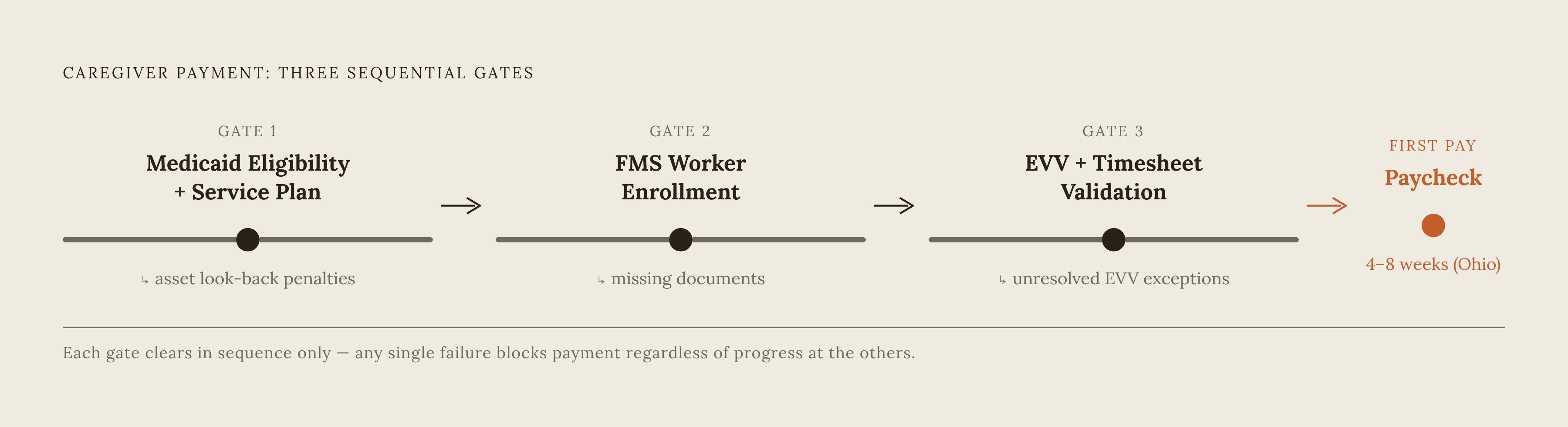
A caregiver cannot be enrolled or paid until the person receiving care has active Medicaid coverage and an approved person-centered service plan. Both prerequisites remain necessary after worker paperwork is complete, the first sequencing problem that many families discover only after they are deep in the process. What looks like an application to become a paid caregiver is initially a determination about someone else’s eligibility for services.
When the person receiving care has no coverage, the family must apply separately for Medicaid while trying to arrange paid care. These efforts may overlap, but their approvals are not independent. Federal rules allow agencies additional weeks to decide, with more time when a disability determination is involved. Everything downstream waits for that decision and the service plan. An onboarding system that overlooks this dependency can leave a family preparing for a stage it cannot yet enter.
Financial eligibility can stop progress even earlier. Asset transfers or gifts made before an application can trigger look-back penalties that delay eligibility, although the family may not understand that those transactions are relevant. Kuang & Miller cite concept mapping research in which participants described misconceptions about LTSS coverage, enrollment difficulties, and missing eligibility information. One caregiver described the absence of a clear “step one, step two, step three”. Another called Medicaid “a very confusing road”.
Qualifying also does not guarantee an available service slot. North Carolina’s CAP/DA program has a federally approved slot cap, and people who apply join a waitlist when the slots are full. Adding more slots requires a federal waiver amendment, and neither a family nor a caseworker can speed that up. This is a capacity constraint. Automation can help distinguish it from an incomplete application, but it cannot make an unavailable slot available.
The tractable problems are uncertainty, omissions, and avoidable review cycles. KFF reports that close to half of states automate less than 10 percent of new applications for real-time eligibility determinations. Pre-screening can identify likely disqualifiers involving asset transfers, income thresholds, and functional level before a family spends weeks applying. Where state data are available, real-time eligibility checks can show whether the person has coverage. Guided document checklists can identify required items at the start rather than through repeated denial and resubmission, while leaving the actual eligibility decision with the responsible agency.
Bottleneck two — caregiver worker enrollment and fiscal intermediary onboarding
Once the person receiving care qualifies and the service plan is approved, the caregiver must enroll separately as a worker through a Financial Management Services agency. The first approval does not settle the second. Onboarding crosses multiple offices, each with requirements that can be difficult for a family to distinguish. Ohio’s PASSPORT and MyCare Ohio pathways show how these steps overlap through Choices Home Care Attendant Service and Consumer Directed Personal Care Service, which have different rules for enrollment and ways of processing payments. A Financial Management Service processes payment as the agent of the common-law employer.
Incomplete documentation is the most common source of delay. A family submits what it believes is a complete application, only to receive a request weeks later for a bank statement, Social Security award letter, or proof of residence. Each exchange can add days or weeks. Missing documents become visible only late in the application process. A checklist generated for the specific state and waiver addresses that delay before submission.
Identity discrepancies create another kind of friction. A nickname or maiden name in one field and a legal name in another can stall automated verification, as can a transposed birth date. Background checks add their own dependencies. An incorrect middle name or birth date, a common name matching multiple records, or a juvenile record requiring manual review can independently extend the timeline. Ohio’s consumer direction pathway typically takes four to eight weeks from choosing a paid caregiver to receiving the first paycheck, and incomplete documents or delayed checks can lengthen it.
The Ohio Department of Medicaid suspended new Medicaid enrollment applications for waiver individual providers, personal care aides, and home care attendants from May 14 through November 14, 2026. A family without current information could spend weeks assembling documents for a process that had stopped. No amount of identity pre-validation would resolve that pause. Proactive alerts serve a different purpose by making the administrative barrier visible before families invest further effort.
New York’s CDPAP transition shows the same visibility problem at scale. Public Partnerships LLC became the sole fiscal intermediary for every CDPAP consumer in the state in spring 2025, replacing more than 600 regional agencies. At the transition’s peak, tens of thousands of consumers were still trying to complete registration. Those waiting until the April 1, 2025 deadline and its April 30 grace period faced multi-week backlogs. Into 2026, a persistent problem was registration that appeared complete to the caregiver but still contained an unresolved verification step or missing document.
Real-time status tracking must expose unresolved requirements rather than leave families to discover them through a missing paycheck. Those requirements can include training, forms, and identity checks. Under Maryland’s Community Pathways Waiver, people must complete self-directed orientation before they can enroll. Together, state-specific checklists, identity pre-validation, status tracking, and administrative alerts address different reasons an apparently finished application may still be unable to produce pay.
Bottleneck three — EVV compliance and the ongoing documentation required to keep getting paid
Electronic Visit Verification and timesheet requirements recur on every visit and in every pay period. A single error can delay payment or permanently eliminate payment for the affected visit. That makes this bottleneck different from the first two, which establish entry into the payment system. After entry, work continues to translate into billable hours only if the caregiver clears the third bottleneck.
The 21st Century Cures Act mandates Electronic Visit Verification for Medicaid personal care services, including self-directed visits. Many states enforce compliance through hard edits, which are automated validation rules that reject non-compliant claims before payment. Some instead use soft edits that allow payment while flagging non-compliance. The distinction changes the immediate consequence of an error. EVV is therefore not merely a background recordkeeping task, and software must account for the applicable payment rules.
Incomplete time entries are a common failure. A caregiver may record a start time without an end time, or use a format the state system cannot validate to establish duration. Inconsistent caregiver identifiers can also cause a claim to bounce, repeating the identity problem that delayed enrollment. Hours that do not match the authorized care plan, arrive late, or lack a required EVV check-in can be returned for correction. A corrected timesheet may then fall into the next pay cycle.
A caregiver can be fully approved and working while the recipient’s service authorization has not yet posted in the state system. Hours worked during that interval may not be billable. Separately, a visit with an unresolved exception can become permanently unbillable if the state’s correction window closes before the exception is resolved. Care may have been delivered and documented in both situations. The missing condition is not evidence of effort, but the authorization or correction required for payment.
Guided clock-in and clock-out prompts can prevent incomplete time entries, while identity consistency checks can catch mismatched names before submission. Timesheet pre-validation can compare hours with the authorized care plan. Real-time exception alerts can bring unresolved claims to attention before correction windows close.
Access also shapes whether those protections work. Self-direction is still rare in rural areas even though it could help where there are too few workers, and many caregivers, especially older family caregivers, have no smartphones or are uncomfortable using EVV apps. These barriers contribute to more manual edits and claim rejections. Low-tech fallback options are therefore essential to the proposed solution. Because documentation repeats indefinitely, this is the hardest bottleneck to solve once and the stage where ongoing automation can deliver the most sustained value.
How can end-to-end automation solve all three bottlenecks together?
The gates must clear in sequence, but their supporting systems cannot be designed in isolation. Eligibility approval does not yield pay if fiscal intermediary onboarding remains incomplete. Worker enrollment has little practical value when persistent EVV errors make hours unbillable. Time lost between these stages is not recovered simply because the next approval eventually arrives. The architecture must preserve progress across each handoff, rather than count an individual transaction as success.
An application-only tool can help organize eligibility documents but leaves worker verification and recurring claims outside its remit. An onboarding-only tool can track worker registration without establishing whether coverage and service-plan prerequisites have cleared. An EVV-only tool addresses visit documentation after those earlier dependencies have been resolved. An AI-powered enrollment and compliance platform spanning all three gates instead connects pre-screening, real-time FMS status tracking, and validation of EVV and timesheets before submission to the state system.
Automation remains dependent on the data it can access, and it cannot reverse an enrollment pause or expand a waiver’s slot cap. Yet incomplete documents, inconsistent identities, missed time entries, and unresolved exceptions are process-design problems as well as information problems. Guided workflows can prevent many of these errors at entry. Automation can credibly promise fewer avoidable failures while leaving Medicaid decisions with the responsible agency.
The same connected process can support oversight. MACPAC identifies limited data reporting and analysis capacity as a barrier to quality monitoring at both state and national levels. Automation is positioned to address that gap through documentation and audit trails that manual processes routinely fail to produce. That benefit goes beyond helping one application advance. It gives the payment pathway a record that can support scrutiny of how the system functions.
The human stakes make reliability the decisive criterion. Kuang & Miller find that people who use self-direction are more likely to have chronic disease and use more healthcare than people who do not. Multiple states in 2026 have also proposed or implemented caregiver wage cuts under HCBS self-direction programs in response to federal Medicaid funding reductions, narrowing the margin for lost pay. Families who need a great deal of care can ill afford to have the process fail them again and again. End-to-end automation can make a functioning payment pathway repeatable for the caregivers most likely to be failed by a manual one.
Sources
- Paying family caregivers: self-direction in medicaid personal care - PMC
- Chapter 5: Self-Direction for Home- and Community-Based Services
- Ohio Consumer Direction: Paid Family Caregiver Guide (2026)
- Paying Family Caregivers through Medicaid Consumer-Directed Programs: State Opportunities and Innovations - NASHP