How to Tell If Your Mom Qualifies as a Dual-Eligible and What That Means for Her Care Costs
Two checks, Medicare and Medicaid, decide what help your mom gets.
Determining whether your mom is dual-eligible means checking two separate things, her Medicare eligibility and her state’s Medicaid income and asset rules. Depending on her coverage tier, she gets help with Medicare bills or broader support, including long-term care. Social Security and her state Medicaid agency are the official starting points, while an eligibility tool can help organize the information but cannot replace the state’s decision.
What dual eligibility actually means and why it matters for your mom's care costs
Roughly 12 million Americans have Medicare and Medicaid at the same time. When both programs cover a service, Medicare pays first and Medicaid pays the remaining costs that it covers, often leaving out-of-pocket costs close to zero. But that does not make every service free. The extent of the help depends on whether your mom qualifies for full Medicaid benefits or a narrower program that helps with Medicare costs.
That distinction explains why “Does she have Medicare?” is not enough to assess her care budget. A person can have Medicare for years before anyone recognizes that she also qualifies for Medicaid assistance. The programs do not share an income test. Understanding her position therefore requires two separate checks, one based on age or health status and another based on income and countable assets.
Checking the Medicare side: age, disability, and the conditions that bypass the wait
Is your mom 65 or older? That is the most common Medicare route, and almost anyone who worked and paid into the system qualifies. Medicare eligibility is independent of income and assets, making Medicare the simpler gate to check before examining the state-specific financial rules for Medicaid.
If she is under 65, the next question is whether she receives Social Security Disability Insurance, or SSDI. Through the usual disability route, she must receive SSDI for at least 24 months before Medicare begins. Someone can therefore have an approved disability benefit without yet being eligible for Medicare through that route.
End-Stage Renal Disease, or ESRD, and ALS provide separate routes to Medicare at any age. The standard disability waiting rule is not the right test for these diagnoses, and ALS bypasses the 24-month wait. Social Security can establish which route applies and when coverage begins. Once she qualifies through one of these routes, the next eligibility question concerns Medicaid’s financial rules.
Supplemental Security Income, or SSI, needs a separate distinction. SSI recipients in most states get Medicaid automatically, but SSI alone does not establish Medicare eligibility. Some recipients also receive a small SSDI benefit. For them, the SSDI waiting period, rather than receipt of SSI, determines when they qualify through the usual disability route.
Checking the Medicaid side: income limits, asset tests, and the state-by-state variation that changes her answer
For full Medicaid, the asset limit often surprises families. A single applicant in most states can have only a few thousand dollars in countable assets. But “countable” is the crucial word here. The primary home, if she lives in it, one vehicle, personal belongings and household goods are excluded, as are life insurance below a modest face-value threshold and burial funds within a small cap.
Income is assessed separately from those assets. In 2026, the full Medicaid income threshold for a single person is roughly $994 a month, the SSI Federal Benefit Rate, in most states, although some use a slightly higher threshold. An income above that figure does not necessarily end the inquiry. Some states allow a spend-down, deducting medical expenses from income until it falls below the Medicaid threshold.
The applicable program also changes the financial test. Qualified Medicare Beneficiary, or QMB, helps people with income up to the federal poverty level, while Medicare Savings Programs generally leave out a small amount of income through a standard income disregard in most states. QMB, SLMB and QI have an individual asset limit at the federal baseline, with a higher limit for couples. These are not interchangeable with the full Medicaid rules.
State policy can make the answer more generous. Maine and Illinois, for example, allow meaningfully more assets for Medicaid than the federal floor. She should compare her finances with the rules for her state and the specific benefit, rather than treating a national figure as a final rejection. If she needs personal care, an HCBS waiver may also have a meaningfully higher income threshold than standard Medicaid.
The four tiers of dual eligibility and what each one actually pays for
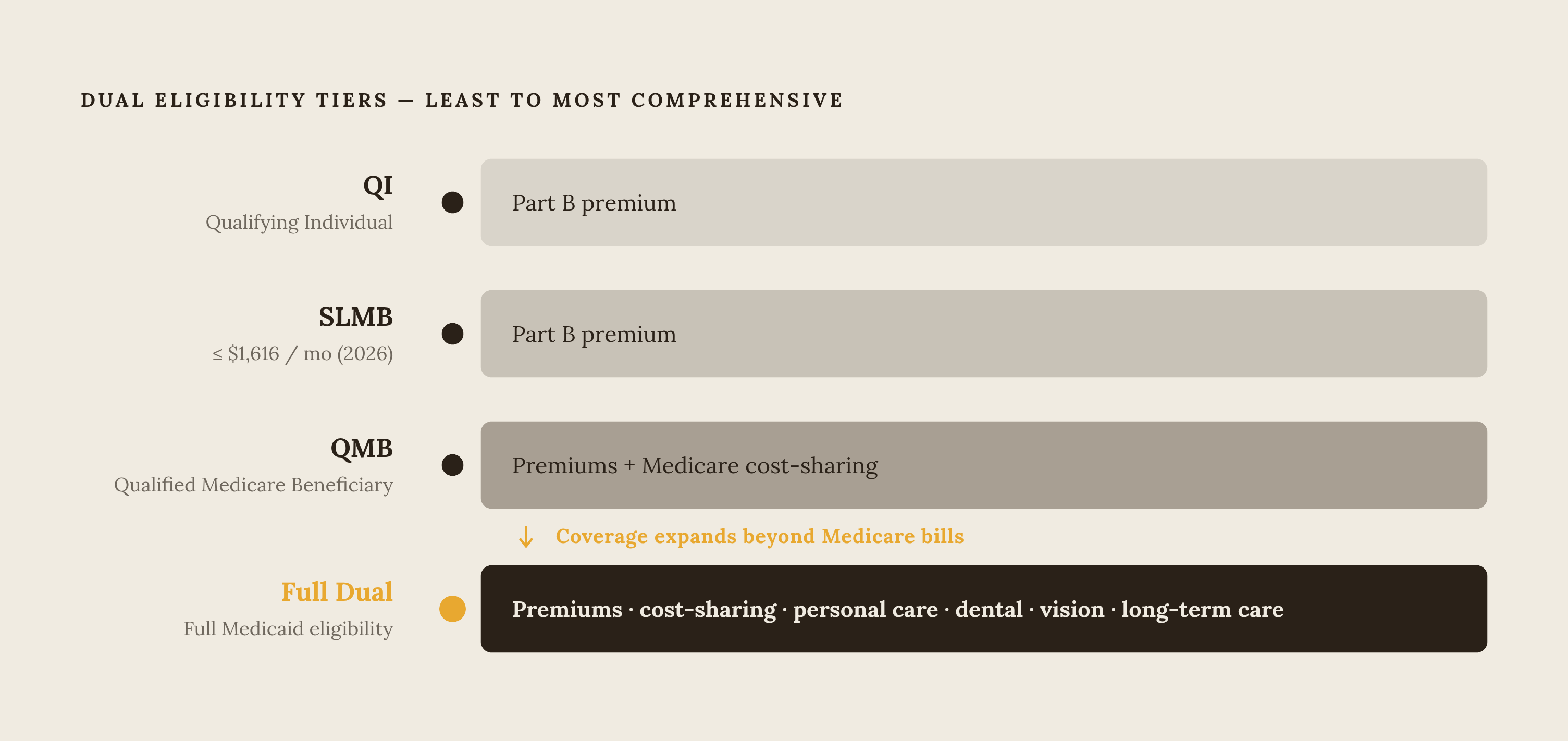
The four categories in this guide are full dual eligibility, QMB, SLMB, and Qualifying Individual, or QI. Each one offers a different level of help. What bill would disappear under each one?
SLMB covers the Medicare Part B premium only. Its income threshold is roughly $1,616 a month for a single person in 2026, and premium assistance can still represent meaningful annual savings. QI also belongs to the Medicare Savings Program category. Premium help should not be mistaken for coverage of every service your mom needs.
QMB pays both premiums and Medicare cost-sharing, so it covers more of her Medicare bills. That difference can reduce what she owes when she uses covered care. Yet QMB alone does not cover the full range of long-term care. A family looking for ongoing personal care must still establish whether she qualifies for full Medicaid and the relevant services.
With full dual eligibility, she can get a wider range of Medicaid benefits, which may cover personal care, dental, vision and long-term care. Access to particular services still depends on the applicable program rules. The financial dividing line is therefore not simply “some assistance” versus “more assistance.” It is help paying Medicare expenses versus access to services Medicare does not ordinarily cover.
What dual status does and does not cover for home care, prescriptions, and nursing home stays
Original Medicare covers medically necessary skilled home health services, such as nursing visits and physical therapy, and she pays no deductible or coinsurance for those covered services. Personal care is a different category.
Equipment has its own payment rules. Medicare Part B covers durable medical equipment, including wheelchairs, hospital beds and oxygen equipment, with coinsurance after the Part B deductible. For full dual eligibles enrolled in a Dual Eligible Special Needs Plan, or D-SNP, that coinsurance can drop to nothing. The home health benefit and equipment benefit therefore should not be treated as one promise of free home care.
Full dual eligibles receive automatic Extra Help enrollment, with no premium, no deductible and very low prescription copays. QMB, SLMB and QI also automatically qualify for Extra Help, even without full Medicaid. People in the separate QDWI program must apply for Extra Help.
Medicare covers only short-term skilled nursing after a qualifying hospital stay, with cost-sharing after the first few weeks and a limited duration. Medicaid can cover long-term custodial nursing home care if she meets its rules for both finances and the help she needs to function. That difference matters especially to families dealing with dementia or another condition that calls for ongoing care in a residential setting.
D-SNP extras need to be checked separately from these benefits. Plans can offer dental, vision, hearing, over-the-counter allowances, transportation and meal delivery, but availability varies by plan and state. A benefit advertised by one plan should not be assumed to exist in another.
How dual status can unlock pay for a family member already providing her care
For a full dual eligible who needs personal care, Medicaid can do more than reduce medical bills. Consumer-directed programs can pay an adult child or another family member for care they already provide without pay. Eligibility is not automatic, however. Your mom must qualify for an HCBS waiver or similar program through both financial eligibility and a documented functional need.
In these programs, the Medicaid enrollee acts as the employer. She selects and trains her caregiver and can dismiss that person, including when the caregiver is a relative. The caregiver receives an hourly wage. In KFF’s survey of state Medicaid officials, all states that responded said they pay family caregivers in at least some cases, but every relative must still qualify under the rules of the program.
State examples make the variation concrete. New York’s Consumer Directed Personal Assistance Program, or CDPAP, pays roughly the upper teens to low-to-mid twenties per hour, with the rate depending on the region. California’s In-Home Supportive Services, or IHSS, averages around the high teens, while lower-cost states such as Missouri and Texas often pay in the low-to-mid teens. These ranges are not individual wage guarantees.
Texas has the Consumer Directed Services option, while Florida has Consumer-Directed Care Plus as part of the iBudget Medicaid waiver. Find the program that fits your mom’s needs and eligibility. AI-guided enrollment support can help match those facts to state programs and walk through how to apply. It is most useful here as navigation.
The family should also check the payment rules before signing up. Caregiver pay has tax and Social Security implications, so the applicable treatment belongs in the family’s financial planning. Starting July 2026, states must post on their Medicaid websites the average rates paid per hour for personal care, home health aide, homemaker and habilitation services. Those figures can help families compare rates, though states do not all present them in the same way, which makes comparisons harder.
D-SNPs: when enrolling in one helps and when it can make coordination worse
A D-SNP is a Medicare Advantage plan restricted to dual eligibles. It is intended to coordinate Medicare and Medicaid, potentially offering one insurance card and care coordinators who manage both sets of benefits. But integration varies widely across plans. A single card is not, by itself, evidence that the two programs work together well.
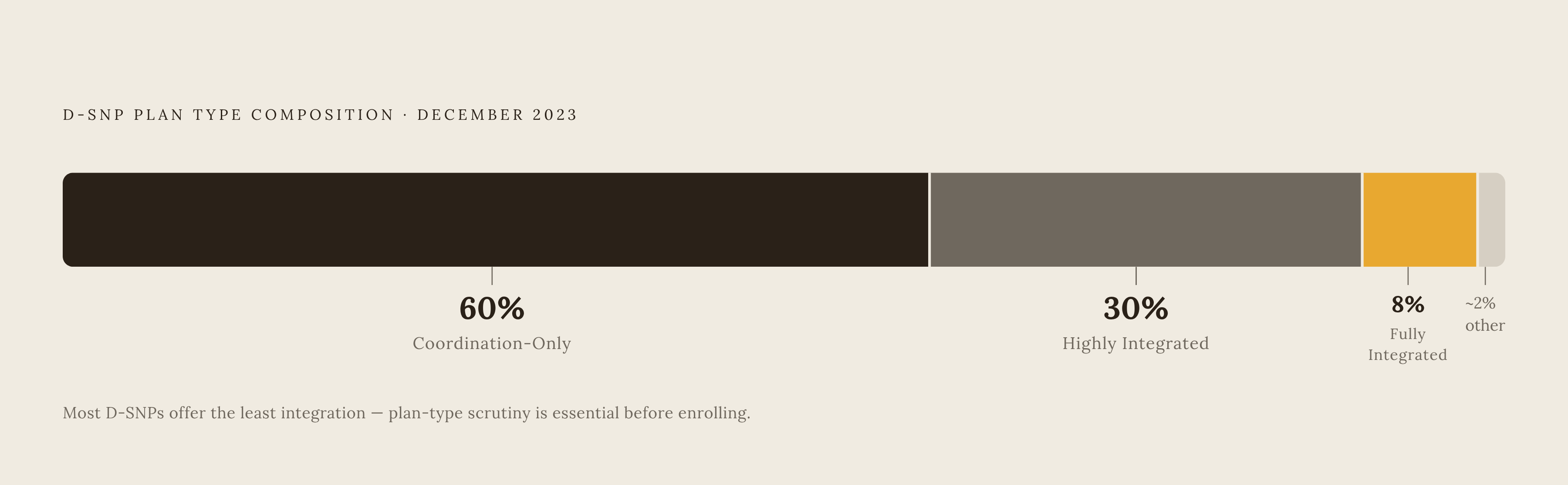
The plan categories reveal the difference. As of December 2023, roughly three-fifths of D-SNPs were Coordination-Only plans, roughly three-tenths were Highly Integrated plans, and about one-in-twelve were Fully Integrated plans. For a family choosing coverage, the useful test is whether the D-SNP and Medicaid plan share an organization or have a genuine data-sharing contract. Families should take a closer look at Coordination-only arrangements before ruling them out.
Provider access belongs in that assessment too. The Centers for Medicare & Medicaid Services introduced a monthly Integrated Care Special Enrollment Period for full-benefit dual eligibles starting January 2025. That gives eligible people a route to an integrated plan, but the enrollment opportunity does not establish that a particular network fits their care. An auto-enrollment notice without details about providers, medications or other choices cannot answer that question.
The Medicare Rights Center describes a client who lost Medicaid, her Medicare Savings Program and her D-SNP when recertification paperwork did not arrive in time. She lost those benefits even though she still had Medicare. The concrete action for caregivers is to calendar Medicaid recertification deadlines and track the required paperwork.
How can you check your mom’s eligibility? The documents and application steps in the right order
Start with the records the applications will require. These include proof of identity, citizenship or lawful immigration status, and state residency, such as a utility bill or lease. Records of her income include a Social Security award letter, pay stubs and pension statements, while records of her assets include recent bank statements and life insurance policies. Her Medicare card belongs with them if she already has one.
Confirm Medicare eligibility through Social Security first. Then compare her income and countable assets with her state’s full Medicaid and Medicare Savings Program limits, accounting for excluded assets and any more generous state rules. Apply through the state Medicaid agency and ask it to check whether she qualifies for every Medicare Savings Program. Agencies are required to screen across the tiers, but the request can help prevent an incomplete assessment.
If her income seems too high, ask about spend-down. If she needs personal care, also ask about the HCBS waiver income limit and functional eligibility requirements. Once she has full dual eligibility, look at D-SNP and PACE options, giving priority to those that work closely with her Medicaid managed care plan. If she qualifies for HCBS services, ask whether consumer direction permits a family member to become her paid caregiver.
This is where an eligibility tool can be useful. AI-guided support can map income, assets and care needs to state-specific programs and walk through enrollment, but the notes do not establish a named free tool that delivers an instant eligibility decision. Social Security and the state Medicaid agency remain the official routes. A screening result should say which application comes next as well as whether she is likely to qualify.
Finally, keep the renewal calendar with the application records. The One Big Beautiful Bill Act introduces stricter Medicaid eligibility rules and more frequent redeterminations beginning December 31, 2026, with most impact felt in 2027. Its community engagement requirements concern many non-elderly adults and should not be assumed to apply to your mom simply because she receives Medicaid. Her specific category and renewal requirements determine what she must do to keep coverage.