What Companion Care Services Include and Exclude
Companion care handles daily living tasks but excludes hands-on body care and medical services.

Companion care’s inclusions and exclusions follow a practical distinction: it helps with instrumental activities of daily living, or IADLs, while personal care adds help with basic activities of daily living, or ADLs. Understanding that boundary helps families judge what a companion can do, when another level of care is needed, and how coverage affects the choice.
Why companion care's service list looks the way it does
The unopened mail, the untouched fridge, and the missed Sunday call can make a family notice that daily life is becoming harder. These signs can appear even when someone can still care for their body without hands-on help. Yet together they can make a family wonder whether someone can still live on their own without help. Someone may be able to handle basic physical self-care but struggle to keep a household running, stick to a routine, or stay in touch with others.
Families looking for help then come across terms that overlap, including homemaker services, sitter care, and non-medical care. Those labels can make differences between service lists look like marketing choices or provider quirks. A more useful explanation lies in the kind of task being performed. Companion care helps with the instrumental activities that let someone live on their own, while personal care helps with basic self-care and usually instrumental tasks too. The distinction gives families a way to interpret a service description rather than having to memorize every inclusion and exclusion.
What ADLs and IADLs are, and why the distinction carries so much weight
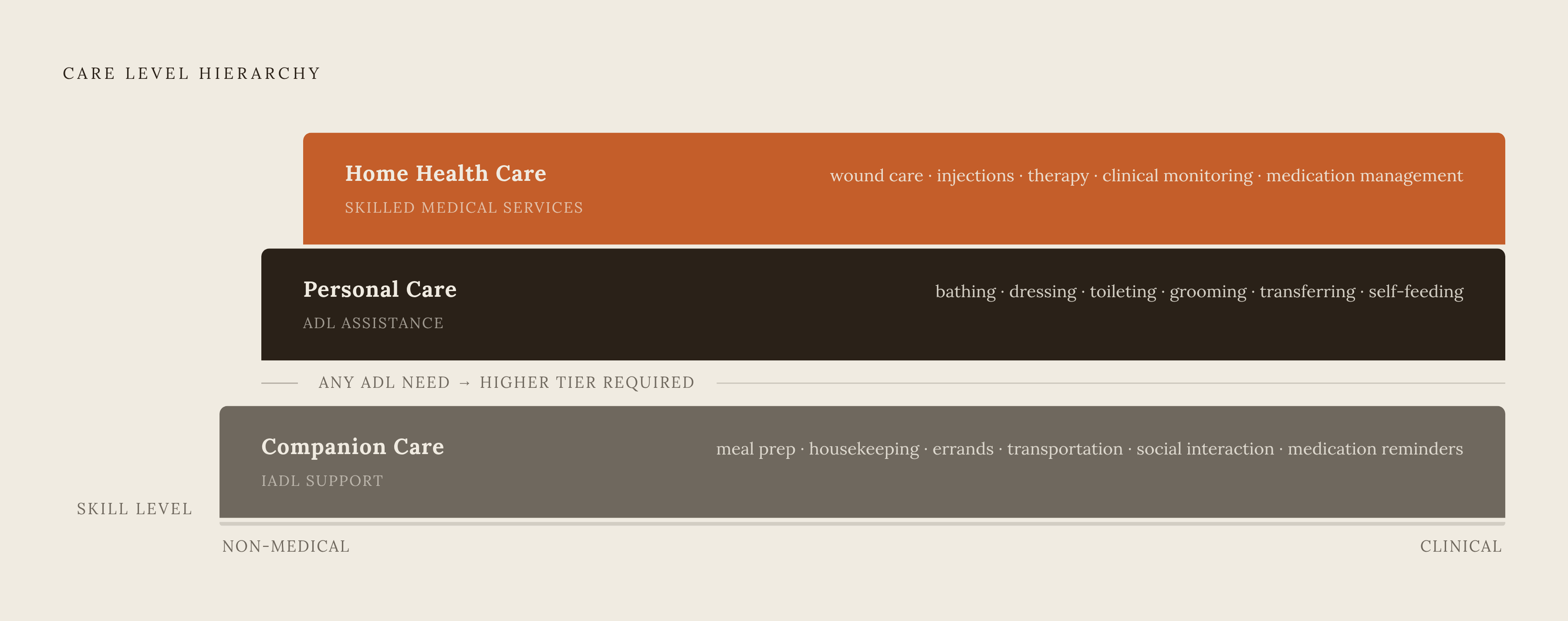
Activities of Daily Living are basic self-care functions, including bathing, toileting, dressing, grooming, transferring, and self-feeding. Transferring means moving from bed to chair, for example. These are the physical tasks a person must be able to do or have done for them. When someone needs another person’s hands-on help with them, the need crosses into personal care.
Instrumental Activities of Daily Living are the tasks that support independent living in a community. They include meal preparation, light housekeeping, errands, transportation, managing medications, managing finances, and using the telephone. Cooking a meal is an IADL because it supports daily life without providing physical assistance with the body. The distinction is therefore not between important and unimportant work, but between different kinds of assistance.
That distinction separates three levels of support. Companion care addresses IADLs, personal care adds ADL assistance, and home health care provides skilled medical services. However, an IADL label does not authorize every possible task within that category. With managing medications, for instance, a reminder and a medical act fall on different sides of the boundary.
What companion care actually covers, category by category
Social interaction and emotional support are central to companion care. Conversation, shared meals, and games give a visit its companionship while other tasks help sustain daily life. Help with meals can include planning menus around what someone likes and their dietary limits, shopping, and cooking. Eating together also matters because appetite can improve when meals are no longer solitary. The service supports both the preparation of food and the social setting in which someone eats it.
Light housekeeping maintains the client’s living space. It can include dishes, laundry, bed-changing, tidying, taking out trash, caring for plants, feeding pets, and keeping walkways clear. Errands bring that help outside the home, with trips to the pharmacy, grocery store, bank, or post office. Always Best Care includes driving clients to medical appointments, going in with them, and taking notes for the family to read afterward. Going with someone to an appointment helps them get care without making the companion a medical provider.
Routine and organization connect these individual tasks. A companion may keep track of appointments on calendars, sort mail, gather bills for the family to review, and help set a routine for mornings and evenings. A companion can say “it's two o'clock, time for the blue pill” and hand over the organizer, but cannot fill it, adjust a dose, or place a pill in someone’s mouth. The reminder supports a routine, while administration crosses the medical boundary.
Safety monitoring adds another layer through visual wellness checks, noticing fall hazards, and reporting changes in mood, sleep, appetite, or cognition. A sample four-hour visit shows how these categories fit together. The companion arrives at 10, shares coffee, puts laundry in, and makes a grocery run with a prescription pickup. Lunch at the table and two rounds of gin rummy are followed by cleaning the kitchen and sending a short text to the family.
What companion care excludes and why each exclusion follows from the framework
The clearest exclusions involve hands-on body care. Making lunch is part of companion care, but feeding someone who cannot feed themselves is part of personal care. The same reasoning excludes hands-on help with bathing, dressing, toileting, grooming, and transferring. These exclusions identify a different need and, consequently, a different level of support.
Medication administration, injections, wound care, catheter or ostomy care, clinical monitoring, and physical or occupational therapy are outside the companion role. Nursing tasks require appropriately licensed professionals, including RNs or LPNs, while therapy services require licensed physical or occupational therapists. A companion’s willingness to help does not substitute for those qualifications. For the same reason, advanced dementia with wandering, two-person transfers, ventilator or feeding-tube dependence, and active post-surgical management exceed ordinary companion care.
The household boundary requires a further distinction because not every non-medical task is companion work. Light housekeeping does not extend to deep cleaning, yard work, home repairs, or heavy lifting. Similarly, gathering bills for family review is organizational support. BrightStar Care states that financial planning and legal services are outside the companion’s role.
The U.S. Department of Labor’s FLSA Fact Sheet 79A also distinguishes whose needs the domestic work serves. It specifies that companionship services exclude domestic services performed primarily for the benefit of other household members. So cooking dinner for the whole family or doing another household member’s laundry falls outside that definition. This is a labor-law distinction, separate from the boundary around body care or medical work. Together, these limits define the task, the qualifications it requires, and the person it is meant to benefit.
Where the line blurs in practice and how families should respond
A clear framework does not make every real visit easy to manage. Companions and clients develop close relationships, and a companion who visits three mornings a week may notice that the client is struggling to bathe. The human impulse to help can conflict with the authorized scope. The difficulty is genuine, but it does not change bathing from an ADL into an IADL. Instead, it reveals a need that the existing arrangement may no longer meet.
Other forms of boundary creep can be less obvious. Visits may extend when family caregivers return late, or families may assign “make-work” tasks to justify more hours. Grocery shopping may expand into financial paperwork, while requests for emotional support may move toward a therapeutic role. Each change can seem small on its own. Taken together, they show how an agreed service can become something different without a deliberate decision about care.
Because scope varies, families should get the agency’s task list in writing before signing to establish what the companion is authorized to do. When requests begin crossing it, families should reassess the level of care and keep the companion’s role within the agreed scope. The framework still holds, but applying it requires active management. A changing need is information for care planning, with responsibility clearly defined.
How to tell whether companion care is the right level or whether a higher tier is needed
Check whether every unmet need is an IADL. If so, companion care is likely sufficient, provided the requested tasks fall within the agency’s scope. An older adult who remains physically independent but is socially isolated, misses meals, skips appointments, or lives in accumulating disorder fits this pattern. Companion care is designed to address that gap.
As soon as someone needs help with a routine ADL, they need personal care. Someone who needs help bathing or dressing requires more than company and household support, even if those services would also be useful. Always Best Care frames the distinction in terms of companion caregivers providing social interaction and emotional support, while personal caregivers provide hands-on help with bathing, grooming, and mobility. The deciding factor is the assistance required, not how similar the two visits might otherwise look.
Medical needs call for home health care instead. A person who needs wound care, injections, therapy, clinical monitoring, or medication management beyond reminders requires appropriately licensed support. For example, someone whose main unmet need is wound care does not have a companion-care problem simply because the care happens at home. The setting does not determine the tier. The work being performed does.
Mixed needs do not require treating these categories as mutually exclusive choices. Many agencies staff companions and personal caregivers separately, so families can begin with companion care and add personal care as needs evolve, often retaining the same companion. That allows social continuity while the hands-on support changes. If the need is unclear, a professional assessment is more useful than guessing. Agencies typically offer care assessments, and the family’s physician can document ADL and IADL status to guide the discussion.
How companion care is paid for and where public coverage applies
Choosing the right level of support does not by itself establish how it will be paid for. Because companion care is non-medical, it falls outside most standard insurance coverage. Private pay is the most common path, with families using income, savings, or retirement funds. Since this support is ongoing, families need to budget for monthly costs beyond the one-time quote.
Medicare usually does not cover routine companion care. Its home health coverage is tied to skilled care and homebound requirements through a Medicare-certified agency. Routine companionship, supervision, meal help, and errands are not covered on their own.
In some states, Medicaid may pay for companion care through Home and Community-Based Services, or HCBS, waiver programs. For older adults who qualify, that coverage can pay for supervision, light housekeeping, and social support. However, service definitions, waiting lists, financial limits, and functional criteria vary significantly by state. Eligibility for public coverage of non-medical companion care depends on the particular program’s home care benefits.
Long-term care insurance may also cover home care, depending on the contract and its elimination periods. Families should review policy definitions carefully because some policies use ADL impairment thresholds that companion care alone may not trigger. A person may need substantial IADL support while remaining independent in basic self-care. That is precisely why the ADL/IADL distinction matters beyond the service list. It connects the help a person needs to the worker qualified to provide it and the coverage rules that may determine who pays.
Sources
- Fact Sheet # 79A: Companionship Services Under the Fair Labor Standards Act (FLSA)
- Companion Care vs Personal Care: Key Differences
- Activities of Daily Living (ADLs)
- Activities of daily living (ADL)
- 12VAC30-122-340. Companion service.
- Companion Care - Definition & Detailed Explanation - Caregiving for Seniors Glossary - utahhospice.org